Introduction
A dietitian may spend an hour helping a client develop a realistic nutrition plan, then spend another hour organizing food records, updating clinical notes, preparing educational materials, and arranging the next consultation.
For practitioners managing many clients, this administrative workload can become difficult to sustain.
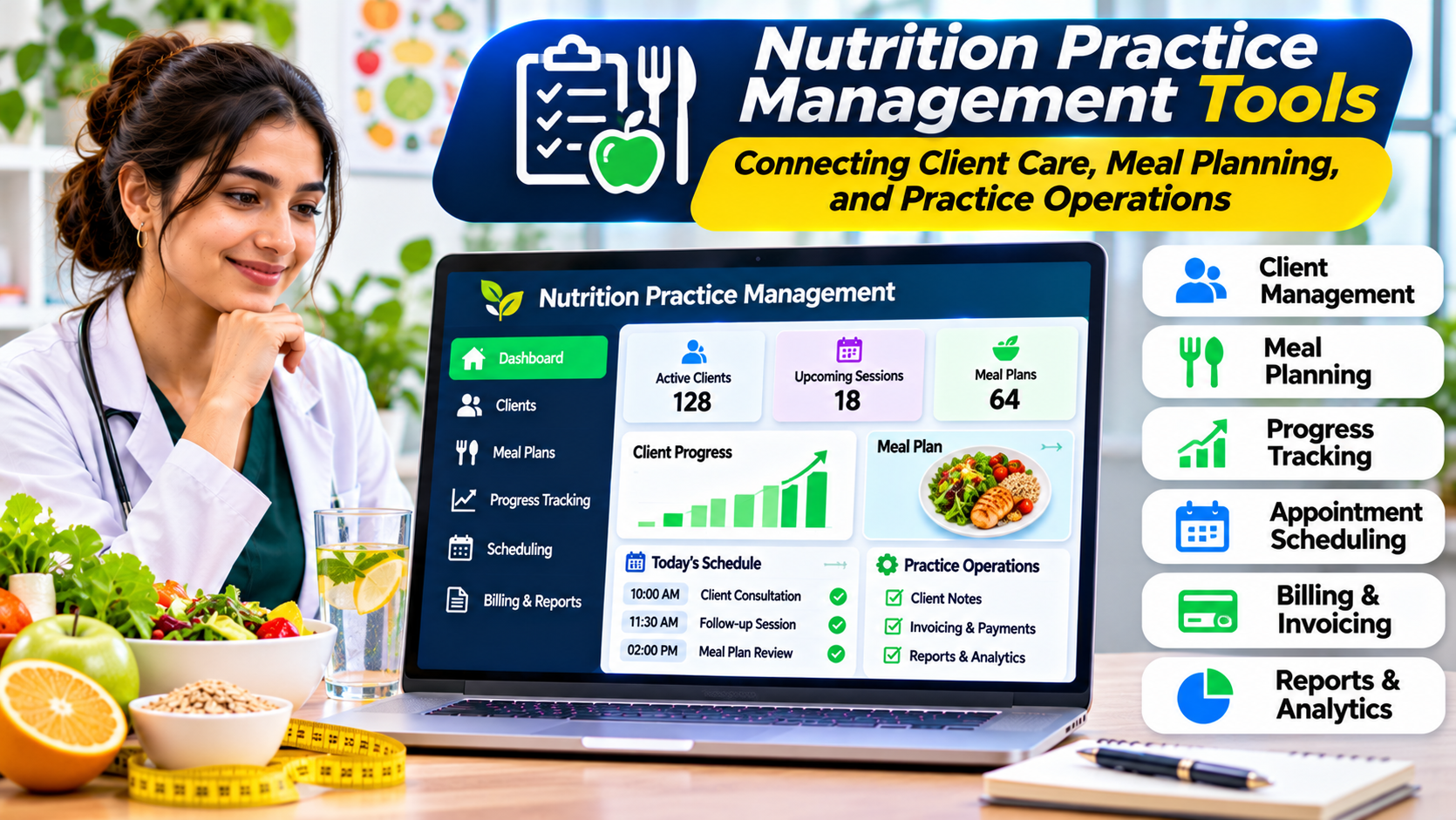
Nutrition practice management tools help organize the work surrounding nutrition counseling. They bring together client records, appointment scheduling, dietary assessments, meal planning, communication, and financial administration.
But nutrition software is not a single, uniform category.
Some applications are designed for registered dietitians providing medical nutrition therapy. Others focus on wellness coaching, food tracking, or personalized meal plans. A platform that works well for general fitness coaching may not provide the documentation required in a clinical nutrition practice.
The central purchasing decision is therefore not which application offers the most attractive meal plans. It is which system supports the practitioner’s actual scope of work while making client care easier to manage.
Understanding the Different Types of Nutrition Software
Nutrition practice management platforms typically combine several functions, but the balance differs.
Clinical Nutrition Practice Software
Clinical platforms support dietitians and nutrition professionals who document assessments, interventions, and follow-up care.
They may include electronic health records, nutrition care plans, clinical notes, and billing workflows.
These features are particularly relevant to practitioners working with medical conditions or coordinating with healthcare providers.
Nutrition Coaching Platforms
Coaching-oriented applications focus on client engagement, behavior change, meal planning, messaging, and progress tracking.
They may be useful for wellness professionals whose work centers on general nutrition education and lifestyle habits.
However, coaching functionality does not automatically provide clinical recordkeeping capabilities.
Meal Planning Applications
Meal planning software helps practitioners organize recipes, dietary preferences, food choices, and shopping lists.
Some systems offer nutrient calculations or food databases.
These applications may complement a clinical platform rather than replace it.
General Practice Management Software
General healthcare practice management platforms can handle appointments, forms, billing, and communication.
They may be appropriate when specialized nutrition functionality is limited or supplied through other applications.
The disadvantage is that dietary assessments and meal planning may require separate tools.
The Nutrition Workflow That Software Must Support
Nutrition care is rarely completed in one appointment.
A practitioner may assess dietary patterns, identify concerns, establish goals, recommend changes, review progress, and revise the plan over several consultations.
The software must support that continuing relationship.
Consider a client referred for nutrition counseling.
Before the first appointment, the practitioner may collect health history, food preferences, relevant medical information, and existing dietary records.
During the consultation, the practitioner reviews the information and develops an appropriate care plan.
Afterward, the client may receive educational materials, a meal plan, or instructions for tracking specific behaviors.
At the next visit, the practitioner evaluates progress and adjusts the approach.
A well-designed system keeps these activities connected without turning every consultation into a lengthy data-entry exercise.
Client Intake and Nutrition Assessment
Intake is one of the most important areas to evaluate.
Nutrition professionals may need to collect information about dietary patterns, allergies, preferences, medications, relevant health conditions, lifestyle, and goals.
The appropriate information depends on the practitioner’s qualifications and services.
A platform should support configurable forms rather than forcing every client through the same questionnaire.
Structured Information Versus Narrative Notes
Structured fields can make information easier to compare over time.
For example, a practitioner may want to review changes in meal patterns or specific dietary behaviors.
However, not every meaningful observation fits a predefined field.
Narrative notes remain important for recording context, barriers, and professional judgment.
The strongest approach often combines structured information with flexible documentation.
Meal Planning: Useful Feature or Unnecessary Complexity?
Meal planning is a major selling point for nutrition software.
Yet not every practice needs detailed daily menus.
Some practitioners provide individualized meal plans. Others emphasize education, food choices, portion guidance, or behavior-based goals.
A software platform should reflect the practitioner’s method.
What to Examine in Meal Planning Tools
Evaluate whether the system can account for dietary preferences, allergies, food restrictions, and culturally relevant food choices.
Check whether recipes can be edited and whether clients can access plans conveniently.
If the application calculates nutrients, investigate the source and quality of its food composition data.
Food databases may contain incomplete entries, different serving assumptions, or user-submitted information.
Calculated values should not automatically be treated as clinically precise.
Avoiding Excessive Automation
Automated meal generation may save preparation time, but practitioners remain responsible for reviewing recommendations within their professional scope.
A plan that appears nutritionally balanced in software may still be inappropriate for a particular client’s circumstances.
Software should support professional decisions rather than replace them.
Nutrition Practice Management Platforms to Explore
Several products approach nutrition care from different directions.
Practice Better
Practice Better offers practice management capabilities for health and wellness professionals.
Its platform addresses scheduling, forms, client records, communication, programs, and administrative workflows.
It is relevant to nutrition professionals who want to coordinate consultations and client engagement within one environment.
Buyers should verify which features are included in their selected subscription and whether specialized nutrition workflows require integrations.
Healthie
Healthie provides a healthcare-oriented platform used by nutrition professionals and other care providers.
Its capabilities span clinical records, scheduling, telehealth, billing, and client engagement.
It is worth evaluating for practices that need structured healthcare workflows or plan to expand into coordinated services.
However, buyers should distinguish between capabilities available to individual practitioners and those intended for larger organizations.
Nutrium
Nutrium focuses on nutrition professionals and their clients.
Its emphasis includes nutrition assessment, meal planning, dietary management, and communication.
This makes it particularly relevant to practitioners who regularly develop and manage individualized nutrition plans.
Before selecting it, evaluate the suitability of its food database, local food coverage, reporting formats, and practice administration features.
That Clean Life
That Clean Life focuses on meal planning and recipe-based nutrition resources.
It may be useful to practitioners who want structured recipe collections and customizable meal plans.
However, meal planning functionality should not be confused with a complete clinical practice management system.
A practitioner may still require separate software for medical records, billing, or appointment administration.
General Healthcare Platforms
A multidisciplinary clinic may prefer a broader practice management system that supports nutrition services alongside other healthcare disciplines.
This approach can simplify shared scheduling and administration.
The trade-off is that specialized dietary assessment or meal planning functions may be less developed.
Choosing Software Based on Practice Type
| Practice model | Primary software priorities |
|---|---|
| Independent clinical dietitian | Clinical documentation, intake, appointments, billing |
| Nutrition coaching business | Client communication, programs, progress tracking |
| Meal-planning specialist | Recipes, dietary customization, nutrient information |
| Multidisciplinary clinic | Shared records, permissions, scheduling, integrations |
| Online nutrition practice | Telehealth, digital forms, remote communication |
| Corporate wellness provider | Program administration, participant management, reporting |
This distinction prevents an expensive mistake: purchasing a sophisticated platform whose strongest features do not match the services delivered.
Client Progress Tracking Without Misleading Metrics
Progress tracking can help practitioners understand how a care plan is working.
However, nutrition outcomes are not always captured by a single number.
Weight, calorie intake, or body measurements may be relevant in some contexts, but they are not universally appropriate measures of progress.
Depending on the care plan, useful information may include dietary variety, meal consistency, symptom records, adherence to agreed goals, or laboratory results reviewed within the practitioner’s scope.
The software should allow practitioners to select relevant measures rather than imposing the same dashboard on every client.
The Role of Client-Reported Information
Food diaries and habit trackers can provide useful context.
They also have limitations.
Clients may forget entries, estimate portions inaccurately, or change their reporting behavior over time.
A nutrition professional should interpret these records as supporting information rather than unquestionable measurements.
Good software makes the data accessible without creating a false impression of precision.
Communication and Client Engagement
Nutrition counseling often depends on consistent support between appointments.
Client portals and secure messaging can help practitioners share resources, answer appropriate questions, and maintain continuity.
However, constant messaging can become a burden.
Before choosing a platform, determine whether communication expectations can be clearly defined.
For example, a practice may offer messaging during business hours while reserving clinical decisions for scheduled consultations.
The platform should support the service model rather than create an expectation of unlimited availability.
Billing and Business Administration
Nutrition practices may operate through direct client payments, packages, memberships, or insurance reimbursement.
Software should accommodate the relevant business model.
A private-pay practitioner may prioritize invoices, payment links, receipts, and package tracking.
An insurance-based practice may need more detailed coding, claim submission, and reconciliation processes.
Availability varies by platform and country.
Do not assume that software supporting insurance billing in one market will support another country’s reimbursement system.
Privacy and Data Protection
Nutrition records may contain sensitive health information.
The appropriate safeguards depend on the services provided, the jurisdiction, and the type of information collected.
Important evaluation areas include access permissions, authentication, secure communication, data retention, backup arrangements, and export options.
Practitioners should also examine third-party integrations.
Connecting a nutrition platform to external applications may create additional data flows that need to be understood.
A convenient integration is not automatically an appropriate one for sensitive clinical information.
How to Run a Meaningful Software Trial
Instead of testing isolated features, use a representative client journey.
Create a fictional client with realistic dietary preferences and a defined service package.
Complete intake, document the initial assessment, prepare a care plan, schedule follow-up, and issue an invoice.
Then make changes.
Modify the client’s dietary preferences, revise the plan, record progress, and update the next appointment.
Observe how many steps each change requires.
A strong platform should make routine adjustments manageable without duplicating information across several screens.
Test the Client Experience
Practitioners are not the only software users.
Clients may need to complete forms, view meal plans, record information, or attend virtual appointments.
Ask someone unfamiliar with the system to test the client-facing experience.
Complicated navigation can reduce engagement even when the practitioner dashboard looks impressive.
Total Cost and Integration Considerations
Subscription fees may depend on client numbers, practitioners, available features, or service levels.
Additional costs may arise from payment processing, telehealth, messaging, integrations, or advanced programs.
If the practice uses separate meal planning and recordkeeping systems, include the cost of both.
Also consider the time required to transfer information between applications.
An integrated platform may reduce administrative effort, but only if its individual functions are suitable.
When Specialized Nutrition Software Is Worth the Investment
A dedicated nutrition platform becomes more valuable when the practice repeatedly performs specialized tasks.
These may include dietary assessments, individualized meal plans, ongoing nutrition monitoring, or structured nutrition education.
If a practitioner mainly needs appointment booking and basic invoicing, a simpler platform may be sufficient.
The goal is not to digitize every possible activity.
It is to remove avoidable administrative work while preserving the flexibility needed for individualized nutrition care.
Frequently Asked Questions
Can nutrition practice management software replace a clinical EHR?
Some platforms include clinical recordkeeping capabilities, but suitability depends on professional requirements and the specific product. A meal planning application alone is not necessarily a clinical EHR.
Do nutrition platforms automatically create personalized meal plans?
Some offer automated or template-based planning. Practitioners should review outputs for accuracy, suitability, and individual requirements.
Can clients track food intake through these platforms?
Some systems support food journals or related integrations. The available features and quality of food data vary.
Is nutrition software useful for a solo dietitian?
Yes, particularly when scheduling, intake, documentation, billing, and follow-up activities create substantial administrative work.
Making the Right Choice
Nutrition practice management software should reflect how nutrition care is actually delivered.
For clinical dietitians, documentation and appropriate recordkeeping may take priority.
For nutrition coaches, program delivery and client communication may be more important.
For practitioners producing detailed meal plans, food database quality and dietary customization deserve close attention.
The most useful evaluation starts with one complete client journey and tests how the platform supports each stage.
Software that makes those steps easier, while preserving professional judgment and client privacy, offers a stronger foundation than a platform selected for its longest feature list.