Introduction
A resident returns to a nursing facility after an unexpected hospital stay. Their medication orders have changed, their mobility has declined, and several members of the care team need updated instructions.
The nursing team needs accurate clinical information. The pharmacy must receive the correct orders. Rehabilitation staff need to reassess the resident, while administrators must update the resident’s status and related financial records.
When these activities depend on disconnected applications, paper documents, and informal communication, important information can be delayed or overlooked.
Long-term care management systems help facilities coordinate clinical, operational, and financial responsibilities through structured digital workflows.
However, not every platform serves the same type of organization.
A skilled nursing facility has different requirements from an assisted living community, memory care residence, or continuing care retirement community. The most suitable software depends on the services delivered, regulatory obligations, staffing structure, and complexity of resident care.
What Long-Term Care Management Systems Actually Manage
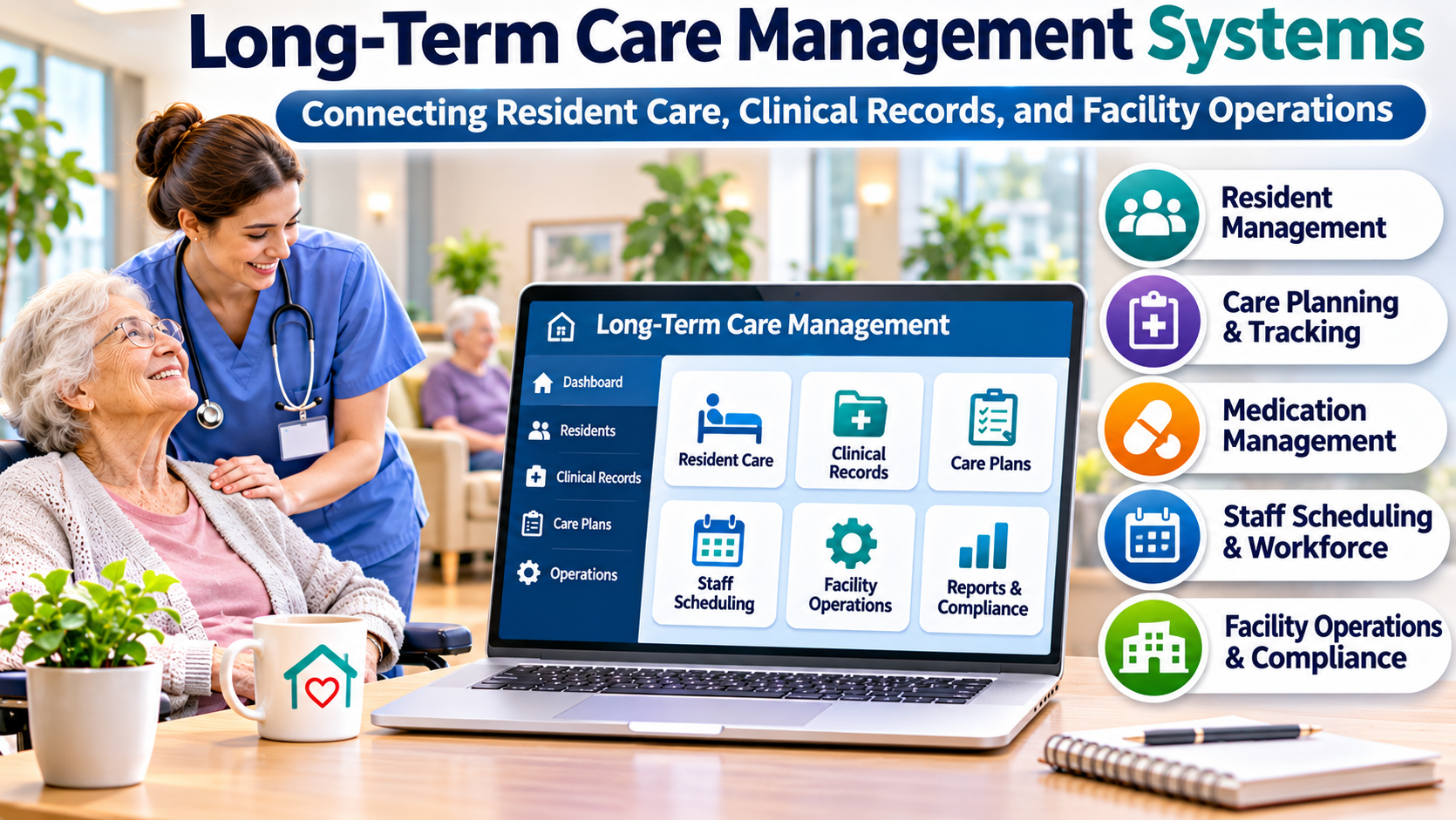
Long-term care management systems are specialized software platforms used by organizations providing ongoing residential care, nursing services, rehabilitation, or assisted living support.
They commonly combine electronic health records with administrative and financial management capabilities.
Depending on the product and care setting, functionality may include:
- Resident registration and admission records.
- Clinical assessments and care plans.
- Nursing and point-of-care documentation.
- Medication and treatment administration records.
- Staffing and service coordination.
- Incident and infection management.
- Billing and revenue-cycle workflows.
- Referral and discharge coordination.
- Regulatory documentation and reporting.
- Family and external provider communication.
Some platforms provide these functions within a single environment. Others depend on additional modules, integrations, or third-party applications.
A buyer should distinguish between a vendor’s overall product portfolio and the capabilities included in a specific contracted package.
The First Decision: Which Care Setting Must the System Support?
The term long-term care covers several different operational environments.
This distinction is more important than the number of features advertised.
Skilled Nursing Facilities
Skilled nursing facilities provide nursing care and may deliver rehabilitation and other medically necessary services.
Their software requirements often include detailed clinical documentation, physician orders, medication administration, assessments, and reimbursement-related workflows.
In the United States, facilities participating in relevant Medicare or Medicaid programs must consider applicable documentation and assessment requirements.
The Minimum Data Set, commonly called MDS, is especially important in nursing facility assessment workflows.
A platform serving this environment must support the facility’s actual clinical and regulatory processes.
Assisted Living Communities
Assisted living organizations often focus on personal assistance, medication support, wellness monitoring, and resident services.
Clinical documentation requirements may differ from those of skilled nursing facilities.
Scheduling, service plans, resident communication, and administrative management can carry greater operational importance.
Software designed exclusively around skilled nursing reimbursement may introduce unnecessary complexity.
Memory Care Communities
Memory care settings require careful coordination of individualized support, behavioral observations, daily routines, and communication.
The software should make relevant care instructions accessible to authorized staff.
However, technology should support professional judgment and person-centered care rather than reduce residents to standardized behavioral categories.
Continuing Care Retirement Communities
Continuing care retirement communities, also called life plan communities, may operate independent living, assisted living, and skilled nursing services.
Their software challenge is managing different service models while maintaining appropriate continuity of resident information.
A single platform may simplify administration, but only if it handles the distinct requirements of each care level.
Why Resident Transitions Are a Critical Test
Long-term care is defined partly by continuity.
Residents may move between hospitals, rehabilitation services, nursing units, and different levels of residential support.
Each transition creates an opportunity for information loss.
Consider a resident returning from a hospital with revised medication orders.
A reliable workflow should help authorized staff identify the new orders, reconcile relevant information, document necessary reviews, and communicate changes to the care team.
The software must preserve a clear distinction between historical information and current instructions.
This is particularly important when previous orders remain visible in the record.
A successful transition requires both appropriate software functionality and clearly assigned clinical responsibilities.
Clinical Documentation and Care Planning
Clinical documentation is a central function of long-term care software.
A resident record may contain assessments, diagnoses, allergies, vital signs, nursing notes, care plans, and treatment information.
These records must remain accessible to authorized staff while preserving appropriate controls.
Care Plans That Reflect Actual Needs
A care plan should describe relevant resident needs, goals, interventions, and responsibilities.
Software can provide templates and structured fields.
However, templates should not encourage identical care plans for residents with different circumstances.
Facilities should evaluate how easily staff can individualize plans and update them when conditions change.
Point-of-Care Documentation
Point-of-care tools allow staff to record activities closer to the time and location of care.
This may include assistance with daily living, observations, treatments, or relevant measurements.
Mobile devices and workstations can make documentation more accessible.
Yet the interface must remain practical for staff working under time pressure.
An application that requires excessive navigation may encourage delayed documentation.
Assessment Management
Structured assessments support care planning and may contribute to regulatory or reimbursement processes.
The software should make required assessments available to appropriate staff and preserve their completion history.
Organizations should verify the exact assessment standards supported in their jurisdiction.
Medication Management and eMAR
Medication management is one of the most consequential areas of long-term care operations.
Residents may receive multiple medicines, and orders can change following clinical reviews or hospital transfers.
An electronic medication administration record, or eMAR, helps document medication administration activities.
Depending on the system, it may connect medication orders, administration schedules, staff documentation, and pharmacy communications.
What an eMAR Should Support
Facilities should examine how the system handles current orders, discontinued medicines, administration records, exceptions, and authorized changes.
The relationship between the EHR, pharmacy, and medication administration system is particularly important.
An integration problem can create inconsistencies between what was prescribed, what was supplied, and what staff see during administration.
Technology Does Not Eliminate Medication Risk
Electronic systems can support safer processes, but they cannot independently guarantee medication safety.
Organizations still need appropriate verification, clinical oversight, staff training, and escalation procedures.
A software demonstration should include medication changes, missed administrations, discontinued orders, and temporary system outages.
Long-Term Care Software Platforms Worth Evaluating
Several established platforms address different parts of the long-term and post-acute care market.
PointClickCare
PointClickCare offers cloud-based electronic health record solutions for skilled nursing facilities and senior living organizations.
Its skilled nursing platform addresses clinical documentation, care coordination, medication-related workflows, and financial operations.
The platform is particularly relevant to organizations that need a connected approach to resident records and facility administration.
Its broader ecosystem may also be valuable when coordinating with external healthcare providers.
However, buyers should distinguish between core functionality, optional packages, and separately contracted services.
A facility should verify which integrations and clinical workflows are included in its proposed implementation.
MatrixCare
MatrixCare provides software for long-term care, senior living, life plan communities, and home-based care organizations.
Its portfolio is relevant to providers managing complex care operations or several service environments.
The important evaluation question is whether the specific MatrixCare solution supports the organization’s care setting.
For example, a continuing care community may need workflows that connect residential services with skilled nursing operations.
A standalone nursing facility may place greater emphasis on clinical documentation and reimbursement.
Buyers should investigate product-specific functionality rather than assuming every offering in the portfolio is interchangeable.
Netsmart
Netsmart provides healthcare technology for several care environments, including post-acute and long-term care.
Its solutions may be relevant to organizations seeking clinical records, care coordination, and interoperability across different services.
However, buyers must identify the exact product and supported care setting.
Netsmart’s broad healthcare portfolio should not be interpreted as evidence that one application satisfies every long-term care requirement.
Senior Living-Oriented Platforms
Some organizations may benefit from software designed primarily for senior living administration.
These platforms may emphasize occupancy, resident services, billing, staff coordination, and family engagement.
They can be appropriate for assisted living or independent living communities.
However, a strong resident management system does not automatically provide the clinical documentation required by a skilled nursing facility.
A Comparison Based on Care Requirements
| Requirement | Skilled nursing | Assisted living | Multi-level care community |
|---|---|---|---|
| Detailed clinical documentation | Central | Depends on services | Varies by care level |
| Medication administration workflows | Often essential | Depends on services and jurisdiction | Important across relevant units |
| Resident service planning | Essential | Essential | Essential |
| Reimbursement documentation | Often complex | Depends on payment model | Varies |
| Occupancy and resident billing | Important | Important | Important |
| Cross-setting information exchange | Important | Useful | Especially important |
This comparison illustrates why software selection should begin with the organization’s operating model.
A product designed for one setting may not provide the right balance for another.
Interoperability With Hospitals and Pharmacies
Long-term care organizations rarely operate independently of the broader healthcare system.
They may exchange information with hospitals, laboratories, pharmacies, rehabilitation providers, and physicians.
The software should support the information exchanges necessary for safe and efficient operations.
Common requirements may involve admissions, discharges, medication orders, laboratory results, and clinical documents.
Healthcare interoperability standards such as HL7 and FHIR can support certain exchanges.
However, standards compatibility does not guarantee that every required workflow is available.
Organizations should verify the actual interfaces, supported data elements, error handling, and responsibilities for maintaining connections.
Staffing, Workload, and Operational Visibility
Long-term care organizations face complex staffing requirements.
Care needs change, residents require different levels of support, and staff qualifications vary.
Software may help managers monitor staffing assignments, care activities, and operational workload.
However, staffing dashboards should not be treated as substitutes for professional assessment.
A resident with complex needs may require more time than a standard scheduling model assumes.
The software should support informed staffing decisions rather than impose simplistic productivity targets.
Staff Access and Permissions
Different employees need different information.
Nursing staff, therapists, administrators, billing personnel, and support workers should receive access appropriate to their responsibilities.
Role-based permissions are especially important when organizations operate multiple facilities or care levels.
Billing and Revenue Management
Long-term care facilities may manage several payment arrangements.
These can include private payments, insurance, government programs, or combinations of funding sources.
Billing workflows may depend on resident status, service level, payer rules, and clinical documentation.
The system should support accurate records and appropriate reconciliation.
A facility should examine how the software handles changes in payer coverage, transfers between care levels, adjustments, and outstanding balances.
Financial automation can reduce repetitive work, but incorrect source data can still produce incorrect invoices or claims.
Security, Privacy, and Regulatory Responsibilities
Long-term care systems contain sensitive resident information.
Organizations should evaluate authentication, encryption, audit logging, access controls, backup arrangements, and incident response.
Regulatory requirements depend on location, licensing, services, and payer participation.
For US organizations, HIPAA and applicable Medicare or Medicaid requirements may be relevant.
Other countries apply different healthcare privacy and long-term care regulations.
A vendor’s compliance statement does not replace the facility’s own legal and operational assessment.
Data Migration: The Risk Hidden in a Software Replacement
Replacing a long-term care system can be particularly difficult because resident records span long periods.
Historical information may include assessments, medication records, care plans, incidents, clinical notes, and billing histories.
A migration plan should distinguish between active information and historical records.
It should also define how staff will access information that cannot be imported into the new system.
Validate Relationships, Not Just Records
A successful migration must preserve meaningful relationships.
For example, an assessment should remain associated with the correct resident and care episode.
Medication histories should not be confused with active orders.
Financial records must remain traceable to the appropriate accounts.
These relationships require validation before the new system becomes operational.
A Practical Vendor Demonstration
Rather than accepting a generic product tour, ask each vendor to demonstrate a realistic resident journey.
Begin with an admission from a hospital.
Create the resident record, document an assessment, establish a care plan, and enter relevant orders.
Next, demonstrate a medication change and an updated care plan.
Then simulate a transfer to another care setting.
Finally, review the billing and reporting consequences.
The demonstration should also include an unexpected event, such as an unavailable interface or an incorrect record requiring correction.
This approach reveals how the platform handles operational complexity.
Understanding Total Ownership Costs
Long-term care software costs may include subscriptions, implementation, data migration, integrations, training, support, and additional modules.
Multi-facility organizations may incur further costs for centralized administration and reporting.
Mobile devices, connectivity improvements, and backup procedures can also affect the budget.
A meaningful financial evaluation should consider several years of expected operations.
It should also account for the cost of staff time during implementation.
A lower software quotation may not represent a lower total cost if the system requires extensive manual workarounds.
When a Single Platform Is Not the Best Answer
An integrated platform can simplify administration and reduce duplicated data.
However, one application may not provide the strongest functionality for every department.
Some organizations may benefit from a core EHR connected to specialized pharmacy, rehabilitation, or workforce management systems.
This approach can offer deeper functionality but increases integration and vendor coordination responsibilities.
The decision should depend on workflow requirements and the organization’s capacity to manage multiple systems.
Frequently Asked Questions
What is a long-term care management system?
It is software used to coordinate resident care, clinical records, medication workflows, administration, billing, and other operations in long-term care environments.
Is long-term care software the same as a nursing home EHR?
A nursing home EHR is often a central component, but long-term care management software may include broader operational and financial functions.
Can one platform support assisted living and skilled nursing?
Some vendors offer products for both settings. Organizations should verify whether the proposed solution supports each care level appropriately.
Does long-term care software include medication management?
Many platforms provide medication-related capabilities or integrations. The depth of eMAR, pharmacy connectivity, and order management varies.
What should facilities prioritize when selecting software?
Clinical workflow fit, accurate records, medication management, interoperability, staff usability, and regulatory requirements should guide the decision.
Final Thoughts
Long-term care management systems sit at the intersection of clinical care, residential services, and facility administration.
The most important purchasing decision is not which platform advertises the greatest number of features. It is which system accurately supports the care setting and preserves reliable information as residents’ needs change.
Facilities should begin with real care transitions, medication workflows, staff responsibilities, and reimbursement requirements.
A platform that handles these situations consistently provides a stronger operational foundation than one selected primarily for its interface or marketing claims.