Introduction
A personal trainer creates a workout plan for a new client, reviews another client’s training log, answers questions about exercise technique, and prepares next week’s sessions.
The actual coaching may take only part of the day. The remaining time goes toward programming, communication, scheduling, payments, and tracking progress.
As the client list grows, these activities become difficult to manage through spreadsheets, messaging apps, and separate calendars.
Fitness coaching platforms bring training delivery and business administration into a more connected workflow.
However, software designed for an independent online coach may not be suitable for a gym managing multiple trainers. A strength coach working with competitive athletes may need different programming tools from a trainer delivering general fitness programs.
The best platform depends on the coaching model, not simply the number of exercises in its library.
What Fitness Coaching Platforms Actually Do
Fitness coaching platforms are applications used by trainers, coaches, and fitness businesses to design programs, deliver workouts, communicate with clients, and manage coaching relationships.
Common capabilities include workout builders, exercise libraries, progress tracking, messaging, scheduling, and payments.
Some platforms also support nutrition-related activities, habit tracking, group programs, and business reporting.
The category overlaps with gym management software, fitness tracking applications, and wellness coaching systems.
These products are related but serve different purposes.
A fitness tracker records activity. A gym management system focuses on memberships and facility operations. A coaching platform centers on the relationship between a coach and the people following a training program.
Start With the Coaching Business Model
Before evaluating software, define how training is delivered.
Individual Online Coaching
Online coaches often provide personalized programs and review client progress remotely.
They may need flexible workout programming, exercise demonstrations, messaging, and check-in forms.
The ability to modify programs without rebuilding them is particularly important.
In-Person Personal Training
In-person trainers may prioritize appointments, session packages, payments, and client records.
Digital workout delivery can still be useful, but it may not be the main reason to purchase software.
Hybrid Coaching
Hybrid coaches combine in-person sessions with remote programming.
They need continuity between supervised training and workouts completed independently.
A system should allow both types of activity to appear within a coherent training plan.
Group Coaching
Group programs require reusable programming, enrollment management, shared resources, and appropriate participant communication.
The challenge is maintaining consistency while accommodating individual differences.
Strength and Performance Coaching
Strength coaches may require detailed control over sets, repetitions, intensity, rest periods, progression, and training cycles.
General-purpose wellness apps may not provide sufficient programming flexibility.
The software should support the coach’s actual training methodology.
Workout Programming Is the Core Product
For most coaching businesses, workout programming deserves more attention than visual branding.
A platform should allow coaches to build training sessions efficiently and revise them as clients progress.
Exercise Libraries
Many systems provide exercise databases with names, descriptions, and demonstrations.
A large library can be convenient, but quantity is not the same as quality.
Coaches should examine whether demonstrations are clear, whether exercise variations are appropriately distinguished, and whether custom exercises can be added.
A specialized coach may need movements that are absent from a general library.
Program Templates
Templates can save time when coaches deliver similar training structures to several clients.
However, a template should remain editable.
A coach may need to adjust exercise selection, volume, intensity, or session frequency according to individual circumstances.
Software that makes customization difficult can encourage overly standardized programs.
Progressive Overload and Training History
Training programs often change over time.
A useful platform should make previous sessions accessible so coaches can review performance and plan progression.
Relevant information may include completed sets, repetitions, loads, perceived effort, or other appropriate measures.
The platform should support meaningful analysis without implying that every increase in workload represents progress.
Recovery, technique, consistency, and individual circumstances also matter.
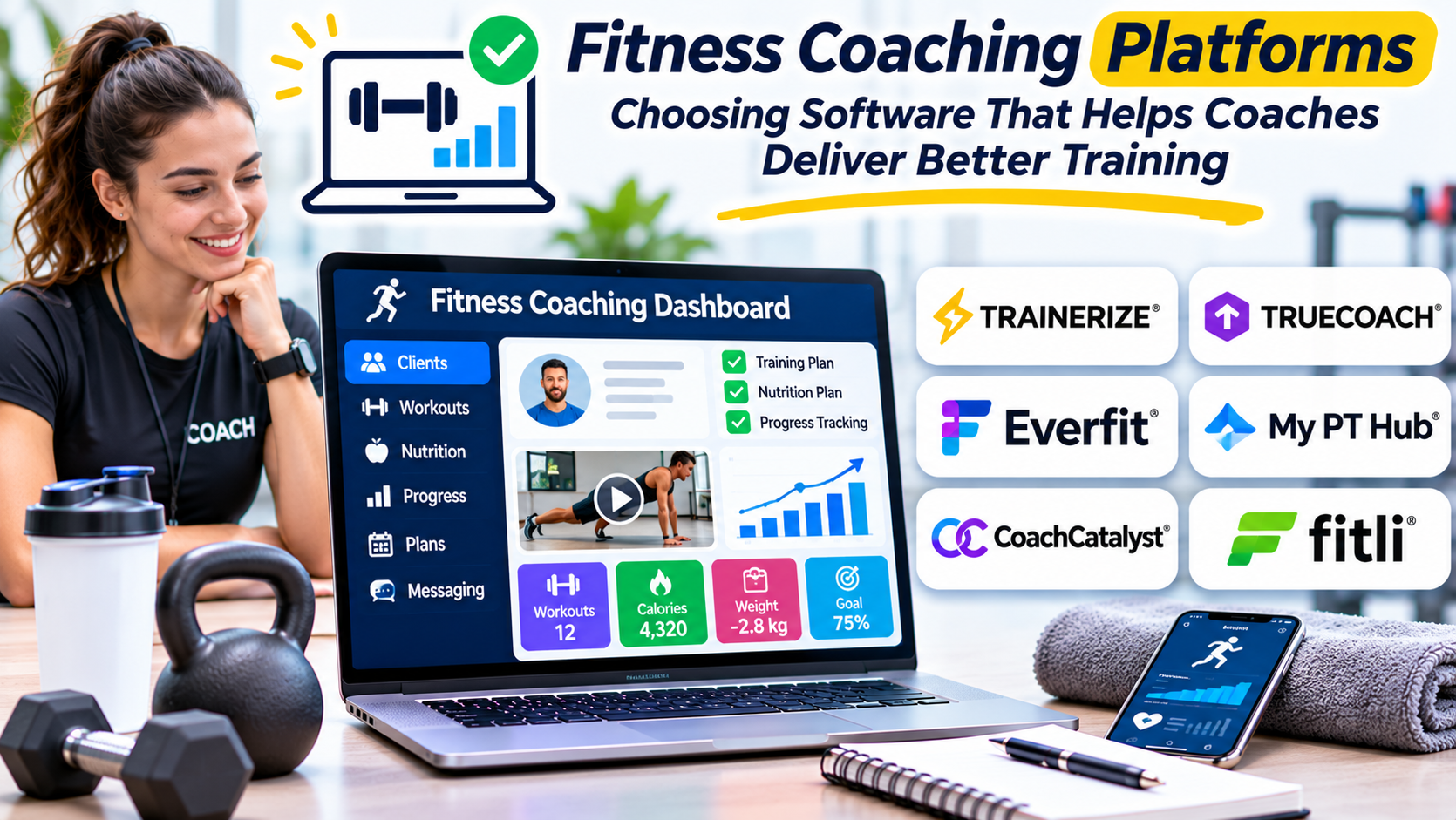
Fitness Coaching Platforms Worth Evaluating
Several established products address different coaching needs.
Trainerize
Trainerize is designed for fitness and wellness coaching businesses.
Its platform supports workout delivery, client communication, progress tracking, and business-related workflows.
It is particularly relevant to trainers combining personalized exercise programming with ongoing client engagement.
Coaches should examine how its programming tools fit their methods and whether desired features require additional subscriptions or integrations.
Its suitability depends on the balance between training delivery and business administration.
TrueCoach
TrueCoach focuses on workout programming and the coach-client relationship.
It is worth evaluating for trainers who place substantial importance on individualized workout delivery and performance feedback.
A strength-focused coach may find a programming-centered workflow more relevant than a broad wellness platform.
However, buyers should verify whether scheduling, payments, nutrition support, and other business functions meet their needs or require separate tools.
Everfit
Everfit provides tools for fitness coaches to create training programs, manage clients, and deliver online coaching experiences.
Its broader coaching capabilities may appeal to businesses combining workout programming, communication, and additional client engagement activities.
Coaches should assess the actual client experience and the effort required to manage personalized plans at scale.
The value of an integrated platform depends on whether its individual workflows remain efficient.
My PT Hub
My PT Hub supports personal trainers through workout planning, client management, and related business functions.
It may be relevant to trainers seeking a combination of coaching and administrative tools.
Buyers should investigate how its programming flexibility, payment arrangements, and client-facing application compare with their current workflow.
A product that is convenient for general personal training may not offer every specialized feature required by performance coaches.
TeamBuildr
TeamBuildr focuses on strength and conditioning program delivery.
It is particularly relevant to coaches managing structured performance training and athletes.
Its orientation differs from general fitness coaching platforms that emphasize wellness services or subscription-based online coaching.
Organizations should evaluate athlete management, programming methods, reporting needs, and administrative requirements.
Matching Platforms to Coaching Priorities
| Coaching model | What to evaluate first |
|---|---|
| Solo online personal trainer | Program delivery, messaging, client check-ins |
| In-person trainer | Scheduling, session management, payments |
| Hybrid coaching business | Shared training history, flexible programming |
| Group fitness coach | Templates, enrollment, communication |
| Strength and conditioning coach | Detailed programming, athlete performance records |
| Multi-coach business | Staff permissions, client assignments, reporting |
This approach avoids the misleading assumption that one platform is best for every coach.
A system with extensive marketing tools may be less useful to a performance coach than one with precise training controls.
The Client Experience Matters as Much as the Coach Dashboard
A coach may enjoy using a sophisticated programming interface while clients struggle to follow workouts.
This mismatch can reduce engagement.
The client application should make it easy to identify the next session, understand exercise instructions, record completed activity, and communicate relevant questions.
Logging Workouts
Workout logging should require minimal unnecessary input.
Clients may need to record repetitions, weights, duration, or other prescribed measures.
The platform should make those fields clear.
A confusing interface can produce incomplete records even when the client completes the training.
Exercise Demonstrations
Videos and instructions can help clients understand planned exercises.
However, prerecorded demonstrations cannot observe technique or provide individualized correction.
Coaches should define when clients need direct feedback or supervised instruction.
Notifications
Reminders can support consistency.
Too many notifications may become distracting.
The system should allow appropriate control over workout reminders, messages, and other prompts.
Progress Tracking Without Misleading Conclusions
Fitness platforms often display charts showing training volume, body measurements, completed workouts, or performance changes.
These can be useful, but coaches should interpret them carefully.
A client may improve strength while body weight remains unchanged.
Another may complete fewer sessions because a program deliberately includes recovery.
Progress should be assessed according to the client’s goals and the training plan.
Choose Metrics That Match the Goal
A strength program may emphasize performance on selected movements.
An endurance program may track relevant duration, distance, or perceived effort.
A general fitness program may focus on consistency, functional ability, or other appropriate outcomes.
The platform should not force every client into the same progress dashboard.
Self-Reported Data Has Limits
Clients may forget to log sessions or enter estimates.
Wearable devices also produce measurements with varying accuracy.
Coaches should treat these records as useful evidence rather than perfect observations.
Nutrition Coaching and Professional Boundaries
Some fitness coaching platforms include food logging, meal plans, or nutrition-related features.
These functions can support general coaching workflows.
However, professional qualifications and legal scope of practice vary.
A personal trainer may be qualified to provide certain general nutrition guidance but not medical nutrition therapy.
Software availability does not establish professional authorization.
Coaches should use nutrition functions within their qualifications and applicable rules.
Avoid Overcomplicated Tracking
Detailed food tracking may be useful for some clients and unsuitable for others.
Coaches should consider whether tracking supports the client’s goals and well-being.
The presence of a feature is not a reason to require its use.
Communication and Accountability
Remote coaching depends on communication.
Clients may need to ask questions, report difficulties, or explain why they missed sessions.
Platforms often include messaging, check-in forms, or progress reviews.
These features can help coaches maintain continuity.
However, they also create expectations.
Define Response Boundaries
Coaches should explain when they respond to messages and what types of questions are appropriate through the platform.
An application with continuous messaging does not require a coach to be available continuously.
Clear boundaries protect both service quality and business sustainability.
Use Check-Ins With a Purpose
A weekly check-in can help a coach understand adherence, recovery, obstacles, and client feedback.
But excessively long questionnaires may reduce participation.
Collect information that will influence coaching decisions.
Payments, Packages, and Business Operations
Fitness coaching businesses use different commercial models.
Some sell individual sessions.
Others offer monthly coaching, fixed-length programs, memberships, or group subscriptions.
A platform should support the actual arrangement.
Important considerations include recurring billing, session tracking, refunds, cancellations, and client access when a package ends.
Watch for Hidden Costs
Subscription pricing may depend on active clients, trainers, available modules, or branding options.
Additional charges may apply to payment processing, integrations, messaging, or premium features.
Coaches should calculate the cost at their current client count and at a realistic future level.
A low entry price may become less attractive as the business expands.
Branding and White-Label Applications
Some platforms offer custom branding or white-label applications.
These features can help established coaching businesses present a consistent experience.
However, branding should not take priority over programming reliability and client usability.
A custom logo cannot compensate for confusing workout instructions or unreliable records.
Small coaching businesses may benefit more from improving their service workflow before investing in a branded application.
Data Ownership and Portability
Coaching records can represent substantial work.
They may include exercise programs, client histories, progress records, and business information.
Before adopting a platform, determine whether these records can be exported.
Ask what happens if the subscription ends.
Can coaches retrieve their programs?
Can clients access historical information?
Are uploaded videos and custom exercises portable?
A platform that makes it difficult to retrieve essential information can create long-term dependence.
Privacy and Sensitive Client Information
Fitness platforms may collect personal details, activity histories, body measurements, and health-related information.
Some data can be sensitive even when the business is not a healthcare provider.
Coaches should understand how information is stored, shared, and retained.
Access permissions become particularly important when several coaches work within one business.
A trainer should not automatically receive access to every client’s information.
The organization should establish appropriate policies for consent, communication, and data handling.
Integrations With Wearables and Other Tools
Some platforms connect with activity trackers, payment services, calendars, or other applications.
Integrations can reduce manual work.
However, they may also introduce synchronization errors or additional data sharing.
A coach should verify exactly which data moves between systems and how frequently it updates.
For example, a wearable integration may provide activity information without supporting every measurement needed for a training program.
Integration availability should be tested rather than assumed.
A Realistic Platform Trial
A useful software trial should involve at least two different client scenarios.
The first client follows a simple general fitness program.
The second needs a more individualized plan with frequent adjustments.
Create programs for both.
Then simulate several weeks of training.
Record completed sessions, missed workouts, exercise substitutions, and progress updates.
Ask clients or colleagues to test the mobile experience.
Next, revise the programs.
Observe whether changes are easy to make and whether historical records remain intact.
Finally, test communication, billing, and data export.
This process reveals more than a feature checklist.
Common Purchasing Mistakes
Choosing Based on Exercise Library Size
A large library is useful only if the exercises are relevant and the demonstrations are appropriate.
Ignoring Client Usability
Coaches may tolerate complicated interfaces that clients find frustrating.
Overvaluing Automation
Automated programming and messages can save time, but they should not replace appropriate individualized coaching.
Underestimating Administrative Costs
Payments, client onboarding, and account management can create significant work if they remain disconnected.
Failing to Test Program Changes
The ability to revise a training plan efficiently is often more important than the speed of creating the first version.
Frequently Asked Questions
What is a fitness coaching platform?
It is software that helps coaches create training programs, deliver workouts, track progress, communicate with clients, and manage related business activities.
Is fitness coaching software the same as a workout tracker?
No. Workout trackers primarily record activity, while coaching platforms support the ongoing relationship between a coach and clients.
Can fitness coaching platforms replace a personal trainer?
They can deliver programs and organize information, but software alone does not provide the full judgment, observation, and individualized support of a qualified coach.
Do coaches need an all-in-one platform?
Not always. Some businesses benefit from integrated tools, while others prefer specialized programming software combined with separate administrative systems.
Which feature should coaches test first?
The complete programming workflow: creating a plan, delivering it, recording performance, and making adjustments.
Final Thoughts
Fitness coaching platforms are most valuable when they reduce administrative work without weakening the quality of coaching.
The right system should reflect the training methods used, make programs understandable to clients, and preserve useful performance records.
For independent online coaches, client engagement and efficient programming may be the priorities.
For performance coaches, precise training controls may matter more.
For growing businesses, staff permissions, billing, and operational consistency become increasingly important.
The best purchasing decision comes from testing how the software supports real coaching relationships, not simply counting its advertised features.