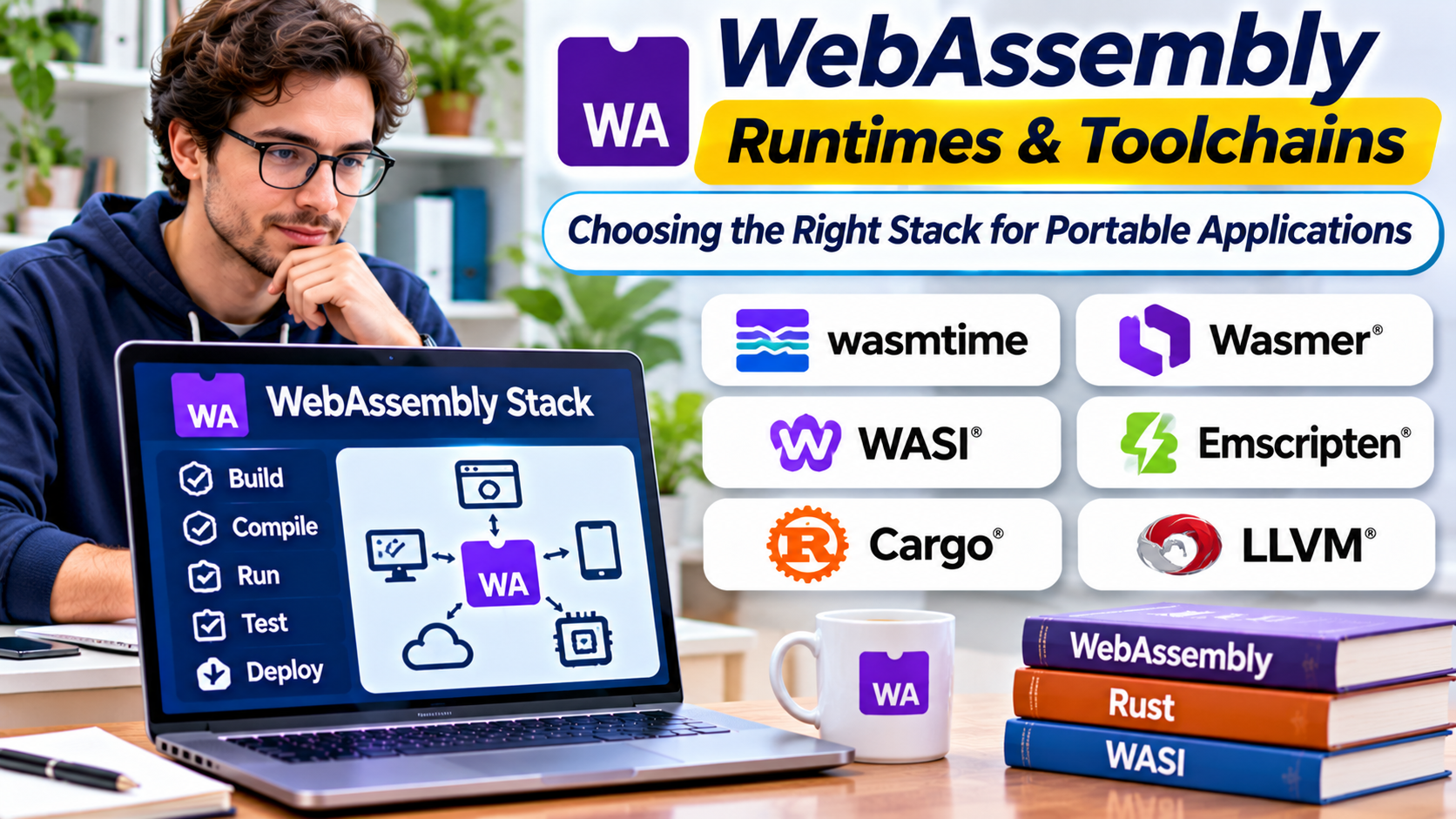
Introduction
A development team has a computationally intensive library written in C++. The library works well on native systems, but the team wants to reuse it inside a browser without maintaining a separate JavaScript implementation.
Another team wants to run lightweight plugins inside a server application without giving those plugins unrestricted access to the host operating system.
Both teams may benefit from WebAssembly, but they need different tools.
The first team needs a compilation toolchain that can produce browser-compatible WebAssembly modules. The second needs a runtime that can execute untrusted or semi-trusted modules under controlled conditions.
This distinction is essential.
WebAssembly is not a single application platform. It is a portable binary instruction format supported by browsers, standalone runtimes, language toolchains, and increasingly sophisticated component systems.
Choosing a WebAssembly stack requires understanding where code will run, which host capabilities it needs, and how modules will interact with the surrounding application.
What WebAssembly Actually Provides
WebAssembly, commonly abbreviated as Wasm, is a binary instruction format designed as a compilation target for programming languages.
Instead of distributing only source code, developers can compile supported programs into WebAssembly modules.
A compatible execution environment can then validate and execute those modules.
WebAssembly was initially associated with browser applications, but its architecture also supports execution outside browsers.
Standalone runtimes allow Wasm modules to run in servers, command-line applications, embedded systems, and other environments.
However, portability has limits.
A module may depend on host interfaces, runtime extensions, or particular WebAssembly features that are not supported everywhere.
The fact that two systems support WebAssembly does not guarantee that every module will behave identically on both.
Four Layers of the WebAssembly Ecosystem
A useful way to understand the ecosystem is to separate its major layers.
Language Toolchains
Toolchains compile source code into WebAssembly.
They may also provide libraries, linking tools, debugging support, and compatibility layers.
WebAssembly Runtimes
Runtimes validate, compile or interpret, and execute Wasm modules.
They also determine which host functions and resources are accessible.
Host Interfaces
Host interfaces connect WebAssembly programs to capabilities outside the core instruction format.
WASI, the WebAssembly System Interface, is particularly important for non-browser applications.
Component Tooling
The WebAssembly Component Model introduces structured interfaces that help components communicate across language boundaries.
It aims to make independently developed software components easier to compose.
These layers overlap in some products, but they solve different engineering problems.
Comparing Important WebAssembly Tools
| Tool | Primary role | Most relevant use |
|---|---|---|
| Wasmtime | Standalone runtime and embeddable execution engine | Server-side Wasm and component execution |
| Wasmer | Standalone and embeddable Wasm runtime | Portable execution and runtime integration |
| WasmEdge | WebAssembly runtime with extensibility features | Edge, server, and specialized workloads |
| Emscripten | C/C++ compilation toolchain | Bringing native code to the browser |
| Rust WebAssembly toolchain | Rust compilation and browser integration | Rust-based Wasm modules |
| wasm-bindgen | Rust-JavaScript interoperability tooling | Browser application integration |
| wasm-pack | Packaging Rust-generated WebAssembly | JavaScript package workflows |
| WABT | WebAssembly Binary Toolkit | Inspecting and transforming Wasm files |
| Binaryen | WebAssembly optimization and tooling | Module optimization and transformation |
| componentize-py | Python component tooling | Building supported Python Wasm components |
The appropriate choice depends on the application’s execution target rather than a general ranking of products.
Wasmtime: A Runtime Focused on Standards and Embedding
Wasmtime is a standalone WebAssembly runtime developed within the Bytecode Alliance ecosystem.
It supports WebAssembly, WASI, and the Component Model.
It can operate as a command-line runtime or be embedded into larger applications.
This makes Wasmtime relevant to teams building plugin systems, application platforms, and services that need controlled execution of Wasm code.
Its use of the Cranelift code generator is an important architectural characteristic.
However, Wasmtime should not be evaluated only by claims about execution speed.
Developers should examine supported language bindings, startup behavior, memory usage, host interface requirements, and component compatibility.
An application embedding Wasmtime also needs to define which host capabilities modules can access.
A secure runtime does not automatically make an unsafe host API secure.
Wasmer: Portable Execution and Runtime Integration
Wasmer is another WebAssembly runtime designed to execute Wasm modules across supported environments.
It provides runtime capabilities and APIs for embedding WebAssembly execution into applications.
This can be useful when developers want to add portable modules to an existing software system.
For example, a service might use Wasm to execute extension logic without loading arbitrary native libraries into the main process.
The evaluation should focus on the actual embedding interface, runtime compatibility, and deployment requirements.
Developers should also verify which WASI and Component Model capabilities are available in the version they intend to use.
Support for core WebAssembly modules does not necessarily imply support for every component interface.
WasmEdge: Extensible Runtime Capabilities
WasmEdge is a WebAssembly runtime associated with edge and server-side workloads.
Its architecture includes support for plugins and host-function extensions.
This can be attractive when applications need functionality beyond the basic WebAssembly execution model.
For example, a workload may require specialized host capabilities that are provided through supported runtime extensions.
However, extensions introduce portability considerations.
A module that depends on a particular WasmEdge plugin may not run unchanged on another runtime.
Teams should therefore distinguish between portable WebAssembly instructions and runtime-specific integrations.
Component Model support should also be checked at the feature and version level rather than assumed from general compatibility claims.
Emscripten: Bringing C and C++ Applications to the Web
Emscripten is a compilation toolchain particularly relevant to C and C++ projects.
It uses LLVM-based tooling to compile supported native code into WebAssembly and associated JavaScript integration code.
This can help teams reuse existing computational libraries in browser applications.
However, compiling a native application is not always a simple rebuild.
Programs that rely on operating-system-specific APIs, unrestricted filesystem access, or native graphical interfaces may require adaptation.
The browser environment has its own security and execution model.
Developers should evaluate the application’s dependencies before assuming that the entire program can be transferred unchanged.
Rust and WebAssembly Tooling
Rust has an established WebAssembly development ecosystem.
Developers can compile suitable Rust code to WebAssembly targets and use additional tools for integration.
wasm-bindgen
wasm-bindgen helps connect Rust-generated WebAssembly with JavaScript.
This is useful when a browser application needs to call Rust functions or exchange supported data types.
wasm-pack
wasm-pack supports workflows for building and packaging Rust-based WebAssembly projects for JavaScript environments.
These tools are particularly relevant to browser integration.
However, Rust WebAssembly development also includes non-browser targets.
Developers should select the appropriate compilation target and runtime interfaces according to the deployment environment.
WASI: The Interface Between Modules and the Host
Core WebAssembly does not provide unrestricted operating-system access.
A Wasm module cannot simply assume that familiar native system calls will be available.
WASI defines interfaces through which compatible programs can access selected host capabilities.
These may include filesystem operations, clocks, randomness, and other supported functionality.
The host determines which resources are made available.
This creates opportunities for capability-oriented execution.
For example, a plugin might receive access to a specific directory rather than the entire filesystem.
However, the security benefit depends on correct runtime configuration.
A module granted broad filesystem or network access can still cause harm within those permissions.
The Component Model and Cross-Language Composition
The WebAssembly Component Model addresses a limitation of traditional module integration.
Core WebAssembly modules operate at a relatively low level.
Connecting components written in different languages can require custom conventions for memory, data representation, and function calls.
The Component Model introduces typed interfaces and structured composition.
Interface definitions can describe how components communicate without requiring every participant to share the same source language.
This is particularly interesting for plugin ecosystems and modular application architectures.
However, developers should confirm which Component Model features and WASI interfaces are supported by their chosen runtime and toolchain.
Compatibility evolves, and implementation coverage can differ.
WebAssembly in the Browser
Browsers provide a mature execution environment for supported WebAssembly modules.
Wasm can be useful for computational tasks such as image processing, simulation, media operations, and existing native libraries adapted for the web.
However, WebAssembly does not replace the browser’s entire application platform.
JavaScript and browser APIs remain important for interacting with documents, user interfaces, and other web capabilities.
The most effective architecture often combines JavaScript with WebAssembly.
For example, JavaScript can manage interface interactions while Wasm performs a computationally intensive operation.
The performance benefit should be measured.
Crossing the boundary between JavaScript and WebAssembly has costs, and small operations may not benefit from moving into Wasm.
WebAssembly for Server Plugins
Plugin execution is one of the most compelling non-browser use cases.
Traditional native plugins may execute within the host process with extensive privileges.
A WebAssembly runtime can provide a more constrained execution environment.
The host can expose selected functions and resources to the plugin.
This may simplify support for plugins written in different languages.
However, plugin isolation depends on the runtime, host interfaces, resource limits, and overall application design.
Developers should evaluate memory limits, execution time limits, error handling, and protection against denial-of-service behavior.
WebAssembly sandboxing is a useful security boundary, not a substitute for application-level authorization.
WebAssembly vs. Containers
WebAssembly and containers are sometimes presented as competing technologies.
In practice, they solve overlapping but different problems.
Containers package applications with their runtime dependencies and use operating-system isolation mechanisms.
WebAssembly modules use a portable instruction format executed by a compatible runtime.
A container may run an ordinary native application, a WebAssembly runtime, or both.
WebAssembly can offer advantages for certain lightweight execution and embedding scenarios.
Containers remain important for packaging and operating complex applications.
The right comparison depends on the workload.
A complete web service with extensive system dependencies has different requirements from a small user-defined plugin.
Performance Testing Without Misleading Benchmarks
WebAssembly performance depends on the workload and execution environment.
Relevant factors include:
- Runtime compilation strategy
- Startup and initialization time
- Memory allocation
- Host function calls
- Data transfer between environments
- Supported SIMD and threading features
- Garbage collection behavior where applicable
- Runtime configuration
A benchmark that measures only a tight computational loop may not represent a real application.
For a plugin system, startup time and memory overhead may matter more.
For a long-running numerical workload, sustained execution performance may dominate.
Benchmark the actual application with representative inputs.
Do not assume that WebAssembly is always faster than JavaScript or equivalent to native execution.
Security Questions Before Deployment
WebAssembly validation and sandboxing provide important foundations, but deployment security requires more.
A production design should address resource limits, host permissions, module provenance, updates, and dependency management.
Untrusted modules should not receive unnecessary host capabilities.
Runtimes and toolchains should be maintained and updated.
Organizations should also establish a process for verifying where modules originate.
A malicious Wasm module can still perform harmful actions through permissions legitimately granted by the host.
The security model should therefore focus on both module execution and the interfaces surrounding it.
How to Choose a WebAssembly Stack
Begin with the execution target.
For browser-based C/C++ reuse, Emscripten is an appropriate starting point.
For Rust and JavaScript integration, evaluate the Rust WebAssembly toolchain, wasm-bindgen, and wasm-pack.
For standalone server execution, compare Wasmtime, Wasmer, and WasmEdge using the application’s required interfaces.
For component-based systems, prioritize verified Component Model and WASI compatibility.
Then test a representative workload.
Measure performance, startup time, memory use, host integration effort, and operational complexity.
Finally, verify that the chosen toolchain and runtime support a maintainable release process.
Final Thoughts
WebAssembly provides a portable execution format, but successful adoption depends on choosing the right surrounding tools.
Compilers determine how source code becomes Wasm. Runtimes determine how modules execute. WASI and the Component Model influence how those modules interact with their environment.
Wasmtime, Wasmer, WasmEdge, Emscripten, and language-specific toolchains each serve different purposes.
The most useful starting point is a concrete application requirement.
Choose the stack that supports the required interfaces, security boundaries, deployment model, and performance characteristics—not the one with the broadest claims about portability.