Introduction
Quantum computing presents a long-term security challenge for organizations that rely on traditional public-key cryptography. Although sufficiently capable cryptographically relevant quantum computers are not yet publicly demonstrated, organizations must prepare for the possibility that future systems could compromise widely used encryption and digital signature algorithms.
Many enterprise applications depend on RSA and elliptic curve cryptography for secure communication, identity verification, digital certificates, and software signing. Replacing these technologies requires careful planning because cryptographic dependencies often exist across applications, networks, hardware devices, and third-party services.
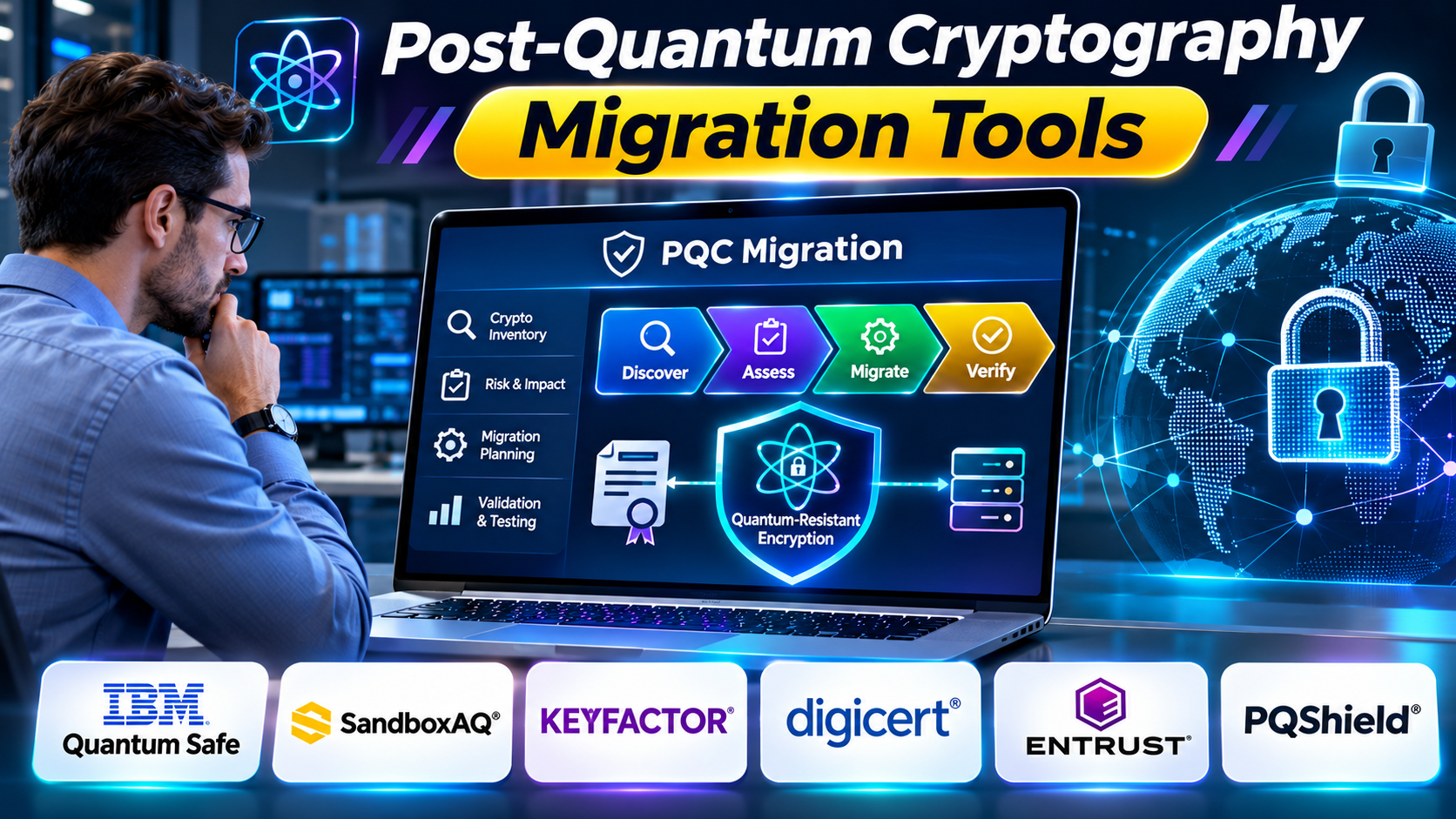
Post-quantum cryptography migration tools help organizations identify vulnerable cryptographic systems, assess quantum-related risks, and transition toward algorithms designed to resist known quantum attacks. These solutions may provide cryptographic discovery, certificate management, algorithm implementation, migration planning, and ongoing security monitoring.
The transition has become increasingly important following the publication of initial post-quantum cryptography standards by the National Institute of Standards and Technology (NIST). Standards such as FIPS 203, FIPS 204, and FIPS 205 provide specifications for quantum-resistant key establishment and digital signatures.
However, post-quantum migration involves more than replacing one encryption algorithm with another. Organizations must evaluate compatibility, performance, certificate infrastructure, hardware constraints, regulatory expectations, and the ability to update cryptographic systems in the future.
This article compares ten post-quantum cryptography migration tools and platforms, including their features, benefits, limitations, practical applications, and suitability for different organizations. It also explains how businesses can plan a structured transition toward quantum-resistant security.
What Are Post-Quantum Cryptography Migration Tools?
Post-quantum cryptography migration tools are software applications, security platforms, and development frameworks that help organizations prepare cryptographic systems for threats associated with future quantum computing capabilities.
These tools support the transition from vulnerable public-key algorithms toward standardized post-quantum alternatives. Their capabilities may include discovering cryptographic dependencies, assessing risks, implementing quantum-resistant algorithms, and managing changes across enterprise infrastructure.
Post-quantum cryptography differs from quantum key distribution. Post-quantum algorithms are designed to run on conventional computing systems, while quantum key distribution requires specialized communication technologies.
How Post-Quantum Cryptography Migration Tools Work
Cryptographic Discovery: Tools inspect supported applications, certificates, network services, or software components to identify cryptographic algorithms and dependencies.
Cryptographic Inventory: Platforms organize discovered information into records that help teams understand where vulnerable algorithms are used.
Risk Assessment: Solutions help prioritize systems according to data sensitivity, exposure, operational importance, and migration complexity.
Post-Quantum Algorithm Implementation: Cryptographic libraries and providers support standardized algorithms such as ML-KEM, ML-DSA, and SLH-DSA.
Hybrid Cryptography: Some implementations combine traditional and post-quantum mechanisms during transitional deployments, subject to protocol compatibility.
Crypto-Agility: Organizations introduce architectures that allow cryptographic algorithms to be updated without redesigning entire applications.
Migration Validation: Testing tools help developers assess interoperability, performance, and implementation behavior before production deployment.
Why Organizations Need Post-Quantum Migration Tools
Organizations store and transmit sensitive information that may need to remain confidential for many years. Attackers could collect encrypted communications today and attempt to decrypt them using future quantum capabilities.
This threat is commonly described as harvest now, decrypt later. It is particularly relevant to long-lived government information, financial records, intellectual property, and sensitive enterprise communications.
Migration tools help organizations understand their existing cryptographic exposure and prepare controlled modernization programs. They can also support compliance planning and coordination with software vendors.
However, no single tool can automatically migrate every enterprise system. Effective transition requires cryptographic expertise, application testing, operational governance, and cooperation across technology teams.
Top 10 Post-Quantum Cryptography Migration Tools in 2026
The following solutions represent different parts of the post-quantum migration lifecycle. Some focus on cryptographic discovery, while others provide implementation libraries, key management capabilities, or enterprise migration infrastructure.
1. IBM Quantum Safe
Short Description
IBM Quantum Safe is a collection of technologies and services designed to help organizations assess and modernize cryptographic systems for the post-quantum era. Its approach covers cryptographic discovery, risk assessment, and migration planning.
The solution is particularly relevant to large enterprises with complex technology environments. These organizations often depend on cryptographic algorithms embedded across applications, certificates, infrastructure, and business services.
IBM Quantum Safe capabilities can help teams identify cryptographic exposure and organize modernization efforts. The broader IBM ecosystem also includes technologies supporting quantum-resistant cryptography and cryptographic lifecycle management.
A key strength of the approach is its emphasis on understanding existing cryptographic dependencies before introducing replacements. This is important because unmanaged changes can disrupt applications and create compatibility problems.
Organizations should evaluate the specific IBM products, services, and licensing arrangements required for their environments. The complete migration process may involve multiple components rather than one standalone application.
Key Features
- Cryptographic Discovery: Helps identify supported cryptographic algorithms and dependencies across enterprise environments.
- Cryptographic Inventory: Supports documentation of discovered cryptographic assets and their associated risks.
- Quantum Risk Assessment: Helps organizations prioritize systems according to exposure and migration requirements.
- Migration Planning: Supports structured transition planning for applications and infrastructure.
- Crypto-Agility Support: Encourages architectures that can accommodate future algorithm changes.
- Enterprise Security Integration: Aligns migration activities with broader security and infrastructure programs.
- Post-Quantum Cryptography Enablement: Supports adoption of quantum-resistant cryptographic capabilities through relevant IBM technologies.
- Consulting and Implementation Support: Provides access to specialized services for complex enterprise transformation projects.
Benefits
IBM Quantum Safe can help organizations establish a coordinated migration strategy instead of making isolated cryptographic changes. This is particularly valuable when different business units maintain separate applications and infrastructure.
Discovery and assessment capabilities can improve visibility into cryptographic dependencies. Organizations can use this information to prioritize high-risk systems and plan realistic migration schedules.
The broader enterprise approach can also support governance and accountability throughout a multi-year transition.
Pros
- Strong enterprise migration focus.
- Supports discovery and risk assessment.
- Relevant to complex infrastructure environments.
- Encourages structured cryptographic modernization.
- Offers access to specialized expertise.
- Can align with broader security transformation programs.
Cons
- Implementation may involve multiple IBM offerings.
- Enterprise deployment can require significant planning.
- Commercial costs depend on scope and services.
- Legacy systems may still require custom remediation.
- Not every cryptographic dependency can be automatically discovered.
Use Cases
Enterprise Cryptographic Inventory: Security teams can document algorithms used across supported systems.
Quantum Risk Assessment: Organizations can prioritize sensitive applications for migration.
Infrastructure Modernization: Enterprises can coordinate cryptographic changes with broader platform upgrades.
Regulatory Preparation: Compliance teams can document transition plans and implementation progress.
Long-Term Data Protection: Organizations can prioritize systems protecting information with extended confidentiality requirements.
Best For
IBM Quantum Safe is best suited for large enterprises, financial institutions, government organizations, and security teams managing complex cryptographic migration programs.
2. SandboxAQ AQtive Guard
Short Description
SandboxAQ AQtive Guard is a cryptographic management and security platform designed to help organizations discover, monitor, and manage cryptographic assets. Its capabilities are relevant to preparing enterprise environments for post-quantum migration.
Organizations frequently lack complete visibility into where cryptography is used. Certificates, algorithms, keys, and cryptographic libraries may be distributed across networks, applications, and infrastructure components.
AQtive Guard addresses this visibility problem by supporting cryptographic discovery and inventory management. These capabilities can help security teams understand exposure and establish priorities for modernization.
The platform is particularly useful during the assessment and planning stages of post-quantum migration. Rather than serving only as an algorithm implementation library, it focuses on managing cryptographic risk across organizational environments.
Organizations should verify the specific discovery methods, integrations, and remediation capabilities available for their systems. Visibility and coverage depend on deployment configuration and supported technologies.
Key Features
- Cryptographic Asset Discovery: Identifies supported cryptographic technologies across monitored environments.
- Cryptographic Inventory Management: Organizes information about certificates, algorithms, and other cryptographic assets.
- Risk Assessment: Helps teams evaluate exposure associated with vulnerable cryptographic implementations.
- Continuous Monitoring: Supports ongoing visibility into changes within the cryptographic environment.
- Post-Quantum Readiness Assessment: Helps organizations understand migration requirements and priorities.
- Cryptographic Policy Support: Provides information relevant to organizational cryptographic governance.
- Enterprise Integration: Supports incorporation into selected security and infrastructure workflows.
- Migration Prioritization: Helps teams focus remediation efforts on important or exposed systems.
Benefits
AQtive Guard can reduce uncertainty about the location and use of cryptography across enterprise infrastructure. This visibility is essential before organizations attempt widespread algorithm replacement.
Continuous monitoring can help teams identify newly introduced cryptographic dependencies. It can also support long-term governance after initial migration activities are complete.
The platform is particularly useful for organizations seeking centralized cryptographic risk management.
Pros
- Focuses on cryptographic visibility.
- Supports inventory and risk management.
- Relevant to post-quantum readiness programs.
- Useful for complex enterprise environments.
- Encourages continuous cryptographic governance.
- Helps prioritize migration activities.
Cons
- Does not automatically replace every vulnerable algorithm.
- Discovery coverage depends on supported systems.
- Enterprise integration may require planning.
- Commercial pricing depends on deployment requirements.
- Remediation may require separate tools and engineering work.
Use Cases
Cryptographic Inventory: Enterprises can document cryptographic assets across supported infrastructure.
Migration Readiness: Security teams can identify systems requiring quantum-resistant upgrades.
Certificate Risk Management: Organizations can assess selected certificate-related cryptographic exposure.
Continuous Governance: Teams can monitor changes in cryptographic usage.
Security Modernization: Enterprises can incorporate cryptographic risk into broader remediation programs.
Best For
SandboxAQ AQtive Guard is best suited for enterprises requiring cryptographic discovery, continuous monitoring, and centralized post-quantum migration planning.
3. QuSecure QuProtect
Short Description
QuSecure QuProtect is an enterprise-oriented post-quantum security solution designed to help organizations introduce quantum-resistant cryptographic protection into supported environments. Its approach emphasizes cryptographic modernization and flexible security deployment.
The platform is relevant to organizations seeking to protect sensitive communications and infrastructure while preparing for future quantum threats. It can support migration strategies that introduce post-quantum capabilities without immediately redesigning every application.
QuProtect focuses on practical deployment of quantum-resistant protection through supported security architectures. This can be useful for enterprises operating heterogeneous systems with different modernization schedules.
Its capabilities are particularly relevant when organizations want to introduce protection at selected infrastructure or communication layers. Such approaches can complement application-level cryptographic upgrades.
However, organizations must understand exactly which data paths and protocols are protected. Infrastructure-level protection does not automatically replace vulnerable cryptography embedded inside applications.
Key Features
- Post-Quantum Cryptographic Protection: Supports deployment of quantum-resistant mechanisms in compatible environments.
- Cryptographic Agility: Helps organizations introduce flexible cryptographic configurations.
- Enterprise Security Integration: Supports selected infrastructure and communication security workflows.
- Migration-Oriented Deployment: Enables organizations to introduce protection as part of a phased modernization program.
- Hybrid Security Approaches: Supports transitional architectures where compatible.
- Sensitive Communication Protection: Addresses selected data transmission risks.
- Centralized Security Management: Supports administration of compatible cryptographic protection deployments.
- Quantum Readiness Planning: Helps organizations incorporate post-quantum capabilities into broader security strategies.
Benefits
QuProtect can help enterprises introduce quantum-resistant protection into selected environments. This may reduce the complexity of early migration phases when application-level changes are difficult.
A phased approach allows organizations to prioritize sensitive communication paths and critical systems. It can also provide operational experience before broader cryptographic modernization.
The platform should be evaluated against specific protocols, performance requirements, and infrastructure dependencies.
Pros
- Focuses on practical post-quantum protection.
- Supports phased enterprise migration.
- Relevant to sensitive communication environments.
- Encourages crypto-agile architectures.
- Can complement existing security infrastructure.
- Suitable for organizations with complex modernization needs.
Cons
- Protection scope depends on deployment architecture.
- Does not automatically modernize every application.
- Integration may require network or infrastructure changes.
- Commercial implementation costs may vary.
- Compatibility testing remains essential.
Use Cases
Sensitive Network Communications: Organizations can introduce supported quantum-resistant protection.
Enterprise Migration Programs: Security teams can deploy transitional protection during broader modernization.
Critical Infrastructure: Operators can evaluate protection for selected high-value communication paths.
Hybrid Cryptographic Deployment: Enterprises can test compatible transitional architectures.
Long-Term Security Planning: Organizations can incorporate quantum-resistant mechanisms into infrastructure roadmaps.
Best For
QuSecure QuProtect is best suited for enterprises and critical infrastructure organizations seeking deployable post-quantum protection for supported communication environments.
4. Keyfactor
Short Description
Keyfactor provides certificate lifecycle management, public key infrastructure, and machine identity security capabilities. These functions are important to post-quantum migration because digital certificates and signing systems often depend on traditional public-key algorithms.
Organizations may operate large numbers of certificates across servers, applications, devices, and internal services. Migrating these environments requires visibility into certificate usage and coordinated replacement processes.
Keyfactor helps organizations manage certificate and PKI operations, making it relevant to quantum-readiness programs. Its capabilities can support cryptographic governance and the modernization of certificate-dependent infrastructure.
The platform is particularly useful for enterprises that need to coordinate certificate changes across distributed systems. Automated lifecycle management can reduce manual effort during supported certificate renewal and replacement workflows.
However, post-quantum readiness depends on the algorithms, certificate profiles, issuing infrastructure, and integrations supported in a particular deployment. Organizations should verify these details rather than assuming all PKI environments can immediately use post-quantum certificates.
Key Features
- Certificate Lifecycle Management: Supports management of digital certificates throughout their operational lifecycle.
- PKI Management: Provides capabilities for administering supported public key infrastructure environments.
- Certificate Discovery: Helps organizations identify certificates across compatible systems.
- Automation: Reduces manual effort in selected certificate issuance and renewal processes.
- Machine Identity Governance: Supports management of cryptographic identities used by applications and devices.
- Cryptographic Policy Management: Helps organizations apply consistent certificate and identity policies.
- Enterprise Integrations: Connects certificate management with supported infrastructure and applications.
- Migration Support: Provides relevant capabilities for coordinating certificate-related cryptographic modernization.
Benefits
Keyfactor can help organizations manage the certificate-related portion of post-quantum migration. Centralized visibility and automation are valuable when enterprises operate large numbers of machine identities.
The platform may reduce operational risk during supported certificate replacement processes. It can also improve governance over cryptographic assets.
Organizations should still validate post-quantum algorithm compatibility across certificate authorities, applications, and relying systems.
Pros
- Strong certificate lifecycle management focus.
- Relevant to PKI modernization.
- Supports certificate discovery and automation.
- Useful for large machine identity environments.
- Helps coordinate cryptographic governance.
- Can support phased certificate migration.
Cons
- Not a complete application cryptography migration platform.
- Post-quantum compatibility varies by component.
- Legacy certificate consumers may require upgrades.
- Enterprise deployment can be complex.
- Licensing and integration costs depend on scope.
Use Cases
Certificate Inventory: Enterprises can identify and organize certificates.
PKI Modernization: Security teams can plan changes to certificate infrastructure.
Machine Identity Management: Organizations can govern certificates used by applications and devices.
Certificate Replacement: Teams can automate supported lifecycle operations.
Quantum Readiness: Enterprises can evaluate certificate dependencies before introducing new algorithms.
Best For
Keyfactor is best suited for enterprises, PKI administrators, and machine identity security teams managing certificate-related post-quantum migration requirements.
5. DigiCert
Short Description
DigiCert provides digital trust, certificate management, and public key infrastructure technologies that are relevant to post-quantum cryptography migration. Its ecosystem includes capabilities supporting certificate lifecycle management and cryptographic modernization.
Digital certificates are essential to secure websites, applications, devices, and software distribution systems. Many existing certificate environments rely on public-key algorithms that will require modernization as post-quantum adoption progresses.
DigiCert’s technologies can help organizations manage certificate inventories and evaluate transitions toward quantum-resistant trust infrastructure. This is particularly relevant to enterprises operating large numbers of public and private certificates.
The company has also participated in post-quantum cryptography development and testing initiatives. These efforts can help organizations explore compatibility and migration requirements.
However, public certificate ecosystem support for post-quantum algorithms depends on standards, browser compatibility, certificate authority policies, and industry adoption. Organizations should distinguish experimental capabilities from production-ready certificate deployment.
Key Features
- Certificate Lifecycle Management: Supports administration of certificates across compatible enterprise systems.
- PKI Services: Provides infrastructure for managing cryptographic trust relationships.
- Certificate Discovery: Helps organizations identify certificates requiring governance or modernization.
- Automation: Supports selected issuance, renewal, and replacement workflows.
- Post-Quantum Cryptography Initiatives: Provides technologies and resources relevant to quantum-resistant cryptographic transition.
- Digital Trust Management: Helps organizations manage certificates and related trust assets.
- Enterprise Integration: Connects certificate operations with supported infrastructure.
- Migration Planning Support: Helps organizations assess certificate-related changes required for future cryptographic standards.
Benefits
DigiCert can help enterprises prepare certificate infrastructure for post-quantum changes. Its lifecycle management capabilities are useful when organizations need to coordinate large-scale certificate operations.
Centralized management can also improve visibility into existing cryptographic dependencies. This supports planning and reduces reliance on manual certificate tracking.
Organizations should confirm current algorithm support and interoperability requirements before production migration.
Pros
- Established certificate and PKI capabilities.
- Relevant to enterprise digital trust infrastructure.
- Supports certificate management automation.
- Useful for cryptographic inventory and governance.
- Provides resources related to post-quantum transition.
- Suitable for organizations with extensive certificate deployments.
Cons
- Not a complete solution for all application cryptography.
- Post-quantum support varies across services.
- Public trust ecosystem compatibility remains a consideration.
- Enterprise licensing may involve significant costs.
- Legacy systems may require additional modernization.
Use Cases
Enterprise Certificate Management: Organizations can administer certificates across supported systems.
PKI Migration: Security teams can evaluate cryptographic changes within trust infrastructure.
Machine Identity Security: Enterprises can improve governance over certificate-based identities.
Quantum Readiness Testing: Teams can assess compatibility with emerging cryptographic approaches.
Digital Trust Modernization: Organizations can coordinate certificate and signing infrastructure upgrades.
Best For
DigiCert is best suited for enterprises, certificate administrators, and organizations preparing digital trust infrastructure for post-quantum cryptography.
6. PQShield
Short Description
PQShield develops post-quantum cryptography technologies for software, hardware, and embedded environments. Its capabilities are relevant to organizations that need to implement quantum-resistant algorithms within products and infrastructure.
The company focuses on cryptographic engineering rather than only enterprise inventory management. This makes its technologies particularly relevant to hardware manufacturers, device vendors, and organizations developing security-sensitive systems.
Post-quantum algorithms may introduce different computational and memory requirements from traditional cryptographic mechanisms. Embedded devices and constrained hardware therefore require careful implementation and performance evaluation.
PQShield addresses these challenges through specialized cryptographic implementations and related engineering capabilities. Its technologies can support organizations integrating standardized post-quantum algorithms into selected environments.
However, implementation requirements depend on the target architecture and product design. Organizations should evaluate supported algorithms, validation requirements, performance, and integration complexity.
Key Features
- Post-Quantum Cryptographic Implementations: Provides quantum-resistant cryptographic technology for supported environments.
- Hardware-Oriented Cryptography: Addresses implementation requirements for selected hardware architectures.
- Embedded System Support: Supports cryptographic modernization in constrained computing environments.
- Software Cryptographic Components: Provides implementation options for compatible software systems.
- Performance Optimization: Focuses on computational efficiency and implementation requirements.
- Cryptographic Engineering Expertise: Supports organizations developing quantum-resistant products.
- Standards Alignment: Addresses relevant post-quantum cryptographic standards.
- Product Integration Support: Helps manufacturers incorporate cryptographic capabilities into supported designs.
Benefits
PQShield can help product developers implement post-quantum cryptography where conventional enterprise software tools may be insufficient. This is particularly important for devices with limited processing power or memory.
Specialized implementations can reduce the engineering effort required to integrate new algorithms. They may also help organizations evaluate performance and security tradeoffs.
The platform is most relevant to technical teams responsible for cryptographic implementation rather than general business users.
Pros
- Specialized post-quantum cryptography expertise.
- Relevant to hardware and embedded environments.
- Supports cryptographic implementation work.
- Focuses on performance-sensitive applications.
- Useful for manufacturers and technology vendors.
- Addresses practical algorithm integration challenges.
Cons
- Requires technical cryptographic knowledge.
- Not primarily an enterprise discovery platform.
- Integration depends on hardware and software architecture.
- Commercial arrangements may be specialized.
- Organizations still need broader migration governance.
Use Cases
Embedded Device Security: Manufacturers can implement quantum-resistant cryptography in supported devices.
Hardware Security Development: Engineering teams can evaluate cryptographic implementations for hardware platforms.
Industrial Systems: Developers can modernize security mechanisms in selected industrial products.
Secure Product Design: Vendors can incorporate post-quantum algorithms into new product architectures.
Performance Testing: Teams can assess cryptographic behavior under device constraints.
Best For
PQShield is best suited for hardware manufacturers, embedded systems developers, cryptographic engineers, and security-focused product teams.
7. Open Quantum Safe
Short Description
Open Quantum Safe is an open-source project focused on supporting the development and testing of quantum-resistant cryptographic algorithms. Its ecosystem includes liboqs and integrations with selected cryptographic and networking software.
The project is particularly useful for developers, researchers, and organizations experimenting with post-quantum cryptography. It provides a practical environment for evaluating algorithms and interoperability.
Open Quantum Safe helps teams explore how quantum-resistant mechanisms behave within software applications and communication protocols. This is important because migration introduces performance and compatibility considerations that cannot be resolved through standards documents alone.
Its open-source approach allows technical teams to inspect implementation behavior and build experimental integrations. It also supports research and prototyping across different environments.
However, not every algorithm or integration is appropriate for production deployment. Organizations must evaluate security status, implementation maturity, supported standards, and maintenance requirements before operational use.
Key Features
- liboqs Cryptographic Library: Provides implementations of supported quantum-resistant algorithms.
- Algorithm Experimentation: Enables testing of selected post-quantum cryptographic mechanisms.
- OpenSSL Integration Projects: Supports experimentation with post-quantum capabilities in compatible TLS environments.
- Open-Source Development: Allows researchers and developers to inspect and contribute to the project.
- Interoperability Testing: Helps teams evaluate compatibility across supported implementations.
- Performance Evaluation: Enables measurement of computational and communication overhead.
- Research Support: Provides tools for academic and industry experimentation.
- Migration Prototyping: Helps organizations test post-quantum approaches before selecting production technologies.
Benefits
Open Quantum Safe provides a practical foundation for learning and testing post-quantum cryptography. Developers can explore algorithm behavior without immediately committing to a commercial platform.
The project is useful for evaluating protocol integration and performance. It can also help organizations identify technical obstacles before production migration.
However, experimental tooling should not be deployed into sensitive environments without appropriate security review and validation.
Pros
- Open-source ecosystem.
- Useful for cryptographic research.
- Supports algorithm experimentation.
- Provides practical development tools.
- Relevant to TLS and application testing.
- Helps evaluate migration feasibility.
Cons
- Requires technical expertise.
- Some integrations are experimental.
- Not a complete enterprise migration management solution.
- Production suitability varies by component.
- Organizations must manage implementation and maintenance risks.
Use Cases
Post-Quantum Research: Researchers can evaluate cryptographic algorithms.
TLS Experimentation: Developers can test supported post-quantum communication mechanisms.
Application Prototyping: Engineering teams can explore cryptographic integration.
Performance Benchmarking: Organizations can measure algorithm overhead.
Migration Preparation: Enterprises can identify compatibility challenges before production deployment.
Best For
Open Quantum Safe is best suited for developers, researchers, cryptographic engineers, and organizations conducting post-quantum migration experiments.
8. wolfSSL
Short Description
wolfSSL provides lightweight cryptographic and secure communication software for embedded systems, IoT devices, and other computing environments. Its product ecosystem includes post-quantum cryptography support in selected configurations.
The platform is relevant to organizations that need secure communication capabilities in environments with constrained processing power, memory, or storage. These requirements are common in industrial equipment, connected devices, and specialized hardware.
Post-quantum migration can be challenging for embedded systems because new algorithms may require larger keys, signatures, or additional processing resources. wolfSSL provides implementation options that can help developers evaluate these constraints.
Its cryptographic libraries and TLS capabilities make it useful for integrating quantum-resistant mechanisms into compatible applications. Developers can assess protocol behavior and resource usage within their target environments.
Organizations should verify current algorithm support, configuration requirements, and validation status before production deployment. Post-quantum capabilities may differ across products and versions.
Key Features
- Lightweight TLS Implementation: Supports secure communications in resource-constrained environments.
- Post-Quantum Algorithm Support: Provides selected quantum-resistant cryptographic capabilities.
- Embedded System Compatibility: Addresses security requirements for specialized devices.
- Cryptographic Libraries: Offers software components for integrating cryptographic functions.
- Performance Optimization: Focuses on efficiency in constrained environments.
- Cross-Platform Support: Supports multiple operating systems and hardware architectures.
- Developer Integration: Provides APIs and development resources for compatible applications.
- Hybrid Cryptography Options: Supports selected transitional approaches where available.
Benefits
wolfSSL can help developers introduce post-quantum capabilities into embedded applications. Its lightweight design is relevant when hardware resources are limited.
Organizations can use its libraries to evaluate performance and compatibility before widespread deployment. This may reduce uncertainty during device security modernization.
The platform is especially useful when cryptographic migration must be coordinated with firmware and product lifecycle planning.
Pros
- Suitable for embedded and IoT environments.
- Provides lightweight cryptographic components.
- Supports selected post-quantum capabilities.
- Useful for secure communication development.
- Offers cross-platform integration options.
- Relevant to resource-constrained systems.
Cons
- Requires software development expertise.
- Algorithm support depends on configuration.
- Not a cryptographic inventory management platform.
- Legacy hardware may have performance limitations.
- Production validation requires careful review.
Use Cases
IoT Device Security: Developers can evaluate quantum-resistant communication mechanisms.
Industrial Equipment: Manufacturers can modernize embedded cryptographic systems.
Secure Firmware: Engineering teams can incorporate supported cryptographic capabilities.
Embedded TLS Migration: Developers can test post-quantum communication configurations.
Product Lifecycle Planning: Vendors can prepare long-lived devices for future cryptographic requirements.
Best For
wolfSSL is best suited for embedded developers, IoT manufacturers, industrial technology providers, and organizations requiring lightweight cryptographic implementations.
9. ISARA
Short Description
ISARA has developed post-quantum cryptography technologies and migration-related capabilities for organizations preparing security infrastructure for quantum threats. Its work has included cryptographic agility, certificate-related modernization, and quantum-resistant security.
The technology is relevant to enterprises that need to understand how post-quantum algorithms interact with existing public key infrastructure. Certificate systems and authentication protocols can create significant migration challenges.
ISARA’s historical work contributed to practical approaches for introducing quantum-resistant cryptography into existing environments. Its technologies and expertise are relevant to the evolution of post-quantum security engineering.
However, organizations should carefully verify the current commercial availability, ownership, and support status of any specific ISARA-branded product. Historical technology offerings should not automatically be treated as independently available current platforms.
The company’s work remains useful for understanding post-quantum migration approaches, particularly in certificate infrastructure and cryptographic transition planning.
Key Features
- Post-Quantum Cryptography Technology: Includes work involving quantum-resistant cryptographic mechanisms.
- Cryptographic Agility Concepts: Supports approaches to managing algorithm transitions.
- PKI Modernization Research: Addresses challenges associated with quantum-resistant certificate infrastructure.
- Hybrid Cryptography Approaches: Includes work relevant to transitional cryptographic architectures.
- Enterprise Migration Concepts: Supports understanding of cryptographic modernization requirements.
- Certificate-Related Security: Addresses post-quantum challenges involving digital certificates.
- Technical Integration Knowledge: Provides relevant historical experience in cryptographic implementation.
- Quantum Readiness Research: Contributes to the development of practical migration strategies.
Benefits
ISARA’s technology and research provide useful context for organizations evaluating post-quantum migration. Its work demonstrates the importance of cryptographic agility and certificate infrastructure planning.
Security architects can apply these concepts when designing transition strategies. However, current product availability and support arrangements must be confirmed before procurement.
Pros
- Relevant experience in post-quantum cryptography.
- Strong connection to cryptographic migration concepts.
- Useful for PKI modernization research.
- Addresses hybrid cryptographic approaches.
- Contributes to enterprise quantum readiness knowledge.
- Provides historical context for the industry.
Cons
- Current standalone product availability requires verification.
- Historical offerings may not be commercially accessible.
- Not a default choice without confirmed support.
- Implementation requirements can be complex.
- Organizations may need alternative current platforms.
Use Cases
PKI Migration Research: Security teams can examine post-quantum certificate approaches.
Cryptographic Architecture Planning: Enterprises can study hybrid migration strategies.
Security Education: Teams can learn about cryptographic agility concepts.
Technology Evaluation: Architects can compare historical and current migration approaches.
Quantum Readiness Planning: Organizations can incorporate relevant technical lessons.
Best For
ISARA is most relevant as a post-quantum cryptography technology reference unless current product availability and support are independently confirmed.
10. Entrust
Short Description
Entrust provides identity, certificate management, public key infrastructure, and cryptographic security technologies. These capabilities are relevant to organizations preparing for post-quantum migration across digital trust systems.
Enterprises often depend on cryptographic infrastructure for secure communication, authentication, and document signing. Transitioning these systems requires coordination across certificates, key management, hardware security modules, and application integrations.
Entrust’s portfolio can support selected aspects of cryptographic modernization. Its technologies are particularly relevant to organizations managing enterprise PKI and hardware-protected cryptographic keys.
Post-quantum migration may require upgrades to certificate infrastructure, signing processes, and hardware security components. Entrust’s ecosystem provides capabilities that organizations can evaluate as part of these changes.
However, support for specific post-quantum algorithms depends on the product, version, and deployment environment. Organizations should confirm current capabilities and interoperability before implementing production changes.
Key Features
- Public Key Infrastructure: Supports management of certificate-based trust systems.
- Certificate Lifecycle Management: Helps organizations administer digital certificates.
- Hardware Security Module Integration: Provides options for protecting cryptographic keys in supported environments.
- Cryptographic Key Management: Supports selected key lifecycle and governance processes.
- Post-Quantum Readiness Initiatives: Addresses relevant cryptographic modernization requirements.
- Enterprise Identity Security: Connects cryptographic trust with identity-related infrastructure.
- Digital Signing Support: Provides capabilities relevant to secure signing workflows.
- Enterprise Security Integration: Supports deployment within complex organizational environments.
Benefits
Entrust can help organizations prepare certificate and key management infrastructure for post-quantum changes. Its relevance is strongest where cryptographic operations depend on managed trust systems.
Enterprises can coordinate modernization across PKI, signing, and key protection environments. This can support more consistent cryptographic governance.
Organizations should still conduct compatibility testing and verify specific algorithm support before production deployment.
Pros
- Broad enterprise cryptographic security portfolio.
- Relevant to PKI and certificate modernization.
- Supports key management infrastructure.
- Useful for organizations with hardware security requirements.
- Can contribute to quantum readiness planning.
- Suitable for complex enterprise trust environments.
Cons
- Product-specific post-quantum support varies.
- Not a complete replacement for application-level migration.
- Enterprise deployment may involve multiple products.
- Commercial costs can be significant.
- Legacy integrations may require modernization.
Use Cases
Enterprise PKI Modernization: Organizations can prepare certificate infrastructure for new algorithms.
Cryptographic Key Protection: Security teams can evaluate quantum-resistant key management requirements.
Digital Signing Infrastructure: Enterprises can plan updates to signing workflows.
Hardware Security Migration: Organizations can assess cryptographic hardware compatibility.
Quantum Readiness Programs: Security architects can incorporate trust infrastructure into migration plans.
Best For
Entrust is best suited for enterprises, PKI administrators, security architects, and organizations modernizing certificate and key management infrastructure.
Comparison Table: Top 10 Post-Quantum Cryptography Migration Tools
| Tool | Best For | Primary Focus | Deployment Approach | Pricing Model |
|---|---|---|---|---|
| IBM Quantum Safe | Large enterprises | Discovery and migration planning | Enterprise technologies and services | Commercial |
| SandboxAQ AQtive Guard | Cryptographic risk teams | Inventory and monitoring | Enterprise platform | Commercial |
| QuSecure QuProtect | Sensitive communications | Quantum-resistant protection | Enterprise integration | Commercial |
| Keyfactor | PKI administrators | Certificate lifecycle management | Enterprise software | Commercial |
| DigiCert | Digital trust teams | Certificates and PKI modernization | Managed and enterprise services | Commercial |
| PQShield | Hardware developers | PQC implementation | Software and hardware integration | Commercial |
| Open Quantum Safe | Researchers and developers | Algorithm testing | Open-source libraries | Free / open source |
| wolfSSL | Embedded developers | Lightweight cryptography | Software libraries | Open-source and commercial |
| ISARA | Security researchers | Historical PQC migration technology | Verify current availability | Product-dependent |
| Entrust | Enterprise security teams | PKI and key management | Enterprise products | Commercial |
Important Differences Between These Tools
IBM Quantum Safe and SandboxAQ AQtive Guard focus on understanding cryptographic exposure and organizing migration activities. They are particularly relevant to enterprises beginning large-scale quantum readiness programs.
QuSecure QuProtect emphasizes deployment of quantum-resistant protection within supported environments. Keyfactor, DigiCert, and Entrust address certificate and trust infrastructure requirements.
PQShield and wolfSSL focus on cryptographic implementation in software, hardware, or embedded systems. Open Quantum Safe provides an open-source environment for research and experimentation.
ISARA is included for its historical contribution to post-quantum migration technology, but organizations should verify current product availability before considering procurement.
Which Post-Quantum Cryptography Migration Tool Is Right for You?
1. Start With Cryptographic Discovery
Organizations should first understand where vulnerable public-key cryptography is used. This includes certificates, applications, network protocols, devices, and third-party dependencies.
Discovery-oriented platforms can help create a starting inventory. However, manual investigation may still be required for custom or legacy systems.
2. Prioritize Sensitive Information
Systems protecting long-lived confidential information may require earlier migration. Organizations should consider data sensitivity, retention periods, and the consequences of future exposure.
A risk-based approach helps teams allocate resources to the most important systems.
3. Evaluate Algorithm Standards
Organizations should prioritize standardized algorithms and supported implementations. ML-KEM, ML-DSA, and SLH-DSA provide important reference points for current post-quantum planning.
However, algorithm selection must account for protocol compatibility, application requirements, and implementation maturity.
4. Assess Legacy Infrastructure
Older applications and devices may not support larger cryptographic keys or signatures. Hardware constraints can also complicate migration.
Organizations should identify systems requiring upgrades, replacement, or alternative protection strategies.
5. Consider Crypto-Agility
Crypto-agility allows organizations to replace cryptographic algorithms without extensive application redesign. This is valuable because standards and security recommendations may evolve.
Architectures should minimize unnecessary dependencies on fixed algorithms.
6. Test Interoperability and Performance
Post-quantum algorithms may affect handshake sizes, processing time, memory usage, and network behavior. Testing should use realistic workloads and deployment conditions.
Organizations should validate compatibility across clients, servers, devices, and security infrastructure.
7. Establish Governance
Migration requires coordination among security teams, developers, infrastructure administrators, and vendors. Clear ownership helps prevent fragmented implementation.
Organizations should document priorities, dependencies, milestones, and verification procedures.
Best Post-Quantum Cryptography Migration Tools for Different Users
| User Type | Suitable Tools | Main Reason |
|---|---|---|
| Large Enterprises | IBM Quantum Safe | Migration assessment and planning |
| Cryptographic Risk Teams | SandboxAQ AQtive Guard | Discovery and monitoring |
| Network Security Teams | QuSecure QuProtect | Supported quantum-resistant protection |
| PKI Administrators | Keyfactor, DigiCert | Certificate modernization |
| Hardware Manufacturers | PQShield | Specialized PQC implementation |
| Embedded Developers | wolfSSL | Lightweight cryptographic integration |
| Cryptography Researchers | Open Quantum Safe | Algorithm experimentation |
| Security Architects | IBM Quantum Safe, Entrust | Enterprise migration planning |
| Digital Trust Teams | DigiCert, Entrust | Trust infrastructure modernization |
| Academic Researchers | Open Quantum Safe | Open-source testing |
Practical Example: Migrating an Enterprise Application Toward Post-Quantum Cryptography
Consider a financial services organization that operates customer-facing applications, internal APIs, and long-term document storage systems. Its security team wants to reduce future quantum-related risks without disrupting existing services.
Step 1: Identify Cryptographic Dependencies
The organization examines certificates, network protocols, application libraries, and key management systems. It documents where RSA and elliptic curve cryptography are used.
Discovery tools can help automate selected parts of this process.
Step 2: Build a Cryptographic Inventory
Security teams organize the findings into a central inventory. Each record includes relevant system ownership, algorithm information, business importance, and migration dependencies.
The inventory becomes the foundation for prioritization.
Step 3: Assess Quantum-Related Risk
The organization evaluates which systems protect long-lived confidential information. It also considers exposure to collected encrypted traffic.
High-risk systems receive earlier migration attention.
Step 4: Select Appropriate Algorithms
Technical teams evaluate standardized post-quantum algorithms for relevant use cases. They distinguish key establishment requirements from digital signature requirements.
Algorithm choices are reviewed against current standards and implementation support.
Step 5: Test in a Controlled Environment
Developers introduce compatible post-quantum mechanisms into a test environment. They measure performance, interoperability, and application behavior.
The organization also examines certificate and protocol compatibility.
Step 6: Plan a Phased Deployment
The migration begins with systems that have manageable dependencies and clear rollback procedures. More complex applications are scheduled after successful testing.
Hybrid approaches may be considered where supported and appropriate.
Step 7: Validate Security and Operations
Teams verify that applications continue to operate correctly. They monitor performance, certificate behavior, and error conditions.
Unexpected compatibility problems are addressed before wider deployment.
Step 8: Maintain Cryptographic Agility
The organization establishes procedures for future algorithm updates. It also continues monitoring cryptographic dependencies as new applications and devices are introduced.
This ensures that quantum readiness becomes an ongoing security capability rather than a one-time project.
Frequently Asked Questions (FAQs)
1. What are post-quantum cryptography migration tools?
Post-quantum cryptography migration tools help organizations identify vulnerable cryptographic systems and prepare transitions toward quantum-resistant algorithms. They may provide discovery, inventory, implementation, testing, and governance capabilities.
Different tools support different stages of migration. Organizations often need several technologies to complete the process.
2. Why is post-quantum cryptography important?
Future cryptographically relevant quantum computers could compromise widely used public-key algorithms. Organizations protecting sensitive information must prepare for this possibility.
The migration process can take years because cryptography is embedded throughout enterprise systems.
3. What is quantum-resistant cryptography?
Quantum-resistant cryptography uses algorithms designed to resist known attacks involving both classical and quantum computers. These algorithms can operate on conventional computing infrastructure.
Their security depends on mathematical assumptions, correct implementation, and ongoing cryptographic evaluation.
4. What is the difference between post-quantum cryptography and quantum cryptography?
Post-quantum cryptography uses conventional computing systems and quantum-resistant algorithms. Quantum cryptography often refers to technologies that use quantum physical properties, such as quantum key distribution.
These approaches have different infrastructure and deployment requirements.
5. What is ML-KEM?
ML-KEM is a standardized module-lattice-based key encapsulation mechanism specified in NIST FIPS 203. It supports establishing shared secret material between communicating parties.
Its use requires compatible protocols and secure implementation practices.
6. What is ML-DSA?
ML-DSA is a standardized module-lattice-based digital signature algorithm specified in NIST FIPS 204. It provides a post-quantum alternative for selected digital signature applications.
Organizations must evaluate signature sizes, performance, and interoperability before deployment.
7. What is SLH-DSA?
SLH-DSA is a stateless hash-based digital signature algorithm specified in NIST FIPS 205. It provides an alternative post-quantum signature approach based on hash-function security assumptions.
Its performance and signature characteristics differ from ML-DSA.
8. What is cryptographic agility?
Cryptographic agility is the ability to change algorithms, keys, and cryptographic implementations without extensive system redesign. It helps organizations respond to evolving security requirements.
Crypto-agile systems can simplify future migrations and reduce dependence on fixed algorithms.
9. What is harvest now, decrypt later?
Harvest now, decrypt later describes the risk that attackers collect encrypted information today and attempt to decrypt it using future capabilities. This is particularly concerning for information requiring long-term confidentiality.
Organizations should consider data retention periods when prioritizing migration.
10. Can post-quantum migration tools automatically update every application?
No. Automated tools can help discover cryptographic dependencies and manage selected changes, but many applications require engineering work.
Legacy software, embedded devices, and proprietary systems may present additional challenges.
11. Are post-quantum algorithms standardized?
Yes. NIST has published initial standards covering ML-KEM, ML-DSA, and SLH-DSA.
Organizations should monitor ongoing standards development and implementation guidance. Not every experimental algorithm is appropriate for production use.
12. What is hybrid post-quantum cryptography?
Hybrid approaches combine traditional and post-quantum mechanisms within supported cryptographic protocols. They can provide transitional options during migration.
The security properties depend on the exact construction and implementation.
13. Which tools are best for cryptographic discovery?
IBM Quantum Safe and SandboxAQ AQtive Guard are relevant to enterprise cryptographic discovery and assessment. Their coverage depends on supported environments and deployment configurations.
Organizations should evaluate discovery accuracy against representative infrastructure.
14. Which tools are best for developers?
Open Quantum Safe provides open-source tools for experimentation. wolfSSL and PQShield offer implementation capabilities relevant to selected development environments.
The appropriate choice depends on application architecture, hardware constraints, and production requirements.
15. Is post-quantum cryptography expensive?
Costs vary according to infrastructure complexity, software licensing, engineering requirements, and testing needs. Large enterprises may require multi-year modernization programs.
Open-source tools can reduce licensing costs but do not eliminate implementation expenses.
16. Does post-quantum cryptography protect against all cyberattacks?
No. Post-quantum cryptography addresses specific cryptographic threats associated with quantum computing.
It does not prevent phishing, malware, weak authentication, or application vulnerabilities. Organizations still need comprehensive security controls.
17. Do VPNs need post-quantum cryptography?
VPNs that rely on vulnerable public-key key establishment mechanisms may eventually require quantum-resistant alternatives. The appropriate migration depends on the VPN protocol and supported implementations.
Organizations should verify interoperability and security properties before deploying new configurations.
18. What industries should prioritize post-quantum migration?
Government, financial services, healthcare, telecommunications, and critical infrastructure organizations may have significant long-term confidentiality requirements.
Prioritization should depend on actual risk rather than industry classification alone.
19. How long does post-quantum migration take?
Migration timelines depend on cryptographic complexity, system age, vendor support, and organizational resources. Large environments may require several years.
Early discovery and testing can reduce future implementation pressure.
20. What is the future of post-quantum cryptography migration?
Post-quantum migration will increasingly involve standardized algorithms, improved interoperability, and broader vendor support. Cryptographic inventory and agility are also likely to become more important.
Organizations should treat migration as a managed modernization program rather than a single software upgrade.
Conclusion
Post-Quantum Cryptography Migration Tools help organizations prepare for security challenges associated with future quantum computing capabilities. They support cryptographic discovery, risk assessment, algorithm implementation, certificate modernization, and migration governance.
IBM Quantum Safe and SandboxAQ AQtive Guard are relevant to enterprise discovery and planning. QuSecure QuProtect addresses selected quantum-resistant protection requirements, while Keyfactor, DigiCert, and Entrust support important certificate and trust infrastructure functions.
PQShield and wolfSSL provide implementation capabilities for specialized software and hardware environments. Open Quantum Safe supports research and experimentation, while ISARA represents relevant historical work in post-quantum migration.
The right solution depends on existing cryptographic dependencies, infrastructure complexity, technical expertise, and long-term security requirements. Organizations should prioritize standardized algorithms and validate compatibility before production deployment.
A successful post-quantum transition requires a comprehensive cryptographic inventory, risk-based planning, phased implementation, and ongoing crypto-agility. These practices can help organizations prepare for future cryptographic threats while maintaining reliable operations.