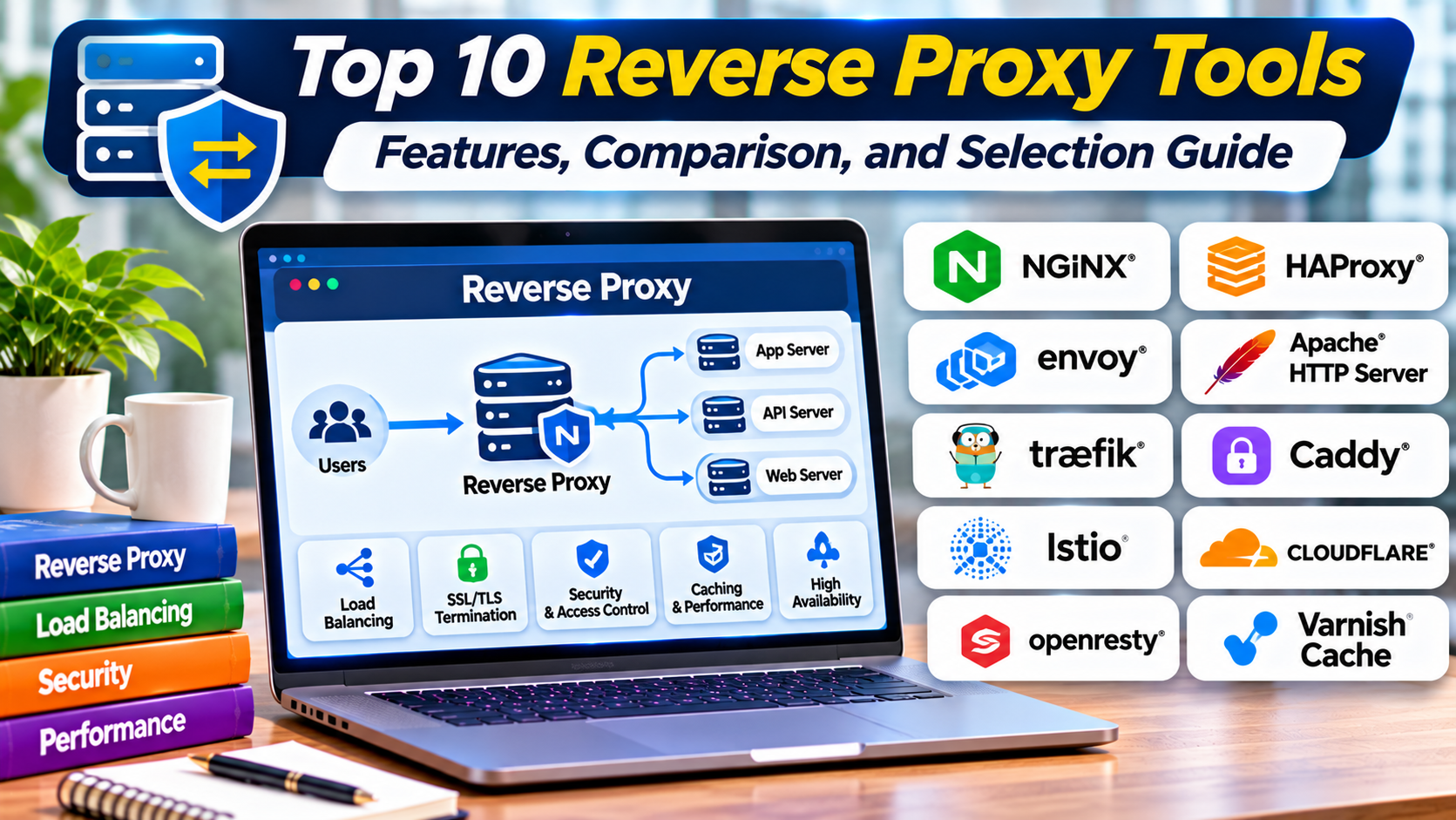
Introduction
Web applications rarely operate as a single server anymore. A modern application may include frontend services, authentication systems, APIs, background workers, and several internal applications.
Allowing every service to communicate directly with internet users can create security, performance, and management challenges.
Reverse proxy tools provide a controlled entry point between clients and backend applications.
They receive incoming requests, apply configured policies, and forward traffic to appropriate services.
This architecture helps organizations centralize TLS termination, application routing, caching, access controls, and traffic management.
Reverse proxies also play an important role in microservices and container environments, where backend services frequently change.
However, different reverse proxy technologies serve different requirements. Some prioritize high-performance HTTP processing, while others focus on automatic service discovery, enterprise application delivery, or cloud-native networking.
This guide examines ten reverse proxy tools, compares their capabilities, and explains how organizations can select an appropriate solution.
1. What Are Reverse Proxy Tools?
A reverse proxy is a server or service that accepts requests on behalf of one or more backend servers.
Instead of connecting directly to an application server, a client connects to the reverse proxy.
The proxy then forwards the request to the appropriate destination and returns the response.
How a Reverse Proxy Works
A typical workflow includes:
- A user requests a website or API endpoint.
- DNS directs the client toward the reverse proxy entry point.
- The reverse proxy accepts the connection.
- It evaluates routing, security, and connection policies.
- It selects an appropriate backend service.
- The backend processes the request.
- The reverse proxy returns the response.
- Logging and monitoring systems record relevant activity.
Common Reverse Proxy Functions
Application routing: Directs requests according to hostnames, paths, headers, or other configured attributes.
TLS termination: Handles encrypted client connections and manages certificates.
Load balancing: Distributes traffic across multiple backend instances.
Caching: Stores eligible responses to reduce repeated backend processing.
Access control: Restricts access according to authentication or network policies.
Request transformation: Modifies supported headers, paths, and other request attributes.
Traffic protection: Applies connection limits, rate limits, or other defensive controls.
Not every reverse proxy provides all these capabilities. Some features require additional modules, external services, or commercial editions.
Reverse Proxy vs. Forward Proxy
A forward proxy generally represents clients when accessing external services.
A reverse proxy represents servers when receiving incoming requests.
The distinction matters because the two technologies operate at different points in the communication path.
2. Top 10 Reverse Proxy Tools
1. NGINX
Best For: High-performance web applications and general-purpose reverse proxy infrastructure.
Overview
NGINX is one of the most established reverse proxy technologies used in modern web infrastructure.
It combines web serving, HTTP proxying, load balancing, and traffic management within a configurable server platform.
Organizations commonly place NGINX in front of web applications to handle incoming HTTPS connections and route requests toward backend services.
For example, an application may expose its frontend at the main domain while routing requests beginning with an API path to separate application servers.
NGINX can manage this arrangement through routing rules and upstream configurations.
Its event-driven architecture is designed to handle large numbers of concurrent connections efficiently.
NGINX also supports response caching, compression, header manipulation, and other capabilities that can reduce backend work.
In container environments, teams often deploy NGINX as a gateway or ingress-related component.
The open-source edition provides extensive functionality, while commercial offerings add selected enterprise management and operational capabilities.
Key Features
- HTTP and HTTPS reverse proxying.
- Upstream load balancing.
- TLS termination.
- Path-based and hostname-based routing.
- Response caching.
- Compression and header management.
- Connection and request controls.
- Logging and monitoring integration.
Advantages
NGINX is versatile and well suited to a broad range of web applications.
Its established ecosystem makes it easier to find deployment patterns, automation examples, and operational guidance.
It can consolidate several infrastructure responsibilities into one component.
Limitations
Complex configurations require careful management.
Some advanced dynamic routing and monitoring capabilities depend on the product edition or supporting automation.
NGINX must also be deployed redundantly when high availability is required.
Ideal Users
Web developers, DevOps engineers, hosting providers, and organizations operating scalable web applications.
2. HAProxy
Best For: Advanced traffic routing and performance-sensitive application proxying.
Overview
HAProxy is a high-performance proxy and load balancer that supports both HTTP and TCP traffic.
Although frequently associated with load balancing, HAProxy is also a powerful reverse proxy for applications requiring precise control over incoming connections.
It allows administrators to inspect request attributes and apply routing policies before forwarding traffic to backend services.
For example, a SaaS platform may route authentication requests to one service group and reporting requests to another.
HAProxy can also apply rate limits, manage connections, and remove unhealthy servers from eligible routing pools.
Its detailed configuration capabilities make it useful in complex environments where traffic behavior must be predictable.
HAProxy is especially relevant to teams that prioritize performance, routing flexibility, and operational visibility.
Key Features
- HTTP and TCP proxying.
- Advanced request routing.
- Multiple load balancing algorithms.
- Backend health checks.
- TLS termination.
- Session persistence.
- Rate limiting.
- Operational statistics and runtime controls.
Advantages
HAProxy provides extensive traffic control and supports demanding application workloads.
Its flexible policies can accommodate complex routing requirements.
Limitations
Sophisticated configurations can become difficult to maintain.
Teams must manage infrastructure redundancy, software updates, and monitoring.
Ideal Users
Platform engineers, network administrators, and enterprises running high-traffic applications.
3. Traefik Proxy
Best For: Docker, Kubernetes, and dynamic microservices environments.
Overview
Traefik Proxy is a reverse proxy designed around automatic configuration and integration with modern application platforms.
It is particularly useful when backend services frequently change.
In traditional environments, administrators may manually maintain lists of backend addresses.
Traefik can obtain routing information from supported infrastructure providers, reducing the need for manual updates.
For example, a team operating Docker containers can configure routing through container metadata.
When a supported service is created or removed, Traefik can update its routing configuration accordingly.
Traefik also supports middleware for authentication integration, redirects, header processing, and traffic controls.
Its certificate management capabilities can simplify HTTPS configuration for supported deployments.
Key Features
- Dynamic configuration discovery.
- HTTP and TCP reverse proxying.
- Docker and Kubernetes integrations.
- Automatic certificate management.
- Routing middleware.
- Load balancing.
- Observability integration.
- Declarative configuration options.
Advantages
Traefik reduces configuration overhead in dynamic environments.
Its infrastructure integrations make it convenient for container-focused teams.
Limitations
Advanced routing configurations require understanding Traefik’s provider and middleware models.
Certain enterprise features depend on commercial offerings.
Ideal Users
Container platform teams, DevOps engineers, and cloud-native application developers.
4. Envoy Proxy
Best For: Microservices networking and programmable traffic management.
Overview
Envoy is an open-source proxy designed for distributed application environments.
It can operate at the network edge or between internal services.
Envoy provides detailed control over request routing, connection handling, retries, timeouts, and traffic observation.
Its dynamic configuration APIs are particularly important in environments where service instances change continuously.
Rather than requiring every proxy configuration to be edited manually, a control plane can distribute configuration updates to Envoy instances.
For example, an organization operating hundreds of microservices can use Envoy to apply consistent traffic policies across its application environment.
Envoy is also commonly used as a data plane component in service mesh architectures.
Key Features
- HTTP and TCP proxying.
- Dynamic configuration APIs.
- Advanced request routing.
- Load balancing and health checking.
- TLS and mutual TLS support.
- Retry and timeout policies.
- Detailed metrics and tracing integration.
- Service mesh compatibility.
Advantages
Envoy is highly flexible and suited to complex distributed systems.
Its observability and dynamic configuration capabilities are valuable in cloud-native infrastructure.
Limitations
Direct administration can be complex.
Large environments often require additional control-plane infrastructure and specialized engineering expertise.
Ideal Users
Platform engineering teams, service mesh operators, and enterprises managing large microservices systems.
5. Caddy
Best For: Simple HTTPS reverse proxy deployments and developer-friendly configuration.
Overview
Caddy is a web server and reverse proxy known for its straightforward configuration and automatic HTTPS capabilities.
It is attractive to organizations that want to deploy secure web services without manually managing every certificate renewal process.
Caddy can receive incoming requests, establish encrypted connections, and forward traffic to backend applications.
For example, a small SaaS team can use Caddy to expose an internal application through a public HTTPS domain.
Its configuration syntax is designed to be approachable, while its underlying capabilities support more sophisticated routing and proxy behavior.
Caddy also provides a modular architecture and programmable configuration interfaces.
These features make it useful for both simple deployments and selected advanced automation scenarios.
Key Features
- HTTP reverse proxying.
- Automatic HTTPS.
- TLS certificate management.
- Load balancing.
- Health checking.
- Header manipulation.
- Configuration API.
- Modular extension architecture.
Advantages
Caddy simplifies common HTTPS and reverse proxy tasks.
It is particularly convenient for small teams that want secure defaults and manageable configuration.
Limitations
Some specialized enterprise networking workflows may require additional modules or custom configuration.
Teams should verify feature support before adopting it for complex traffic architectures.
Ideal Users
Developers, startups, small infrastructure teams, and organizations seeking straightforward HTTPS proxying.
6. Apache HTTP Server
Best For: Traditional web hosting and flexible module-based reverse proxying.
Overview
Apache HTTP Server is a mature web server that also supports reverse proxy functionality through its module ecosystem.
It is commonly found in established hosting environments and enterprise applications.
Modules such as mod_proxy allow Apache to forward requests toward backend services.
Additional modules provide load balancing, HTTP rewriting, caching, and other functions.
For example, an organization hosting several legacy web applications can use Apache to route requests between applications while retaining its existing operational tooling.
Apache’s modular architecture makes it flexible.
However, administrators must understand which modules are enabled and how their configurations interact.
Key Features
- HTTP reverse proxying.
- Module-based architecture.
- Load balancing modules.
- TLS support.
- URL rewriting.
- Authentication integrations.
- Caching modules.
- Extensive configuration options.
Advantages
Apache is suitable for organizations with established Apache infrastructure.
Its modular design supports diverse application requirements.
Limitations
Configuration complexity can increase as more modules are introduced.
Organizations should benchmark performance and resource usage against their actual workloads.
Ideal Users
Web hosting providers, enterprise administrators, and teams maintaining established web environments.
7. Kong Gateway
Best For: API-focused reverse proxying and gateway management.
Overview
Kong Gateway is an API gateway built around proxying and managing API traffic.
Although its primary purpose is API management, it also performs reverse proxy functions for supported services.
Kong is especially useful when organizations need consistent policies across many APIs.
For example, a business operating customer, payment, inventory, and reporting APIs can use Kong to provide a common entry point.
The gateway can route requests to appropriate services while applying authentication, rate limiting, logging, and other supported policies.
Kong’s plugin ecosystem allows organizations to extend gateway behavior.
It also supports deployment patterns relevant to Kubernetes and cloud-native applications.
Key Features
- API reverse proxying.
- Request routing.
- Authentication plugins.
- Rate limiting.
- TLS support.
- Traffic transformation.
- Observability integrations.
- Declarative and automated configuration.
Advantages
Kong combines proxying with API-specific governance capabilities.
It is valuable when teams need consistent API policies across multiple services.
Limitations
It may be more complex than necessary for basic website proxying.
Advanced enterprise capabilities and management features may require commercial products.
Ideal Users
API platform teams, microservices developers, and organizations managing large API portfolios.
8. OpenResty
Best For: Programmable reverse proxying and custom traffic processing.
Overview
OpenResty is a web platform built around NGINX and Lua-based extensibility.
It allows developers to implement custom request processing and application gateway behavior.
This is useful when conventional proxy configuration directives are insufficient for specialized requirements.
For example, a company may need to inspect request metadata, perform custom authentication checks, or apply dynamic routing logic.
OpenResty provides capabilities for implementing such workflows within the web processing layer.
Its architecture can reduce the need to create separate middleware applications for certain request-processing tasks.
However, custom logic must be designed carefully to avoid introducing performance or security problems.
Key Features
- NGINX-based proxy capabilities.
- Lua scripting support.
- Custom request processing.
- HTTP routing.
- Header manipulation.
- Caching integration.
- Extensible modules.
- Programmable gateway behavior.
Advantages
OpenResty provides substantial flexibility for specialized proxy workflows.
It can support custom application logic close to the request-processing layer.
Limitations
Custom scripts introduce maintenance and testing responsibilities.
Performance-sensitive code requires careful implementation and benchmarking.
Ideal Users
Experienced developers, platform engineers, and organizations building specialized application gateways.
9. Apache APISIX
Best For: Dynamic API gateway and reverse proxy infrastructure.
Overview
Apache APISIX is an open-source API gateway that supports dynamic routing and traffic management.
It is designed for environments where API policies and backend configurations may change frequently.
APISIX provides routing, authentication integration, traffic controls, and observability capabilities through a plugin-based architecture.
For example, a microservices platform can use APISIX to expose multiple internal APIs through a common gateway.
Administrators can configure routing and security policies centrally instead of implementing the same functionality independently in every application.
APISIX is particularly relevant to organizations building API infrastructure with dynamic configuration requirements.
Key Features
- Dynamic API routing.
- Reverse proxy functionality.
- Load balancing.
- Authentication plugins.
- Rate limiting.
- Traffic transformation.
- Monitoring integrations.
- Kubernetes-related integration options.
Advantages
APISIX offers flexible API traffic management with an open-source foundation.
Its dynamic configuration capabilities are useful for rapidly changing service environments.
Limitations
It introduces additional infrastructure and configuration concepts.
Teams should evaluate the operational requirements of its configuration storage and control components.
Ideal Users
API engineering teams, cloud-native organizations, and platform developers.
10. Nginx Proxy Manager
Best For: GUI-based reverse proxy administration for small environments.
Overview
Nginx Proxy Manager provides a graphical management interface for common NGINX reverse proxy tasks.
It is particularly useful for administrators who prefer managing proxy hosts and certificates through a web interface rather than editing configuration files manually.
For example, a small business hosting several internal applications can use Nginx Proxy Manager to configure domain routing and HTTPS access.
The interface helps users create proxy hosts, configure certificate settings, and manage selected access controls.
This approach can reduce the learning curve for straightforward deployments.
However, organizations must still understand networking, DNS, TLS, and security fundamentals.
A graphical interface does not eliminate the need for secure administration and infrastructure maintenance.
Key Features
- Web-based management interface.
- NGINX reverse proxy configuration.
- Proxy host management.
- TLS certificate integration.
- Access list configuration.
- Domain-based routing.
- Container-friendly deployment.
- Centralized configuration interface.
Advantages
Nginx Proxy Manager makes basic reverse proxy administration more accessible.
It is convenient for small environments with several hosted applications.
Limitations
It does not expose every advanced NGINX capability through its interface.
Organizations with complex automation or enterprise governance requirements may prefer direct configuration management.
Ideal Users
Small businesses, homelab administrators, developers, and teams managing modest self-hosted environments.
3. Reverse Proxy Tools Comparison Table
| Tool | Best For | Primary Strength | Main Consideration |
|---|---|---|---|
| NGINX | General web applications | Versatile HTTP proxying | Configuration management |
| HAProxy | Advanced traffic routing | Detailed traffic policies | Operational expertise |
| Traefik | Containers | Dynamic discovery | Provider configuration |
| Envoy | Microservices | Programmable networking | Control-plane complexity |
| Caddy | HTTPS applications | Automatic TLS management | Specialized feature requirements |
| Apache HTTP Server | Traditional hosting | Modular flexibility | Module administration |
| Kong Gateway | API management | API policies and plugins | Gateway complexity |
| OpenResty | Custom proxy logic | Lua extensibility | Custom code maintenance |
| Apache APISIX | Dynamic APIs | Plugin-based gateway | Infrastructure dependencies |
| Nginx Proxy Manager | Small deployments | Graphical management | Advanced feature limitations |
4. How to Choose the Right Reverse Proxy Tool
Identify the Main Application Requirements
Determine whether the reverse proxy will serve websites, APIs, internal applications, or microservices.
A simple website may only need HTTPS termination and basic routing.
A large API platform may require authentication policies, rate limits, request transformations, and detailed analytics.
Evaluate Routing Flexibility
Review support for hostname routing, path matching, headers, redirects, and dynamic backend discovery.
Complex applications often require more than simple forwarding rules.
Assess TLS Management
Verify certificate installation, automated renewal, supported protocols, and backend encryption.
Automatic HTTPS can reduce administrative effort, but certificates and trust settings still require monitoring.
Consider Infrastructure Dynamics
Static environments may work well with manually managed NGINX or Apache configurations.
Dynamic container platforms may benefit from Traefik, Envoy, or other technologies with automated configuration capabilities.
Review Performance Requirements
Benchmark concurrent connections, request latency, CPU usage, and memory consumption.
Performance depends on workload characteristics and configuration, not only the product name.
Evaluate Security
Review access controls, header handling, request limits, TLS policies, and integration with dedicated security systems.
Ensure that backend applications cannot be accessed through unintended public network paths.
Consider Observability
A production proxy should provide meaningful logs, error metrics, latency measurements, and backend health information.
Distributed tracing may be useful in microservices environments.
Calculate Total Ownership Cost
Include licensing, hosting, monitoring, engineering labor, upgrades, and operational support.
5. Practical Example: Securing Multiple Applications Behind One Reverse Proxy
Consider a company operating three applications:
- A public customer website.
- An internal administration portal.
- A REST API used by mobile applications.
Initially, each application has its own public server configuration.
This creates duplicated certificate management and inconsistent access policies.
The company decides to introduce a centralized reverse proxy.
Step 1: Define application domains.
The team assigns separate hostnames to the website, administration portal, and API.
Step 2: Select a reverse proxy.
Engineers compare NGINX, Caddy, and Traefik according to their infrastructure.
Step 3: Configure backend routing.
Requests are forwarded to the correct application based on hostname and path.
Step 4: Enable HTTPS.
The team installs or automates trusted TLS certificates.
Step 5: Restrict administrative access.
The internal portal receives additional authentication and network access controls.
Step 6: Configure request limits.
Selected API endpoints receive appropriate rate limiting policies.
Step 7: Add monitoring.
Engineers collect proxy logs, error rates, and request latency.
Step 8: Test failure behavior.
The team simulates unavailable backend services and verifies that users receive predictable responses.
The resulting architecture centralizes important traffic management responsibilities while allowing applications to remain independently deployed.
6. Benefits and Challenges of Reverse Proxy Tools
Major Benefits
Centralized routing: Multiple applications can share a controlled entry point.
Simplified TLS management: Certificate handling can be consolidated.
Improved application isolation: Backend services can remain on private networks.
Traffic optimization: Caching and connection management may reduce backend workload.
Operational consistency: Shared policies can be applied across applications.
Scalability: Reverse proxies can distribute requests across multiple instances when configured for load balancing.
Common Challenges
Single points of failure: A nonredundant proxy can interrupt access to every application behind it.
Configuration mistakes: Incorrect routing or headers can break application functionality.
Security misconfiguration: Improper forwarding headers or trust settings can expose applications to risk.
Certificate management: Expired or incorrectly configured certificates can interrupt HTTPS connections.
Debugging complexity: Additional network hops can make application failures harder to diagnose.
Performance bottlenecks: An undersized proxy can limit overall application throughput.
7. Frequently Asked Questions
What is the best reverse proxy tool?
NGINX is a versatile choice for general web applications. Traefik is attractive for container environments, Caddy simplifies HTTPS, and Envoy supports advanced distributed networking.
Is NGINX a reverse proxy?
Yes. NGINX can operate as a web server, reverse proxy, and load balancer.
What is the difference between a reverse proxy and a load balancer?
A reverse proxy forwards client requests to backend services. A load balancer distributes traffic across multiple destinations. Many products perform both functions.
Does a reverse proxy improve security?
It can centralize access controls and reduce direct exposure of backend systems. Security still depends on correct configuration and complementary protections.
Can reverse proxies cache content?
Yes. Some reverse proxies support response caching, which can reduce repeated backend processing.
What is TLS termination?
TLS termination occurs when a proxy handles an encrypted client connection. Communication between the proxy and backend can also be encrypted when configured.
Can a reverse proxy support multiple domains?
Yes. Hostname-based routing allows a reverse proxy to serve multiple domains and direct requests to different applications.
Are reverse proxy tools suitable for Kubernetes?
Yes. Several reverse proxy technologies integrate with Kubernetes ingress and gateway architectures.
Can reverse proxies support WebSockets?
Many modern reverse proxies support WebSocket traffic when configured appropriately.
Should every application use a reverse proxy?
Not necessarily. Reverse proxies are useful when centralized routing, security controls, or traffic management provide meaningful benefits.
8. Conclusion
Reverse proxy tools provide a foundation for secure, manageable, and scalable application access.
NGINX and HAProxy offer flexible traffic handling for traditional and modern applications.
Traefik and Envoy are particularly relevant to dynamic container and microservices environments.
Caddy simplifies HTTPS deployment, while Apache HTTP Server remains useful for established web infrastructure.
Kong Gateway and Apache APISIX provide API-focused traffic management.
OpenResty supports custom programmable proxy behavior, and Nginx Proxy Manager makes common administration tasks more accessible.
The right solution depends on application architecture, security requirements, routing complexity, operational expertise, and infrastructure scale.
Organizations should prioritize secure defaults, reliable certificate management, useful observability, and redundant deployment.
A carefully configured reverse proxy can simplify application delivery while improving operational control and resilience.