Introduction
Businesses increasingly need applications that respond quickly to events without requiring continuously running servers.
An online store may need to send an order confirmation after a purchase. A financial application may process transaction events. A media platform may resize uploaded images, while an IT team may automate infrastructure maintenance.
These tasks often run for short periods and may occur at unpredictable intervals.
Traditional hosting requires organizations to maintain application servers even when there is little work to process.
Function-as-a-Service, commonly called FaaS, offers a different execution model.
FaaS platforms allow developers to deploy individual functions that run in response to supported events, HTTP requests, messages, or schedules.
The platform manages much of the underlying compute infrastructure, including provisioning execution environments and scaling capacity.
This can reduce operational overhead and make event-driven application development more efficient.
However, FaaS platforms differ significantly in runtime support, execution limits, networking, pricing, deployment methods, and integration capabilities.
Some are deeply integrated with major cloud ecosystems. Others specialize in edge execution or self-hosted infrastructure.
This guide compares ten FaaS platforms and explains how to choose the right solution for modern application workloads.
1. What Is Function-as-a-Service?
Function-as-a-Service is a cloud computing model in which developers deploy discrete units of application logic that execute when triggered.
Instead of provisioning and managing servers, developers package functions and configure the events that invoke them.
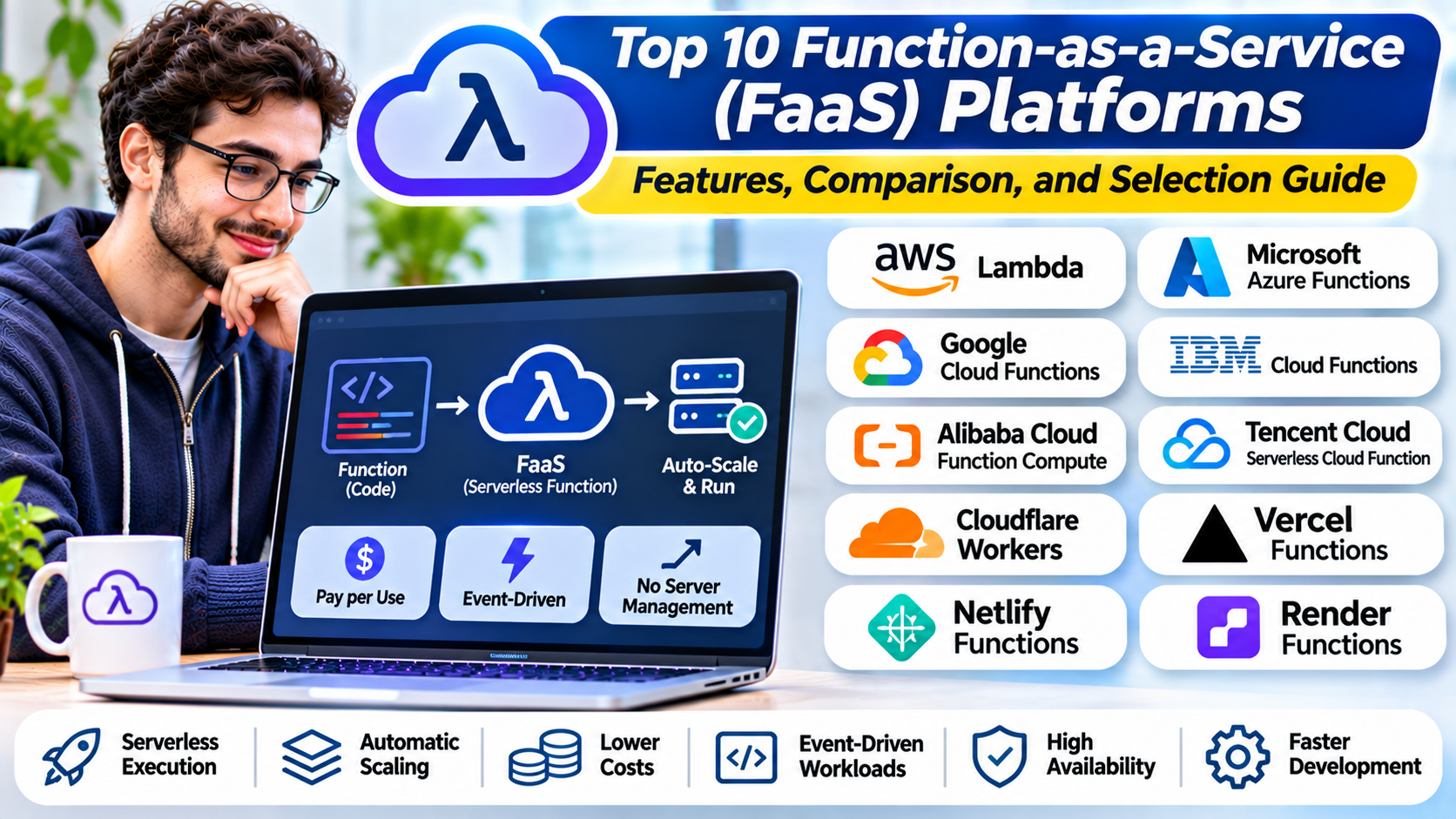
How FaaS Works
A typical FaaS workflow includes:
- A developer writes a function.
- The function is packaged and deployed.
- The platform stores the function code and configuration.
- An event or request triggers execution.
- The platform allocates an execution environment.
- The function processes the event.
- Results are returned or written to another service.
- Execution resources are reused or released according to platform behavior.
Common FaaS Triggers
Functions can respond to different event types:
- HTTP requests.
- Object storage uploads.
- Database changes.
- Message queue events.
- Scheduled operations.
- Authentication events.
- Cloud infrastructure notifications.
- Application-generated events.
Trigger availability depends on the platform.
FaaS vs. Traditional Application Hosting
Traditional hosting generally runs applications on provisioned compute resources.
FaaS runs individual functions through managed execution infrastructure.
This difference changes how developers approach scaling, application state, deployment, and cost management.
FaaS vs. Serverless Computing
FaaS is one category of serverless computing.
Serverless also includes managed container execution, databases, application hosting, and other services that abstract infrastructure management.
FaaS focuses specifically on executing functions.
2. Top 10 Function-as-a-Service Platforms
1. AWS Lambda
Best For: Event-driven applications deeply integrated with AWS.
Overview
AWS Lambda is a managed FaaS platform that allows developers to run code without provisioning conventional application servers.
It supports event-driven processing through integrations with many AWS services.
Developers can create functions using supported programming languages or compatible deployment packages.
For example, an online retailer can configure a Lambda function to respond when an order event arrives through Amazon EventBridge.
The function can validate order details, update a database, and initiate downstream processing.
Lambda is also useful for APIs, file processing, scheduled tasks, automation, and data transformation.
Its integration with AWS identity, logging, monitoring, and messaging services makes it attractive to organizations already using AWS infrastructure.
Lambda can scale function execution according to incoming demand, subject to concurrency settings, quotas, and other constraints.
Developers remain responsible for secure code, dependency management, and downstream resource protection.
Key Features
- Event-driven function execution.
- Managed compute environments.
- Multiple supported runtimes.
- AWS service integrations.
- Automatic scaling.
- Configurable memory and execution settings.
- Concurrency management.
- Monitoring and logging integrations.
Advantages
AWS Lambda provides broad integration with the AWS ecosystem.
It supports many event-driven application patterns without requiring dedicated server administration.
Its mature tooling ecosystem helps teams automate deployment and testing.
Limitations
Execution time limits make it unsuitable for some long-running workloads.
Cold starts, dependency initialization, and concurrency settings can affect latency.
AWS-specific integrations may increase migration complexity.
Ideal Users
AWS developers, SaaS companies, cloud automation teams, and organizations building event-driven systems.
2. Azure Functions
Best For: Microsoft cloud applications and enterprise event processing.
Overview
Azure Functions is Microsoft’s managed FaaS offering.
It allows developers to execute code in response to supported triggers without directly managing the underlying server fleet.
Azure Functions integrates with services such as Azure Storage, Event Hubs, Service Bus, and other Azure components.
For example, a logistics company can create a function that processes shipment updates arriving through a messaging service.
The function can validate the message, update shipment records, and initiate customer notifications.
Azure Functions supports several programming languages and development environments.
It also provides different hosting plans, which influence scaling behavior, networking, execution limits, and cost.
This flexibility is useful for organizations with varying workload requirements.
However, selecting the appropriate hosting plan is an important architectural decision.
Key Features
- Event and HTTP triggers.
- Multiple supported languages.
- Azure service bindings and integrations.
- Managed scaling options.
- Scheduled execution.
- Identity and access integration.
- Monitoring support.
- Deployment automation.
Advantages
Azure Functions fits naturally into Microsoft development and cloud workflows.
It supports enterprise integration scenarios involving Azure messaging and data services.
Limitations
Hosting models have different operational characteristics.
Cold starts and execution limits must be evaluated according to the selected plan.
Ideal Users
Microsoft developers, Azure engineering teams, and enterprises building event-driven applications.
3. Google Cloud Run Functions
Best For: Event-driven functions within Google Cloud.
Overview
Google Cloud Run functions provides a managed environment for deploying event-driven application logic.
The service is part of Google’s broader Cloud Run ecosystem.
It supports functions triggered by HTTP requests and supported cloud events.
For example, a media company can create a function that responds when a video file is uploaded to Cloud Storage.
The function may validate metadata, create a processing record, and initiate a downstream workflow.
Cloud Run functions integrates with Google Cloud services and event delivery technologies.
Its managed infrastructure reduces the need to provision compute servers.
Developers should understand how function execution relates to Cloud Run’s underlying execution and scaling model.
This is particularly important when evaluating concurrency, networking, and deployment behavior.
Key Features
- HTTP-triggered functions.
- Event-driven execution.
- Google Cloud integrations.
- Managed scaling.
- Supported language runtimes.
- Cloud logging and monitoring.
- Deployment tooling.
- Identity and access controls.
Advantages
Cloud Run functions provides a convenient way to implement event-driven logic in Google Cloud.
It integrates with the surrounding cloud platform and managed event services.
Limitations
Runtime behavior and execution constraints depend on the selected deployment model.
Applications relying heavily on Google Cloud integrations may require additional migration work.
Ideal Users
Google Cloud developers, data engineering teams, and organizations building event-driven applications.
4. Cloudflare Workers
Best For: Edge functions and globally distributed request processing.
Overview
Cloudflare Workers is a serverless execution platform designed to run application logic across Cloudflare’s global network.
It is particularly relevant to functions that process HTTP requests near users.
Unlike conventional FaaS systems centered primarily on regional cloud execution, Workers emphasizes distributed edge execution.
For example, a global SaaS application can use Workers to validate authentication tokens, modify HTTP responses, or implement lightweight API endpoints.
This can reduce the distance between users and selected application logic.
Workers also integrates with Cloudflare’s storage, messaging, and application services.
Its runtime model differs from conventional server environments, so developers must verify compatibility with required libraries and APIs.
Key Features
- Edge function execution.
- HTTP request processing.
- Distributed deployment.
- JavaScript and TypeScript support.
- Cloudflare service integrations.
- Request routing.
- Automatic scaling.
- Observability capabilities.
Advantages
Cloudflare Workers is attractive for latency-sensitive workloads.
It simplifies deploying request-processing logic across a distributed network.
Limitations
Runtime constraints differ from traditional application hosting.
Certain native dependencies and long-running workloads may require other platforms.
Ideal Users
Frontend engineers, API developers, global application providers, and edge computing teams.
5. Alibaba Cloud Function Compute
Best For: Event-driven applications using Alibaba Cloud infrastructure.
Overview
Alibaba Cloud Function Compute is a managed FaaS service for executing code in response to supported events and requests.
It is designed to reduce infrastructure administration while supporting elastic application execution.
For example, an e-commerce business operating on Alibaba Cloud can use Function Compute to process uploaded product images.
When an image arrives in object storage, a function can validate the file and initiate transformation tasks.
Function Compute integrates with supported Alibaba Cloud services, making it useful for cloud-native workflows.
The platform provides configuration options for runtime resources, triggers, and execution behavior.
Organizations should evaluate regional availability, supported runtimes, and pricing details for their intended workloads.
Key Features
- Managed function execution.
- Event and HTTP triggers.
- Automatic scaling.
- Cloud service integrations.
- Supported runtime environments.
- Execution configuration.
- Monitoring and logging.
- Deployment automation.
Advantages
Function Compute fits well into Alibaba Cloud architectures.
It can simplify event processing and application automation.
Limitations
Ecosystem compatibility and regional service availability require evaluation.
Cloud-specific integrations can create portability challenges.
Ideal Users
Alibaba Cloud customers, regional cloud developers, and organizations building event-driven applications.
6. DigitalOcean Functions
Best For: Lightweight serverless applications and developer-friendly cloud automation.
Overview
DigitalOcean Functions is a managed serverless compute service intended for executing functions without maintaining dedicated servers.
It is relevant to developers seeking straightforward cloud infrastructure and simple deployment workflows.
For example, a startup can deploy a function that receives a webhook from an external application.
The function can validate the payload, perform a transformation, and forward the result to another service.
DigitalOcean Functions can complement applications running on other DigitalOcean services.
Its relatively focused ecosystem may appeal to smaller teams that do not need the extensive service catalogs of larger cloud providers.
However, organizations should verify supported runtimes, quotas, deployment capabilities, and current product availability before selecting it for production.
Key Features
- Managed function execution.
- HTTP-based invocation.
- Supported programming runtimes.
- Deployment tooling.
- Event-processing workflows.
- Cloud infrastructure integration.
- Execution configuration.
- Logging capabilities.
Advantages
DigitalOcean Functions offers a straightforward approach to selected serverless workloads.
It can complement applications already hosted in DigitalOcean.
Limitations
The ecosystem is narrower than those of major hyperscale providers.
Some complex enterprise integrations may require additional services or custom development.
Ideal Users
Independent developers, startups, and small cloud engineering teams.
7. OpenFaaS
Best For: Self-hosted functions and Kubernetes-based serverless execution.
Overview
OpenFaaS is a framework for deploying and operating functions on supported container infrastructure.
It is particularly relevant to organizations that want FaaS capabilities while retaining control over their execution environment.
OpenFaaS uses container-oriented packaging and deployment patterns.
For example, a company operating a private Kubernetes environment can deploy functions that process internal automation events.
These functions can perform tasks such as data transformation, document processing, or internal API integration.
OpenFaaS provides tooling for building, deploying, and managing functions.
Because the organization controls much of the infrastructure, it can customize networking and operational policies.
However, this flexibility comes with responsibility for cluster availability, security, scaling, and maintenance.
Key Features
- Container-based function deployment.
- Kubernetes integration.
- HTTP-triggered functions.
- Function templates.
- Deployment tooling.
- Scaling capabilities.
- Self-hosted execution.
- Infrastructure customization.
Advantages
OpenFaaS provides infrastructure control and deployment flexibility.
It is suitable for organizations seeking FaaS patterns within existing container platforms.
Limitations
It does not eliminate infrastructure administration.
Capabilities and licensing vary across available editions.
Ideal Users
Platform engineers, Kubernetes operators, and organizations building private serverless environments.
8. Apache OpenWhisk
Best For: Open-source event-driven function execution.
Overview
Apache OpenWhisk is an open-source serverless platform designed to execute functions in response to events.
It provides a framework for building event-driven applications using actions, triggers, and rules.
For example, an organization can configure an OpenWhisk action to process an incoming event from a supported integration.
The action performs the required logic and can participate in a larger workflow.
OpenWhisk is relevant to organizations that want control over a self-managed FaaS platform.
Its architecture can support different deployment and integration scenarios.
However, teams must evaluate the operational requirements of running the platform, including its dependencies, security, and scaling behavior.
Key Features
- Event-driven actions.
- Triggers and rules.
- Multiple language support.
- Open-source architecture.
- Function composition patterns.
- API-based invocation.
- Container-based execution.
- Self-managed deployment options.
Advantages
OpenWhisk offers flexibility for organizations exploring open-source FaaS architectures.
It supports event-oriented application development without requiring a specific proprietary cloud provider.
Limitations
Deployment and maintenance require engineering expertise.
The surrounding ecosystem and operational tooling should be assessed before production adoption.
Ideal Users
Platform developers, research teams, and organizations operating custom serverless infrastructure.
9. Nuclio
Best For: High-performance event processing and data-oriented serverless workloads.
Overview
Nuclio is a serverless framework designed for event-driven function execution.
It is especially relevant to workloads involving data processing, streaming events, and performance-sensitive automation.
Nuclio supports function deployment on supported infrastructure, including Kubernetes-based environments.
For example, a data engineering team can use Nuclio to process incoming events from a data pipeline.
The function can validate records, transform information, and forward results to downstream systems.
Nuclio is also associated with machine learning and data platform integrations.
Its value is greatest when teams need event-processing capabilities within infrastructure they can control.
Key Features
- Event-driven functions.
- Kubernetes deployment.
- Multiple event trigger integrations.
- Container-based execution.
- Data processing workflows.
- Function configuration.
- Scaling capabilities.
- Monitoring integrations.
Advantages
Nuclio is useful for specialized event-processing workloads.
Its architecture supports integration with containerized data platforms.
Limitations
It requires infrastructure management and operational expertise.
Organizations should verify the maintenance status and compatibility of the specific distribution they plan to use.
Ideal Users
Data engineers, platform teams, and organizations building event-driven processing systems.
10. Knative Serving and Eventing
Best For: Kubernetes-native serverless functions and event-driven services.
Overview
Knative is an open-source project that adds serverless-style capabilities to Kubernetes.
Its Serving and Eventing components provide foundations for request-driven execution and event delivery.
Knative is not a turnkey FaaS developer platform in the same sense as AWS Lambda.
Instead, it provides infrastructure components that organizations can use to build serverless application and function platforms.
For example, an enterprise can deploy containerized function handlers through Knative Serving.
Knative Eventing can help route supported events to those workloads.
The platform can scale services according to demand and support scale-to-zero behavior.
This makes Knative attractive to organizations building internal developer platforms on Kubernetes.
Key Features
- Kubernetes-native serving.
- Event delivery components.
- Request-driven scaling.
- Scale-to-zero support.
- Container-based execution.
- Declarative configuration.
- Integration with Kubernetes networking.
- Extensible serverless infrastructure.
Advantages
Knative provides control and flexibility for Kubernetes-based serverless architectures.
It supports organizations seeking open infrastructure components rather than relying entirely on managed FaaS services.
Limitations
Knative requires Kubernetes expertise.
A complete FaaS experience may require additional developer tooling, deployment abstractions, and platform components.
Ideal Users
Platform engineering teams, Kubernetes administrators, and enterprises developing internal serverless platforms.
3. FaaS Platforms Comparison Table
| Platform | Best For | Deployment Model | Primary Strength |
|---|---|---|---|
| AWS Lambda | AWS event processing | Managed cloud | Broad AWS integrations |
| Azure Functions | Microsoft cloud workloads | Managed cloud | Azure triggers and bindings |
| Google Cloud Run functions | Google Cloud events | Managed cloud | Google Cloud integration |
| Cloudflare Workers | Edge functions | Managed edge | Global request processing |
| Alibaba Function Compute | Alibaba Cloud workloads | Managed cloud | Cloud ecosystem integration |
| DigitalOcean Functions | Lightweight applications | Managed cloud | Simple deployment |
| OpenFaaS | Private infrastructure | Self-hosted | Container-based functions |
| Apache OpenWhisk | Open-source FaaS | Self-hosted | Event-driven actions |
| Nuclio | Data processing | Self-hosted | Event-processing integration |
| Knative | Kubernetes serverless | Self-managed | Kubernetes-native foundation |
The list includes managed FaaS services, self-hosted function frameworks, and Kubernetes infrastructure components. Their operational responsibilities differ substantially.
4. How to Choose the Right FaaS Platform
Identify the Trigger Requirements
Determine whether functions will respond to HTTP requests, messages, storage events, database changes, or schedules.
Verify native integrations and event delivery guarantees.
Evaluate Runtime Support
Check supported languages, libraries, container formats, and dependency packaging options.
Review Execution Limits
Assess execution duration, memory, CPU, request payload size, and concurrency quotas.
Understand Cold Starts
Measure startup latency under realistic traffic patterns.
Latency-sensitive applications may require provisioned capacity or other mitigation strategies.
Evaluate State Management
Functions should not depend on durable local execution state.
Use appropriate external storage and database services.
Review Security
Apply least-privilege permissions, secure secret storage, and controlled network access.
Compare Pricing
Estimate invocation counts, execution time, resource consumption, network charges, and supporting services.
Consider Operational Control
Managed platforms reduce infrastructure maintenance.
Self-hosted frameworks provide greater control but require dedicated platform operations.
5. Practical Example: Event-Driven Invoice Processing
Consider a company receiving thousands of invoices through a customer portal.
The number of uploads varies significantly throughout the month.
The organization wants to process invoices without maintaining continuously running worker servers.
Step 1: Identify the event.
An invoice upload generates an object storage event.
Step 2: Select a platform.
The team compares AWS Lambda, Azure Functions, and Google Cloud Run functions.
Step 3: Define the processing logic.
A function validates file format, records metadata, and initiates document processing.
Step 4: Configure secure access.
The function receives limited permissions to access the required storage and database resources.
Step 5: Implement retries.
The team handles temporary failures and prevents duplicate processing through idempotency controls.
Step 6: Test concurrency.
Engineers simulate periods with many simultaneous uploads.
Step 7: Configure monitoring.
Dashboards track invocation counts, errors, execution duration, and processing delays.
Step 8: Evaluate costs.
The organization compares usage-based execution charges with a continuously running worker architecture.
The resulting workflow can scale with demand while reducing idle compute administration.
6. Benefits and Challenges of FaaS
Major Benefits
Reduced infrastructure management: Developers focus on function logic rather than server maintenance.
Automatic scaling: Managed services can allocate execution capacity according to demand.
Event-driven integration: Functions connect naturally to messaging and cloud events.
Faster development: Small functions can be deployed independently.
Potential cost efficiency: Intermittent workloads may avoid continuous compute charges.
Modular architecture: Functions can isolate selected business operations.
Common Challenges
Cold starts: Initialization can increase response latency.
Execution limits: Long-running workloads may not fit the platform.
Debugging complexity: Distributed functions require effective logging and tracing.
Vendor lock-in: Provider-specific integrations can complicate migration.
Concurrency management: Sudden traffic may overwhelm databases or external APIs.
Cost variability: High invocation volumes can create unexpected charges.
7. Frequently Asked Questions
What is the best FaaS platform?
AWS Lambda is suitable for many AWS applications. Azure Functions works well with Microsoft cloud services, while Google Cloud Run functions supports Google Cloud event processing. Self-hosted alternatives suit organizations requiring infrastructure control.
What does FaaS stand for?
FaaS stands for Function-as-a-Service.
Is FaaS the same as serverless?
FaaS is a category of serverless computing focused on executing individual functions.
How does FaaS pricing work?
Managed platforms commonly charge based on requests, execution duration, resource allocation, or related usage dimensions.
What is a cold start?
A cold start occurs when a platform initializes a new execution environment before running a function.
Can FaaS support APIs?
Yes. Many FaaS platforms support HTTP-triggered functions and API integrations.
Can FaaS replace traditional servers?
It can replace selected workloads, but long-running or specialized applications may be better suited to other compute models.
Is FaaS suitable for data processing?
Yes. Functions can process events, files, messages, and data transformations when workload requirements fit platform limits.
Are open-source FaaS platforms production-ready?
They can support production workloads when properly deployed, secured, monitored, and maintained.
What is the difference between FaaS and PaaS?
FaaS executes individual functions, while PaaS generally provides a managed environment for deploying and running broader applications.
8. Conclusion
Function-as-a-Service platforms provide a flexible execution model for event-driven applications.
AWS Lambda, Azure Functions, and Google Cloud Run functions offer managed execution integrated with major cloud ecosystems.
Cloudflare Workers emphasizes edge execution, while Alibaba Cloud Function Compute and DigitalOcean Functions provide additional managed options.
OpenFaaS, Apache OpenWhisk, Nuclio, and Knative support organizations seeking open-source or self-hosted serverless capabilities.
The right platform depends on event sources, runtime compatibility, execution limits, security, operational expertise, and cost.
Organizations should test representative workloads and evaluate both application performance and downstream dependencies.
A carefully designed FaaS architecture can simplify event processing, support variable demand, and reduce unnecessary infrastructure administration.