Introduction
A domain name is one of the most important digital assets a business can own.
It connects customers to websites, supports branded email addresses, and establishes a recognizable online identity. For many organizations, domain names also serve as the foundation for application endpoints, authentication systems, and customer-facing services.
However, registering a domain involves more than choosing an available name and paying an introductory fee.
Businesses must consider renewal costs, DNS management, account security, transfer policies, privacy protection, and long-term ownership.
A poor registrar choice can create unnecessary expenses and operational risks. Unexpected renewal charges, weak account protection, confusing management interfaces, and limited support can make domain administration difficult.
Domain registration platforms help individuals and organizations search for available names, register domains, renew ownership rights, and manage important settings.
Some platforms emphasize affordable registration and simple administration. Others provide advanced portfolio management, developer APIs, integrated DNS services, or enterprise security controls.
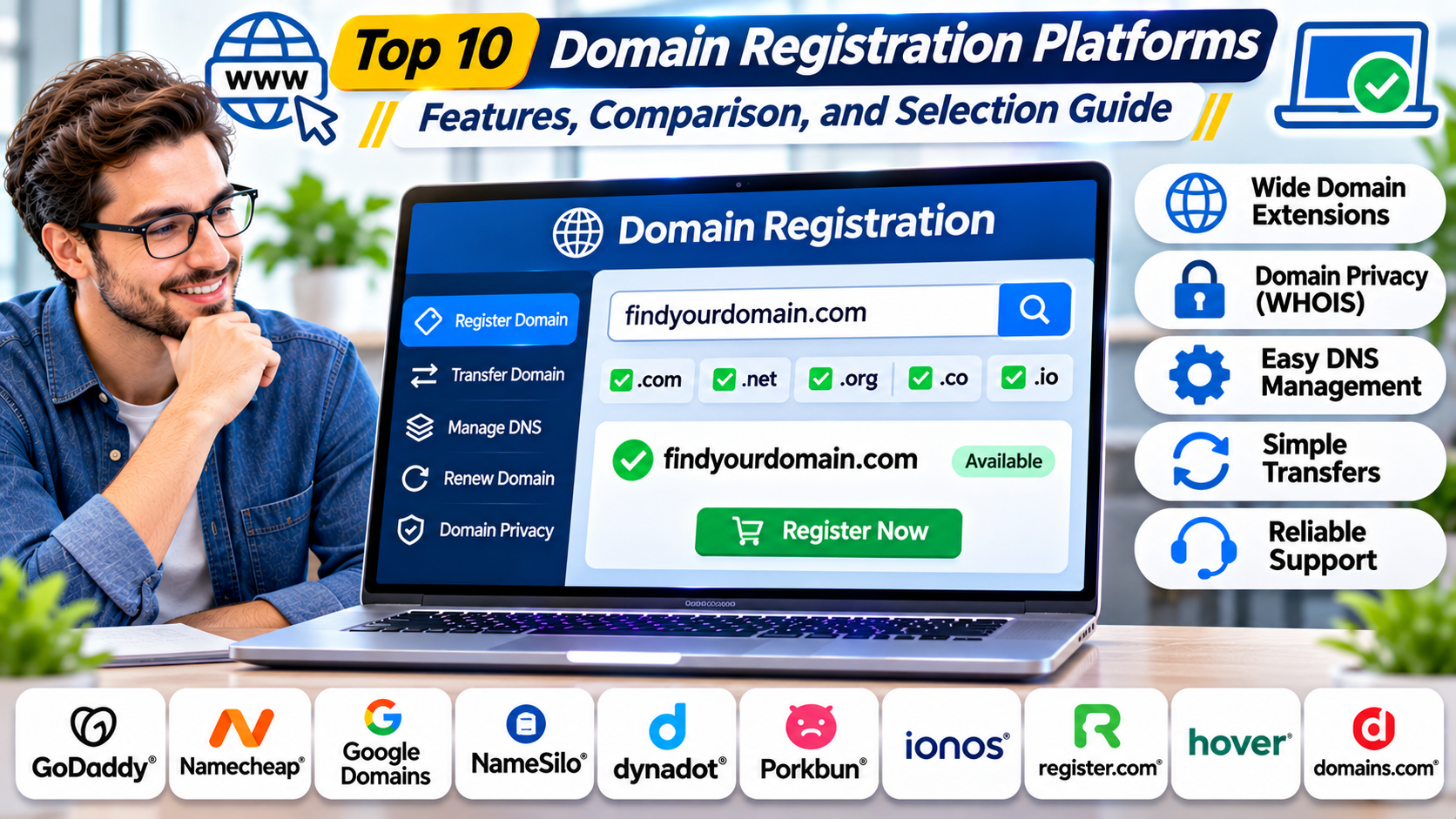
This guide compares ten domain registration platforms, explains their capabilities and limitations, and provides a practical framework for selecting the right registrar.
1. What Are Domain Registration Platforms?
Domain registration platforms are services that allow customers to register and manage internet domain names.
Most operate as accredited domain registrars or as resellers working with accredited registrars.
A domain registrar communicates with the appropriate domain registry to create and maintain registration records.
For example, when a business registers a domain ending in .com, the registration is processed through the relevant registry infrastructure.
The customer receives the right to use the domain for the registration period, subject to applicable policies and renewal requirements.
Domain registration does not mean purchasing permanent ownership of the name.
Core Functions of Domain Registration Platforms
Domain availability searches: Check whether a requested name is available for registration.
Domain registration: Register available names under supported top-level domains.
Renewal management: Extend registrations before expiration.
DNS management: Configure records that connect domains to websites, email services, and applications.
Domain transfers: Move registrations between supported registrars.
Contact management: Maintain required registration information.
Privacy services: Reduce public exposure of eligible registration contact information.
Security controls: Protect registrar accounts and domain settings.
Portfolio administration: Manage multiple domains through a centralized interface.
Domain Registrar vs. DNS Provider
A domain registrar manages the domain registration relationship.
A DNS provider hosts the records used to resolve the domain to internet services.
One company may provide both services, but they are technically separate functions.
Domain Registrar vs. Web Hosting
Domain registration establishes the domain name.
Web hosting provides the infrastructure where a website or application runs.
Organizations can purchase these services from different providers.
Important Domain Security Concepts
Registrar lock: A control that helps prevent unauthorized transfers.
Registry lock: A stronger, registry-level protection mechanism available for eligible domains through participating providers.
DNSSEC: A technology that helps protect DNS responses against certain forms of tampering.
Multi-factor authentication: An additional verification requirement for account access.
Auto-renewal: A feature that can help prevent accidental expiration when payment and account details remain valid.
These controls should be evaluated together rather than individually.
2. Top 10 Domain Registration Platforms
1. Cloudflare Registrar
Best For: Transparent domain pricing and integration with Cloudflare DNS.
Overview
Cloudflare Registrar is a domain registration service designed around straightforward pricing and integration with Cloudflare’s broader network services.
Its distinguishing feature is its at-cost registration and renewal pricing approach for supported domains.
Instead of emphasizing introductory discounts followed by substantial renewal markups, Cloudflare Registrar generally passes through registry and applicable ICANN charges without adding a registrar markup.
This approach can be attractive to businesses managing domains over many years.
For example, a software company operating several production websites may use Cloudflare Registrar to consolidate registrations and manage DNS through Cloudflare.
The platform integrates with Cloudflare’s DNS and security ecosystem.
This can simplify administration for organizations already using Cloudflare for DNS, content delivery, or website protection.
However, Cloudflare Registrar requires domains to use Cloudflare’s nameservers.
This is an important limitation for organizations that prefer an independent authoritative DNS provider.
Key Features
- At-cost registration and renewal pricing for supported domains.
- Cloudflare DNS integration.
- Domain transfer management.
- DNSSEC support for eligible configurations.
- Registrar account security controls.
- Domain renewal management.
- Centralized domain administration.
- Integration with Cloudflare services.
Advantages
Cloudflare’s pricing approach supports long-term cost transparency.
Its integration with DNS and security services can reduce administration across multiple vendors.
Limitations
The nameserver requirement limits DNS provider flexibility.
Supported domain extensions and advanced registrar features should be checked before migration.
Ideal Users
Developers, SaaS businesses, and organizations already using Cloudflare DNS.
2. Namecheap
Best For: Domain registration combined with website and email services.
Overview
Namecheap is a domain registration provider offering a broad range of domain extensions and related internet services.
It is particularly popular among individuals, small businesses, and website owners seeking a centralized interface for domain management.
For example, a small consulting company can register a business domain, configure DNS records, and purchase related hosting or email services.
Namecheap provides tools for managing nameservers, renewals, transfers, and eligible domain privacy services.
Its domain search experience also helps customers explore alternative names and extensions.
The platform is useful for organizations that prefer domain administration and related services in one account.
However, promotional registration prices may differ significantly from renewal prices.
Customers should evaluate the full cost of maintaining a domain over several years.
Key Features
- Domain search and registration.
- Broad extension availability.
- DNS management.
- Domain transfer services.
- Renewal controls.
- Privacy services for eligible domains.
- Hosting and email offerings.
- Account security features.
Advantages
Namecheap provides a broad set of domain-related services.
Its interface is approachable for small businesses and individual users.
Limitations
Introductory discounts can make long-term costs less obvious.
Advanced portfolio administration may require additional tools or workflows.
Ideal Users
Small businesses, bloggers, freelancers, and website administrators.
3. GoDaddy
Best For: Domain registration with extensive small-business services.
Overview
GoDaddy is a large domain registration provider offering domain names, website services, email products, and related business tools.
It serves individuals, small businesses, and organizations managing larger domain portfolios.
For example, a retail business can register a branded domain and connect it to a website and business email service.
GoDaddy provides domain search, renewal, transfer, and DNS management capabilities.
Its broader service catalog can be convenient for customers who prefer a single vendor for multiple website-related needs.
GoDaddy also offers products for domain investors and businesses managing multiple names.
However, customers should carefully review optional services, renewal pricing, and product bundles.
A low introductory registration price does not necessarily indicate the lowest long-term cost.
Key Features
- Domain registration and transfers.
- Domain search tools.
- DNS management.
- Auto-renewal.
- Domain portfolio services.
- Website and email products.
- Domain aftermarket services.
- Account security controls.
Advantages
GoDaddy provides a broad domain and website services ecosystem.
Its product range can support businesses at different stages.
Limitations
Optional products and renewal pricing can increase total expenses.
The breadth of services may introduce complexity for customers seeking only domain registration.
Ideal Users
Small businesses, entrepreneurs, and organizations wanting integrated website services.
4. Porkbun
Best For: Straightforward domain pricing and uncomplicated administration.
Overview
Porkbun is a domain registrar focused on providing accessible domain registration and management services.
It is attractive to individuals and businesses that prioritize pricing clarity and straightforward domain administration.
For example, a developer launching several independent projects can register domains, configure DNS records, and manage renewals through Porkbun.
The platform provides domain search, transfer, and management capabilities.
It also supports features such as DNS configuration and eligible privacy protection.
Porkbun is particularly relevant to customers who want flexibility in choosing nameservers without committing to a broader hosting ecosystem.
Its pricing approach can make it a useful option for long-term domain management.
However, renewal prices and supported extensions should still be checked individually.
Key Features
- Domain registration.
- Domain transfers.
- DNS management.
- Renewal controls.
- Domain privacy for eligible extensions.
- API capabilities.
- Account security.
- Domain portfolio administration.
Advantages
Porkbun emphasizes straightforward domain management.
It is suitable for users who want registrar flexibility and transparent pricing.
Limitations
Its broader enterprise service ecosystem is smaller than those of some major providers.
Specialized portfolio requirements should be evaluated separately.
Ideal Users
Developers, freelancers, startups, and small businesses.
5. Dynadot
Best For: Domain portfolios, bulk administration, and domain investors.
Overview
Dynadot is a domain registrar offering registration, renewal, transfer, and portfolio management services.
It is particularly relevant to customers managing numerous domains.
For example, a digital agency may register and administer domains for multiple client projects.
Dynadot’s management capabilities can help organize renewals, DNS settings, and account operations.
The platform also supports domain marketplace activities, making it relevant to domain investors.
Developer-oriented management capabilities can assist organizations that need to automate repetitive domain tasks.
Security features and supported protection mechanisms should be evaluated according to the value and risk of the domains being managed.
Key Features
- Domain registration and transfers.
- Bulk domain administration.
- DNS management.
- Portfolio management tools.
- Domain marketplace capabilities.
- API access.
- Renewal management.
- Account security features.
Advantages
Dynadot supports domain portfolio administration.
Its bulk management capabilities can reduce repetitive tasks.
Limitations
Some advanced services may involve additional charges.
Organizations should verify support for their specific extensions and security requirements.
Ideal Users
Domain investors, agencies, developers, and businesses managing multiple domains.
6. Squarespace Domains
Best For: Domain registration connected to website creation.
Overview
Squarespace Domains provides domain registration and management capabilities within the Squarespace ecosystem.
It is especially relevant to individuals and businesses using Squarespace websites.
For example, a photography studio can register a branded domain and connect it to a Squarespace portfolio website.
The platform provides domain management, DNS configuration, and renewal controls.
Its integration with website-building workflows can simplify setup for users who do not want to manage several technical vendors.
Squarespace Domains also serves customers who need domain registration independently of website hosting.
However, customers should evaluate whether its DNS capabilities, transfer options, and pricing meet their long-term needs.
Key Features
- Domain search and registration.
- DNS configuration.
- Renewal management.
- Domain transfers.
- Squarespace website integration.
- Account administration.
- Supported domain extensions.
- Domain security controls.
Advantages
Squarespace Domains is convenient for website owners already using Squarespace.
It reduces the complexity of connecting a domain to a supported website.
Limitations
Advanced DNS automation and portfolio requirements may favor other registrars.
Renewal pricing should be reviewed before purchase.
Ideal Users
Creators, small businesses, portfolio websites, and Squarespace customers.
7. Hover
Best For: Simple domain registration and focused domain management.
Overview
Hover is a domain registrar that emphasizes a relatively straightforward domain management experience.
It is suitable for customers who want to register domains without adopting an extensive hosting platform.
For example, a consultant can register a professional domain and configure it to work with an independent website host and email provider.
Hover supports domain registration, transfers, DNS management, and renewal administration.
Its focused approach may appeal to customers who prefer separating domain ownership from hosting infrastructure.
This separation can provide flexibility when changing website or email providers.
However, organizations requiring extensive automation or bulk portfolio administration should compare its capabilities with more developer-oriented registrars.
Key Features
- Domain registration.
- Domain transfers.
- DNS management.
- Renewal administration.
- Supported domain privacy services.
- Account security.
- Email-related offerings.
- Domain management interface.
Advantages
Hover provides a focused domain registration experience.
It can suit customers who prefer independent hosting and email providers.
Limitations
Advanced automation capabilities may be limited.
Pricing should be evaluated against alternative registrars.
Ideal Users
Freelancers, consultants, small businesses, and individual website owners.
8. Gandi
Best For: Professional domain management and technical administration.
Overview
Gandi is a domain registrar offering domain registration, DNS, and related internet services.
It is relevant to organizations that need reliable domain administration and support for multiple extensions.
For example, a technology company managing regional websites can use Gandi to administer several domains and configure DNS records.
Gandi provides management interfaces and API capabilities that can support technical workflows.
Its DNS features can help teams maintain domain settings across applications and services.
However, businesses should review its current renewal pricing, service packages, and support arrangements.
The appropriate registrar choice depends on more than historical reputation.
Key Features
- Domain registration and renewal.
- Domain transfer services.
- DNS management.
- API capabilities.
- Multiple domain extensions.
- Domain portfolio administration.
- Account security.
- Related hosting and email services.
Advantages
Gandi provides professional domain management capabilities.
Its technical interfaces can support organizations with more advanced requirements.
Limitations
Renewal costs may be higher than those of budget-focused registrars.
Available features and service packages should be verified for each account type.
Ideal Users
Technology companies, agencies, and organizations managing international domain portfolios.
9. Amazon Route 53 Domains
Best For: Domain registration integrated with AWS infrastructure.
Overview
Amazon Route 53 provides domain registration capabilities alongside AWS DNS services.
It is particularly relevant to organizations hosting applications on AWS.
For example, a SaaS company can register its domain through Route 53 and configure DNS records that direct traffic to AWS application infrastructure.
The platform integrates with AWS identity and management services.
This can simplify administration for teams already using AWS.
Route 53 also supports DNS routing features, although DNS hosting and domain registration are distinct billable functions.
Organizations should evaluate registration prices, hosted zone charges, and DNS query costs separately.
Key Features
- Domain registration.
- Domain transfer support.
- Route 53 DNS integration.
- AWS account administration.
- Renewal management.
- DNS routing capabilities.
- API and infrastructure automation.
- Integration with AWS services.
Advantages
Route 53 fits naturally into AWS infrastructure workflows.
It can support automated DNS management and application deployment.
Limitations
DNS hosting and registration charges require separate evaluation.
The platform may be unnecessarily complex for customers needing only a simple domain registration.
Ideal Users
AWS developers, cloud architects, and organizations hosting applications on AWS.
10. Spaceship
Best For: Modern domain management and straightforward registration workflows.
Overview
Spaceship is a domain registration and digital services platform associated with the Namecheap organization.
It focuses on domain registration, management, and related online services through a modern interface.
For example, a small business can register a new brand domain and configure the records required for its website and email services.
Spaceship provides tools for searching, purchasing, transferring, and managing domains.
Its interface is designed to simplify common domain administration tasks.
The platform can be attractive to customers seeking a newer alternative to established registrar dashboards.
However, organizations should evaluate supported extensions, renewal prices, automation capabilities, and support arrangements.
Key Features
- Domain registration.
- Domain search.
- Domain transfers.
- DNS management.
- Renewal controls.
- Account administration.
- Related digital services.
- Domain security features.
Advantages
Spaceship provides an accessible domain management experience.
It is relevant to individuals and small businesses seeking straightforward registration.
Limitations
Advanced enterprise and portfolio capabilities should be verified before adoption.
Long-term costs and service compatibility require evaluation.
Ideal Users
Small businesses, startups, freelancers, and independent website owners.
3. Domain Registration Platforms Comparison Table
| Platform | Best For | Main Strength | Important Consideration |
|---|---|---|---|
| Cloudflare Registrar | Cloudflare users | At-cost pricing | Cloudflare nameservers required |
| Namecheap | Small businesses | Broad service ecosystem | Renewal pricing |
| GoDaddy | Integrated website services | Extensive product range | Optional service costs |
| Porkbun | Straightforward registration | Pricing clarity | Enterprise requirements |
| Dynadot | Domain portfolios | Bulk management | Advanced feature costs |
| Squarespace Domains | Website creators | Website integration | Automation flexibility |
| Hover | Simple administration | Focused experience | Limited advanced tooling |
| Gandi | Technical domain management | APIs and DNS services | Renewal costs |
| Amazon Route 53 | AWS infrastructure | Cloud integration | Separate DNS charges |
| Spaceship | Modern domain management | Accessible interface | Feature maturity |
No registrar is universally best. The appropriate choice depends on long-term cost, domain security, supported extensions, and administrative requirements.
4. How to Choose the Right Domain Registration Platform
Compare Renewal Prices
Introductory prices can be misleading.
Calculate the expected registration cost over three to five years.
Include applicable registry fees, taxes, and optional services.
Verify Domain Extension Support
Not every registrar supports every top-level domain.
Country-code domains may have special registration or residency requirements.
Evaluate DNS Management
Check support for required DNS record types, DNSSEC, API access, and external nameservers.
Review Account Security
Prioritize strong multi-factor authentication, registrar locks, access controls, and account recovery procedures.
For high-value domains, investigate registry-level protection.
Check Transfer Policies
Understand transfer eligibility, authorization procedures, and applicable restrictions.
Avoid making critical domain changes immediately before a major migration.
Evaluate Portfolio Management
Organizations with many domains should consider bulk updates, renewal reporting, and administrative delegation.
Review Support Quality
Domain incidents can affect websites and email simultaneously.
Evaluate support availability and escalation procedures.
Consider Vendor Independence
Keeping domain registration separate from hosting can make infrastructure migrations easier.
Integrated services may be convenient, but portability remains important.
5. Practical Example: Managing Domains for a Growing Business
Consider a software company operating one main website, three product websites, and several regional domains.
The company currently uses multiple registrar accounts.
Renewal dates are inconsistent, and administrators do not have a complete inventory.
Step 1: Create a domain inventory.
Document every domain, registrar, expiration date, owner, and DNS provider.
Step 2: Identify critical domains.
Prioritize the primary business domain and domains supporting authentication or customer email.
Step 3: Compare registrars.
Evaluate Cloudflare Registrar, Porkbun, Dynadot, and Route 53 according to requirements.
Step 4: Review security.
Enable strong account authentication and appropriate transfer protections.
Step 5: Standardize administration.
Assign domain ownership and establish approved administrative procedures.
Step 6: Plan transfers carefully.
Check eligibility, DNS dependencies, and registrar transfer procedures.
Step 7: Configure renewal controls.
Enable appropriate auto-renewal and independent expiration reminders.
Step 8: Test DNS continuity.
Confirm that website, email, and application records remain correct.
Step 9: Audit periodically.
Review domain inventory, access permissions, and upcoming renewals.
This process reduces the risk of accidental expiration and unauthorized changes.
6. Benefits and Challenges of Domain Registration Platforms
Major Benefits
Centralized administration: Domains can be managed through a consistent interface.
Brand protection: Organizations can maintain important brand-related names.
DNS integration: Registrars can simplify connections to websites and email systems.
Renewal automation: Automatic renewal can reduce expiration risk.
Security controls: Account and transfer protections help safeguard valuable domains.
Portfolio visibility: Businesses can track registrations across projects and regions.
Common Challenges
Unexpected renewal costs: Promotional pricing may not reflect long-term expenses.
Domain expiration: Failed payments or incorrect account information can disrupt services.
Unauthorized transfers: Weak account security can expose critical domains.
DNS errors: Incorrect changes can interrupt websites and email.
Transfer complexity: Moving domains requires careful coordination.
Ownership disputes: Inaccurate contact records and unclear administrative responsibility can create problems.
7. Frequently Asked Questions
What is the best domain registration platform?
Cloudflare Registrar is attractive for at-cost pricing and Cloudflare DNS integration. Porkbun and Dynadot are useful alternatives, while Namecheap and GoDaddy provide broader related services.
What is a domain registrar?
A domain registrar is a company authorized to provide domain registration services directly or through appropriate registry relationships.
Can I register a domain permanently?
No. Domain registrations are maintained for defined periods and must be renewed.
What is the difference between a registrar and a registry?
A registry operates a top-level domain’s registration database. A registrar provides registration services to customers.
Can I move my domain to another registrar?
Usually, yes, subject to transfer policies, eligibility requirements, and applicable restrictions.
Does domain registration include web hosting?
Not necessarily. Domain registration and hosting are separate services.
What is domain privacy?
Domain privacy services help limit public exposure of eligible registration contact information.
What is DNSSEC?
DNSSEC adds cryptographic validation to DNS responses, helping protect against certain forms of DNS data manipulation.
Should businesses use auto-renewal?
Auto-renewal is generally useful, but payment methods and renewal notifications should still be monitored.
How can businesses protect valuable domains?
Use strong authentication, registrar locks, appropriate registry protections, controlled access, and regular domain inventory reviews.
8. Conclusion
Domain registration platforms provide the foundation for managing online identities.
Cloudflare Registrar emphasizes transparent pricing and DNS integration.
Porkbun and Dynadot offer practical options for straightforward registration and portfolio administration.
Namecheap, GoDaddy, Squarespace Domains, Hover, Gandi, and Spaceship serve different combinations of individual, business, and technical requirements.
Amazon Route 53 is particularly relevant to organizations operating within AWS.
The best registrar is not necessarily the one offering the lowest first-year price.
Businesses should prioritize renewal transparency, security, DNS flexibility, support, and long-term ownership continuity.
A well-managed domain portfolio protects brand identity and reduces avoidable operational risks.