Introduction
Modern applications increasingly rely on distributed services rather than a single software application running on one server.
An online shopping platform may use separate services for customer accounts, product catalogs, payments, inventory, and shipping.
These services must communicate reliably, even as infrastructure changes.
In cloud and container environments, application instances may start, stop, move, or scale automatically. Their network addresses can change frequently.
Hardcoding server addresses into application configurations becomes difficult to maintain.
Service discovery tools help applications locate available services without depending on permanently assigned network addresses.
They maintain or expose information about service instances and provide mechanisms for locating appropriate destinations.
Some platforms include health checking and registration, while others rely on DNS, orchestration metadata, or cloud infrastructure integrations.
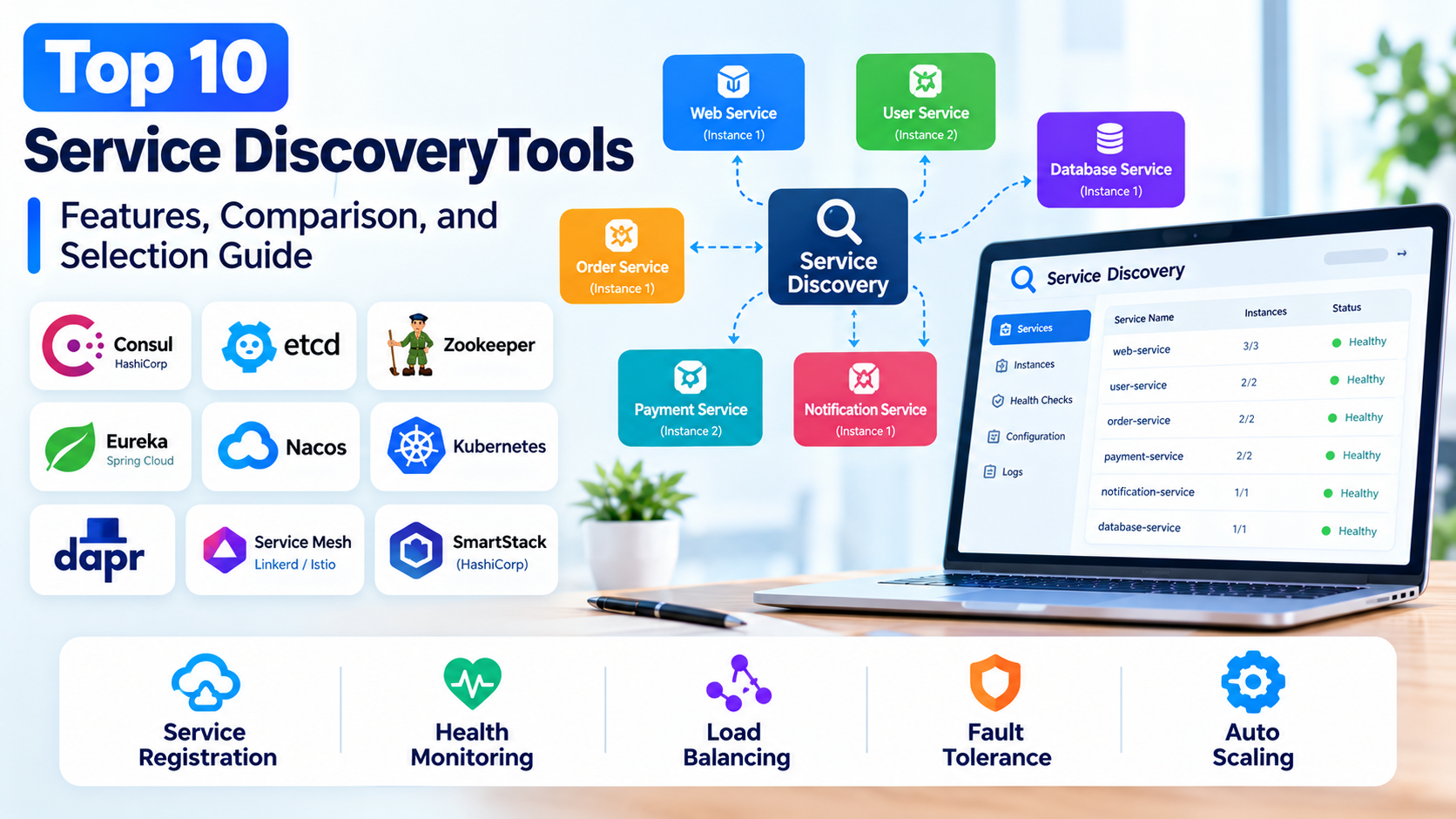
This guide examines ten service discovery technologies, their capabilities, advantages, limitations, and ideal use cases.
It also explains how to choose a discovery approach for microservices, Kubernetes, hybrid cloud, and distributed enterprise infrastructure.
1. What Are Service Discovery Tools?
Service discovery tools help applications identify the network locations of other services.
Instead of storing fixed IP addresses or server names in application code, a service can use a registry, DNS interface, or discovery API to locate available destinations.
How Service Discovery Works
A typical service discovery workflow includes:
- A service instance starts.
- The instance or its infrastructure registers its address and metadata.
- A discovery system records the service information.
- Health monitoring or orchestration state identifies available instances.
- A client requests the location of a service.
- The discovery system returns suitable connection information.
- The client or an intermediary routes traffic to a selected instance.
- Registration information changes as services scale or terminate.
Not every platform follows this exact process. Kubernetes, for example, manages service endpoints through orchestration resources rather than requiring every application to register itself with an external registry.
Client-Side Service Discovery
With client-side discovery, an application queries a registry and chooses a service instance.
This approach provides flexibility but introduces discovery logic into the application or its supporting libraries.
Server-Side Service Discovery
With server-side discovery, a load balancer, proxy, or gateway resolves the available destinations.
Applications communicate with a stable entry point rather than selecting individual backend instances themselves.
DNS-Based Discovery
DNS-based discovery allows applications to resolve service names into network addresses.
It is especially common in container orchestration platforms and cloud infrastructure.
Why Service Discovery Matters
Service discovery supports dynamic scaling, infrastructure automation, service resilience, and distributed application management.
However, discovery alone does not guarantee successful communication.
Organizations must also consider load balancing, timeouts, retries, network security, and service health.
2. Top 10 Service Discovery Tools
1. HashiCorp Consul
Best For: Multi-cloud service discovery and hybrid infrastructure.
Overview
HashiCorp Consul is a service networking platform that provides service discovery, health checking, and related networking capabilities.
It is designed for environments where applications run across virtual machines, containers, and multiple infrastructure platforms.
Consul maintains a service catalog containing information about registered services and their locations.
Applications and infrastructure components can query this information through supported interfaces, including DNS and APIs.
For example, an enterprise operating applications in two data centers can use Consul to register internal services and help applications locate healthy instances.
Consul is particularly valuable when infrastructure spans several environments that do not share one native discovery system.
The platform also provides service mesh capabilities for organizations that need additional service-to-service networking controls.
These capabilities can include secure communication and traffic management when the appropriate components are deployed.
Key Features
- Service registration and discovery.
- DNS and API interfaces.
- Health checking.
- Service catalog management.
- Multi-data-center support.
- Hybrid infrastructure integration.
- Service mesh capabilities.
- Access controls and secure communication options.
Advantages
Consul provides a platform-independent discovery approach.
It is particularly useful when organizations operate services across virtual machines, containers, and cloud environments.
Its health-aware catalog can help clients avoid unavailable service instances.
Limitations
Production deployments require careful planning for cluster availability, security, and monitoring.
Service mesh capabilities introduce additional operational components.
Ideal Users
Enterprise platform teams, hybrid-cloud organizations, and companies managing distributed applications.
2. Kubernetes Service Discovery
Best For: Native service discovery within Kubernetes clusters.
Overview
Kubernetes provides built-in mechanisms for discovering services running inside a cluster.
Applications can communicate through Kubernetes Service resources rather than depending directly on individual Pod addresses.
A Service provides a stable logical endpoint while the underlying application instances change.
Kubernetes maintains information about the backend endpoints associated with the Service.
Cluster DNS allows applications to resolve service names.
For example, a frontend application can connect to an internal payments Service using its configured DNS name.
When payment Pods are replaced or scaled, the frontend does not need to maintain a list of individual Pod addresses.
Kubernetes service discovery is especially attractive because it is integrated into the orchestration platform.
Organizations generally do not need to introduce an independent service registry for basic communication between workloads in one cluster.
Key Features
- Native Service resources.
- Cluster DNS integration.
- Dynamic endpoint management.
- Service name resolution.
- Integration with Pod readiness.
- Internal service networking.
- Namespace-aware service names.
- Compatibility with Kubernetes networking components.
Advantages
Kubernetes service discovery requires relatively little additional infrastructure for applications already running in Kubernetes.
It integrates directly with workload scheduling and scaling.
Limitations
Native discovery is primarily scoped to Kubernetes environments.
Cross-cluster and external service discovery may require additional networking technologies.
Ideal Users
Kubernetes administrators, cloud-native developers, and platform teams operating containerized applications.
3. CoreDNS
Best For: DNS-based service discovery and customizable cluster DNS.
Overview
CoreDNS is an extensible DNS server commonly used for service name resolution in Kubernetes.
It is a critical component in many Kubernetes clusters because applications rely on DNS names to locate internal services.
CoreDNS uses a plugin-based architecture that allows administrators to customize DNS behavior.
For example, a Kubernetes application may request the address of an internal inventory service.
CoreDNS can resolve the service name using information supplied through its Kubernetes integration.
CoreDNS can also support DNS forwarding, caching, and other name-resolution workflows.
Its value extends beyond Kubernetes because it can operate as a general-purpose DNS server.
However, CoreDNS should not be confused with a complete service registry.
In Kubernetes, it commonly exposes service information maintained by the orchestration platform rather than independently managing every service registration.
Key Features
- DNS-based service discovery.
- Kubernetes integration.
- Plugin-based architecture.
- DNS forwarding.
- DNS caching.
- Configurable resolution policies.
- Custom DNS behavior.
- Lightweight deployment options.
Advantages
CoreDNS is flexible and integrates naturally with Kubernetes.
Its plugin architecture supports specialized DNS requirements.
Limitations
CoreDNS primarily provides name resolution rather than a complete service lifecycle management system.
Incorrect DNS configuration can affect communication across many applications.
Ideal Users
Kubernetes platform engineers, infrastructure administrators, and teams managing internal DNS.
4. Netflix Eureka
Best For: Service discovery in Spring-based microservices applications.
Overview
Netflix Eureka is a service registry technology associated with the Netflix OSS ecosystem.
It is commonly encountered in Java and Spring Cloud microservices architectures.
Eureka allows application instances to register themselves and enables clients to discover available service instances.
For example, a Java-based order service can query Eureka to locate instances of an inventory service.
This avoids hardcoding individual server addresses into application configuration.
Eureka is particularly relevant to architectures using client-side service discovery.
Applications or supporting libraries can retrieve instance information and apply their own load balancing logic.
Eureka uses registration and renewal mechanisms to maintain service availability information.
Organizations should evaluate its maintenance status, framework compatibility, and operational fit before adopting it for a new platform.
Key Features
- Service registration.
- Client-side discovery.
- Service registry APIs.
- Instance renewal mechanisms.
- Integration with Spring ecosystems.
- Multi-instance service lookup.
- Distributed registry deployment options.
- Application-level discovery patterns.
Advantages
Eureka fits established Spring-based microservices architectures.
It provides a recognizable registration and discovery model for Java development teams.
Limitations
It is less platform-neutral than some infrastructure-oriented discovery systems.
Registry health information may not always represent complete application readiness.
Ideal Users
Java developers, Spring Cloud teams, and organizations maintaining Eureka-based applications.
5. etcd
Best For: Building custom service discovery and distributed coordination systems.
Overview
etcd is a distributed key-value store designed for reliable configuration and coordination data.
It is widely known as a core data storage component in Kubernetes control-plane architectures.
Although etcd is not a turnkey service discovery platform, it can serve as a foundation for custom discovery systems.
Applications can store service registration information as key-value records.
Other components can query or watch those records to detect changes.
For example, a custom infrastructure platform might store service endpoints in etcd and update clients when registrations change.
etcd supports leases, watches, and transactional operations that are useful for distributed coordination.
However, organizations must build or integrate the application-level logic that converts these capabilities into a complete service discovery workflow.
Key Features
- Distributed key-value storage.
- Consistent data operations.
- Watch APIs.
- Lease mechanisms.
- Transaction support.
- Cluster replication.
- TLS and authentication capabilities.
- Distributed coordination primitives.
Advantages
etcd provides strong foundations for reliable distributed state management.
It is useful when platform teams need direct control over custom service registration behavior.
Limitations
It is not a complete ready-made service discovery product.
Teams must implement registration, health evaluation, lookup, and operational policies themselves.
Ideal Users
Infrastructure developers, platform engineering teams, and organizations building custom orchestration systems.
6. Apache ZooKeeper
Best For: Distributed coordination and custom service registration.
Overview
Apache ZooKeeper is a distributed coordination service used by applications that require shared state and coordination across multiple nodes.
It provides hierarchical data structures and mechanisms for monitoring changes.
These capabilities can support service discovery when applications create registration records and clients watch for updates.
For example, a distributed processing platform can use ZooKeeper to maintain information about active worker nodes.
When a worker disconnects and its session expires, the associated ephemeral registration can disappear.
Other components can then update their view of available workers.
ZooKeeper is especially relevant to established distributed systems that already depend on it for coordination.
However, it is not a dedicated modern service discovery interface for every application architecture.
Key Features
- Distributed coordination.
- Hierarchical data storage.
- Ephemeral nodes.
- Change notifications.
- Session management.
- Consistent coordination operations.
- Access controls.
- Cluster deployment support.
Advantages
ZooKeeper offers established coordination primitives.
It can support discovery requirements in systems already using its ecosystem.
Limitations
Applications must implement discovery-specific behavior.
Operational complexity and coordination semantics require careful understanding.
Ideal Users
Distributed systems engineers, infrastructure teams, and organizations maintaining ZooKeeper-based platforms.
7. AWS Cloud Map
Best For: Managed service discovery within AWS environments.
Overview
AWS Cloud Map is a managed service discovery technology that helps applications locate cloud resources and services.
It is particularly useful for applications running on AWS infrastructure.
Organizations can define service namespaces and register instances with associated attributes.
Applications can discover those instances using supported DNS or API mechanisms.
For example, an application running in Amazon ECS can use AWS Cloud Map integrations to locate internal services.
This reduces the need to maintain static service endpoint lists.
Cloud Map is also useful when organizations want discovery metadata associated with their AWS resources.
Its managed approach reduces the infrastructure maintenance associated with operating a separate service registry.
Key Features
- Managed service registry.
- DNS-based discovery.
- API-based discovery.
- Service instance attributes.
- AWS infrastructure integration.
- Namespace management.
- Health-related discovery options.
- Cloud resource discovery capabilities.
Advantages
AWS Cloud Map integrates with AWS service architectures.
It can simplify discovery for applications already using AWS networking and container services.
Limitations
Its strongest integration is within the AWS ecosystem.
Organizations should review service quotas, API behavior, DNS caching, and health-check limitations.
Ideal Users
AWS architects, ECS developers, and cloud infrastructure teams.
8. Nacos
Best For: Microservices service discovery and centralized configuration management.
Overview
Nacos is an open-source platform designed to support service discovery and dynamic configuration management.
It is commonly associated with Java microservices and cloud-native application ecosystems.
Nacos allows services to register their locations and provides mechanisms for clients to discover available instances.
It also supports configuration management, allowing applications to retrieve centrally maintained settings.
For example, a business operating several Java microservices can use Nacos to manage service registration and application configuration.
This combination can reduce the number of separate infrastructure components required for selected architectures.
Nacos is especially relevant to organizations already using frameworks and technologies that integrate with its ecosystem.
Key Features
- Service registration.
- Service discovery.
- Health-related instance management.
- Dynamic configuration.
- Service metadata.
- Naming services.
- API-based management.
- Microservices framework integration.
Advantages
Nacos combines discovery and configuration management.
It can simplify selected Java microservices deployments.
Limitations
Teams should verify client compatibility and deployment requirements.
Operating a reliable Nacos cluster requires monitoring, security configuration, and upgrade planning.
Ideal Users
Java microservices developers, cloud-native teams, and organizations using compatible application frameworks.
9. Serf
Best For: Lightweight cluster membership and decentralized service awareness.
Overview
Serf is a decentralized cluster membership and event propagation technology.
It is designed to help distributed nodes discover one another and exchange membership information.
Serf uses gossip-based communication to share information about participating nodes.
For example, a distributed application cluster can use Serf to track which machines have joined or left the environment.
Applications can respond to membership events and update their internal view of available resources.
Serf is particularly useful when organizations need decentralized cluster awareness without operating a conventional centralized registry.
However, cluster membership should not be confused with complete application-level service discovery.
Additional logic is often required to map nodes to specific services and verify application readiness.
Key Features
- Gossip-based membership.
- Decentralized node discovery.
- Membership event propagation.
- Failure detection mechanisms.
- Custom event support.
- Lightweight agent operation.
- Distributed cluster awareness.
- Integration with custom automation.
Advantages
Serf provides a decentralized approach to node membership.
It can be useful for specialized distributed infrastructure.
Limitations
It does not provide every capability of a full service registry.
Application health checking, service metadata, and routing behavior may require additional components.
Ideal Users
Distributed systems developers, infrastructure engineers, and teams building custom cluster management platforms.
10. Eureka-Compatible Spring Cloud Discovery
Best For: Application-level discovery abstractions in Spring microservices.
Overview
Spring Cloud provides service discovery abstractions that allow Spring applications to interact with compatible discovery implementations.
Rather than representing a completely independent registry server, Spring Cloud Discovery provides application-side integration patterns.
These abstractions can help developers reduce coupling between application logic and a specific discovery provider.
For example, a Spring-based application can use discovery-aware client components to locate service instances without embedding individual IP addresses.
Depending on the selected implementation, the application may integrate with Eureka, Consul, Kubernetes, or another supported discovery mechanism.
This approach is useful for development teams that want discovery behavior integrated into their Java application framework.
It also allows developers to combine discovery with other Spring Cloud networking components.
Key Features
- Service discovery client abstractions.
- Spring application integration.
- Discovery-aware service lookup.
- Support for compatible registry implementations.
- Integration with client-side load balancing.
- Framework-based configuration.
- Microservices development support.
- Application-level discovery patterns.
Advantages
Spring Cloud Discovery can simplify service lookup in Spring applications.
It allows teams to use familiar application development patterns.
Limitations
It is not a standalone service registry.
Its capabilities depend on the selected discovery provider and compatible framework versions.
Ideal Users
Spring developers, Java microservices teams, and organizations standardizing application-level discovery integrations.
3. Service Discovery Tools Comparison Table
| Tool | Best For | Discovery Approach | Primary Consideration |
|---|---|---|---|
| HashiCorp Consul | Hybrid infrastructure | Registry, DNS, API | Cluster operations |
| Kubernetes Service Discovery | Kubernetes workloads | Native Services and DNS | Cluster scope |
| CoreDNS | DNS resolution | DNS-based | Not a standalone registry |
| Netflix Eureka | Spring microservices | Client-side registry | Framework compatibility |
| etcd | Custom platforms | Key-value coordination | Custom implementation |
| Apache ZooKeeper | Distributed coordination | Ephemeral registrations | Operational complexity |
| AWS Cloud Map | AWS workloads | Managed DNS and API | AWS dependency |
| Nacos | Java microservices | Registry and configuration | Ecosystem compatibility |
| Serf | Cluster membership | Gossip protocol | Limited service semantics |
| Spring Cloud Discovery | Spring applications | Client abstraction | Requires discovery backend |
The comparison includes complete discovery systems, supporting infrastructure, and application integration technologies. They are not interchangeable products, and some are designed to work together.
4. How to Choose the Right Service Discovery Tool
Understand the Infrastructure Environment
Start by identifying where applications run.
Kubernetes workloads often benefit from native service discovery.
Applications spread across virtual machines and cloud providers may require a platform-independent registry.
AWS-centered applications may benefit from AWS Cloud Map.
Select the Discovery Model
Determine whether applications should query a registry directly or communicate through a stable proxy or load balancer.
Client-side discovery can provide flexibility but requires application integration.
Server-side discovery can simplify application behavior by centralizing routing decisions.
Evaluate Health Awareness
A registry entry does not necessarily mean that an application is ready to serve requests.
Review how the platform identifies unhealthy instances and removes them from discovery results.
Consider Availability Requirements
Service discovery infrastructure can become critical to application communication.
Evaluate clustering, replication, failure recovery, and behavior during registry outages.
Review DNS and Caching Behavior
DNS caching can delay the visibility of service changes.
Understand time-to-live settings, client caching behavior, and how stale addresses are handled.
Evaluate Security
Service registries may reveal sensitive infrastructure information.
Assess authentication, access controls, encrypted communication, and network isolation.
Consider Scale
Review the expected number of services, instances, registration changes, and discovery queries.
Large environments may require careful tuning and architectural planning.
Assess Operational Complexity
Managed services reduce infrastructure maintenance but may introduce platform dependency.
Self-managed systems offer control but require monitoring, upgrades, backup, and recovery planning.
5. Practical Example: Service Discovery for an Online Shopping Platform
Consider an online retailer using separate microservices for:
- Customer authentication.
- Product catalogs.
- Shopping carts.
- Payments.
- Inventory.
- Order processing.
- Shipping updates.
The company deploys these applications in Kubernetes.
Each service may have multiple instances, and the number of instances changes according to demand.
Step 1: Define Service Boundaries
The engineering team identifies the responsibilities and communication requirements of each microservice.
Step 2: Create Kubernetes Services
Each application receives an appropriate Kubernetes Service resource.
Step 3: Configure DNS-Based Communication
Applications use stable internal service names instead of individual Pod addresses.
Step 4: Configure Readiness Checks
Kubernetes uses readiness information to determine whether application endpoints should receive eligible traffic.
Step 5: Test Dynamic Scaling
The team increases the number of inventory service instances and verifies that communication continues.
Step 6: Simulate Instance Failures
Engineers terminate selected application instances and observe endpoint updates and client behavior.
Step 7: Configure Timeouts and Retries
Applications use appropriate network timeouts and carefully designed retry policies.
Step 8: Monitor Service Communication
Dashboards track application errors, request latency, DNS performance, and endpoint availability.
Step 9: Evaluate External Services
If the retailer later connects applications running outside Kubernetes, the team evaluates whether Consul or another discovery integration is necessary.
This architecture allows application instances to change without requiring every dependent service to maintain static server addresses.
6. Benefits and Challenges of Service Discovery Tools
Major Benefits
Dynamic infrastructure support: Applications can locate services as instances change.
Reduced hardcoded configuration: Developers avoid maintaining fixed backend address lists.
Improved scaling: New application instances can become discoverable through supported registration mechanisms.
Operational flexibility: Services can move between infrastructure resources with less manual reconfiguration.
Microservices integration: Distributed applications can communicate through stable service identities.
Infrastructure automation: Discovery can integrate with orchestration and deployment workflows.
Common Challenges
Registry availability: Discovery failures can affect application communication.
Stale information: Cached records may point toward unavailable instances.
Health-check limitations: Basic health signals may not represent full application readiness.
Network complexity: Service discovery does not eliminate routing, firewall, or connectivity problems.
Security exposure: Registries can reveal internal service locations and metadata.
Operational overhead: Self-managed discovery clusters require maintenance and recovery planning.
7. Frequently Asked Questions
What is the best service discovery tool?
HashiCorp Consul is useful for hybrid infrastructure, while Kubernetes native discovery is often sufficient for applications running within one Kubernetes cluster. AWS Cloud Map is a managed option for AWS workloads.
What is service discovery in microservices?
Service discovery allows microservices to locate available instances of other services without relying on permanently configured network addresses.
Does Kubernetes provide service discovery?
Yes. Kubernetes provides native service discovery through Service resources and cluster DNS.
What is the difference between Consul and Eureka?
Consul provides infrastructure-oriented service discovery across multiple environments. Eureka is associated with application-level discovery, particularly in Java and Spring architectures.
Is CoreDNS a service registry?
Not by itself. CoreDNS provides DNS resolution and can expose service information maintained by Kubernetes or other supported systems.
Can service discovery improve availability?
It can help applications locate healthy instances, but availability also depends on networking, routing, application design, and infrastructure redundancy.
What is client-side service discovery?
Client-side discovery occurs when an application retrieves service instance information and selects a destination itself.
What is server-side service discovery?
Server-side discovery uses an intermediary, such as a proxy or load balancer, to resolve destinations on behalf of clients.
Can service discovery work across multiple clouds?
Yes. Platforms such as Consul can support discovery across different infrastructure environments when properly configured.
Is service discovery the same as a service mesh?
No. Service discovery identifies service locations. A service mesh provides additional communication management capabilities, often including traffic policies, security, and observability.
8. Conclusion
Service discovery tools help distributed applications communicate reliably as infrastructure changes.
HashiCorp Consul provides broad service networking capabilities for hybrid and multi-cloud environments.
Kubernetes Service Discovery and CoreDNS support service name resolution within container orchestration environments.
Netflix Eureka and Spring Cloud Discovery are relevant to Java microservices architectures.
etcd and Apache ZooKeeper provide coordination primitives that can support custom discovery systems.
AWS Cloud Map offers managed discovery for AWS workloads, while Nacos combines service registration with configuration management.
Serf supports decentralized cluster membership and specialized infrastructure automation.
The right choice depends on deployment architecture, discovery requirements, health monitoring, security, and operational capabilities.
Organizations should also evaluate failure handling, DNS caching, client behavior, and registry availability.
A well-designed service discovery strategy reduces manual configuration and provides a more adaptable foundation for modern distributed applications.