A factory machine starts to vibrate more than usual. Its temperature rises, but production continues. A traditional monitoring system may show two warning signals. A digital twin can place those signals in context by connecting them to a model of the machine, its operating history, and its expected behavior.
That difference matters. A useful digital twin does more than display a 3D model. It helps teams understand what is happening, explore why it is happening, and decide what to do next.
Digital twin platforms support these tasks across manufacturing, energy, buildings, infrastructure, and other industries. However, not every platform solves the same problem. Some focus on industrial data. Others specialize in engineering simulation, connected assets, or large-scale virtual environments.
This guide explains the main approaches, compares important platforms, and shows how to evaluate them.
What Makes a Digital Twin Different?
A digital twin is a digital representation of a physical asset, system, or process that stays connected to relevant real-world information.
A simple digital model may describe a machine’s design. A digital shadow may receive operating data from that machine. A more advanced digital twin can combine data, behavior models, and analysis to support decisions.
The level of sophistication varies. Not every digital twin requires a detailed 3D model, artificial intelligence, or real-time simulation.
Consider a wind turbine. Its digital twin might combine:
- Sensor readings for temperature, vibration, and power output.
- Maintenance records and component specifications.
- Weather conditions and operating loads.
- Engineering models that estimate component behavior.
- Alerts when actual performance differs from expectations.
The purpose is not to create a visually impressive copy. It is to make the physical system easier to understand and manage.
The Main Types of Digital Twin Platforms
Asset-centered platforms
These platforms organize information around individual assets, such as pumps, turbines, robots, or vehicles.
They are useful when the goal is condition monitoring, maintenance planning, or asset performance analysis.
System and process twins
A system twin represents how several assets work together.
For example, a factory production line may need models of machine capacity, material flow, downtime, and operating schedules.
These twins can help teams investigate bottlenecks and test changes before making them.
Engineering simulation twins
Simulation-driven twins use mathematical or physics-based models to estimate how equipment behaves.
They are particularly useful when sensor data alone cannot explain a problem or predict a system’s response to new conditions.
Spatial and visual twins
These platforms connect digital information to 3D environments, buildings, industrial facilities, or geographic spaces.
They are valuable when the physical location and relationships between assets are important.
Digital Twin Platforms Worth Evaluating
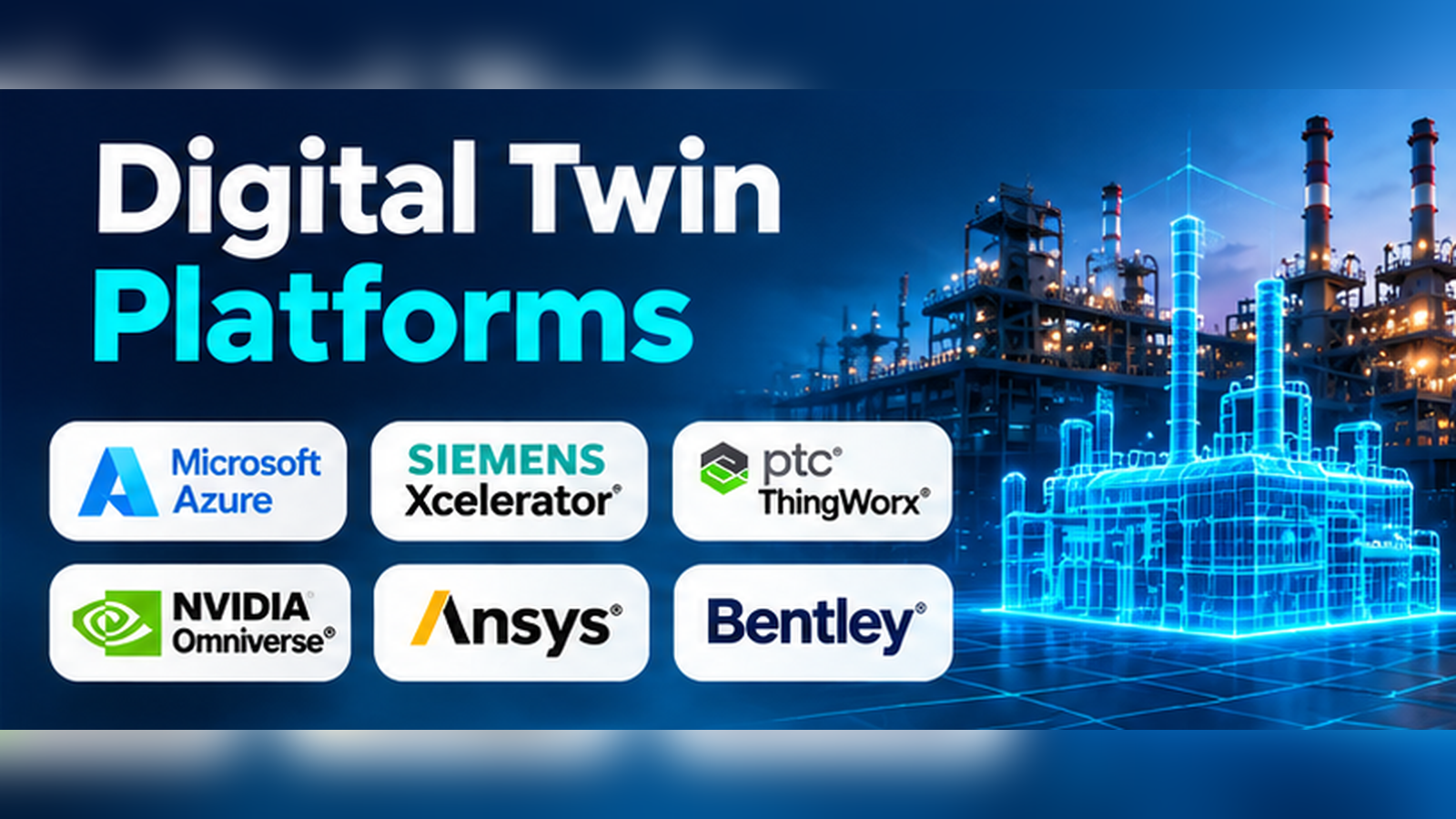
The following platforms represent different parts of the digital twin market. They should not be treated as interchangeable products.
1. Azure Digital Twins
Microsoft Azure Digital Twins helps developers build models of connected environments.
Its graph-based approach represents entities and their relationships. A building, for example, can contain floors, rooms, equipment, and sensors.
The Digital Twins Definition Language (DTDL) supports structured models of these entities.
Where it fits: Connected buildings, industrial environments, and custom applications that need a relationship-based digital model.
Important strengths:
- Models relationships between assets and spaces.
- Supports event-driven application architectures.
- Works with other Azure services for ingestion, storage, analytics, and visualization.
Trade-offs: Azure Digital Twins is not a complete simulation or visualization package. Teams must design the broader application, data pipeline, and user experience.
It is a strong candidate when an organization wants a flexible digital twin foundation rather than a finished industrial application.
Official website: https://azure.microsoft.com/products/digital-twins
2. AWS IoT TwinMaker
AWS IoT TwinMaker helps developers create digital representations of physical systems by connecting data sources and visual components.
It can bring operational information into a common environment and associate that information with equipment or spatial scenes.
Where it fits: Industrial monitoring applications and connected environments already using AWS.
Its value comes from connecting existing data sources instead of requiring every operational record to move into one new database.
However, implementation still requires data modeling, integration work, and a suitable visualization layer.
Organizations should verify current service availability, regional support, and the long-term product roadmap before committing to a new deployment.
Official website: https://aws.amazon.com/iot-twinmaker/
3. Siemens Digital Twin Technologies
Siemens offers digital twin capabilities across engineering design, manufacturing, simulation, and industrial operations.
Products in the Siemens Xcelerator portfolio can support different stages of the product and production lifecycle.
For example, engineering teams may use simulation to evaluate a product before manufacturing. Production teams may use manufacturing software to plan and validate processes.
Where it fits: Complex industrial engineering and manufacturing environments.
The main advantage is the connection between engineering models and operational workflows.
The challenge is scope. Siemens does not offer one universal product that replaces every digital twin component. Buyers must identify which applications, licenses, integrations, and services their use case requires.
Official website: https://www.siemens.com/
4. Ansys Twin Builder
Ansys Twin Builder focuses on simulation-based digital twins.
It helps engineers develop reduced-order and system-level models that can represent physical behavior without always running a full, computationally expensive simulation.
Where it fits: Engineering teams working with complex equipment, electronics, energy systems, and other physics-intensive applications.
A physics-based model can be useful when engineers need to examine conditions outside the range of historical sensor readings.
The trade-off is model development effort. Reliable results depend on suitable engineering assumptions, validation data, and ongoing model maintenance.
Official website: https://www.ansys.com/
5. Bentley iTwin Platform
Bentley’s iTwin technology focuses on infrastructure digital twins.
It can connect engineering information, asset data, and 3D infrastructure representations.
Where it fits: Roads, bridges, railways, utilities, buildings, and other infrastructure projects.
Infrastructure teams often work with many design files, revisions, and asset information systems. A connected digital environment can make those relationships easier to understand.
The main evaluation questions concern supported engineering formats, data synchronization, project scale, and integration with existing asset management tools.
Official website: https://www.bentley.com/
6. NVIDIA Omniverse
NVIDIA Omniverse is a platform for developing and connecting 3D applications and simulation workflows.
It supports workflows built around OpenUSD and can be used in industrial visualization, robotics simulation, and physical AI development.
Where it fits: Teams that need sophisticated 3D environments, simulation, and visual collaboration.
Omniverse is especially relevant when spatial accuracy, scene composition, and visual simulation are central to the project.
It is not a substitute for every asset management or industrial data platform. Organizations may need to connect it to separate systems for telemetry, business logic, and operational records.
Official website: https://www.nvidia.com/omniverse/
7. PTC ThingWorx
PTC ThingWorx is an industrial IoT platform that supports connected-product and industrial application development.
It can provide an application foundation for monitoring assets, managing operational data, and supporting service workflows.
Where it fits: Industrial organizations developing connected equipment and service applications.
Its practical appeal is the ability to connect asset data with business applications.
However, organizations should assess integration complexity, application customization, deployment requirements, and ongoing administration.
Official website: https://www.ptc.com/
Comparing the Platforms by Primary Purpose
| Platform | Primary emphasis | Suitable scenario |
|---|---|---|
| Azure Digital Twins | Relationship-based digital models | Connected buildings and custom applications |
| AWS IoT TwinMaker | Connected operational data and visual environments | AWS-based industrial applications |
| Siemens technologies | Engineering and manufacturing lifecycle | Industrial design and production |
| Ansys Twin Builder | Physics-based simulation | Engineering analysis and predictive models |
| Bentley iTwin | Infrastructure information and visualization | Civil infrastructure and asset management |
| NVIDIA Omniverse | 3D environments and simulation | Industrial visualization and robotics |
| PTC ThingWorx | Industrial IoT applications | Connected products and equipment |
The table shows each platform’s main orientation. It does not establish a performance ranking.
What to Evaluate Before Buying
Start with a business decision
A digital twin project should begin with a specific question.
For example:
- Can we detect equipment problems earlier?
- Can we reduce unplanned downtime?
- Can we evaluate production changes safely?
- Can we improve energy use?
- Can maintenance teams find the right asset information faster?
A project without a measurable decision or workflow may become an expensive visualization exercise.
Examine data availability
Digital twins depend on useful data.
Check whether sensors provide reliable readings, whether historical records are complete, and whether different systems use consistent asset identifiers.
Missing data can limit the value of even sophisticated simulation software.
Test model accuracy
A simulation should be checked against observed behavior.
Teams should document the conditions under which a model is valid, how uncertainty is handled, and when recalibration is required.
Understand the full cost
Platform subscriptions are only part of the expense.
Other costs may include:
- Sensor installation and connectivity.
- Cloud computing and data storage.
- Engineering model development.
- Integration with operational systems.
- Cybersecurity controls.
- Training and ongoing support.
A realistic budget must include implementation and maintenance, not only software licensing.
A Practical Digital Twin Implementation Plan
Consider a manufacturer that wants to reduce unexpected pump failures.
Step 1: Define the target. Select a measurable outcome, such as reducing avoidable equipment downtime.
Step 2: Choose a limited asset group. Start with a few pumps rather than the entire factory.
Step 3: Review available data. Identify sensor readings, maintenance history, and equipment specifications.
Step 4: Build the model. Represent the equipment and the relationships needed for analysis.
Step 5: Connect operational data. Establish secure ingestion, validation, and monitoring.
Step 6: Validate insights. Compare model outputs with actual operating conditions and maintenance findings.
Step 7: Integrate decisions. Connect useful alerts or recommendations to the maintenance workflow.
Step 8: Expand carefully. Scale only after the pilot demonstrates practical value.
This approach reduces risk and makes it easier to identify where the platform provides measurable benefits.
Security and Governance Considerations
Digital twins may connect operational technology, cloud systems, engineering data, and business applications.
That creates important security responsibilities.
Organizations should evaluate access controls, network segmentation, encryption, audit logging, and data retention policies.
Industrial environments also require care when connecting monitoring systems to equipment control networks.
A digital twin should not receive permission to change physical processes unless that capability is necessary, tested, and governed by appropriate safety controls.
When a Digital Twin Is Not Necessary
Not every monitoring problem needs a digital twin.
A simple dashboard may be sufficient when users only need to see temperature, pressure, or equipment status.
Traditional analytics may be more cost-effective when the goal is to analyze historical performance.
A digital twin becomes more compelling when relationships, behavior models, simulation, or continuous feedback materially improve decisions.
Frequently Asked Questions
Is a digital twin the same as a 3D model?
No. A 3D model represents geometry or appearance. A digital twin connects a digital representation to information about a physical system and may include behavior models and analytics.
Do digital twins require IoT sensors?
Not always. They can use information from enterprise systems, manual updates, engineering models, or other sources. Sensors are especially useful for frequently updated operational twins.
Can small businesses use digital twin technology?
Yes, but project scope matters. A focused asset monitoring or simulation project may be practical. A large enterprise platform may be unnecessary for a small operation.
Are digital twins always real-time?
No. Update frequency depends on the use case. Some applications require rapid updates, while others work with hourly, daily, or event-based information.
Which digital twin platform is best?
There is no universal winner. The right choice depends on whether the priority is engineering simulation, infrastructure, connected assets, operational data, or 3D visualization.
Conclusion
Digital twin platforms can connect physical operations with models, data, and analysis. Their value comes from improving decisions, not simply creating digital replicas.
Azure Digital Twins and AWS IoT TwinMaker are relevant for custom connected environments. Siemens and Ansys support engineering-centered workflows. Bentley focuses on infrastructure, NVIDIA Omniverse emphasizes 3D simulation, and PTC ThingWorx supports industrial IoT applications.
The strongest starting point is a narrow problem, reliable data, and a measurable result. Once a digital twin proves useful in a real workflow, expanding it becomes a much more informed decision.