Sugary drinks are one of the easiest sources of calories to consume without feeling full. Regular intake of sugar-sweetened beverages is associated with unhealthy weight gain and poorer metabolic health, while replacing them with water or other unsweetened drinks can reduce both sugar and calorie intake. The World Health Organization recommends limiting free sugars, and the CDC identifies water, sparkling water, plain coffee and unsweetened tea as healthier drink choices. (World Health Organization)
But there is an important catch: “no sugar” does not automatically mean “healthy.” A heavily caffeinated energy drink or artificially sweetened soda may contain no sugar, yet it is not necessarily an ideal everyday beverage. For this ranking, priority is given to drinks that are:
- Unsweetened rather than artificially sweetened
- Zero or extremely low in calories
- Suitable for regular hydration
- Free from unnecessary stimulants and additives
- Easy to find in Japan and other countries
- Supported by credible nutrition or public-health guidance
The WHO advises against relying on non-sugar sweeteners for long-term weight control. Its recommendation is conditional and does not apply in the same way to people with existing diabetes, but the broader takeaway is sensible: gradually becoming comfortable with less sweetness is preferable to replacing every sugary drink with an intensely sweet “zero” version. (World Health Organization)
The healthiest no-sugar drinks at a glance
| Rank | Drink | Sugar when unsweetened | Caffeine | Best use |
|---|---|---|---|---|
| 1 | Plain mineral water | 0 g | None | Everyday hydration |
| 2 | Unsweetened sparkling water | 0 g | None | Replacing soda |
| 3 | Unsweetened green tea | 0 g | Yes | Daily tea and meals |
| 4 | Suntory Tokucha Premium | Labelled 0 g carbohydrate | 80 mg per 500 ml | Japan-specific functional tea |
| 5 | Barley tea—mugicha | 0 g | Normally none | All-day, caffeine-free drinking |
| 6 | Unsweetened oolong tea | 0 g | Yes | With meals |
| 7 | Rooibos tea | 0 g | None | Evening and caffeine avoidance |
| 8 | Unsweetened herbal tea | 0 g | Usually none | Relaxation and variety |
| 9 | Black coffee | 0 g | Yes | Morning focus |
| 10 | Lightly infused water | Approximately 0 g | None | Making water more appealing |
These values apply only to plain, unsweetened versions. Bottled teas, canned coffees and flavoured waters can contain added sugar even when the basic drink normally does not. The American Diabetes Association specifically identifies water, unsweetened tea, unsweetened coffee, sparkling water and no-added-sugar infused water as zero- or low-calorie choices.
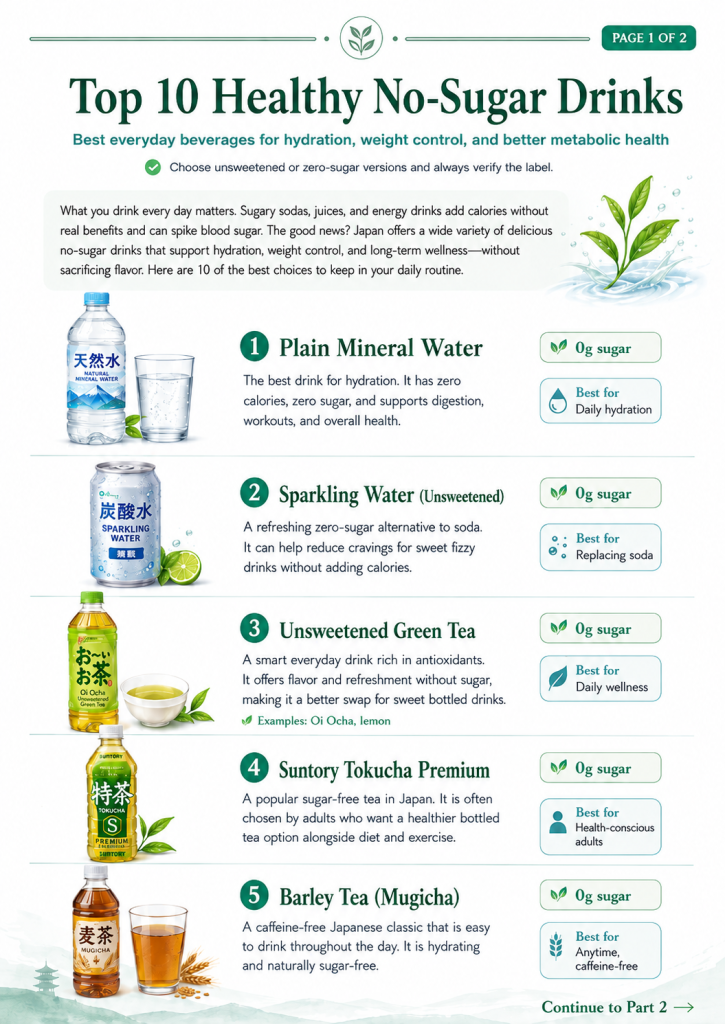
1. Plain mineral water
Best overall healthy drink
Water takes first place because it performs the most important job of a beverage without adding sugar, calories, caffeine or unnecessary ingredients.
Adequate water intake supports normal temperature regulation, joint lubrication, waste removal and the prevention of dehydration. Replacing a caloric drink with water also reduces total calorie intake without requiring changes to the rest of the meal. (CDC)
Tap water, filtered water and unsweetened bottled mineral water can all be good choices when the local supply is safe. Mineral water may contain small amounts of calcium, magnesium or sodium, but these amounts vary by brand. It should not be treated as a mineral supplement.
Choose it when:
- You are thirsty
- You are walking or doing a normal gym workout
- You want something with meals
- You need a dependable drink throughout the day
Watch out for: Bottles labelled “water drink,” “vitamin water” or “flavoured water.” Some contain sugar, syrup or sweeteners and are not equivalent to plain water.
2. Unsweetened sparkling water
Best replacement for soda
Plain sparkling water offers the bubbles and cold refreshment of soda without its sugar or calories. It is particularly useful for people who find ordinary water boring or who miss carbonated soft drinks.
The CDC includes sparkling water and seltzer among healthier low- or no-calorie beverage choices. (CDC)
Look for a short ingredient list such as:
Carbonated water
Water and carbon dioxide
炭酸水
Flavoured varieties can also be suitable when they contain no sugar, syrup or sweetener.
Good Japanese choices include: plain Wilkinson Tansan and other products clearly marked 無糖.
Do not confuse sparkling water with:
- Tonic water, which commonly contains sugar or sweetener
- Ramune or soda
- Sweetened lemon soda
- Energy drinks with carbonation
- Alcoholic sparkling beverages
3. Unsweetened green tea
Best tea for everyday wellness
Green tea provides flavour without sugar and contains naturally occurring tea polyphenols. It also contains caffeine, although usually less than coffee.
Green, black, white and oolong tea all come from the Camellia sinensis plant. Human evidence regarding dramatic disease-prevention or weight-loss effects remains mixed, so green tea should be viewed as a healthy unsweetened beverage—not as medicine or a fat-burning shortcut. NCCIH reports that green-tea beverages are generally safe for adults, while concentrated extracts require more caution. (NCCIH)
Popular unsweetened options in Japan include:
- Oi Ocha—お〜いお茶
- Iemon—伊右衛門
- Ayataka—綾鷹
- Unsweetened sencha
- Unsweetened bottled matcha blends
Check that the nutrition panel shows no sugar or carbohydrate and that the ingredients do not include sugar, fructose, syrup or honey.
Best time: Morning, afternoon or with meals.
Watch out for: Matcha lattes, sweetened bottled green tea, bubble tea and powdered “green tea” mixes. These can contain substantial sugar.
4. Suntory Tokucha Premium—特茶
Best functional no-sugar tea commonly available in Japan
Suntory Tokucha is a Japanese tea product classified as a Food for Specified Health Uses, commonly called FOSHU or トクホ. Japan’s Consumer Affairs Agency requires FOSHU products to undergo product-specific review of effectiveness and safety before their approved health wording can be used. (CAA)
According to Suntory’s current product information, a 500 ml bottle of Iemon Tokucha S contains:
- 0 kcal
- 0 g protein
- 0 g fat
- 0 g carbohydrate
- 80 mg caffeine
- 110 mg quercetin glycosides, expressed as isoquercitrin (商品情報(カロリー・原材料) サントリー)
Its permitted wording says that quercetin glycosides help activate fat-metabolising processes and may help reduce body fat alongside normal daily physical activity. The recommended intake is one 500 ml bottle per day. The official approval also makes clear that consuming large amounts does not cure disease or create progressively greater health benefits. (サントリーホールディングス|水と生きる SUNTORY)
The realistic verdict
Tokucha is a good sugar-free replacement for soda, sweet coffee or juice. Its functional ingredient may provide a modest additional benefit for eligible adults, but the drink will not compensate for overeating, inactivity or poor sleep.
Because one bottle contains about 80 mg of caffeine, count it toward your daily caffeine total.
5. Barley tea—mugicha
Best caffeine-free Japanese everyday tea
Mugicha is prepared from roasted barley rather than traditional tea leaves. It has a toasted, slightly nutty flavour and is commonly served cold in Japan during warm weather.
Plain bottled mugicha is normally:
- Unsweetened
- Calorie-free or nearly calorie-free
- Caffeine-free
- Suitable for drinking later in the day
Major Japanese manufacturers sell mugicha specifically as a caffeine-free drink, and Suntory lists barley-tea products among its caffeine-free tea range. (伊藤園 商品情報サイト)
Its biggest health advantage is refreshingly unglamorous: it makes hydration easier without sugar or caffeine. Claims that mugicha dramatically burns fat, detoxifies the body or supplies large amounts of antioxidants should be treated cautiously.
Important: Barley contains gluten. Although bottled tea generally contains little residual protein, people with coeliac disease or a serious barley allergy should seek appropriate medical guidance before consuming it.
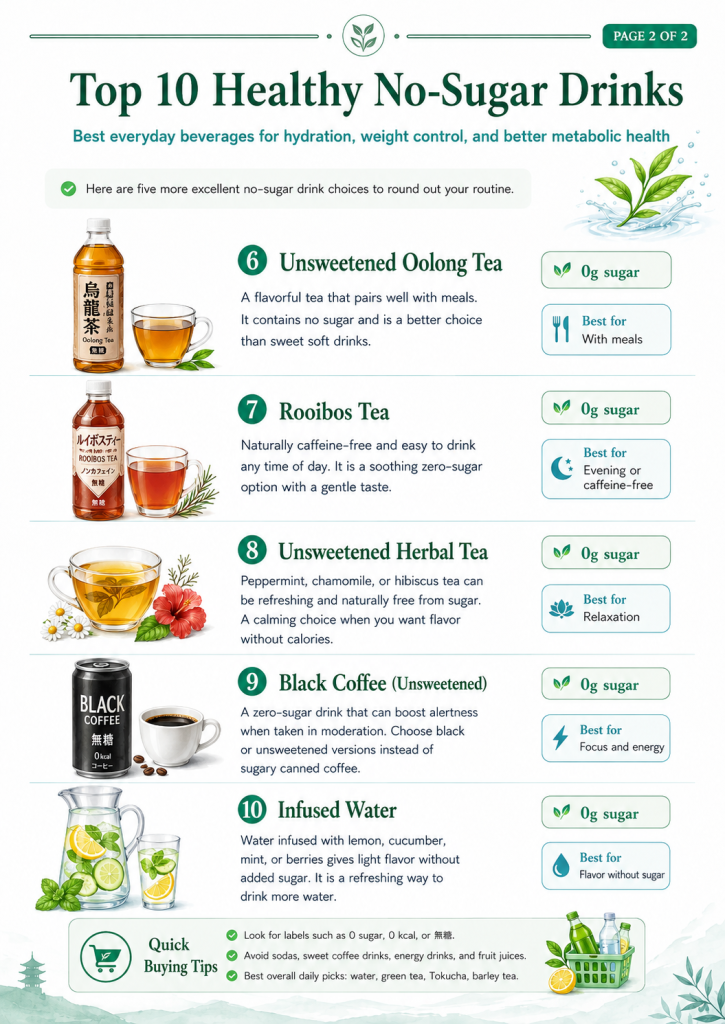
6. Unsweetened oolong tea
Best no-sugar tea with meals
Oolong is produced from the same Camellia sinensis plant as green and black tea but processed differently. It usually has a deeper, roasted or floral flavour and contains caffeine. (NCCIH)
Its strong flavour pairs well with richer meals, making it a useful substitute for cola, sweetened iced tea or juice.
Japanese labels to look for include:
- 烏龍茶
- 無糖
- 糖類ゼロ
- 0 kcal
Products such as plain Suntory Oolong Tea are typically unsweetened, but always check the individual bottle.
There is no need to buy oolong because of exaggerated “fat-blocking” marketing. Its main value is that it is enjoyable, virtually calorie-free when plain and easier to maintain as a habit than forcing yourself to drink something you dislike.
7. Rooibos tea
Best naturally caffeine-free alternative to traditional tea
Rooibos is an herbal infusion made from Aspalathus linearis, a South African plant. Unlike green, black and oolong tea, pure rooibos is naturally caffeine-free. Human research into additional health effects is still limited, so it should be valued primarily as a pleasant, unsweetened alternative rather than as a treatment. (PubMed Central (PMC))
Rooibos is particularly useful for:
- People sensitive to caffeine
- Evening drinking
- People who want a tea-like taste without traditional tea leaves
- Anyone replacing sweet milk tea
Check bottled rooibos carefully. Plain rooibos has no sugar, but some ready-to-drink versions contain fruit juice, honey or sweeteners.
8. Unsweetened herbal tea
Best for variety and relaxation
Peppermint, chamomile, hibiscus and ginger infusions can make sugar-free drinking more interesting. Most pure herbal infusions are naturally caffeine-free, although blends containing green tea, black tea, yerba mate, guayusa or cacao may contain caffeine.
The greatest benefit is practical: herbal teas provide aroma and flavour without requiring sugar.
Try:
- Peppermint after a meal
- Chamomile in the evening
- Hibiscus served cold
- Fresh ginger steeped in hot water
- Lemon balm or lemongrass
Avoid automatically adding honey. Honey is still a source of sugar, even though it is natural.
Herbal products can interact with medicines or aggravate certain conditions. People who take anticoagulants, blood-pressure medicines, sedatives or several prescription drugs should check unfamiliar herbal ingredients with a pharmacist or clinician.
9. Black coffee
Best no-sugar drink for alertness
Plain black coffee contains virtually no sugar and very few calories. It can increase alertness because of its caffeine content.
Large research reviews have found associations between moderate coffee intake and several favourable health outcomes, including lower all-cause mortality in observational data. However, these findings cannot prove that coffee itself causes the benefit, and adding sugar, flavoured syrup or cream changes the nutritional profile considerably. (PubMed Central (PMC))
For most healthy adults, the FDA cites 400 mg of caffeine per day as an amount not generally associated with harmful effects, but sensitivity varies substantially. Pregnancy, some medical conditions and certain medicines may require lower limits. (U.S. Food and Drug Administration)
In Japan, choose cans marked:
- ブラック — black
- 無糖 — unsweetened
- 砂糖ゼロ — zero sugar
Do not assume every black-coloured can is unsweetened. Café au lait, latte, 微糖—“slightly sweet”—and milk-coffee products usually contain sugar or carbohydrate.
Reduce or avoid it when: caffeine worsens anxiety, palpitations, reflux or sleep.
10. Lightly infused water
Best way to make water more interesting
Adding slices of lemon, lime, cucumber, mint or a few berries can improve the aroma and taste of water without turning it into juice.
The CDC and American Diabetes Association both recommend fruit- or herb-infused water as an alternative to sweet beverages. (CDC)
To keep it effectively sugar-free:
- Add a few slices rather than squeezing several fruits
- Do not add honey, syrup or sugar
- Avoid bottled “infused water” unless the label confirms no sugar
- Refrigerate homemade infused water and use it promptly
A couple of lemon slices will transfer only a trivial amount of sugar. Crushing large quantities of fruit or adding juice, however, creates a different drink.

How to read Japanese beverage labels
Japanese convenience stores and vending machines offer excellent unsweetened options, but the terminology can be confusing.
無糖—mutō
Usually means unsweetened or sugar-free. This is one of the most useful labels for tea and coffee.
糖類ゼロ—tōrui zero
Means sugars are low enough to qualify for a zero declaration under Japanese labelling rules. A displayed value of zero does not always mean an absolute laboratory zero.
Japan’s Consumer Affairs Agency permits sugars and carbohydrates to be displayed as zero when the amount is below 0.5 g per 100 ml. Energy may be displayed as zero when it is below 5 kcal per 100 ml. (CAA)
For a 500 ml bottle, a product legally labelled zero could therefore theoretically contain a small non-zero quantity. Plain water and unsweetened tea will normally be genuinely negligible, but the distinction matters for processed drinks.
砂糖不使用—satō fushiyō
Means no sugar was added, but it does not necessarily mean the product contains no naturally occurring sugars or carbohydrates. Japan’s Consumer Affairs Agency distinguishes “no added sugar” claims from claims that the product contains no sugars. (CAA)
微糖—bitō
Means “slightly sweet” or “reduced sugar.” It is not sugar-free.
カロリーゼロ
Means the product meets the legal threshold for a zero-calorie claim. It does not automatically mean it has no sweeteners, caffeine or other additives.
原材料名—ingredients
Check the ingredients for words such as:
- 砂糖 — sugar
- 果糖 — fructose
- 果糖ぶどう糖液糖 — high-fructose glucose syrup
- はちみつ — honey
- シロップ — syrup
- アスパルテーム — aspartame
- スクラロース — sucralose
- アセスルファムK — acesulfame potassium
Which drinks are best for people with diabetes?
Water remains the strongest default choice because it contains no calories or carbohydrates and has no direct effect on blood glucose. The American Diabetes Association also lists unsweetened tea, unsweetened coffee, sparkling water and no-added-sugar infused water among suitable zero- or low-calorie choices.
A practical order of preference is:
- Water
- Plain sparkling water
- Unsweetened barley or rooibos tea
- Unsweetened green or oolong tea
- Black coffee in moderation
- Artificially sweetened drinks only when they help replace a sugary drink and are not becoming the main source of hydration
Caffeine can affect people differently. Some people with diabetes notice a temporary change in blood glucose after coffee or strong tea, so personal glucose readings are more informative than assuming everyone responds identically.
Sports drinks such as Pocari Sweat are not ideal everyday drinks for most people with diabetes because regular versions contain carbohydrate. They are designed for particular situations involving sustained exercise, substantial sweating or dehydration—not ordinary desk work or a short walk. (American Diabetes Association)
Drinks that did not make the list
Diet soda
Diet soda may be useful as a transitional replacement for regular soda, especially when the immediate goal is reducing sugar. However, it remains intensely sweet and generally provides little nutritional value. It should not replace water as the main daily drink. WHO guidance recommends not relying on non-sugar sweeteners as a long-term weight-control strategy. (World Health Organization)
Sugar-free energy drinks
“No sugar” does not neutralise a large stimulant dose. Energy drinks may contain high levels of caffeine and other stimulants, and the FDA notes that caffeine content varies widely. (U.S. Food and Drug Administration)
Fruit juice
Fruit juice contains naturally occurring free sugars and lacks much of the intact fibre found in whole fruit. It is not a no-sugar beverage, even when the packaging says “100% juice” or “no added sugar.”
Sports and electrolyte drinks
Most people do not require a sweet sports drink for normal daily hydration. Water is usually adequate for ordinary activity; electrolyte products have more specific uses during prolonged exercise, heavy sweating, vomiting, diarrhoea or medically advised rehydration. (American Diabetes Association)
Sweetened milk tea and canned coffee
These can contain meaningful amounts of sugar even when the drink does not taste extremely sweet. Labels such as 微糖 mean reduced sugar—not zero sugar.
A simple daily drinking routine
A realistic routine could look like this:
Morning: Water followed by unsweetened green tea or black coffee.
With lunch: Water, green tea or oolong tea.
Afternoon: Sparkling water or Tokucha.
With dinner: Water, mugicha or unsweetened oolong tea.
Evening: Rooibos, mugicha or a caffeine-free herbal infusion.
There is no need to consume all ten drinks. The best routine is the simplest one you can repeat consistently:
Make water your base, use unsweetened tea for variety, and treat caffeinated or functional drinks as optional additions.
Final verdict
The healthiest no-sugar drink is still plain water. It hydrates without calories, caffeine, sweeteners or marketing drama.
Unsweetened sparkling water is the best soda replacement. Green tea and oolong provide flavour and tea polyphenols, while mugicha and rooibos offer caffeine-free alternatives. Black coffee can fit into a healthy routine when caffeine is tolerated. Tokucha is a credible sugar-free Japanese functional tea, but it should complement—not replace—diet, movement and appropriate medical care.
The winning habit is not finding a magical bottle. It is choosing unsweetened drinks often enough that sugary beverages stop being your normal.