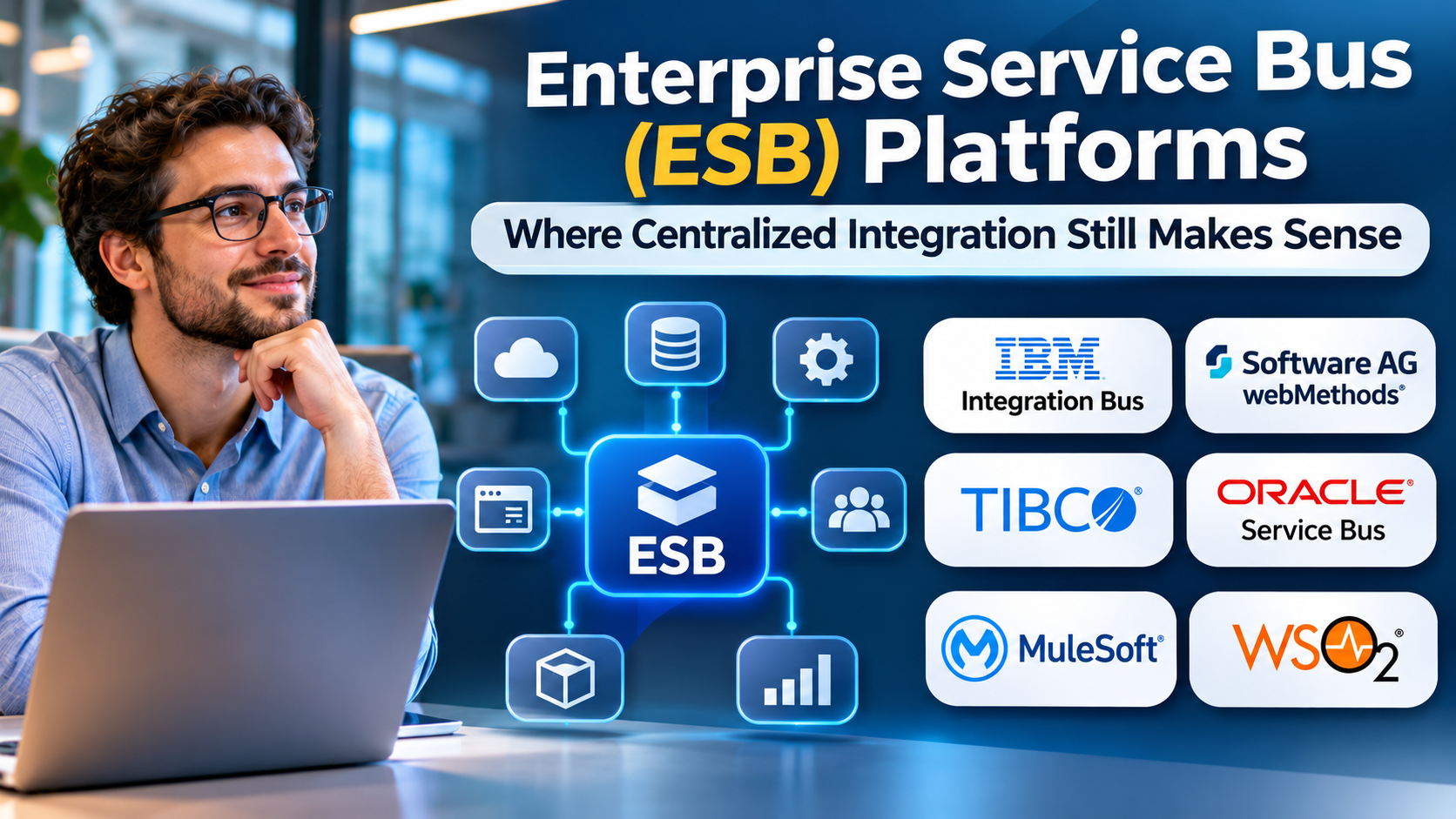
Enterprise integration has evolved from tightly connected applications to APIs, cloud services, event streams, and distributed architectures.
Yet many organizations continue to depend on systems that were never designed for direct cloud connectivity.
Enterprise Service Bus platforms remain relevant because they provide structured communication between applications with different protocols, formats, and operational requirements.
The important question is not whether ESBs are outdated. It is whether their architectural strengths match the integration problem.
What Is an Enterprise Service Bus?
An Enterprise Service Bus is an integration architecture that enables applications to exchange messages through shared integration capabilities.
An ESB commonly provides message routing, protocol mediation, transformation, and orchestration.
For example, an insurance company might need to connect a legacy policy administration system with modern customer portals and claims applications.
An ESB can translate messages, coordinate communication, and reduce the need for each application to understand every other system.
Core ESB Capabilities
Message routing
An ESB determines where messages should go based on configured rules, message content, or service endpoints.
Protocol mediation
Enterprise environments may use HTTP, SOAP, JMS, file transfers, and other communication mechanisms.
ESB technology can help bridge these differences.
Data transformation
Applications often use incompatible message formats. Transformation components map information into structures accepted by receiving systems.
Service orchestration
Some ESB platforms coordinate interactions among multiple services to complete an integration process.
Error handling
Reliable integrations need mechanisms for detecting failures, logging events, retrying operations, and escalating unresolved problems.
ESB Platforms Worth Understanding
IBM App Connect
IBM App Connect provides enterprise integration capabilities for connecting applications and data across different environments.
It is relevant to organizations managing substantial integration requirements and established enterprise infrastructure.
Software AG webMethods
webMethods has a long history in enterprise integration, API connectivity, and business-to-business communication.
Organizations evaluating it should consider their existing integration investments, operational skills, and deployment requirements.
Oracle Service Bus
Oracle Service Bus is designed for service integration within Oracle’s middleware ecosystem.
It is particularly relevant where organizations already operate Oracle enterprise middleware.
WSO2 Micro Integrator
WSO2 Micro Integrator supports integration patterns including routing, mediation, and transformation.
It can appeal to teams seeking integration capabilities within a broader API and middleware architecture.
Apache ServiceMix
Apache ServiceMix is an open-source integration container associated with technologies such as Apache Camel and messaging components.
Organizations considering it should carefully evaluate project maintenance, compatibility, and internal operational expertise.
ESB vs. API Gateway
An API gateway primarily manages API traffic and policies, such as authentication, rate limiting, routing, and access control.
An ESB traditionally addresses broader integration concerns, including transformation and communication between heterogeneous enterprise applications.
Although features can overlap, the architectural responsibilities differ.
Using an API gateway as a complete integration engine may introduce unnecessary complexity. Conversely, routing every API request through a centralized ESB can create performance and operational bottlenecks.
ESB vs. iPaaS
iPaaS typically offers managed integration services with an emphasis on cloud connectivity.
ESBs often provide integration mediation within enterprise-controlled environments.
The distinction is not absolute. Modern integration vendors may offer both approaches.
Organizations should evaluate actual deployment models and capabilities rather than relying solely on product categories.
When an ESB Is a Good Fit
An ESB can be appropriate when an organization has:
- Numerous legacy applications using different protocols.
- Complex message transformation requirements.
- Established middleware infrastructure.
- Strict integration governance.
- Significant investments in service-oriented architecture.
- Operational teams experienced in enterprise messaging.
An ESB may be less suitable when the main requirement is lightweight connectivity among a few cloud applications.
The Risk of Excessive Centralization
Centralized integration can simplify governance, but it can also concentrate operational risk.
If every application depends on one integration layer, outages or changes to that layer may affect many business services.
Teams should consider horizontal scaling, fault isolation, deployment independence, and ownership boundaries.
Avoid placing all business logic inside integration middleware. Domain-specific decisions generally belong with the systems responsible for those business capabilities.
Evaluating ESB Total Cost
Licensing is only one component.
Other expenses include infrastructure, specialist development, monitoring, upgrades, high availability, and integration maintenance.
For open-source implementations, licensing costs may be lower, but operational responsibility remains.
A meaningful comparison should use representative integrations and account for ongoing maintenance.
Modernizing an Existing ESB
Replacing an ESB entirely is not always necessary.
A gradual modernization strategy can expose selected business functions through APIs, move appropriate integrations to event-driven messaging, and retire obsolete connections.
Teams should first document dependencies and identify which integrations genuinely benefit from a different architecture.
Migration should preserve message integrity, business continuity, and traceability.
Frequently Asked Questions
Are ESBs obsolete?
No. They remain useful in certain enterprise integration environments, although newer architectures may be preferable for some workloads.
Is an ESB a message broker?
Not exactly. A message broker focuses on message transport and delivery, while an ESB generally includes additional mediation and integration capabilities.
Can ESBs work with cloud applications?
Yes, depending on the platform and connectivity options.
Conclusion
Enterprise Service Bus platforms should be evaluated as architectural components rather than universal integration solutions.
Their value is strongest when protocol diversity, legacy connectivity, and centralized mediation justify the additional infrastructure.
For simpler cloud-native systems, APIs, managed integration services, or event-driven components may offer a more maintainable alternative.