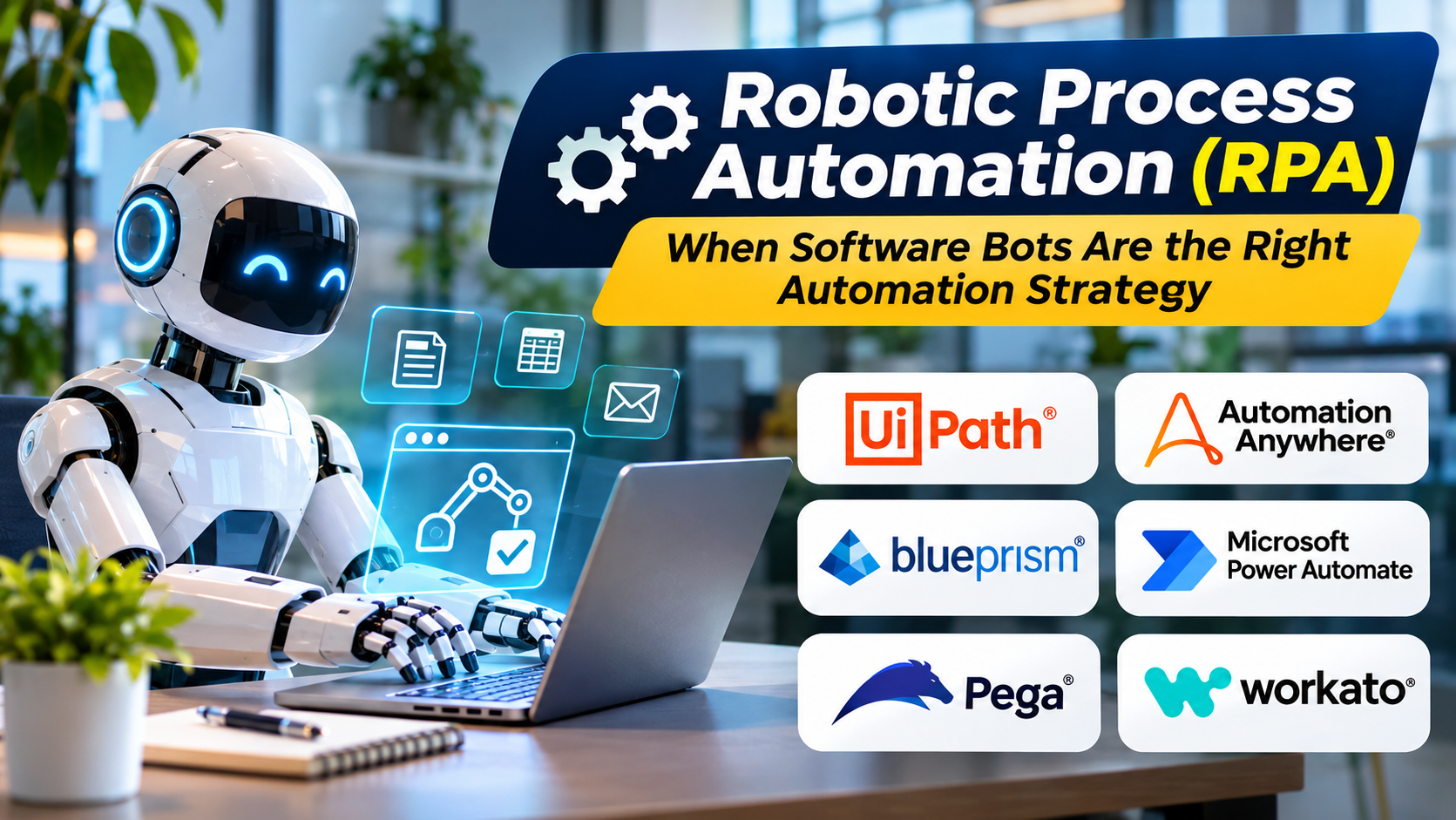
Many organizations still depend on applications that require employees to enter information manually, download files, navigate screens, and repeat the same actions throughout the day.
These tasks can be time-consuming, especially when legacy software lacks modern integration interfaces.
Robotic Process Automation, or RPA, offers a way to automate repetitive digital interactions.
However, successful RPA requires more than recording mouse clicks. It requires selecting stable processes, designing reliable automations, and maintaining them as applications change.
What Is Robotic Process Automation?
RPA is a technology that uses software bots to perform structured tasks through application interfaces.
A bot may open an application, enter credentials, read information, populate forms, move files, or transfer data between systems.
Unlike conventional API integrations, RPA can interact with software through the same interfaces used by human employees.
This makes it useful when direct system integration is unavailable or impractical.
Attended vs. Unattended RPA
Attended automation
Attended bots work alongside employees and are commonly initiated by user actions.
For example, a customer service representative might launch a bot to retrieve information from several systems.
Unattended automation
Unattended bots execute without continuous human interaction.
They may process scheduled workloads, perform background tasks, or respond to events.
These implementations require stronger orchestration, monitoring, and exception handling.
Where RPA Creates Value
Finance operations
RPA can help transfer information between accounting systems, reconcile structured records, and prepare routine reports.
Insurance administration
Bots can assist with data entry, policy administration, and information retrieval from legacy applications.
Human resources
RPA can automate repetitive employee record updates and administrative tasks.
Customer service
Bots can retrieve customer information and reduce repetitive navigation between applications.
Legacy system integration
RPA can bridge systems that lack suitable APIs, although it should not automatically replace more reliable integration methods.
RPA Platforms Worth Evaluating
UiPath
UiPath provides automation development, orchestration, and related enterprise automation capabilities.
It is relevant to organizations managing both attended and unattended automation.
Evaluation should include development complexity, governance, licensing, and operational maintenance.
Automation Anywhere
Automation Anywhere provides enterprise automation capabilities for building and managing software bots.
It is suited to organizations evaluating centrally governed automation programs.
Microsoft Power Automate
Power Automate includes desktop automation capabilities alongside cloud workflows.
Organizations using Microsoft technologies may find this combination useful.
However, desktop automation licensing and execution requirements should be verified.
SS&C Blue Prism
Blue Prism is associated with enterprise RPA and centrally managed digital workers.
It is relevant where organizations prioritize structured automation governance.
Robocorp
Robocorp provides developer-oriented automation technology built around Python-based approaches.
It can be relevant for teams seeking code-driven automation rather than primarily visual bot development.
The Hidden Costs of RPA
RPA projects are sometimes evaluated only by the number of manual hours they could theoretically eliminate.
This overlooks maintenance.
A bot that depends on screen layouts may break when a software update changes a button, form, or navigation sequence.
Other costs include infrastructure, credentials, exception handling, testing, orchestration, and ongoing support.
Organizations should calculate the cost of operating the automation, not just building it.
RPA vs. API Automation
API automation communicates directly with application interfaces designed for system integration.
RPA often imitates user interactions.
Where reliable APIs exist, they may offer better stability and maintainability.
RPA becomes more attractive when systems lack APIs, when integration access is restricted, or when the process requires interaction with desktop applications.
Hybrid architectures can combine APIs for reliable data exchange with RPA for unavoidable user-interface steps.
Selecting the Right Processes
Strong RPA candidates usually have:
- Repetitive, clearly defined steps.
- Stable application interfaces.
- Structured input data.
- Predictable business rules.
- Sufficient transaction volume.
- Manageable exception rates.
Processes involving frequent judgment, changing interfaces, or highly inconsistent data may be poor candidates without additional technologies or redesign.
RPA and Artificial Intelligence
AI can extend automation by helping classify documents, extract information, or interpret less structured inputs.
However, adding AI introduces new risks, including incorrect extraction, uncertain decisions, and additional validation requirements.
High-impact business actions should include appropriate verification and human oversight.
How to Measure RPA Success
Useful measures include processing time, successful completion rate, exception frequency, bot availability, maintenance effort, and cost per transaction.
A successful automation should improve the complete process, not simply make one isolated step faster.
Organizations should also evaluate employee experience and the quality of downstream data.
Frequently Asked Questions
Does RPA require programming?
Some platforms offer visual development environments, while others emphasize scripting. Complex automations may still require technical skills.
Can RPA automate any application?
Not reliably. Application design, access restrictions, interface changes, and technical compatibility affect feasibility.
Will RPA replace traditional integration?
No. RPA is best viewed as one automation method within a broader integration strategy.
Conclusion
RPA is most valuable when it solves a genuine integration or repetitive-work problem that cannot be addressed more simply.
Organizations should prioritize process stability, maintainability, and measurable business outcomes.
The goal is not to deploy the largest number of bots. It is to create automations that remain dependable after the initial demonstration.