A timesheet is more than a record of hours. For many organizations, it is the connection between work performed, payroll calculations, project expenses, and client invoices.
When timesheets are incomplete or inaccurate, the consequences extend beyond administration. Payroll teams may spend additional time correcting records, project managers may misunderstand labor costs, and businesses may struggle to explain billed hours.
Timesheet management tools help create a more reliable process for collecting, reviewing, approving, and reporting working time.
What Are Timesheet Management Tools?
Timesheet management tools are software applications that allow employees to record working hours and submit those records for review.
Unlike basic time tracking applications, timesheet management systems often emphasize formal submission periods, approval workflows, corrections, and integration with payroll or financial systems.
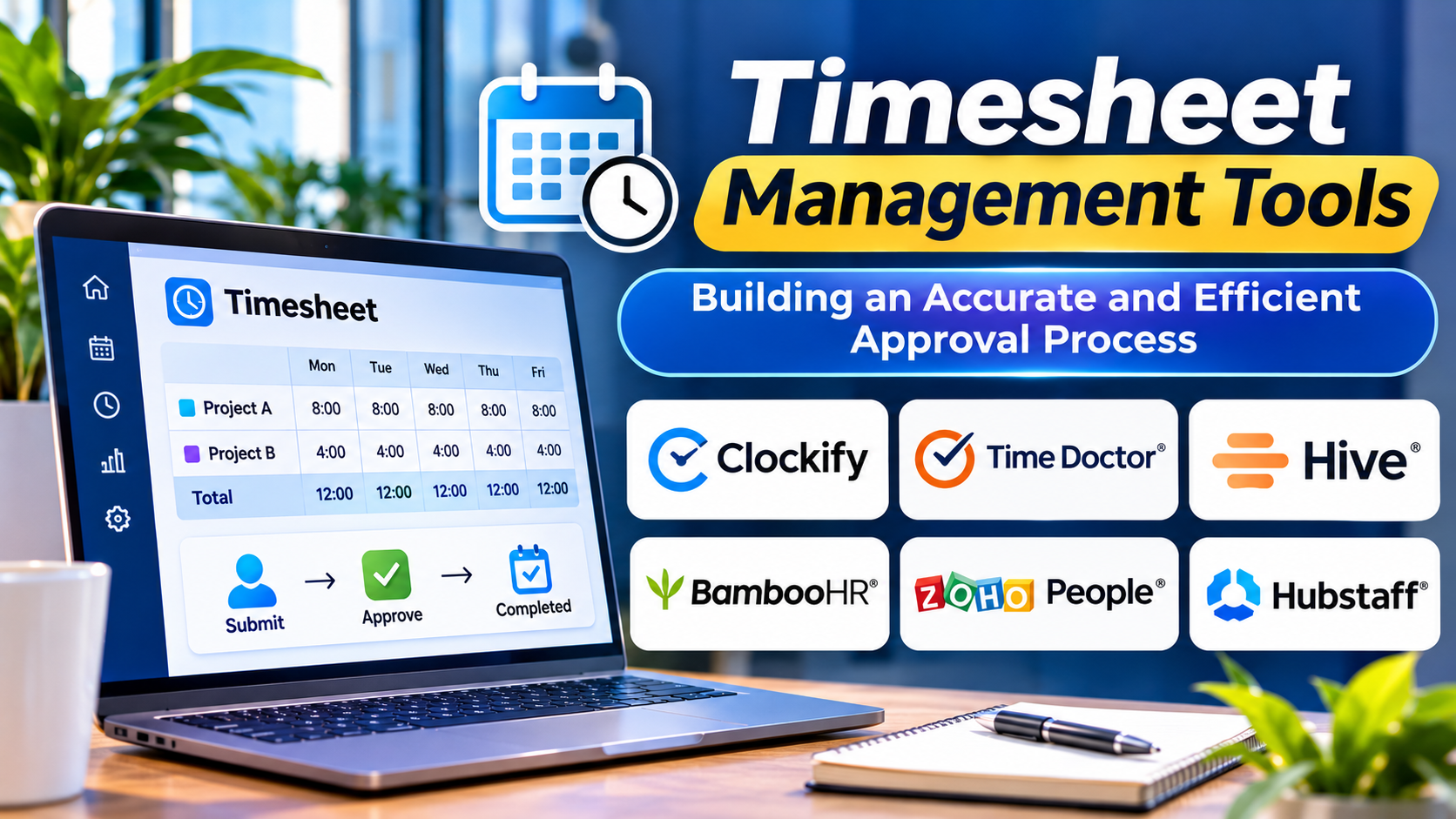
A typical process involves an employee recording hours, a supervisor reviewing the submission, and an authorized administrator transferring approved information to another business system.
The exact workflow depends on whether the organization uses timesheets for payroll, project costing, client billing, or regulatory recordkeeping.
Why Timesheet Accuracy Matters
Manual timesheets introduce several operational problems.
Employees may forget to record hours, use incorrect project codes, or submit information after payroll deadlines. Managers may approve records without enough context, while finance teams must reconcile inconsistent information.
A centralized system can help standardize these activities.
However, software cannot independently establish whether submitted hours are truthful. Effective processes still require clear policies, appropriate review, and accountability.
Timesheet Management Tools to Evaluate
Replicon
Replicon offers time-related solutions for organizations managing employee time, projects, and operational requirements.
It is relevant when timesheet information must support multiple business processes rather than simple personal productivity tracking.
Organizations should evaluate the specific product configuration and required integrations.
Deltek
Deltek provides business software for project-based organizations, including time and expense capabilities within relevant solutions.
It deserves consideration where approved timesheets influence project accounting, client billing, and financial reporting.
Clockify
Clockify supports timesheets and project-based time reporting.
It can be a practical option for teams seeking accessible time entry and reporting without immediately adopting a larger enterprise platform.
Tempo Timesheets
Tempo provides time tracking capabilities associated with Jira workflows.
It is particularly relevant to organizations that already manage substantial project activity in the Atlassian ecosystem.
QuickBooks Time
QuickBooks Time focuses on employee time tracking and related workforce workflows.
Businesses using QuickBooks should assess the compatibility of their specific accounting or payroll products and regional availability.
Essential Features to Compare
| Feature | Why it matters |
|---|---|
| Timesheet submission | Establishes consistent reporting periods |
| Approval workflows | Assigns responsibility for reviewing hours |
| Project codes | Supports accurate allocation of labor costs |
| Corrections and audit history | Helps explain changes to submitted records |
| Reminders | Reduces late submissions |
| Payroll integration | Limits duplicate entry and reconciliation |
| Reporting | Identifies missing records and cost patterns |
The importance of each capability depends on how the organization uses timesheet information.
Designing an Effective Approval Workflow
A strong approval process should be simple enough for routine use but detailed enough to catch meaningful errors.
Employees need clear instructions about reporting periods, activity categories, breaks, and overtime.
Managers should understand what they are expected to verify. Approval should not become a ceremonial click performed without reviewing the underlying information.
Corrections also require attention. Organizations should preserve an appropriate history of changes, particularly when timesheets influence payroll or contractual billing.
Timesheets, Payroll, and Compliance
Working-time requirements differ across jurisdictions, industries, employment arrangements, and contracts.
Organizations should verify applicable rules concerning overtime, rest periods, record retention, and employee access to records.
A software vendor’s general compliance claims do not establish that a particular configuration satisfies every local obligation.
Payroll teams should test how approved hours move into payroll calculations, including exceptions and retroactive adjustments.
Common Implementation Mistakes
One frequent mistake is introducing too many project and activity codes.
Employees may struggle to identify the correct category, resulting in inconsistent reporting.
Another is allowing multiple systems to maintain competing versions of the same time records.
Organizations should establish which system owns submitted hours, which system calculates pay, and how discrepancies are resolved.
Finally, managers need training. Even an excellent approval interface is ineffective when reviewers do not understand the underlying rules.
Final Thoughts
The best timesheet management tool is the one that creates dependable records without unnecessary administrative work.
Replicon and Deltek are worth evaluating for more complex operational requirements, while Clockify, Tempo, and QuickBooks Time serve different project and business ecosystems.
Successful timesheet management depends on a combination of suitable software, consistent policies, and meaningful approvals.
When those elements work together, timesheets become a reliable foundation for payroll, project accounting, and operational decisions.