Employee information moves through many business processes.
A new hire may begin in a recruitment system, enter an HR database, receive payroll records, complete onboarding tasks, and later participate in performance reviews or training.
When these activities operate in disconnected applications, organizations may repeatedly enter the same information and struggle to maintain consistent records.
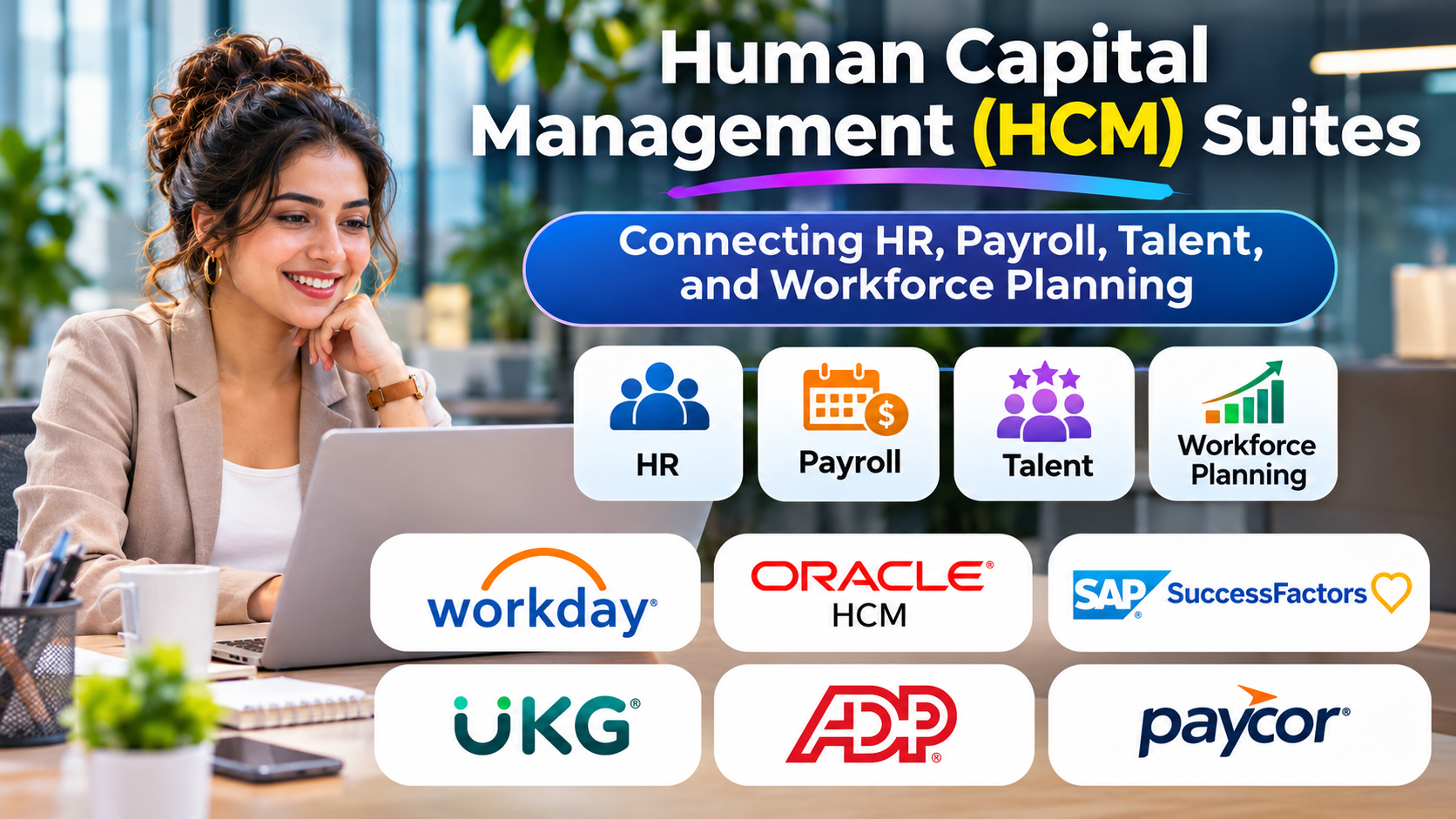
Human capital management suites attempt to bring these processes together.
What Is a Human Capital Management Suite?
A human capital management suite is an integrated software environment for managing major stages of the employee lifecycle.
Typical capabilities include core HR administration, recruitment, onboarding, payroll, workforce management, performance management, learning, and analytics.
Not every HCM suite provides all these functions in every market or subscription.
Some platforms deliver extensive native capabilities, while others depend on additional modules or integrations.
HCM, HRIS, and HRMS: Understanding the Differences
These terms frequently overlap.
An HRIS, or human resources information system, generally emphasizes employee records and core HR processes.
HRMS, or human resources management system, is often used for a broader combination of administrative HR capabilities.
HCM commonly describes a wider employee lifecycle approach, including talent management and workforce planning.
However, vendors use these labels differently. Buyers should compare actual functionality instead of relying on product categories alone.
Major HCM Suites to Consider
Workday
Workday provides enterprise applications for human capital management and finance.
Its HCM offerings are relevant to organizations managing complex employee structures, HR processes, and workforce information.
SAP SuccessFactors
SAP SuccessFactors provides cloud-based human capital management capabilities.
It is especially relevant to organizations evaluating talent processes and HR integration within a broader SAP environment.
Oracle Fusion Cloud HCM
Oracle Fusion Cloud HCM offers integrated HR and talent-related capabilities.
It deserves consideration for organizations seeking enterprise HR functionality connected with Oracle’s wider application ecosystem.
Dayforce
Dayforce combines HR, payroll, workforce management, and related employee processes.
Its approach is relevant when operational workforce data and employee administration need close coordination.
UKG
UKG offers HR, payroll, and workforce management solutions.
Organizations with substantial frontline or shift-based workforces may find its workforce-oriented capabilities particularly relevant.
ADP
ADP provides payroll and human capital management solutions across different business segments.
It can be considered when payroll administration is a central requirement within the broader HR technology strategy.
What an HCM Suite Should Deliver
The main value of integration is not merely having multiple features under one brand.
It is the ability to maintain reliable employee information and coordinate processes without unnecessary duplication.
For example, an approved employee transfer may need to update reporting relationships, organizational structures, access permissions, and payroll-related information.
A well-designed HCM environment should make these dependencies manageable.
Critical Evaluation Criteria
| Area | Questions to investigate |
|---|---|
| Core HR | Can the platform represent your organizational structure? |
| Payroll | Which countries and employee categories are supported? |
| Talent management | How are recruitment, development, and reviews connected? |
| Workforce management | Does it support actual scheduling requirements? |
| Integrations | How does information move to other applications? |
| Reporting | Can teams access consistent workforce information? |
| Security | Are sensitive records protected by appropriate permissions? |
| Implementation | What configuration and migration effort is required? |
The Hidden Complexity of HCM Implementation
HCM implementation is often a business transformation project rather than a simple software installation.
Organizations must reconcile employee records, reporting structures, job classifications, and approval processes.
Historical information may contain inconsistent naming conventions or incomplete records.
These problems should be addressed before migration.
Integration also requires planning. Finance, identity management, benefits, and other systems may depend on HR information.
Avoiding Unnecessary Complexity
A large suite can provide substantial capabilities, but organizations should not assume every module is required.
A smaller business may achieve better results with a focused HR platform and suitable payroll integration.
Enterprise organizations may justify a broader suite when multiple countries, employee populations, and business units require coordinated processes.
The correct decision depends on organizational complexity rather than headcount alone.
Measuring HCM Success
Useful measures include employee record accuracy, onboarding completion, payroll discrepancies, administrative processing time, and the reliability of workforce reporting.
Employee and manager experience also matters.
A system that produces excellent executive reports but makes routine HR requests difficult may create new operational problems.
Final Thoughts
HCM suites provide a framework for connecting employee information with HR and workforce processes.
Workday, SAP SuccessFactors, Oracle Fusion Cloud HCM, Dayforce, UKG, and ADP represent different approaches to this challenge.
The strongest HCM strategy begins with clear data ownership, realistic process requirements, and an understanding of the organization’s operational complexity.
Technology can connect the employee lifecycle, but reliable information and effective governance make that connection valuable.