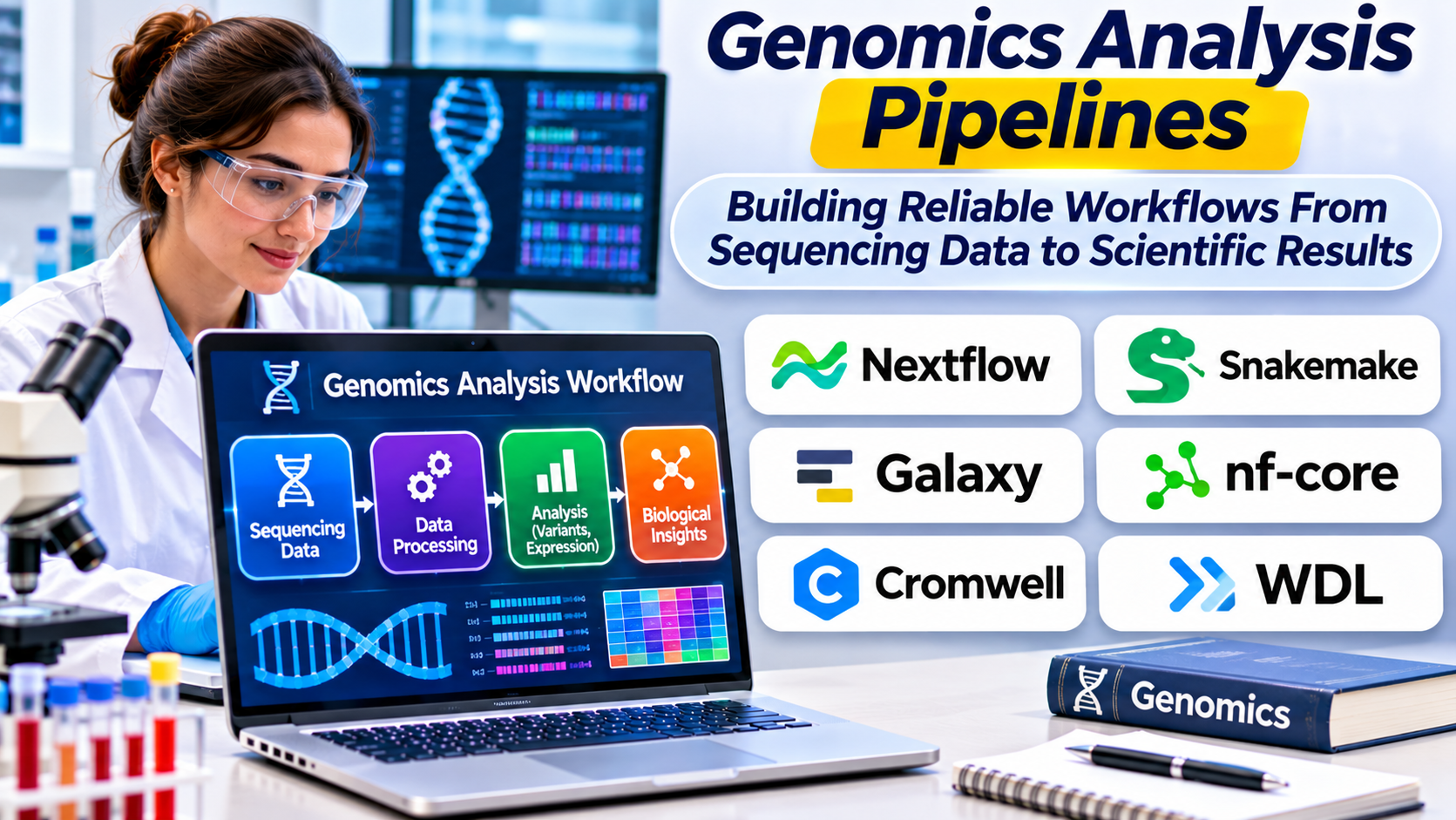
Introduction
Modern sequencing instruments can generate enormous amounts of biological data. Turning that data into meaningful scientific findings requires much more than running a single analysis program.
Researchers must examine sequencing quality, process reads, select appropriate reference information, identify relevant biological features, and interpret results.
Each stage introduces assumptions and potential sources of error.
Genomics analysis pipelines help organize these stages into structured computational workflows. When designed properly, they improve consistency, traceability, and reproducibility.
However, a pipeline that executes without errors is not necessarily scientifically valid.
Choosing the right tools requires understanding both the computational workflow and the biological question it is intended to answer.
What Is a Genomics Analysis Pipeline?
A genomics analysis pipeline is a sequence of computational steps used to process and analyze genomic or sequencing data.
Pipelines may combine multiple software tools, reference datasets, configuration files, and quality-control procedures.
They commonly automate tasks that researchers would otherwise need to execute manually.
Depending on the application, a pipeline may support:
- Sequencing quality assessment
- Read trimming and preprocessing
- Alignment or mapping
- Variant identification
- Variant annotation
- Gene expression analysis
- Genome assembly
- Structural variation analysis
- Quality reporting
- Reproducible computational execution
Different sequencing applications require different workflows.
A pipeline designed for whole-genome variant calling cannot automatically replace a workflow for RNA sequencing or single-cell analysis.
Why Pipeline Design Matters
Genomics analysis involves numerous dependent steps.
An error introduced early in the workflow can influence later results.
For example, inappropriate read filtering may remove useful biological information.
An unsuitable reference genome may affect alignment quality.
Incorrect variant-calling assumptions may generate false positives or miss relevant variation.
Pipeline design must therefore reflect the sequencing technology, sample type, scientific objective, and available evidence.
Automation helps enforce consistency, but it does not eliminate the need for scientific judgment.
The Main Stages of a Sequencing Analysis Workflow
Raw Data Quality Assessment
Sequencing analysis often begins with FASTQ files containing sequence reads and quality scores.
Quality-control tools help researchers examine characteristics such as base quality, sequence composition, adapter contamination, and duplication patterns.
FastQC is commonly used for inspecting sequencing read quality.
MultiQC can aggregate reports from multiple tools into a combined view.
These reports help researchers identify potential problems before proceeding.
However, quality metrics should be interpreted in context. A pattern that appears unusual in one sequencing application may be expected in another.
Read Preprocessing
Some workflows require adapter removal, quality trimming, or other preprocessing.
Tools such as fastp can support read filtering and preprocessing.
The appropriate operations depend on sequencing technology and downstream methods.
Excessive trimming may discard informative sequence data.
Researchers should avoid treating preprocessing as a universal sequence of mandatory operations.
Alignment and Mapping
Read alignment identifies where sequencing reads correspond to a reference sequence.
Common tools include BWA for certain DNA sequencing workflows and STAR for RNA sequencing alignment.
Different aligners use different algorithms and assumptions.
The choice depends on factors such as read length, sequencing technology, expected variation, and analysis objective.
Reference genome selection is also important.
Researchers should record the exact reference assembly and associated annotation versions.
Variant Calling
Variant-calling tools identify differences between sequencing data and reference sequences.
These may include single-nucleotide variants, small insertions and deletions, or other forms of genomic variation.
GATK provides tools and workflows used in genomic variant analysis.
However, variant-calling strategies differ across germline, somatic, and other applications.
A pipeline designed for inherited variation may not be appropriate for detecting low-frequency tumor variants.
Variant Annotation
Variant annotation adds biological or functional context to detected variants.
Annotations may describe genomic locations, predicted molecular consequences, or relationships with known reference information.
The quality of interpretation depends on the annotation resources and their versions.
Computational predictions should not be confused with definitive evidence of biological or clinical significance.
Reporting and Interpretation
The final stage presents results in a form researchers can evaluate.
Reports may include quality metrics, variant files, summary statistics, and analysis metadata.
A useful report should preserve enough information to trace important findings back to the underlying data and computational methods.
For clinical applications, additional validation, professional interpretation, and applicable regulatory requirements are essential.
Workflow Managers and Analysis Tools
Genomics pipelines commonly rely on workflow management software.
A workflow manager coordinates computational steps, handles dependencies, and helps execute analyses consistently.
It is not necessarily responsible for performing the underlying biological calculations.
Nextflow
Nextflow is a workflow system used for scalable and reproducible computational pipelines.
It supports the organization of processes and can work with different execution environments.
Its ecosystem includes nf-core, a community initiative that develops standardized analysis pipelines.
Nextflow can be attractive to teams that need portable workflows and structured software environments.
The main considerations include learning requirements, configuration complexity, and infrastructure compatibility.
Snakemake
Snakemake is a workflow management system widely used in scientific computing.
It defines computational workflows through rules describing inputs, outputs, and dependencies.
Its approach can be suitable for research groups that want explicit control over analytical processes.
As with other workflow systems, reproducibility depends on managing software environments, references, and configuration properly.
Galaxy
Galaxy provides a web-based environment for scientific data analysis.
It can help researchers construct and execute workflows through a graphical interface.
This approach may be particularly useful for teams that want accessible analytical tools without developing every workflow through command-line programming.
Organizations still need to consider deployment, available tools, computational resources, and data governance.
GATK
GATK is a collection of tools and documented workflows for genomic analysis, particularly variant discovery and related processing.
It should not be confused with a general-purpose workflow orchestrator.
GATK tools can form part of pipelines managed by systems such as Nextflow or other workflow frameworks.
Comparing Genomics Workflow Approaches
| Technology | Main role | Practical strength |
|---|---|---|
| Nextflow | Workflow orchestration | Portable, scalable pipeline execution |
| Snakemake | Workflow orchestration | Explicit rule-based dependencies |
| Galaxy | Analysis environment | Graphical workflow development |
| GATK | Genomic analysis toolkit | Variant analysis methods |
| FastQC | Sequencing quality control | Read-level quality reports |
| MultiQC | Report aggregation | Consolidated analysis summaries |
These tools serve complementary roles.
A complete pipeline may use a workflow manager to execute several scientific applications and then combine their results into a quality report.
Reproducibility Is More Than Running the Same Script
A genomics workflow can produce different results when its software, reference data, or parameters change.
Reproducibility therefore requires more than preserving a pipeline definition.
Research teams should track the versions of analytical tools, reference genomes, annotation resources, and relevant software dependencies.
Container technologies can help package software environments.
However, containers do not automatically guarantee identical results across all hardware and execution environments.
Researchers should also consider random seeds, parallel execution, numerical differences, and changes in external resources where relevant.
A reliable workflow records enough information to investigate unexpected differences.
The Importance of Reference Data
Reference datasets are foundational to many genomics analyses.
A workflow may depend on a reference genome, gene annotation files, known variant resources, or specialized biological databases.
Changes to these resources can influence analytical results.
For example, switching reference assemblies may change genomic coordinates and affect comparisons with previously generated results.
Teams should establish policies for reference version management.
A well-designed pipeline should make reference dependencies explicit and prevent accidental mixing of incompatible resources.
Evaluating Pipeline Performance
Computational speed is important, but it should not dominate the evaluation.
A fast pipeline that misses relevant biological signals may be unsuitable for the intended research.
Performance assessment should consider scientific accuracy, reproducibility, resource consumption, and operational reliability.
Scientific Validation
Use appropriate reference samples, established benchmark datasets, or experimentally supported results where available.
The evaluation should reflect the sequencing application.
Variant calling, expression quantification, and genome assembly require different performance measures.
Computational Efficiency
Measure runtime, memory consumption, storage requirements, and infrastructure costs.
Large datasets may benefit from parallel processing, but scaling depends on the workflow structure and underlying tools.
Operational Reliability
Test how the pipeline handles failed tasks, interrupted jobs, missing files, and invalid configurations.
Reliable error handling reduces the risk of incomplete analyses being mistaken for successful results.
Interpretability
Researchers should be able to understand the major computational decisions made by the pipeline.
Important parameters and quality thresholds should be documented.
Cloud Versus On-Premises Execution
Genomics workloads can require substantial computing and storage resources.
Cloud infrastructure provides access to flexible computational capacity.
It may be useful for organizations with variable workloads or limited local infrastructure.
However, cloud execution introduces considerations involving data transfer, storage costs, security, and operational governance.
On-premises infrastructure can provide direct control over computing resources and data environments.
It also requires hardware maintenance, capacity planning, and technical administration.
Some organizations adopt hybrid arrangements.
The appropriate deployment model depends on data sensitivity, computational demand, budget, and institutional requirements.
Protecting Genomic Information
Genomic information can be highly sensitive.
Research organizations should establish appropriate safeguards for data access, storage, transfer, and retention.
Security planning may involve encryption, access controls, audit records, and clearly defined responsibilities.
Cloud services and external collaborators introduce additional governance considerations.
Compliance requirements depend on jurisdiction, institutional arrangements, research purpose, and the nature of the information.
Organizations should verify their specific obligations rather than assume a particular platform automatically provides compliance.
Common Pipeline Implementation Mistakes
Using a Workflow Outside Its Intended Application
A pipeline validated for one sequencing technology or sample type may not perform appropriately on another.
Researchers should verify the intended scope of each workflow.
Ignoring Quality-Control Results
Automated execution can make it tempting to treat quality reports as routine output.
Quality metrics should influence decisions about whether analysis results are reliable.
Allowing Uncontrolled Software Updates
Unexpected version changes can affect results and reproducibility.
Teams should manage updates through documented testing and release procedures.
Underestimating Data Storage
Sequencing projects may produce large intermediate files.
Storage planning should account for raw data, temporary outputs, final results, and retention policies.
Treating Workflow Completion as Scientific Success
A pipeline may finish successfully while producing biologically questionable results.
Scientific review remains necessary.
How to Select a Genomics Pipeline
Begin by defining the sequencing application and the scientific questions the workflow must answer.
Identify the required analytical methods, expected data volumes, and quality standards.
Then evaluate available pipelines against representative datasets.
A practical pilot should examine:
- Compatibility with sequencing inputs
- Appropriateness of scientific methods
- Reproducibility of results
- Quality-control reporting
- Reference data management
- Computational requirements
- Integration with existing systems
- Security and governance needs
- Ease of maintenance
For organizations without substantial bioinformatics engineering capacity, a well-documented community workflow may be more sustainable than a heavily customized pipeline.
For specialized research, customization may be necessary.
The decision should account for long-term maintenance as well as immediate analytical requirements.
Building a Sustainable Genomics Analysis Environment
Reliable genomics analysis depends on the relationship between scientific methods, computational infrastructure, and data governance.
Workflow managers help coordinate processing. Analytical tools perform biological calculations. Quality-control systems help researchers evaluate the resulting evidence.
No single component guarantees trustworthy results.
Research teams should prioritize validated methods, transparent configurations, controlled dependencies, and reproducible execution.
The strongest genomics analysis pipeline is not simply the one that processes the most data. It is the one that consistently transforms sequencing information into results researchers can examine, reproduce, and interpret with confidence.