Introduction
A mass spectrometer can generate thousands of signals from a biological sample. Turning those signals into trustworthy information about proteins is a different challenge.
Researchers must identify peptides, infer which proteins are present, measure relative abundance, and determine whether observed differences reflect meaningful biological changes.
Every step depends on analytical choices.
An unsuitable search database can affect protein identification. Poor normalization can distort quantitative comparisons. Inappropriate statistical methods can turn random variation into apparently significant findings.
Proteomics analysis tools help researchers manage these challenges. However, the available software serves different experimental approaches, from discovery proteomics to targeted measurements and specialized protein characterization.
Choosing the right tools requires understanding the experiment before evaluating the software.
What Are Proteomics Analysis Tools?
Proteomics analysis tools are software applications used to process, identify, quantify, visualize, and interpret protein-related experimental data.
Many platforms focus on mass spectrometry, although proteomics also includes other measurement technologies.
A typical mass spectrometry workflow may involve:
- Importing raw instrument data
- Detecting and processing spectral signals
- Matching spectra to peptide sequences
- Estimating identification confidence
- Inferring proteins from peptide evidence
- Measuring peptide or protein abundance
- Normalizing experimental measurements
- Comparing biological conditions
- Performing statistical analysis
- Interpreting pathways and biological functions
Not every application performs all these tasks.
Some tools specialize in peptide identification. Others focus on quantitative analysis, statistical interpretation, or automation.
A research team may therefore need several complementary applications.
Why the Experimental Method Determines the Software Choice
Proteomics experiments differ in how they collect and analyze information.
Data-Dependent Acquisition
Data-dependent acquisition, commonly called DDA, selects precursor ions for fragmentation during an experiment.
Software subsequently matches the acquired spectra to candidate peptide sequences.
This approach is widely used in discovery proteomics.
However, the selection process can introduce missing observations across samples.
Researchers must account for these limitations when comparing biological conditions.
Data-Independent Acquisition
Data-independent acquisition, or DIA, fragments ions across defined isolation windows.
The resulting data can support broad and consistent peptide measurement, but interpretation requires suitable computational methods.
DIA analysis may use spectral libraries or library-free approaches.
The appropriate strategy depends on the experimental design, software, and available reference information.
Targeted Proteomics
Targeted methods focus on measuring selected peptides or proteins.
These workflows are valuable when researchers already know which biological targets matter.
Software must support careful inspection of chromatographic peaks, transitions, and measurement quality.
Targeted analysis should not be evaluated using the same criteria as large-scale exploratory discovery.
Proteomics Analysis Tools Worth Evaluating
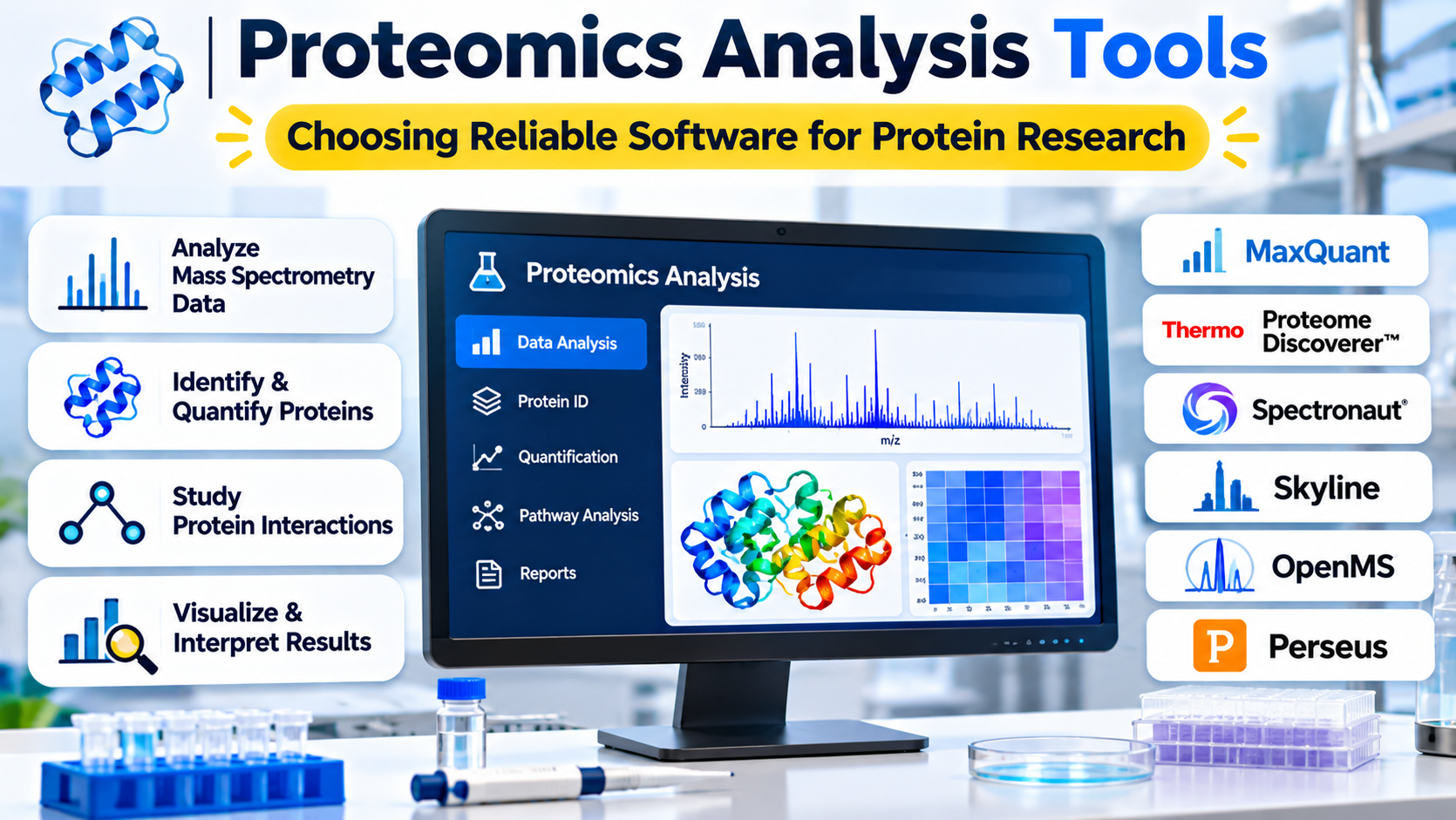
MaxQuant
MaxQuant is a quantitative proteomics software package designed for analyzing high-resolution mass spectrometry datasets.
It supports peptide identification and protein quantification through an integrated analytical workflow.
Its Andromeda search engine supports database-based peptide identification.
MaxQuant is particularly relevant to laboratories conducting established quantitative proteomics experiments.
Researchers can use it for supported label-free and labeling-based approaches.
The associated Perseus framework supports downstream analysis of quantitative data.
Where MaxQuant fits: Research laboratories seeking a mature workflow for protein identification and quantification.
What to examine: Instrument data compatibility, supported acquisition methods, computing requirements, parameter configuration, and downstream analysis needs.
MaxQuant should not be assumed to support every specialized experimental design without additional validation.
Skyline
Skyline is an open-source application widely used in targeted mass spectrometry analysis.
It provides tools for managing peptide targets, examining chromatograms, and evaluating quantitative measurements.
Its visual inspection capabilities are particularly important when researchers need to assess whether selected signals are suitable for measurement.
Skyline also supports broader quantitative mass spectrometry workflows, including certain DIA applications.
Where Skyline fits: Laboratories performing targeted proteomics and researchers who need detailed inspection of quantitative measurements.
What to examine: Compatibility with the acquisition method, target configuration, instrument files, and laboratory quality-control procedures.
A targeted analysis environment is not a direct replacement for every discovery proteomics workflow.
OpenMS
OpenMS is an open-source software ecosystem for mass spectrometry data analysis.
It provides algorithms, command-line tools, and programming interfaces that researchers can combine into analytical workflows.
Its modular architecture makes it useful for organizations developing reproducible pipelines.
Python bindings through pyOpenMS can help integrate mass spectrometry analysis into custom computational applications.
Where OpenMS fits: Bioinformatics teams, computational proteomics groups, and laboratories requiring flexible workflow development.
What to examine: Programming expertise, workflow maintenance, algorithm selection, and compatibility with existing infrastructure.
Its flexibility can require more technical effort than a predefined graphical workflow.
FragPipe
FragPipe provides an integrated environment for mass spectrometry-based proteomics analysis.
It brings together computational components for peptide identification, quantification, and related processing.
The platform is relevant to laboratories working with supported discovery proteomics workflows.
Where FragPipe fits: Teams seeking an integrated approach to peptide identification and quantitative analysis.
What to examine: Supported experimental designs, component versions, resource requirements, and appropriate validation datasets.
Researchers should assess the complete workflow rather than assuming every included algorithm is suitable for their experiment.
Proteome Discoverer
Thermo Scientific Proteome Discoverer is a commercial proteomics data analysis environment.
It supports configurable workflows for processing and interpreting mass spectrometry data.
It can be relevant to laboratories seeking a vendor-supported analytical environment.
Where it fits: Organizations that value an integrated commercial workflow and support arrangements.
What to examine: Instrument compatibility, licensing, supported analysis nodes, software modules, and total operating costs.
A commercial interface does not eliminate the need for scientific validation.
Comparing Proteomics Software by Research Need
| Software | Main emphasis | Suitable research environment |
|---|---|---|
| MaxQuant | Identification and quantitative proteomics | Discovery and quantitative research |
| Skyline | Targeted and quantitative analysis | Targeted assay development and review |
| OpenMS | Modular analysis and workflow development | Computational proteomics |
| FragPipe | Integrated proteomics processing | Discovery proteomics laboratories |
| Proteome Discoverer | Commercial analysis workflows | Laboratories seeking vendor-supported software |
These products are not identical substitutes.
A laboratory may use one platform for peptide identification, another for statistical analysis, and a separate environment for biological interpretation.
The most effective combination depends on the complete research workflow.
Protein Identification Is an Inference Problem
Mass spectrometry generally measures signals associated with peptides rather than directly observing complete proteins.
Software attempts to identify peptide sequences by comparing experimental evidence with candidate sequences or other reference information.
Protein inference then connects peptide evidence to possible proteins.
This introduces ambiguity.
Some peptides occur in multiple proteins. Others may be difficult to detect consistently.
Consequently, a reported protein identification may depend on shared peptides, database composition, and inference rules.
Researchers should examine how software handles these cases.
A simple count of identified proteins is not sufficient evidence that one analysis method is scientifically superior.
Understanding False Discovery Rate
Proteomics software commonly uses false discovery rate, or FDR, estimation to control identification errors.
One widely used approach involves comparing matches against target and decoy sequences.
However, an estimated FDR depends on the method, data, and assumptions.
Researchers should understand whether thresholds apply at the peptide-spectrum match, peptide, or protein level.
These levels are related but not interchangeable.
An identification threshold that is suitable for exploratory research may not be sufficient for every downstream application.
Quality assessment should also consider the experimental design and intended use of the findings.
Quantification Requires More Than Measuring Signal Intensity
Protein abundance estimates are influenced by sample preparation, instrument performance, peptide characteristics, and computational processing.
A quantitative workflow may include normalization, missing-value handling, and aggregation from peptides to proteins.
Each choice can affect the final result.
For example, normalization may help correct systematic differences between samples.
However, an inappropriate normalization assumption can also remove genuine biological variation.
Missing measurements present another challenge.
A missing peptide signal does not necessarily mean the protein is absent.
The software should help researchers distinguish measurement limitations from biological interpretation.
Statistical Analysis and Biological Replication
Proteomics studies often compare protein abundance across experimental conditions.
A common mistake is treating technical measurements as independent biological replicates.
Biological replication captures variation between independent biological samples.
Technical replication helps assess measurement variation.
These serve different purposes.
Statistical analysis should reflect the experimental design, including paired samples, batch effects, and repeated measurements where applicable.
Researchers should also account for multiple testing when evaluating many proteins.
A statistically significant result does not automatically establish biological importance.
Effect sizes, measurement uncertainty, and independent evidence matter.
Instrument Compatibility and Data Formats
Proteomics laboratories frequently operate instruments from different manufacturers.
Raw data formats can vary.
Some software supports particular vendor formats directly. Other workflows require conversion into an open format such as mzML.
Conversion may improve interoperability, but researchers should verify whether important metadata is preserved.
Software selection should consider:
- Supported instrument data
- Required file conversion
- Acquisition method compatibility
- Metadata preservation
- Batch processing capabilities
- Data export formats
- Reproducibility of processing
A tool that performs well on a demonstration dataset may be unsuitable for the laboratory’s actual instrument output.
Building a Reproducible Proteomics Workflow
A reliable workflow begins before data analysis.
Researchers should document sample preparation, instrument acquisition settings, biological replication, and experimental conditions.
During computational processing, they should preserve software versions, search databases, parameters, and filtering thresholds.
Database versions are particularly important.
Changes to protein sequence databases can affect identification results.
Quantitative processing should also be documented.
Researchers should record normalization methods, missing-value treatment, and statistical models.
Where practical, automated workflows can reduce manual variation.
However, automation should include appropriate quality checks rather than silently processing questionable samples.
Open-Source and Commercial Software Trade-Offs
Open-source software can provide flexible access to scientific methods and support custom workflows.
It may be attractive to academic laboratories and computational research groups.
However, internal expertise remains necessary.
Installation, maintenance, troubleshooting, and validation consume time.
Commercial software may offer vendor support, integrated interfaces, and defined licensing arrangements.
These features can be useful for laboratories that prefer centrally managed software.
The relevant comparison is total operating cost.
That includes licensing, computing resources, training, maintenance, and scientific review.
How to Run a Meaningful Software Evaluation
A proteomics software pilot should use representative laboratory data.
Begin with a clearly defined experiment and expected analytical outcomes.
Evaluate the software’s ability to process raw data, identify peptides, quantify proteins, and generate interpretable reports.
Compare results using appropriate reference information or established benchmark samples where available.
Record the time required for configuration, execution, quality review, and troubleshooting.
Assess whether researchers can investigate unexpected results.
A platform that generates impressive summary statistics but obscures its analytical assumptions may be difficult to trust.
The pilot should also examine whether outputs can be exported for independent analysis.
Common Mistakes When Selecting Proteomics Tools
Choosing by Identification Count Alone
More identifications do not automatically mean better analytical accuracy.
Researchers should evaluate identification confidence and reproducibility.
Ignoring Acquisition Methods
DDA, DIA, and targeted workflows require different analytical capabilities.
A tool should be assessed against the actual experiment.
Overlooking Statistical Design
Software cannot correct every weakness in sample selection or biological replication.
Experimental design remains foundational.
Assuming Automation Guarantees Quality
Automated pipelines can reproduce inappropriate assumptions consistently.
Quality review remains necessary.
Underestimating Long-Term Maintenance
Research projects may continue for years.
Teams need access to software versions, parameters, and reference data to reproduce earlier results.
Final Considerations
Proteomics analysis software should be selected according to the evidence researchers need to produce.
MaxQuant, Skyline, OpenMS, FragPipe, and commercial environments address overlapping but distinct analytical needs.
No single product is automatically the best choice for every laboratory.
A defensible decision begins with the experimental method, proceeds through scientific validation, and considers operational requirements.
The goal is not simply to generate more protein identifications or attractive visualizations.
It is to produce measurements and interpretations that researchers can examine, reproduce, and use with confidence.