Introduction
A hospital cannot function as a collection of isolated departments.
When a patient arrives, registration staff create an encounter. Clinicians assess the patient. Laboratory and imaging teams perform tests. Pharmacy staff manage medications. Finance teams process charges and payments.
These activities depend on shared information.
If each department operates in a separate system, staff may need to enter the same information repeatedly. Important updates may arrive late, and administrators may struggle to understand what is happening across the organization.
Hospital information systems help coordinate these activities.
But a hospital information system is not simply a large electronic medical record. It must connect clinical care with patient movement, departmental operations, resource management, and financial processes.
Choosing the right architecture is therefore as important as selecting individual features.
What Is a Hospital Information System?
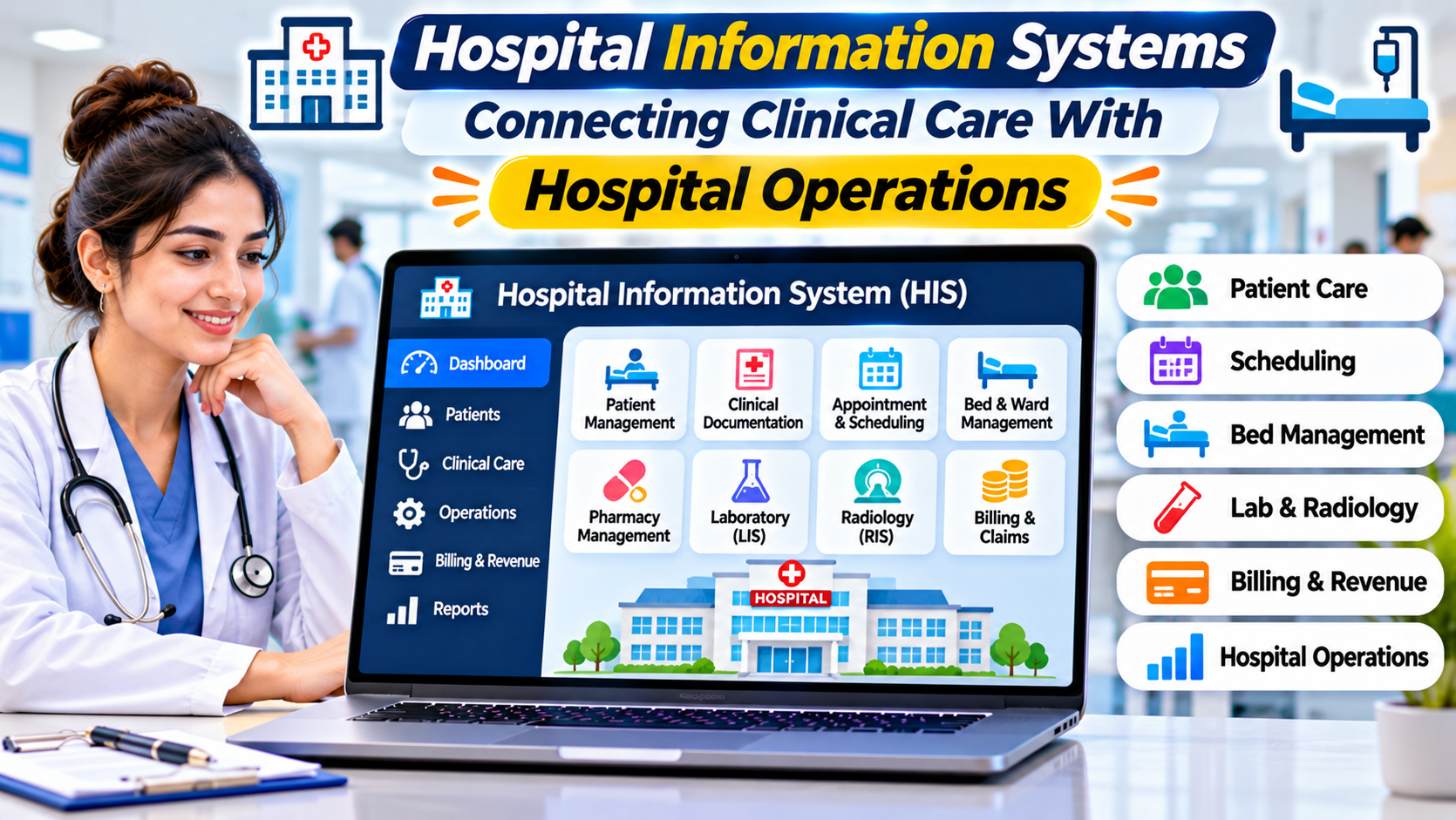
A hospital information system, or HIS, is a collection of software capabilities used to manage clinical, administrative, and operational information within a hospital.
Depending on the implementation, an HIS may include a unified platform or multiple integrated applications.
Its functions can span the patient journey from registration to discharge and subsequent billing.
Common components include:
- Patient registration and identification
- Admission, discharge, and transfer management
- Electronic clinical records
- Outpatient and inpatient workflows
- Laboratory information management
- Radiology and imaging coordination
- Pharmacy operations
- Medication administration
- Operating theater scheduling
- Bed and ward management
- Billing and revenue-cycle processes
- Inventory and supply management
- Management reporting
Not every hospital uses one vendor for all these functions.
Many organizations operate a combination of specialized systems connected through interfaces.
The challenge is ensuring that these applications share information reliably.
HIS, EHR, and ERP: Where the Boundaries Lie
Hospital technology categories overlap, but they solve different problems.
An electronic health record primarily manages clinical information and supports patient care.
An HIS coordinates a broader range of hospital workflows, which may include EHR functions.
Enterprise resource planning, or ERP, software focuses on organizational resources such as finance, procurement, inventory, and human resources.
A hospital may use an EHR as the clinical core of its HIS while relying on an ERP platform for business operations.
Alternatively, a hospital may adopt a broader suite that includes many of these capabilities.
Buyers should not assume that a product marketed as an HIS automatically provides sophisticated functionality in every department.
The actual module scope matters.
Following the Patient Journey Through an HIS
The easiest way to understand hospital information systems is to examine how information moves during a typical admission.
Registration and Patient Identification
Registration establishes the patient’s identity and creates the appropriate encounter.
The system may capture demographics, contact information, insurance details, and relevant administrative data.
Accurate patient identification is foundational.
Duplicate records or incorrect identifiers can affect orders, results, and billing.
A hospital should have procedures for detecting and resolving patient identity problems.
Admission and Bed Allocation
When a patient requires inpatient care, staff must coordinate admission and assign a suitable bed.
Bed management may depend on ward availability, clinical requirements, infection-control considerations, and staffing.
An HIS can help present operational information.
However, automated availability indicators are only useful when underlying records are updated accurately.
Clinical Assessment and Orders
Clinicians document findings and request investigations or treatment.
The system may support clinical notes, orders, medication workflows, and access to historical information.
These functions must reflect clinical responsibilities and authorization rules.
Diagnostic Services
Laboratory and radiology departments receive requests, perform examinations, and return results.
Reliable integration ensures that the results are associated with the correct patient and encounter.
Treatment and Medication Administration
Clinical teams need access to current treatment instructions and medication records.
Depending on the system, electronic medication administration workflows may support documentation and safety checks.
Technology should reinforce clinical processes without introducing confusing or unsafe workarounds.
Discharge and Billing
Discharge involves clinical instructions, medication reconciliation, follow-up arrangements, and administrative closure.
Billing teams may need information about services, supplies, procedures, and payer arrangements.
Poor coordination can delay discharge or create financial errors.
A connected HIS should help the organization identify and resolve these dependencies.
The Core Architecture of a Hospital Information System
A modern HIS is rarely a single isolated application.
It usually involves several layers of technology.
Clinical Application Layer
This layer supports patient records, orders, documentation, and care workflows.
It must be designed around the needs of clinicians and patients.
Departmental Systems
Specialist applications may manage laboratory operations, radiology workflows, pharmacy inventory, or surgical scheduling.
These systems often have requirements that general-purpose hospital software cannot fully address.
Integration Layer
An integration engine or equivalent architecture coordinates data exchange between applications.
It may transform messages, route information, and monitor interface failures.
The integration layer is especially important in hospitals with multiple vendors.
Data and Reporting Layer
Operational and analytical systems combine information for reporting.
Hospitals may use dashboards to examine bed occupancy, turnaround times, financial activity, or service demand.
These reports require consistent definitions.
A metric called length of stay may produce different results if departments use different calculation rules.
Security and Identity Layer
Hospitals must control access across many professional roles.
The security architecture should address authentication, authorization, audit logging, and system administration.
These controls need to function across the connected environment.
Hospital Information System Platforms to Investigate
The following vendors and technologies illustrate different hospital technology strategies.
Epic
Epic provides enterprise clinical information technology used by hospitals and health systems.
Its applications support a broad range of patient care workflows.
Relevant use case: Hospitals seeking an enterprise clinical platform that can serve as a central component of their information environment.
Evaluation priority: Clinical scope, specialty requirements, integration architecture, implementation capacity, and long-term costs.
Epic’s clinical capabilities should not be confused with complete coverage of every hospital ERP function.
Oracle Health
Oracle Health provides clinical information systems and related healthcare technology.
Its offerings are relevant to hospitals evaluating enterprise patient records and connected care workflows.
Relevant use case: Hospitals considering enterprise clinical systems and broader integration requirements.
Evaluation priority: Product-specific capabilities, implementation services, interoperability, and deployment arrangements.
Hospitals should verify available functionality rather than rely on future product plans.
MEDITECH Expanse
MEDITECH Expanse provides integrated healthcare information technology for hospitals and other care settings.
Relevant use case: Hospitals seeking a coordinated clinical information environment.
Evaluation priority: Departmental workflows, supported modules, integration needs, and operational support.
The precise scope depends on the product configuration and deployment.
InterSystems TrakCare
InterSystems TrakCare is a healthcare information system designed to support clinical and administrative workflows.
It is relevant to organizations evaluating integrated patient and hospital information management.
Relevant use case: Healthcare organizations seeking a broad clinical and administrative platform.
Evaluation priority: Regional availability, localization, implementation scope, and integration requirements.
Hospitals should confirm which functions are available and supported in their jurisdiction.
Open-Source and Modular Approaches
Some organizations investigate open-source or modular systems for selected hospital functions.
Projects such as OpenMRS focus on electronic medical records and healthcare information management.
However, an EMR project is not automatically a complete hospital information system.
Organizations using modular approaches must account for integration development, operational support, and clinical governance.
This strategy may offer flexibility but can require substantial internal expertise.
Comparing Hospital Technology Strategies
| Strategy | Potential advantage | Important limitation |
|---|---|---|
| Broad enterprise clinical suite | More coordinated clinical workflows | Significant implementation and configuration demands |
| Integrated hospital information platform | Clinical and administrative coverage | Module depth and regional support may vary |
| Best-of-breed departmental systems | Specialized functionality | Greater integration and governance complexity |
| Custom or open-source architecture | Flexibility and deployment control | High maintenance and support responsibilities |
The right architecture depends on hospital size, existing technology, specialist services, and available resources.
Interoperability Across Hospital Departments
A hospital may connect dozens of systems.
These applications must exchange information without losing clinical meaning.
HL7 messaging is commonly used for patient administration, orders, and results.
FHIR supports structured healthcare data exchange through modern interfaces.
DICOM is central to many medical imaging workflows.
Hospitals may also rely on national or regional healthcare exchange frameworks.
Technical compatibility is only one part of interoperability.
The organization must define which system owns each piece of information.
For example, the admission system may be authoritative for encounter status, while a laboratory system manages specimen processing.
Without clear ownership, departments may create conflicting records.
Master Patient Identity and Encounter Management
Patient identification is one of the most consequential HIS design decisions.
A hospital may assign internal identifiers to patients and encounters.
External systems may use different identifiers.
An enterprise master patient index or equivalent capability can help connect records that refer to the same person.
However, automated matching may produce false matches or fail to recognize valid matches.
Hospitals need procedures for reviewing uncertain identities.
Incorrectly merging records can create serious clinical and privacy risks.
The system should also distinguish the patient from a specific visit or admission.
A single patient may have many encounters over time.
Confusing these concepts can affect orders, results, and financial records.
Managing Laboratory and Radiology Workflows
Laboratory and radiology departments have specialized operational needs.
A laboratory information system may manage specimen accessioning, processing, quality control, and result reporting.
A radiology information system may coordinate examination orders, scheduling, status tracking, and reporting.
A picture archiving and communication system manages medical images.
An HIS should integrate with these applications appropriately.
Replacing every departmental system with a generic module may not be practical.
Hospital leaders should evaluate whether specialized workflows are better served by integrated modules or dedicated applications.
Pharmacy and Medication Safety
Hospital pharmacy operations involve medication ordering, verification, dispensing, inventory, and administration.
Different professionals participate at different stages.
A connected information environment should preserve clear responsibilities.
Medication workflows require attention to dosage, allergies, interactions, patient identity, and administration records.
However, the presence of electronic checks does not eliminate clinical risk.
Poor configuration, excessive alerts, and inaccurate source data can create new problems.
Clinical pharmacists and nursing representatives should participate in system design and testing.
Bed Management and Operational Visibility
Hospitals need accurate information about bed availability and patient movement.
A bed may be physically empty but unavailable because it requires cleaning or lacks appropriate staffing.
An HIS should distinguish operational availability from simple occupancy.
Dashboards can support coordination between admissions, nursing, housekeeping, and clinical teams.
However, reports become unreliable when status updates are delayed.
Operational visibility depends on both software and disciplined processes.
Billing, Finance, and Supply Management
Clinical activity has financial consequences.
Hospital systems may capture charges associated with procedures, medications, supplies, and services.
The relevant workflows depend on local payment models and regulations.
Inventory systems may also track consumables and other supplies.
Integration between clinical activity and financial systems can reduce duplicate entry.
However, organizations must define how charge capture, adjustments, and reconciliation work.
Financial automation should not compromise clinical documentation accuracy.
Security and Business Continuity
Hospitals operate continuously and cannot treat system downtime as a minor inconvenience.
An HIS requires a comprehensive availability and recovery strategy.
This may include:
- Redundant infrastructure where appropriate
- Tested backup procedures
- Disaster recovery arrangements
- Downtime documentation workflows
- Network resilience
- Access controls
- Security monitoring
- Incident response procedures
- Recovery testing
Healthcare organizations should also consider the consequences of ransomware and other cyber incidents.
A backup is only useful when restoration can be performed successfully.
Regular testing is essential.
Why Hospital Information System Implementations Fail
Large hospital technology projects involve more than technical deployment.
They change clinical and administrative work.
Common sources of difficulty include unclear requirements, weak governance, insufficient training, and inadequate integration testing.
A hospital may also underestimate the complexity of migrating historical data.
Another problem arises when different departments make independent configuration decisions without considering organization-wide effects.
Successful implementation requires a shared governance model.
Clinical leaders, administrative teams, information technology staff, and departmental specialists must participate.
A Phased Implementation Approach
Establish the Operating Model
Identify the hospital’s clinical services, organizational structure, and major workflows.
Document which systems currently support each function.
Define System Ownership
Determine which applications will maintain patient identity, clinical records, orders, results, and financial information.
Clear ownership reduces conflicting data.
Prioritize High-Risk Integrations
Test interfaces involving patient identification, medication, laboratory results, and clinical orders carefully.
Failures in these areas may have serious consequences.
Validate Data Migration
Review the completeness and accuracy of transferred records.
Include clinical users in validation.
Train by Role
Physicians, nurses, pharmacists, laboratory staff, and administrative users require different training.
Generic training is rarely sufficient.
Prepare for Go-Live and Downtime
Establish support coverage, escalation procedures, and contingency workflows.
The hospital should know how essential care will continue if systems become unavailable.
Monitor Operational Outcomes
After implementation, measure system issues and workflow performance.
Investigate unintended consequences rather than assuming the project is complete at launch.
How to Evaluate HIS Vendors
A useful procurement process should examine the full hospital environment.
Ask vendors to demonstrate a connected patient journey rather than isolated screens.
The demonstration should include registration, admission, clinical orders, departmental processing, results, discharge, and billing.
Require clear explanations of integration dependencies.
Review security responsibilities, data export rights, and contractual service commitments.
Evaluate implementation partners as carefully as the software itself.
A technically capable product may still be unsuitable if local support or deployment resources are insufficient.
Final Thoughts
Hospital information systems are the connective infrastructure of modern hospital operations.
They bring together clinical care, patient movement, departmental services, and administrative processes.
The strongest HIS strategy does not necessarily place every function inside one application.
It creates a dependable environment in which information reaches the right people and systems at the right time.
Hospitals should prioritize clinical safety, clear data ownership, interoperability, operational resilience, and realistic implementation planning.
When those foundations are sound, technology can support better coordination without forcing staff to work around the system.