Introduction
A healthcare claim can fail long before it reaches an insurance payer.
The patient’s coverage may be recorded incorrectly. A procedure code may not match the documentation. A required authorization may be missing. A claim may contain a formatting error that prevents processing.
These problems create additional work for medical practices and billing teams.
Medical billing and coding software helps organizations manage the administrative and financial processes associated with healthcare services.
However, billing software and coding software solve different problems.
One focuses on converting services into claims, collecting payments, and managing accounts. The other helps professionals assign and validate standardized codes that describe diagnoses, procedures, and services.
The strongest technology strategy connects these activities without treating automation as a substitute for accurate clinical documentation or professional judgment.
Understanding Medical Billing and Coding Software
Medical billing software supports the financial processes associated with healthcare services.
It may help staff verify coverage, prepare claims, submit transactions, track payer responses, post payments, and manage patient balances.
Medical coding software supports the classification of diagnoses, procedures, and other healthcare information using standardized code sets.
These functions often operate together.
A billing platform may include coding assistance, while a coding application may integrate with an electronic health record or revenue-cycle management system.
The software market includes several overlapping categories:
- Practice-management systems
- Medical billing applications
- Revenue-cycle management platforms
- Computer-assisted coding software
- Coding reference and validation tools
- Claims clearinghouse services
- Denial management systems
- Patient payment platforms
A buyer should identify the actual workflow problem before comparing vendors.
The Difference Between Billing and Coding
Medical coding translates documented clinical information into standardized classifications.
Medical billing uses appropriate coded and administrative information to prepare claims and support payment collection.
For example, a clinician documents a patient encounter.
A coding professional or authorized workflow assigns applicable diagnosis and service codes based on the documentation and coding rules.
The billing system then combines those codes with patient, provider, payer, and encounter information.
The claim is checked and transmitted through the appropriate process.
The payer may accept, reject, deny, or pay the claim according to applicable rules and contractual arrangements.
Each stage has different responsibilities.
A correct code does not guarantee payment.
Likewise, a claim that passes an automated validation check may still contain unsupported coding.
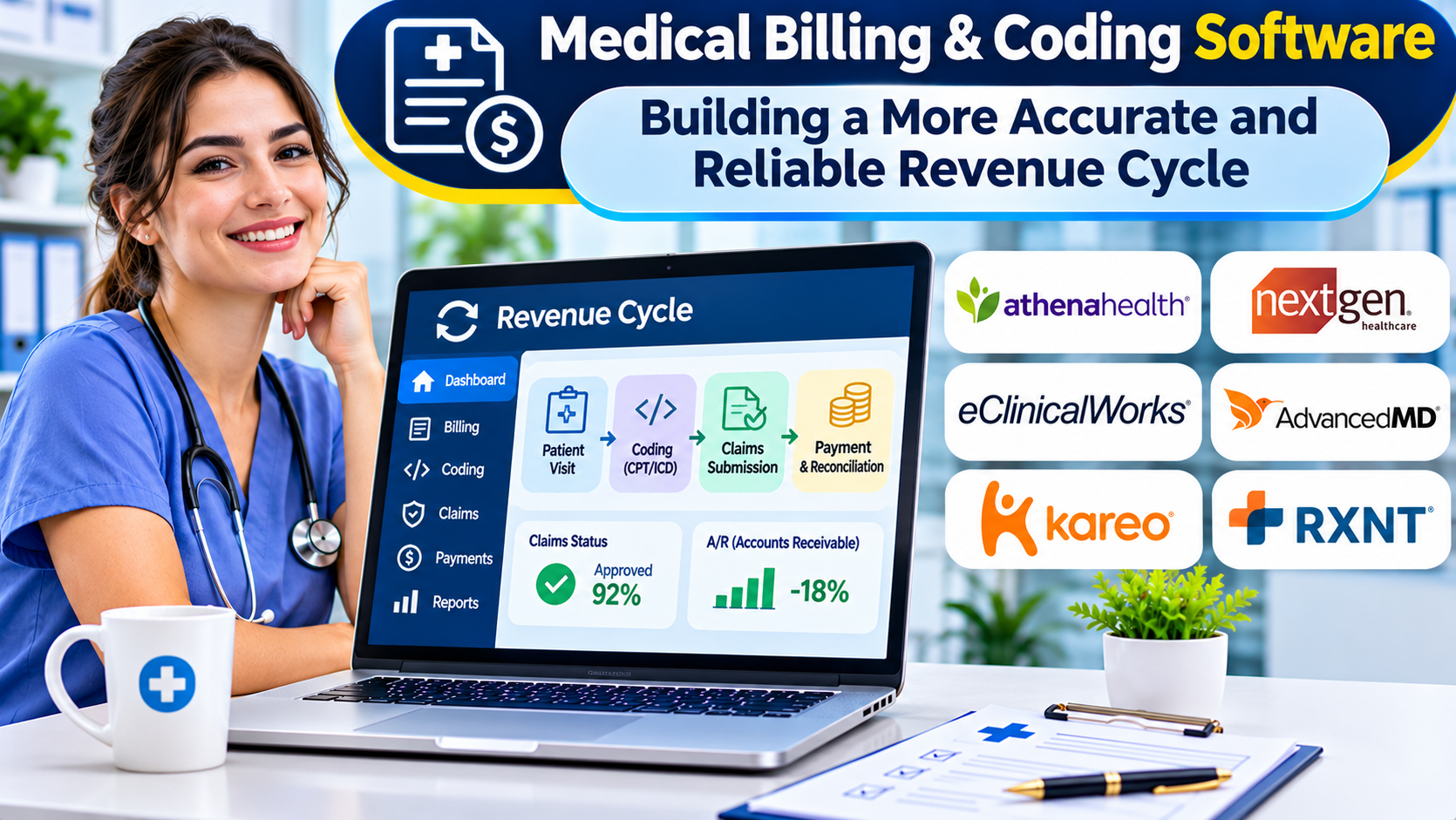
How the Medical Revenue Cycle Works
Understanding the revenue cycle is essential to evaluating software.
Patient Registration
The process begins with accurate patient information.
Staff may collect demographics, insurance details, and other information required for billing.
Errors at this stage can affect later claims.
Eligibility and Benefits Verification
Billing systems may support electronic eligibility inquiries.
These transactions can help organizations confirm coverage information.
However, an eligibility response does not necessarily guarantee payment for a particular service.
Coverage rules, authorization requirements, and payer policies may still apply.
Prior Authorization
Some services require authorization before they are provided.
Software may help track requests and responses.
Authorization workflows vary by payer, service, and jurisdiction.
Organizations should not assume that all prior authorizations can be automated through one interface.
Clinical Documentation and Coding
The medical record provides the basis for coding.
Codes must be supported by the documentation and applicable rules.
Coding software can assist with reference information and validation.
It should not encourage users to select codes merely because they produce higher reimbursement.
Charge Capture
Charge capture identifies billable services and associated information.
Missing charges can reduce revenue.
Incorrect charges can create compliance risks and patient billing problems.
Claim Preparation and Submission
Billing software assembles claim information and applies validation checks.
Claims may be submitted electronically through a clearinghouse or other supported channel.
Payer Adjudication
The payer evaluates the claim according to applicable coverage and payment rules.
The outcome may involve payment, denial, rejection, or requests for additional information.
Payment Posting and Reconciliation
Payments and adjustments must be recorded accurately.
Electronic remittance information can support automated posting.
However, exceptions may require manual review.
Denial Management and Follow-Up
Billing teams investigate unpaid or denied claims.
They may correct errors, submit additional information, or appeal decisions where appropriate.
Effective software should help staff understand the reason for each issue.
The Coding Standards That Matter
Medical coding requirements vary by country and healthcare setting.
In the United States, several code sets play important roles.
ICD-10-CM
ICD-10-CM is used to classify diagnoses in relevant U.S. healthcare settings.
Coding professionals must use the applicable code set and official guidance.
CPT
Current Procedural Terminology, or CPT, describes medical procedures and services.
CPT is maintained by the American Medical Association.
Organizations should understand applicable licensing requirements when using CPT content.
HCPCS Level II
HCPCS Level II includes codes for certain products, supplies, and services not represented by CPT in the same way.
ICD-10-PCS
ICD-10-PCS is used for inpatient procedure coding in applicable U.S. hospital reporting contexts.
It is not interchangeable with CPT.
Different payment settings require different coding approaches.
Software should support the codes and rules relevant to the organization’s services.
Why Coding Accuracy Is More Than Code Lookup
A code search tool can help a user locate a possible classification.
It cannot automatically establish that the code is correct for a particular encounter.
Coding may depend on documentation details, sequencing rules, modifiers, exclusions, and payer-specific requirements.
A diagnosis mentioned in a record may not always be reportable in the same way across settings.
A procedure code may require supporting details about the service performed.
Coding software should help professionals identify relevant rules and missing information.
It should also preserve a clear record of changes.
An unexplained code suggestion is difficult to evaluate.
Medical Billing Software Options Worth Evaluating
The following products illustrate different parts of the billing and coding market. They should not be treated as identical alternatives.
athenaOne
athenaOne combines ambulatory clinical and practice-related capabilities.
Its broader environment includes revenue-cycle functions relevant to outpatient organizations.
Suitable use case: Medical practices seeking connected clinical and billing workflows.
Important consideration: Buyers should examine service arrangements, billing responsibilities, and the exact functionality included in their agreement.
AdvancedMD
AdvancedMD provides practice-management, electronic health record, and medical billing technology.
It is relevant to ambulatory organizations evaluating integrated operational workflows.
Suitable use case: Practices that need scheduling, billing, and clinical system coordination.
Important consideration: Evaluate implementation requirements, available integrations, and the division of responsibilities between software and billing services.
Tebra
Tebra provides software and services for independent healthcare practices.
Its offerings include capabilities relevant to practice administration and billing.
Suitable use case: Independent practices seeking coordinated administrative and patient-facing workflows.
Important consideration: Verify the modules, payment services, and revenue-cycle capabilities included in the proposed package.
Waystar
Waystar focuses on healthcare payments and revenue-cycle technology.
Its capabilities are relevant to organizations managing claims and financial workflows.
Suitable use case: Healthcare providers evaluating specialized revenue-cycle infrastructure.
Important consideration: Determine how the platform connects with existing EHR, practice-management, and financial systems.
Optum Revenue Cycle Solutions
Optum offers revenue-cycle and related healthcare technology and services.
Its portfolio may be relevant to organizations evaluating billing operations and specialized financial workflows.
Suitable use case: Healthcare organizations seeking revenue-cycle technology or services.
Important consideration: Clarify which capabilities are software, which involve managed services, and how data and operational responsibilities are divided.
Medical Coding Tools and Computer-Assisted Coding
Coding applications serve a different purpose from general billing platforms.
AAPC Codify
Codify is a coding reference and research platform associated with AAPC.
It supports professionals who need access to coding information and related resources.
Suitable use case: Coding teams seeking reference materials and code research capabilities.
Important consideration: Confirm the available code sets, references, subscriptions, and workflow features.
3M Coding and Reimbursement Technology
Coding and reimbursement technologies associated with 3M’s healthcare information systems business have been used in professional coding workflows.
These capabilities are associated with the Solventum healthcare technology portfolio.
Suitable use case: Organizations evaluating professional coding support and reimbursement-related workflows.
Important consideration: Confirm current product branding, deployment arrangements, licensing, and integration requirements directly with the provider.
Computer-Assisted Coding Systems
Computer-assisted coding, commonly called CAC, uses software to analyze clinical documentation and suggest relevant codes.
Some systems use natural language processing or machine learning.
These tools may reduce manual searching and support coding review.
However, their suggestions depend on documentation quality, supported specialties, and underlying models.
Organizations should validate coding outputs against appropriate professional review.
Comparing Software by Function
| Software category | Main purpose | Key evaluation priority |
|---|---|---|
| Practice-management and billing | Claims, accounts, scheduling, and payments | Operational fit and EHR integration |
| Revenue-cycle management | Financial workflows across the claim lifecycle | Denial handling and workflow visibility |
| Coding reference software | Code research and rule interpretation | Authoritative, current coding content |
| Computer-assisted coding | Suggested codes from documentation | Accuracy and human review |
| Clearinghouse services | Claims transaction processing | Payer connectivity and rejection handling |
A healthcare organization may use products from several categories.
The objective is not necessarily to consolidate every function into one platform.
It is to create an accurate, auditable workflow.
Claim Scrubbing and Validation
Claim scrubbing checks claims for certain errors before submission.
Depending on the system, checks may identify missing fields, invalid codes, incompatible information, or formatting problems.
These checks can reduce preventable rejections.
However, claim scrubbing is not a guarantee of reimbursement.
A technically valid claim may still be denied because of coverage rules, documentation requirements, medical necessity policies, or other factors.
Organizations should evaluate whether validation rules can be maintained as requirements change.
They should also examine how exceptions are presented to staff.
A system that generates hundreds of unclear warnings may create more work than it saves.
Clearinghouse Integration
A claims clearinghouse helps route and process electronic healthcare transactions.
In the United States, electronic claims commonly use standardized transaction formats such as the HIPAA-adopted X12 837 transaction.
Other transaction types support eligibility, claim status, and payment information.
Billing software may connect directly with a clearinghouse or include clearinghouse services through a commercial arrangement.
Buyers should verify:
- Supported payers
- Transaction types
- Rejection reporting
- Enrollment requirements
- Transaction charges
- Claim status capabilities
- Support procedures
- Data export options
Payer connectivity should be verified for the organization’s actual payer mix.
Denial Management: Where Software Can Deliver Practical Value
Denied claims require investigation and follow-up.
A useful denial management system should help teams understand why claims were denied and which actions are required.
It may group denials by payer, service, reason, or responsible work queue.
However, denial categories need careful interpretation.
A rejection caused by missing information differs from a denial based on coverage or medical necessity.
Software should preserve those distinctions.
Organizations should also examine whether recurring denial patterns reveal upstream problems.
For example, repeated authorization denials may indicate a weakness in scheduling or pre-service verification.
Fixing the source of the problem is often more valuable than processing each denial faster.
Measuring Billing Performance
Financial dashboards can help organizations identify workflow problems.
Useful metrics may include:
Clean Claim Rate
This measures claims that pass a defined standard of completeness or acceptance without requiring correction.
Organizations must define the measure consistently.
Initial Denial Rate
This indicates the proportion of claims denied at an initial adjudication stage under the organization’s reporting definition.
The denominator and classification rules matter.
Days in Accounts Receivable
This metric helps describe how long revenue remains outstanding.
It should be interpreted alongside payer mix, service types, and organizational conditions.
Net Collection Rate
This measures collections relative to collectible amounts under the organization’s accounting definition.
It requires accurate adjustment and contractual allowance data.
Cost to Collect
This helps evaluate the resources required to collect revenue.
Software costs, staffing, outsourcing, and administrative work may all contribute.
No single metric captures the entire revenue-cycle performance.
A low denial rate is less meaningful if claims are not being submitted accurately or promptly.
Integrating Billing With Clinical Systems
Billing information depends on clinical and administrative data.
A practice-management system may receive patient demographics and encounter details from an EHR.
Coding tools may rely on clinical documentation.
Payment systems may update patient balances.
These connections need clear ownership and reconciliation procedures.
If a patient record changes in one system, the organization must understand whether and how the update reaches other applications.
Interfaces should be tested for duplicate transactions, missing information, and failed messages.
A technically connected environment is not necessarily a reliable one.
Automation and AI in Medical Coding
Automation can help staff identify missing information, route work, and suggest codes.
AI-based tools may analyze documentation or classify claims.
These capabilities can be useful, but their outputs require validation.
A model may misinterpret clinical language, miss context, or suggest a code that is not supported by the record.
Organizations should assess performance across relevant specialties and encounter types.
They should also establish review procedures for uncertain or high-risk cases.
Coding automation must not become a mechanism for unsupported billing.
Accuracy, auditability, and appropriate professional oversight are essential.
Compliance and Audit Readiness
Medical billing and coding operate within a regulated environment.
In the United States, organizations must consider applicable healthcare privacy, transaction, coding, and billing requirements.
Other jurisdictions have different rules.
Software should support appropriate access controls, audit records, and retention policies.
It should also help users trace changes to claims and codes.
A useful audit trail may identify who made a change, what changed, and when it occurred.
However, software features alone cannot establish compliance.
Organizations need policies, training, monitoring, and professional oversight.
Understanding Pricing and Total Cost
Medical billing and coding software may use different commercial models.
Possible arrangements include subscriptions, user-based fees, transaction charges, or service agreements.
Outsourced billing services may use different fee structures from standalone software.
Buyers should request clear information about:
- Software subscriptions
- Implementation
- Data migration
- Clearinghouse transactions
- Coding reference licenses
- Payment processing
- Training and support
- Integration development
- Contract termination
- Data export
A low subscription price can become expensive if essential functions require additional services.
Total cost should be evaluated against realistic transaction volumes and operational requirements.
A Practical Software Evaluation Framework
A medical billing and coding software pilot should follow a representative claim through its lifecycle.
Begin with patient registration and eligibility verification.
Then review clinical documentation, code assignment, charge capture, and claim creation.
Test the system’s response to missing or inconsistent information.
Submit suitable test transactions where the available environment permits.
Examine payer responses, payment posting, and denial workflows.
The pilot should answer several practical questions.
Can staff identify errors before submission?
Can coders investigate suggested codes?
Can billing teams see why a claim was rejected or denied?
Can supervisors review work queues and unresolved balances?
Can the organization export the information needed for independent reporting?
The evaluation should include coders, billing specialists, clinical representatives, and finance staff.
Each group sees different operational risks.
Common Selection Mistakes
Confusing Coding Accuracy With Claim Acceptance
A claim can pass technical checks while containing incorrect or unsupported codes.
Coding quality and claim processing are separate concerns.
Selecting Software Without Reviewing Payer Workflows
The organization’s payer mix influences transaction requirements and follow-up processes.
A platform should be tested against relevant payers.
Assuming AI Eliminates Coding Review
Automated suggestions can be wrong.
Professional validation remains important, especially for complex encounters.
Ignoring Upstream Registration Problems
Billing errors often begin before coding or claim submission.
Software evaluation should include the full workflow.
Focusing Only on Collection Speed
Faster collections are valuable only when claims remain accurate and compliant.
Financial efficiency should not encourage inappropriate billing practices.
Choosing the Right Solution for Your Organization
A small outpatient practice may benefit from an integrated practice-management and billing platform.
A multispecialty group may need more advanced coding workflows and denial analytics.
A hospital may require enterprise revenue-cycle capabilities connected to complex inpatient and outpatient services.
A professional coding team may need specialized reference tools or computer-assisted coding technology.
These organizations should not evaluate every product against the same checklist.
The most useful selection criteria depend on transaction volume, clinical complexity, payer arrangements, staffing, and existing systems.
Final Thoughts
Medical billing and coding software plays an important role in healthcare financial operations.
It can help organizations prepare claims, manage payments, investigate denials, and support coding accuracy.
However, effective revenue-cycle management depends on the quality of the entire process.
Accurate patient information, complete clinical documentation, appropriate coding, reliable integrations, and disciplined follow-up all contribute to better results.
The right technology should make errors easier to detect, responsibilities easier to understand, and financial workflows easier to manage.
A successful implementation does more than accelerate claims processing. It helps the organization maintain a revenue cycle that is accurate, transparent, and sustainable.