Introduction
Collecting health measurements at home is becoming easier. Knowing what to do with those measurements remains difficult.
A connected blood pressure monitor may transmit readings automatically. A glucose monitoring system may produce frequent measurements. A weight scale may reveal changes that deserve attention.
But data collection alone does not improve care.
Someone must determine whether the measurements are reliable, whether they require clinical review, and how to respond when a patient’s condition changes.
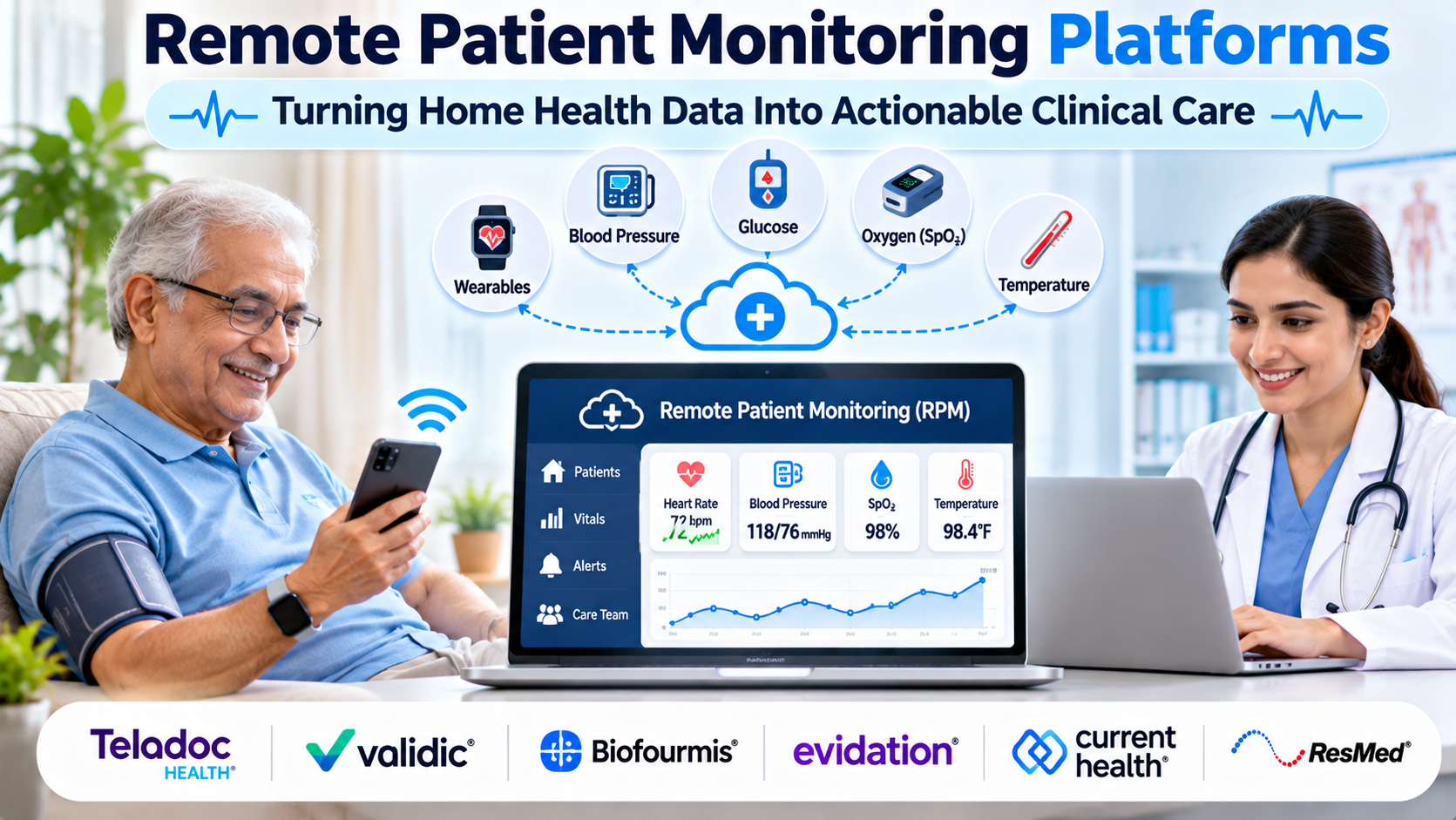
Remote patient monitoring platforms connect home-based measurements with healthcare workflows.
Choosing the right platform therefore involves much more than comparing devices or dashboards.
Healthcare organizations must evaluate clinical purpose, measurement quality, patient participation, alert management, security, integration, and operational responsibility.
What Is a Remote Patient Monitoring Platform?
A remote patient monitoring platform is a technology system used to collect, transmit, organize, and review health-related measurements obtained outside traditional clinical settings.
Depending on the program, measurements may come from connected medical devices, patient applications, or other supported sources.
Common monitoring applications involve:
- Blood pressure
- Blood glucose
- Body weight
- Heart rate
- Oxygen saturation
- Temperature
- Selected cardiac measurements
- Other condition-specific physiological data
The platform may present trends, generate alerts, support patient communication, and help care teams coordinate follow-up.
However, the exact functions depend on the devices, software, clinical program, and regulatory environment.
Remote patient monitoring should not be confused with a general wellness application.
A consumer health tracker and a clinically managed monitoring program may collect similar measurements but operate under very different expectations.
The Most Important RPM Question: Who Acts on the Data?
A remote monitoring program can generate large amounts of information.
That creates a responsibility problem.
If a patient submits an unusual measurement, who reviews it?
How quickly should it be reviewed?
What happens outside normal working hours?
What if the patient cannot be contacted?
What if the measurement is incorrect?
These questions should be answered before selecting a platform.
A dashboard does not create a clinical response process.
Successful RPM requires clearly defined roles, escalation procedures, and patient expectations.
How a Remote Patient Monitoring Program Works
A typical RPM workflow contains several stages.
Patient Enrollment
A healthcare professional or authorized team identifies patients who may benefit from monitoring.
The organization determines whether the program is appropriate for the patient’s clinical situation.
Enrollment may involve education, consent, device selection, and communication preferences.
Not every patient is suitable for every monitoring model.
Device Setup
Patients receive or obtain the required equipment.
They may need assistance pairing devices, connecting to a network, or learning how to take measurements.
Some programs use cellular-connected devices to reduce dependence on a patient’s smartphone.
Others rely on Bluetooth and a mobile application.
The appropriate approach depends on the patient population and operating environment.
Measurement Collection
The patient takes measurements according to the care plan.
Some devices transmit information automatically.
Others require manual steps.
The platform should preserve relevant context, such as measurement time and source.
Data Transmission
Measurements move from the device or application to the monitoring environment.
Transmission may depend on cellular networks, Wi-Fi, Bluetooth, or other supported connections.
Temporary connectivity problems can delay information.
Clinical Review
Care teams examine readings, trends, and alerts according to established protocols.
They may contact the patient, recommend further assessment, or follow an approved clinical workflow.
Documentation and Follow-Up
Relevant actions should be documented appropriately.
The organization should determine which information belongs in the EHR and how monitoring records are retained.
Common Clinical Use Cases
RPM programs are used in different care contexts.
The appropriate clinical value depends on patient selection, intervention design, and evidence for the particular use case.
Hypertension Management
Connected blood pressure monitors can help patients and clinicians review measurements obtained outside the clinic.
Repeated home readings may provide useful context.
However, measurement technique, device suitability, and clinical interpretation matter.
A single unusual reading does not automatically establish a diagnosis or treatment decision.
Diabetes Monitoring
Glucose monitoring technologies can support diabetes management.
Some systems provide frequent glucose measurements and trends.
However, continuous glucose monitoring and general-purpose RPM platforms are not identical categories.
Organizations must evaluate device-specific workflows, data access, and clinical responsibilities.
Heart Failure Follow-Up
Some programs monitor measurements such as weight and blood pressure.
Changes may contribute to clinical assessment when interpreted alongside symptoms and other information.
However, weight changes alone are not sufficient to determine every clinical action.
Monitoring protocols should reflect appropriate clinical evidence and professional judgment.
Post-Discharge Monitoring
Healthcare organizations may use remote measurements during selected recovery periods.
The aim may be to identify issues requiring follow-up or support care coordination.
Programs must define their monitoring duration, staffing, and escalation responsibilities.
Respiratory Monitoring
Pulse oximeters and other devices may provide relevant measurements for selected patients.
However, pulse oximetry has recognized limitations, and accuracy can vary with device characteristics and measurement conditions.
Clinicians should not rely on a single measurement without considering the broader clinical picture.
The Architecture of an RPM Platform
A useful RPM architecture includes more than a patient application.
Connected Devices
Devices capture physiological measurements.
Their suitability depends on the intended use and relevant regulatory requirements.
Connectivity Layer
The connectivity layer transfers measurements to the platform.
Reliable transmission and error handling are important.
Data Management Layer
The platform organizes measurements, timestamps, device identifiers, and patient associations.
It should distinguish valid observations from missing or questionable information.
Alert and Workflow Layer
Rules may identify measurements requiring attention.
These rules should align with the clinical program.
Clinical Review Interface
Care teams need a practical way to review trends, prioritize work, and document actions.
Integration Layer
Relevant information may be exchanged with an EHR or another clinical system.
The organization must define which data should be transferred and how.
Remote Patient Monitoring Platforms Worth Evaluating
RPM vendors vary in their clinical focus, devices, services, and deployment models.
The following examples represent different approaches rather than a ranked list.
Validic
Validic provides health data connectivity and remote monitoring technology.
Its platform is relevant to organizations seeking to bring patient-generated health data into healthcare workflows.
Where it fits: Healthcare organizations that need connected health data and monitoring capabilities.
Important consideration: Evaluate supported devices, integration arrangements, data quality, and the division of responsibilities between technology and clinical operations.
Health Recovery Solutions
Health Recovery Solutions provides remote monitoring and related patient care technology.
Its offerings are associated with remote care programs and patient monitoring workflows.
Where it fits: Healthcare organizations developing structured remote care programs.
Important consideration: Examine the supported devices, clinical workflows, staffing requirements, and service arrangements.
Biofourmis
Biofourmis provides technology associated with remote monitoring and connected care.
Its solutions have addressed clinical monitoring and care delivery use cases.
Where it fits: Organizations evaluating more specialized remote care programs.
Important consideration: Confirm current product availability, supported clinical applications, device arrangements, and service responsibilities.
Cadence
Cadence provides technology-enabled remote care and monitoring services.
Its model is relevant to organizations considering a combination of technology and operational support.
Where it fits: Healthcare providers exploring remote monitoring with associated clinical service arrangements.
Important consideration: Clarify the responsibilities of the healthcare organization and the service provider, including monitoring coverage and escalation.
Current Health
Current Health has offered remote patient monitoring and care-at-home technology.
Its capabilities have been associated with connected devices and remote care workflows.
Where it fits: Organizations investigating care-at-home monitoring models.
Important consideration: Verify current commercial availability, support arrangements, product scope, and contractual responsibilities before treating it as an active procurement option.
Comparing RPM Delivery Models
| Delivery model | Potential advantage | Main challenge |
|---|---|---|
| Software platform with provider-managed monitoring | Greater direct clinical control | Requires internal staffing and workflow management |
| Technology plus monitoring services | May reduce some operational burden | Requires clear contractual and clinical responsibilities |
| Device-centered monitoring solution | Can fit a specific measurement need | May offer limited broader care coordination |
| Custom integration architecture | Flexibility across devices and systems | Requires substantial technical and clinical governance |
No model is universally superior.
A healthcare organization with an established care management team may prefer to manage monitoring internally.
Another organization may require external operational support.
The decision should depend on clinical scope, staffing, and accountability.
Medical Device Quality and Regulatory Considerations
Not every connected health device is appropriate for every clinical application.
Organizations should examine the device’s intended use, measurement performance, and relevant regulatory status.
In the United States, the Food and Drug Administration regulates certain medical devices according to their characteristics and intended uses.
Other jurisdictions have their own requirements.
A platform vendor’s claim of device compatibility does not establish that every connected device is appropriate for clinical decision-making.
Healthcare organizations should verify device specifications and applicable requirements.
They should also consider calibration, maintenance, replacement, and patient training.
Why Measurement Quality Matters
Remote measurements can be affected by patient technique and device conditions.
For example, blood pressure readings may vary with cuff size, body position, and measurement procedure.
A scale may produce misleading trends if used inconsistently.
Connectivity problems can create gaps in data.
The platform should help distinguish a missing measurement from a normal measurement.
It should also preserve sufficient information to investigate unusual readings.
Data quality procedures are essential because incorrect measurements can lead to inappropriate decisions or unnecessary concern.
Alert Fatigue and Clinical Workload
An RPM platform may generate alerts when measurements cross predefined thresholds.
This can help prioritize review.
However, excessive alerts can overwhelm monitoring teams.
An alert threshold that is too sensitive may produce frequent notifications without meaningful clinical value.
A threshold that is too permissive may fail to identify relevant changes.
Organizations should establish alert rules with clinical oversight.
They should monitor alert volume, review times, and escalation outcomes.
The platform should support appropriate prioritization rather than treating every deviation as equally urgent.
Continuous Monitoring Versus Periodic Review
RPM programs differ in how frequently information is collected and reviewed.
Some devices produce continuous or frequent measurements.
Other programs rely on patients taking readings at scheduled intervals.
These distinctions affect staffing and patient expectations.
A device that transmits data continuously does not necessarily mean a clinical team is watching it continuously.
Healthcare organizations must communicate monitoring coverage clearly.
Patients should understand what the program does and does not provide.
They should also receive instructions for emergencies and urgent symptoms.
EHR Integration and Clinical Documentation
RPM information becomes more useful when relevant data can support clinical workflows.
However, importing every measurement into the EHR may create clutter.
Organizations should decide which information needs to appear in the longitudinal record.
Possible approaches include selected measurements, trend summaries, alerts, and documented clinical interventions.
FHIR and other integration methods may support data exchange.
The implementation should preserve patient identity, measurement units, timestamps, and relevant device information.
An incorrectly mapped measurement can be more dangerous than a missing integration.
Clinical and technical teams should jointly validate the data flow.
Patient Engagement and Device Adherence
An RPM program depends on patients participating.
A technically sophisticated platform may fail if patients cannot use the devices consistently.
Organizations should consider:
- Device setup complexity
- Physical accessibility
- Language support
- Connectivity requirements
- Battery charging
- Patient education
- Technical assistance
- Replacement procedures
- Caregiver involvement
Some patients may require assistance with routine measurements.
Others may prefer devices that transmit information without using a smartphone.
The most appropriate technology is often the one patients can use reliably.
Privacy and Cybersecurity
RPM platforms may transmit sensitive health information across several systems.
Data may move from a device to a mobile application, cloud service, monitoring dashboard, and EHR.
Each connection creates security responsibilities.
Organizations should evaluate encryption, authentication, access controls, logging, vendor management, and incident response.
They should also examine device lifecycle management.
A device may be lost, reassigned, or returned after a monitoring program ends.
Procedures should address removal of stored information and secure reassignment where applicable.
Privacy obligations depend on jurisdiction and the roles of the participating organizations.
Reimbursement and Financial Sustainability
Some healthcare systems provide reimbursement mechanisms for qualifying remote monitoring services.
However, eligibility, documentation, device requirements, service definitions, and billing rules vary.
In the United States, Medicare and other payers may apply specific requirements to remote monitoring services.
Organizations should verify current rules through authoritative payer guidance.
A platform should not be selected solely because a vendor claims its services are reimbursable.
The financial model should account for:
- Devices
- Connectivity
- Software fees
- Patient onboarding
- Clinical monitoring time
- Technical support
- Device replacement
- Documentation
- Billing administration
- Unreimbursed activities
A financially sustainable program requires realistic assumptions about both revenue and operating costs.
Measuring RPM Program Effectiveness
A remote monitoring program should have clearly defined objectives.
These may involve patient participation, clinical follow-up, operational efficiency, or other appropriate outcomes.
Enrollment and Activation
Measure whether eligible patients successfully begin monitoring.
Data Completeness
Examine whether expected measurements arrive consistently.
Alert Resolution
Track whether alerts are reviewed and addressed according to program protocols.
Patient Experience
Assess whether patients understand the program and can use the equipment.
Clinical Outcomes
Evaluate outcomes relevant to the patient population and care model.
Clinical effects should not be attributed to software without suitable evidence.
Operational Cost
Measure staffing, device, connectivity, and support expenses.
These measures provide a more complete picture than the number of readings collected.
A Practical RPM Pilot
A useful pilot should focus on a defined patient group and clinical purpose.
Begin by selecting a monitoring use case supported by appropriate clinical guidance.
Identify the measurements required and the devices suitable for collecting them.
Define who reviews the data and when.
Establish alert thresholds and escalation procedures.
Then test the complete workflow.
Enroll patients with different levels of technical experience.
Observe device setup, data transmission, clinical review, and documentation.
Test what happens when readings are missing, devices malfunction, or patients cannot be contacted.
Measure staff workload and patient experience.
A pilot should establish whether the organization can operate the program safely and consistently, not merely whether devices can send data.
Common RPM Implementation Mistakes
Purchasing Devices Before Designing Care Workflows
Devices do not determine who reviews measurements or responds to alerts.
Clinical responsibilities must be defined first.
Assuming More Data Means Better Care
Large volumes of measurements can increase workload without improving decisions.
Collect information that serves a clear clinical purpose.
Treating Automated Alerts as Clinical Judgment
Threshold rules require validation and oversight.
They cannot replace appropriate clinical assessment.
Ignoring Connectivity Problems
Missing data may reflect technical failure rather than patient behavior.
Programs need procedures for investigating gaps.
Overlooking Patient Training
Device usability directly affects measurement quality and participation.
Assuming Reimbursement Is Guaranteed
Billing rules depend on the payer, service, and jurisdiction.
Financial planning should use verified requirements.
How to Choose the Right RPM Platform
Healthcare organizations should begin with the clinical problem they intend to address.
Then determine the necessary measurements, devices, review frequency, and escalation process.
Only after defining those requirements should they compare platforms.
The evaluation should examine device compatibility, data quality, patient usability, alert management, EHR integration, security, clinical responsibilities, and operating costs.
A smaller program may prioritize straightforward monitoring and dependable support.
A large health system may require centralized governance, multiple device types, and integration across care settings.
A service-supported model may be attractive when internal monitoring capacity is limited, provided accountability is clear.
Final Thoughts
Remote patient monitoring platforms can extend the flow of health information beyond the clinic.
They may help healthcare professionals understand selected patient conditions between encounters and support structured follow-up.
However, the technology is only one component of a successful monitoring program.
Reliable measurements, patient participation, appropriate clinical review, clear escalation procedures, and sustainable operations are equally important.
The strongest RPM platform is not the one that collects the most readings.
It is the one that helps the healthcare organization turn appropriate measurements into timely, accountable, and clinically meaningful action.