Introduction
A video call is not the same as a healthcare appointment.
A patient may connect successfully with a clinician but still struggle to share medical information, receive a prescription, arrange follow-up care, or understand what happens next.
For healthcare organizations, the challenge extends beyond video quality. Staff must verify patient identity, manage appointments, document encounters, protect sensitive information, and respond when a remote consultation is clinically inappropriate.
Telemedicine platforms bring these activities together in different ways.
Some provide video consultation technology that integrates with existing clinical systems. Others support broader virtual care operations, including scheduling, patient intake, messaging, and connected devices.
Choosing the right platform requires understanding which parts of the care process must happen remotely and how those activities connect with the organization’s existing services.
What Is a Telemedicine Platform?
A telemedicine platform is a software environment that enables healthcare professionals to deliver selected clinical services remotely.
It may support communication between patients and clinicians through video, audio, secure messaging, or other digital methods.
The available capabilities depend on the product, healthcare setting, and applicable regulations.
Common features include:
- Virtual appointment scheduling
- Video consultations
- Patient identity verification
- Digital registration and intake
- Secure clinical communication
- Waiting rooms and patient queues
- Clinical documentation
- Electronic prescribing integrations
- EHR connectivity
- Payment collection
- Follow-up instructions
- Remote monitoring integrations
Not every telemedicine platform provides all these functions.
A video consultation application may be suitable for a small practice with an existing EHR.
A hospital running multiple virtual care programs may need a more complex system with centralized administration, clinical integrations, and reporting.
Telemedicine, Telehealth, and Virtual Care
These terms overlap, but they are not always identical.
Telemedicine generally refers to the remote delivery of clinical healthcare services.
Telehealth is often used more broadly to include clinical services, patient education, remote monitoring, and other healthcare activities.
Virtual care commonly describes healthcare interactions delivered through digital channels.
The terminology varies across organizations and jurisdictions.
For software procurement, the important distinction is not the marketing label. It is the set of clinical workflows the platform can support.
A system designed for scheduled video consultations may not support remote physiological monitoring.
A messaging application may not provide the documentation, prescribing, or escalation processes needed for clinical care.
The Main Telemedicine Delivery Models
Scheduled Video Consultations
Scheduled consultations resemble traditional appointments.
Patients receive an appointment time and instructions for joining a virtual session.
The platform may include a waiting room, identity verification, and clinician controls.
This model is relevant to many outpatient services.
Its limitations include dependence on connectivity and the inability to perform certain physical examinations or procedures.
On-Demand Virtual Visits
On-demand services allow patients to request care without a previously scheduled appointment.
They may require queue management, clinician availability, and appropriate triage.
The technology must support reliable routing and communication.
However, on-demand access depends on staffing capacity, not software alone.
Asynchronous Care
Asynchronous telemedicine involves exchanging information without requiring the patient and clinician to communicate simultaneously.
A patient may submit symptoms, images, or questionnaire responses for later review.
This approach can be useful for selected clinical situations.
However, organizations must establish appropriate response times and escalation procedures.
Not every medical concern is suitable for asynchronous assessment.
Provider-to-Provider Consultation
Some telemedicine environments support consultation between healthcare professionals.
A clinician may seek specialist input or collaborate with another care team.
These workflows require appropriate access to clinical information and clear responsibility for patient care.
Hybrid Care
Many healthcare services combine virtual and in-person encounters.
A patient may begin with a remote consultation and later require laboratory testing, imaging, or physical examination.
A strong telemedicine platform should support this transition without creating fragmented records or unclear follow-up responsibilities.
Telemedicine Platforms Worth Evaluating
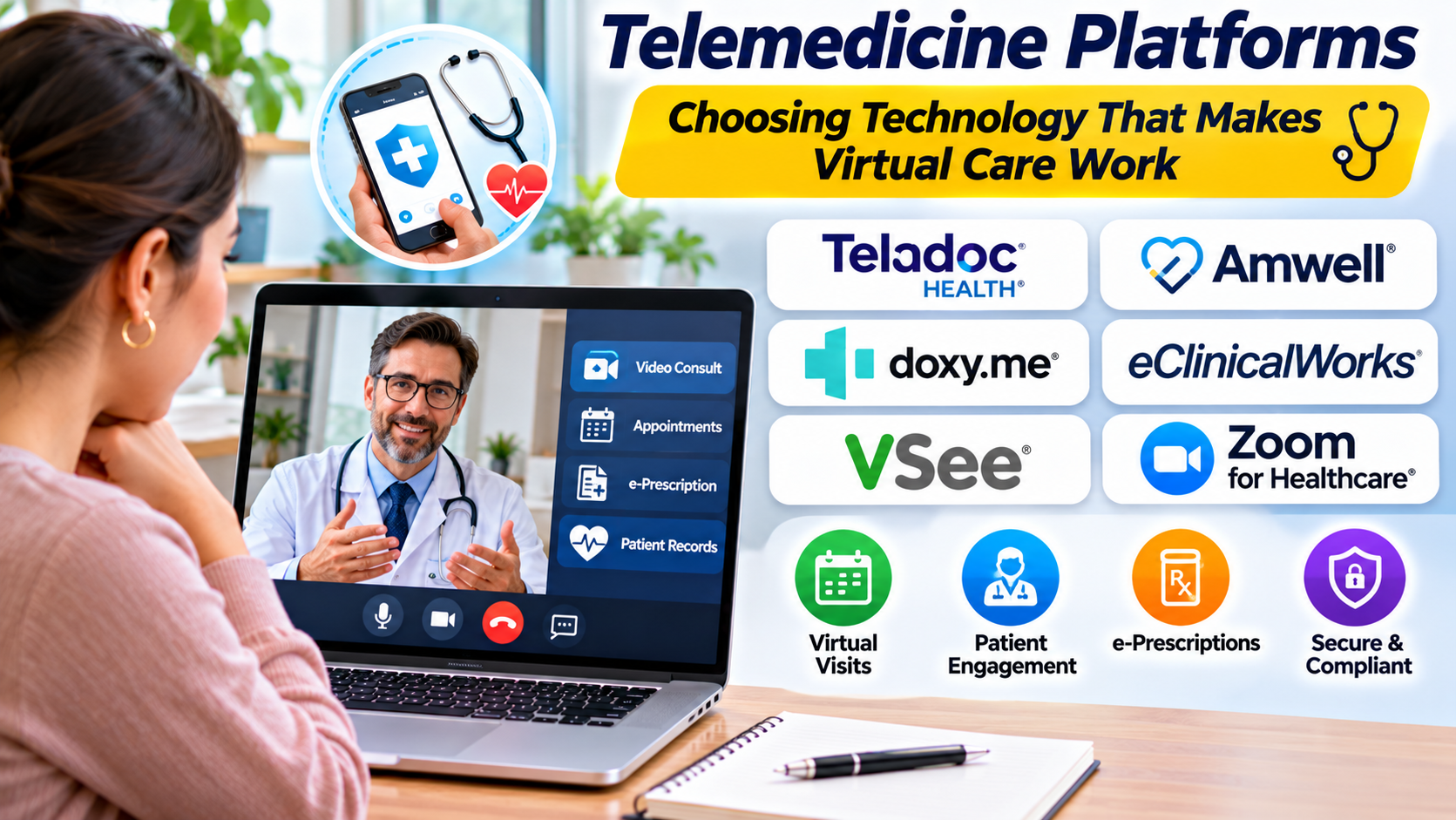
The following technologies illustrate different approaches to virtual care. They are not interchangeable products, and buyers should verify current availability and contractual capabilities.
Zoom for Healthcare
Zoom offers healthcare-oriented communication capabilities through its broader collaboration technology.
It may be used to support virtual clinical encounters when appropriately configured and operated.
Where it fits: Healthcare organizations seeking video communication that can be incorporated into existing clinical workflows.
Important trade-off: Video communication does not automatically provide a complete clinical operating system. Scheduling, documentation, prescribing, and other functions may require separate applications or integrations.
Organizations must also evaluate their own privacy and regulatory responsibilities.
Doxy.me
Doxy.me is a telemedicine platform focused on browser-based virtual consultations.
Its approach emphasizes the consultation experience for clinicians and patients.
Where it fits: Practices that need a dedicated virtual visit environment without building a complex custom communication system.
Important trade-off: Buyers should examine which administrative and clinical functions are included and which must remain in an existing EHR or practice-management system.
Amwell
Amwell provides virtual care technology and related healthcare services.
Its offerings are relevant to organizations considering broader virtual care programs and enterprise healthcare workflows.
Where it fits: Health systems, healthcare organizations, and other entities evaluating large-scale virtual care capabilities.
Important trade-off: Buyers should distinguish technology licensing, service arrangements, clinical staffing, and integrations when evaluating proposals.
Teladoc Health
Teladoc Health operates virtual healthcare services and provides technology associated with remote care delivery.
Its business model differs from that of a standalone video consultation application.
Where it fits: Organizations evaluating virtual care services, connected care arrangements, or related healthcare programs.
Important trade-off: Procurement should establish which clinical services, software capabilities, and operational responsibilities are included.
Mend
Mend provides patient engagement and telehealth technology associated with healthcare communication and virtual visits.
Its approach can be relevant to practices seeking to connect virtual appointments with patient-facing workflows.
Where it fits: Healthcare organizations evaluating telehealth alongside digital intake and communication needs.
Important trade-off: Confirm the available integrations, scheduling arrangements, supported clinical workflows, and exact product scope.
Comparing Telemedicine Approaches
| Approach | Main strength | Important consideration |
|---|---|---|
| Video-first consultation platform | Focused virtual appointment experience | May require separate clinical and administrative systems |
| EHR-integrated telemedicine | Connected records and established workflows | Depends on EHR capabilities and configuration |
| Enterprise virtual care platform | Broader organizational coordination | Greater implementation and governance demands |
| Virtual care service provider | May combine technology and clinical services | Requires clear accountability and contractual boundaries |
| Custom video integration | Flexible experience within existing applications | Development, security, and maintenance responsibilities |
The best approach depends on the care model.
A small specialty practice and a hospital-wide virtual care program should not use identical procurement criteria.
Clinical Suitability Comes Before Technology
Not every patient or clinical concern can be managed appropriately through telemedicine.
Some encounters require physical examination, diagnostic testing, procedures, or urgent in-person assessment.
Healthcare organizations need policies for determining when remote care is appropriate.
These decisions should be guided by qualified clinicians and applicable professional standards.
A telemedicine platform should support escalation when a virtual encounter cannot safely address the patient’s needs.
For example, the clinician may need to direct the patient toward an in-person appointment or emergency services.
The software should make appropriate documentation and communication possible.
It should not imply that remote care is a substitute for every form of healthcare.
Designing the Virtual Appointment Workflow
A successful virtual appointment involves several connected stages.
Before the Visit
The organization may need to confirm the appointment, verify identity, collect relevant information, and explain how the patient will connect.
Patients should understand any technical requirements.
A test connection or simple setup guidance can reduce avoidable problems.
At Check-In
The platform should help staff identify patients who have arrived virtually.
Depending on the workflow, administrative staff may verify information before the clinician begins.
During the Consultation
The clinician needs reliable communication and access to relevant clinical information.
The system should support appropriate documentation and consent processes.
After the Visit
Patients may need instructions, prescriptions, referrals, or follow-up appointments.
These activities should connect to the organization’s existing systems.
A consultation is not complete merely because the video session ends.
Video Quality, Reliability, and Accessibility
Telemedicine depends on communication quality.
Poor audio can make clinical conversations difficult even when the video appears acceptable.
Organizations should evaluate performance under realistic network conditions.
Patients may connect through older phones, shared computers, or unstable mobile networks.
A useful platform should handle common technical problems gracefully.
Accessibility matters as well.
Organizations should evaluate support for assistive technologies, language interpretation workflows, and patients who cannot use video effectively.
Where clinically and legally appropriate, alternative communication methods may be necessary.
Patient Identity and Location
Healthcare organizations may need to verify the identity and location of patients receiving remote services.
Location can matter for emergency response, professional licensing, prescribing, and reimbursement requirements.
These rules differ across jurisdictions.
A platform should help collect the information needed for the intended care model.
However, the organization remains responsible for determining which requirements apply.
A patient’s ability to connect to a virtual appointment does not automatically establish that a clinician is authorized to provide services in that location.
Privacy and Security
Telemedicine platforms handle sensitive health information.
Security evaluation should cover the complete workflow, not just video encryption.
Relevant controls include:
- Authentication and account management
- Meeting access restrictions
- Secure communication
- Role-based permissions
- Audit records
- Data retention
- Recording controls
- Vendor and subcontractor arrangements
- Incident response
- Secure integrations
Recording deserves particular attention.
A platform may technically support recording, but recording clinical encounters raises additional privacy, consent, and storage questions.
Organizations should define when recording is permitted and how recordings are handled.
In the United States, HIPAA may apply to covered organizations and their relevant service providers.
Other jurisdictions impose different requirements.
No platform should be assumed compliant for every healthcare use merely because it advertises security features.
EHR and Practice-Management Integration
A telemedicine platform becomes more useful when it fits existing clinical operations.
Scheduling systems should provide accurate appointment information.
The EHR should remain the appropriate source for clinical documentation.
Patient communication tools may support instructions and follow-up.
Billing systems may need encounter details.
Integration should reduce duplicate entry and prevent conflicting records.
Buyers should ask whether connections are native, configurable, or dependent on custom development.
They should also test failures.
For example, what happens if an appointment is rescheduled after a virtual visit link has already been sent?
A reliable system should avoid directing patients to outdated sessions.
Prescribing and Clinical Orders
Some telemedicine workflows include electronic prescribing and clinical orders.
However, these functions may depend on separate systems.
Prescribing requirements vary by medication, professional role, and jurisdiction.
Controlled substances can involve additional restrictions.
Organizations should verify current legal and technical requirements rather than assume remote consultation automatically permits every prescription.
Clinical orders should also connect to appropriate downstream workflows.
A laboratory order is useful only when the patient can access the required service and the results return to the responsible care team.
Understanding Telemedicine Costs
Telemedicine pricing can reflect different commercial models.
A provider may charge per clinician, per user, per encounter, or through an enterprise agreement.
A service provider may use a different arrangement from a software-only vendor.
Organizations should evaluate the total operating cost, including:
- Software subscriptions
- Implementation
- EHR integration
- Training
- Technical support
- Clinical staffing
- Patient assistance
- Security administration
- Additional communication services
- Data storage and export
A low-cost video solution may be economical for a simple workflow.
It may become expensive if extensive custom integration is required.
Conversely, an enterprise platform may provide more functionality than a small practice needs.
A Practical Telemedicine Pilot
A meaningful pilot should follow real clinical workflows.
Choose representative appointment types that are appropriate for remote care.
Include patients with different devices and levels of technical confidence.
Test scheduling, check-in, identity verification, consultation, documentation, and follow-up.
Observe how the platform handles interrupted connections.
Test the transition from a virtual visit to an in-person service.
Measure staff effort as well as patient experience.
A successful pilot should establish whether the organization can deliver the intended service safely and consistently.
Common Telemedicine Selection Mistakes
Choosing Based on Video Features Alone
Video is only one component of a clinical encounter.
Documentation, scheduling, follow-up, and escalation are equally important.
Assuming All Services Are Suitable for Remote Delivery
Clinical appropriateness must be determined by qualified professionals.
Technology cannot eliminate the need for in-person care.
Ignoring Patient Technology Barriers
Patients may lack suitable devices, connectivity, or digital skills.
Accessible alternatives should be considered.
Overlooking Licensing and Jurisdiction
Remote access does not remove professional or regulatory requirements.
Organizations must verify where and how care can legally be delivered.
Failing to Define Technical Support
Patients and clinicians need help when connections fail.
Support responsibilities should be established before launch.
Choosing the Right Platform for Different Care Settings
Independent practices may prefer focused virtual consultation software that works with their existing EHR.
Multispecialty groups may need centralized scheduling and consistent patient workflows.
Hospitals may require integration with inpatient and outpatient systems, specialist consultation, and complex governance.
Virtual care service organizations may need technology that supports scheduling, clinical operations, and workforce coordination at scale.
The decision should reflect the actual services being delivered.
Making Virtual Care Sustainable
Telemedicine platforms can expand access and reduce certain barriers to healthcare.
Their success depends on more than reliable communication technology.
Organizations need appropriate clinical protocols, clear responsibilities, secure information handling, and dependable connections to existing care systems.
The strongest telemedicine platform supports the entire remote encounter while recognizing the limits of virtual care.
The objective is not to move every appointment online. It is to make remote care a safe, practical, and well-integrated option when it serves patients and clinicians appropriately.