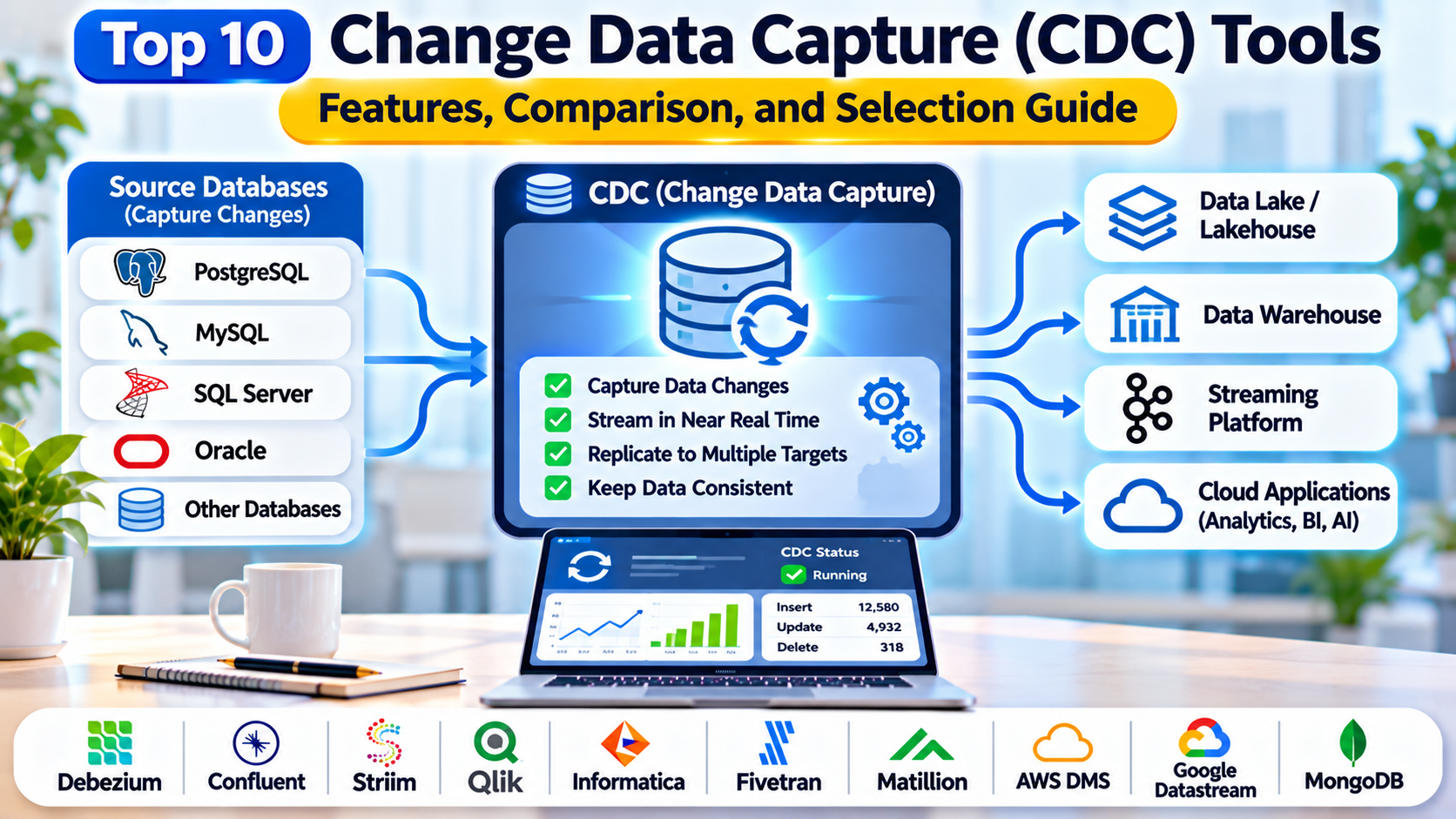
Introduction
Modern applications generate data continuously. Customer orders, financial transactions, inventory changes, and application events can occur thousands of times within a short period.
Businesses often need these changes to reach other systems quickly. Traditional batch extraction methods may introduce delays, repeatedly scan large tables, and increase the workload on production databases.
Change Data Capture, commonly called CDC, offers a more efficient approach.
CDC tools identify changes made to source data and deliver those changes to downstream systems. This allows organizations to maintain current analytical datasets, synchronize applications, and build event-driven architectures.
However, CDC platforms differ considerably. Some provide low-level change events for engineering teams. Others offer fully managed pipelines, automated transformations, and enterprise monitoring.
This guide compares ten CDC tools and explains how to select the right solution for real-time data integration.
1. What Are Change Data Capture Tools?
Change Data Capture tools identify and extract modifications from source databases or other supported data systems.
Instead of repeatedly transferring complete datasets, CDC technologies focus on information that has changed.
Common changes include:
- New records inserted into a database.
- Existing records updated.
- Records deleted.
- Selected schema modifications.
- Transaction metadata associated with changes.
How CDC Works
A typical log-based CDC workflow follows several stages.
Source database: An application writes transactions to its operational database.
Change capture: The CDC connector reads supported transaction logs or equivalent change mechanisms.
Event processing: The system converts captured changes into records or messages.
Data transport: Changes move through a streaming platform, connector pipeline, or managed integration service.
Destination processing: The receiving system applies changes to a database, warehouse, search index, or application.
Monitoring: Engineers track processing delays, errors, throughput, and recovery checkpoints.
Types of CDC
Log-based CDC reads database transaction logs or equivalent mechanisms. It is commonly preferred for continuous replication because it can reduce repeated source queries.
Trigger-based CDC uses database triggers to record changes. It can support specific environments but introduces additional database operations.
Query-based incremental extraction identifies modified records using timestamps or version columns. It is simpler in some environments but may miss deletes unless special handling exists.
These approaches should not be treated as equivalent. Their consistency, performance, and recovery characteristics differ.
2. Top 10 Change Data Capture Tools
1. Debezium
Best For: Open-source CDC, Kafka-based data pipelines, and event-driven applications.
Overview
Debezium is an open-source change data capture platform designed to convert database modifications into structured change events.
It is widely used in architectures where operational databases must communicate with streaming systems and downstream applications.
Debezium provides connectors for supported database engines, including PostgreSQL, MySQL, SQL Server, MongoDB, and other systems.
The connectors use database-specific mechanisms to capture changes and publish events.
A common deployment uses Apache Kafka Connect to operate connectors and distribute captured records. Other deployment models can support different application architectures.
Debezium is particularly valuable when organizations need access to individual change events rather than simply maintaining a replicated destination table.
For example, an order update could generate an event that updates a search index, refreshes a cache, or informs another application service.
Key Features
- Open-source database change capture.
- Transaction log integration.
- Initial snapshot capabilities.
- Structured change events.
- Kafka ecosystem support.
- Connector configuration options.
- Integration with event-driven architectures.
Advantages
Debezium provides extensive architectural flexibility and avoids proprietary software licensing.
Its event-oriented model is useful for microservices and real-time processing.
Limitations
Teams must manage connectors, event infrastructure, monitoring, and downstream consumers.
Schema evolution and recovery require deliberate engineering.
Ideal Users
Data engineers, backend developers, and organizations operating Kafka-based systems.
2. Fivetran
Best For: Managed CDC pipelines into cloud data warehouses.
Overview
Fivetran is a managed data integration platform that helps organizations move information from databases and applications into analytical destinations.
For supported databases, Fivetran provides CDC capabilities that reduce the need for repeated complete data extraction.
Its managed approach is attractive to organizations that want reliable data movement without operating every component of the underlying infrastructure.
Teams configure connections, select supported sources, and establish destination environments.
Fivetran then manages many aspects of extraction, loading, synchronization, and operational recovery.
The platform is especially relevant when database changes must join information from SaaS applications, financial systems, and other enterprise sources inside a cloud warehouse.
Fivetran is generally more focused on analytical data integration than on providing a low-level event bus for application microservices.
Key Features
- Managed database connectors.
- CDC for supported relational databases.
- Automated initial synchronization.
- Schema change handling.
- Pipeline monitoring.
- Cloud warehouse integrations.
- Managed recovery and synchronization workflows.
Advantages
Fivetran reduces infrastructure management and connector maintenance.
It is well suited to organizations prioritizing analytical data availability and operational simplicity.
Limitations
Usage-based pricing requires monitoring.
Not every connector provides the same latency or CDC functionality.
Ideal Users
Analytics engineers, business intelligence teams, and organizations maintaining cloud data warehouses.
3. Airbyte
Best For: Flexible data integration with open-source deployment options.
Overview
Airbyte is a data integration platform that connects databases, applications, and analytical destinations.
Its connector ecosystem supports multiple synchronization methods, including log-based CDC for selected database sources.
Airbyte is useful when organizations need to integrate many kinds of information rather than exclusively capture database transaction events.
Teams can configure data sources, destinations, synchronization schedules, and supported incremental loading options.
The platform offers managed and self-hosted deployment choices, allowing organizations to balance convenience with infrastructure control.
Airbyte can be particularly attractive when engineering teams want customizable integration pipelines while retaining access to an open-source ecosystem.
However, users must distinguish true log-based CDC connectors from connectors that rely on polling or scheduled incremental extraction.
Key Features
- Broad connector ecosystem.
- CDC support for selected databases.
- Full-refresh and incremental synchronization modes.
- Self-hosted and managed deployment options.
- Connector development framework.
- Pipeline configuration and monitoring.
- Integration with cloud analytical platforms.
Advantages
Airbyte offers flexibility and supports diverse integration requirements.
Its open-source ecosystem can help organizations adapt connectors to specialized needs.
Limitations
Connector reliability and functionality vary.
Self-hosted deployments require infrastructure maintenance, monitoring, and upgrades.
Ideal Users
Data engineering teams, startups, and organizations building customizable data integration platforms.
4. Striim
Best For: Enterprise CDC with real-time transformations.
Overview
Striim is a streaming data integration platform that combines change capture with continuous data processing.
It allows organizations to extract database changes and transform or route those changes before delivering them to downstream systems.
This is useful when businesses need more than straightforward database synchronization.
For example, a financial services organization may need to filter sensitive information, enrich transactions, and deliver processed events to multiple destinations.
Striim provides streaming pipeline capabilities that support these workflows.
It can connect operational databases with cloud warehouses, messaging platforms, and other supported environments.
Its architecture is particularly relevant to hybrid enterprises that must integrate existing transactional systems with modern cloud infrastructure.
Key Features
- Continuous database change capture.
- Streaming transformations.
- Data filtering and enrichment.
- Multiple source and destination integrations.
- Real-time pipeline monitoring.
- Hybrid-cloud deployment support.
- Continuous migration workflows.
Advantages
Striim combines CDC and stream processing.
Organizations can implement sophisticated data movement workflows without creating every processing component independently.
Limitations
Pipeline architecture and resource management require technical expertise.
Costs and complexity may be excessive for simple synchronization projects.
Ideal Users
Enterprise data engineers, streaming analytics teams, and organizations modernizing operational data systems.
5. Qlik Replicate
Best For: Enterprise CDC across heterogeneous databases.
Overview
Qlik Replicate provides change capture and replication capabilities across supported databases and analytical platforms.
It is particularly useful for organizations that need to synchronize data across different database technologies.
The platform supports initial loading and ongoing change capture, allowing teams to populate a destination and then maintain continuous updates.
Its visual management capabilities can reduce the amount of custom programming needed for enterprise replication projects.
Qlik Replicate is often considered when organizations operate a mixture of legacy databases, on-premises systems, and cloud destinations.
It can also support migration initiatives where operational changes must continue flowing while the destination is prepared.
Key Features
- Log-based CDC.
- Automated initial data loading.
- Heterogeneous database connectivity.
- Continuous replication.
- Visual task management.
- Monitoring and error reporting.
- Schema change support for compatible systems.
Advantages
Qlik Replicate offers broad enterprise connectivity and established replication functionality.
It is suitable for organizations managing multiple database technologies.
Limitations
Commercial licensing and specialist administration increase ownership costs.
Advanced transformations may require complementary tools.
Ideal Users
Enterprise integration teams, database administrators, and hybrid-cloud organizations.
6. Estuary Flow
Best For: Managed streaming CDC and real-time analytical pipelines.
Overview
Estuary Flow is a data integration platform focused on continuously capturing, processing, and delivering information.
It supports CDC for selected databases and provides capabilities for moving captured changes into analytical and operational destinations.
A distinguishing aspect of its architecture is the use of durable collections that can support downstream processing and materialization.
This allows organizations to separate data capture from the systems consuming that data.
For example, a business could capture changes from PostgreSQL and use the resulting data in an analytical warehouse while also supporting another downstream application.
Estuary Flow is useful when organizations need low-latency data movement but want to avoid operating a complete streaming infrastructure themselves.
Key Features
- Managed CDC connectors.
- Initial backfill capabilities.
- Continuous data capture.
- Durable data collections.
- Streaming transformations.
- Multiple destination materializations.
- Monitoring and recovery features.
Advantages
Estuary Flow can simplify the development of streaming data pipelines.
Its architecture supports reusing captured information across multiple downstream systems.
Limitations
Connector availability and deployment options must be verified.
Teams should evaluate data volume, processing guarantees, and pricing carefully.
Ideal Users
Data platform teams, real-time analytics developers, and organizations building streaming data products.
7. AWS Database Migration Service
Best For: CDC-driven database migration in AWS environments.
Overview
AWS Database Migration Service supports continuous database replication using change data capture for compatible sources.
Although it is primarily associated with migration, its CDC functionality can also support ongoing synchronization requirements.
Organizations often use AWS DMS when transferring workloads from existing infrastructure into AWS-managed database services.
A migration task can begin with a complete data load and then apply subsequent changes from the source.
This allows the destination to remain current while applications continue operating against the original database.
AWS DMS integrates with AWS infrastructure and monitoring services, making it convenient for organizations already using the AWS ecosystem.
However, its suitability depends on the intended destination, source database capabilities, and the complexity of the transformation requirements.
Key Features
- Full-load and CDC replication.
- Managed AWS deployment.
- Support for selected heterogeneous databases.
- Migration task monitoring.
- Replication checkpoint management.
- Integration with AWS services.
- Continuous synchronization options.
Advantages
AWS DMS reduces the need to manage a separate replication platform.
It is useful for AWS-centered migration projects.
Limitations
Schema conversion, complex transformations, and database-specific limitations may require additional services.
It is not a complete replacement for every event-streaming platform.
Ideal Users
Cloud migration engineers, AWS architects, and database administrators.
8. Google Cloud Datastream
Best For: Managed CDC pipelines within Google Cloud.
Overview
Google Cloud Datastream is a serverless change data capture and replication service designed to move changes from supported databases into Google Cloud destinations.
It is especially relevant to organizations building analytical environments on Google Cloud.
Datastream can capture changes from compatible operational databases and deliver them to supported destinations, including Google Cloud data services.
This helps organizations build pipelines that keep analytical information more current than traditional scheduled batch extraction.
The managed service model reduces infrastructure administration, although teams remain responsible for source configuration, permissions, networking, and downstream processing design.
Datastream is particularly attractive when organizations already use BigQuery, Cloud Storage, and related Google Cloud technologies.
Key Features
- Managed change data capture.
- Database log integration.
- Continuous data replication.
- Google Cloud destination integration.
- Stream monitoring.
- Initial backfill support.
- Serverless service operation.
Advantages
Datastream fits naturally into Google Cloud data architectures.
It reduces the infrastructure management needed for supported CDC workflows.
Limitations
Its destination ecosystem is more specialized than broad multi-cloud integration platforms.
Database compatibility and destination behavior must be checked carefully.
Ideal Users
Google Cloud engineers, analytics teams, and organizations modernizing cloud data pipelines.
9. Confluent CDC Connectors
Best For: Database change streaming within Kafka-based environments.
Overview
Confluent provides data integration capabilities that help organizations connect databases to Kafka-based streaming architectures.
Its CDC connector offerings can capture changes from supported databases and publish those changes into Kafka topics.
This approach is useful when multiple applications need access to the same database events.
For example, an order-processing system might publish transaction changes that are consumed by inventory, billing, analytics, and notification services.
Confluent provides a broader streaming ecosystem that can include managed connectors, governance capabilities, processing technologies, and operational monitoring.
The exact CDC mechanism depends on the connector and source database.
Organizations should evaluate whether the required connector is managed, self-operated, or subject to separate licensing.
Key Features
- Database-to-Kafka connectivity.
- CDC support for selected databases.
- Streaming event delivery.
- Kafka ecosystem integration.
- Connector management.
- Stream processing compatibility.
- Data governance integrations.
Advantages
Confluent is suitable for organizations already investing in Kafka-based event streaming.
It supports architectures where many independent consumers process database changes.
Limitations
Kafka introduces architectural and operational considerations.
Connector functionality, licensing, and availability differ across database technologies.
Ideal Users
Platform engineers, streaming application developers, and enterprises operating event-driven systems.
10. PeerDB
Best For: PostgreSQL CDC and analytical replication.
Overview
PeerDB is a data movement technology focused particularly on PostgreSQL replication and change capture.
It is relevant to organizations that use PostgreSQL as an operational database and need to move changes into analytical destinations.
PostgreSQL logical replication capabilities allow compatible tools to capture database changes without repeatedly scanning entire tables.
PeerDB builds on this approach to support continuous data movement and initial synchronization workflows.
Its specialized focus can make it attractive when organizations want to optimize PostgreSQL-oriented data pipelines rather than adopt a broad enterprise integration suite.
PeerDB is also relevant to teams working with analytical systems that require current operational information.
Key Features
- PostgreSQL-focused CDC.
- Logical replication integration.
- Initial data synchronization.
- Continuous data movement.
- Analytical destination support.
- Replication monitoring.
- Open-source technology foundations.
Advantages
PeerDB provides a focused approach to PostgreSQL data movement.
It can reduce the need for custom CDC engineering in supported environments.
Limitations
Its source database focus is narrower than broad enterprise CDC platforms.
Deployment, product availability, and supported destinations should be verified before selection.
Ideal Users
PostgreSQL administrators, data engineers, and teams building operational-to-analytical pipelines.
3. Change Data Capture Tools Comparison Table
| Tool | Best For | Deployment Approach | Key Strength |
|---|---|---|---|
| Debezium | Event-driven applications | Self-managed/open source | Detailed change events |
| Fivetran | Cloud analytics | Managed | Automated integration |
| Airbyte | Flexible pipelines | Managed/self-hosted | Connector extensibility |
| Striim | Enterprise streaming | Cloud/self-managed options | In-flight processing |
| Qlik Replicate | Heterogeneous replication | Enterprise deployment | Database compatibility |
| Estuary Flow | Real-time integration | Managed/private options | Streaming materialization |
| AWS DMS | AWS migrations | AWS managed | Migration-oriented CDC |
| Google Datastream | Google Cloud analytics | Managed/serverless | Google Cloud integration |
| Confluent CDC | Kafka streaming | Connector-dependent | Event ecosystem |
| PeerDB | PostgreSQL pipelines | Deployment-dependent | PostgreSQL specialization |
CDC capabilities, latency, and operational guarantees vary by connector and configuration. A platform supporting CDC for one database does not necessarily support the same behavior for every source.
4. How to Choose the Right CDC Tool
Confirm the Change Capture Method
Determine whether the platform uses transaction logs, triggers, database APIs, or incremental polling.
Log-based CDC is often preferred when organizations require continuous updates with minimal repeated source queries.
However, database logging requirements and permissions must be considered.
Evaluate End-to-End Latency
Measure the time between a committed source transaction and its availability at the destination.
Latency can be affected by source activity, connector performance, message transport, transformation workloads, and destination capacity.
Check Initial Snapshot Capabilities
Most production CDC projects require an initial copy of existing data.
Verify how the platform coordinates snapshots with ongoing change capture to avoid missing or duplicating records.
Assess Schema Evolution
Applications frequently introduce new columns, modify data types, and change table structures.
Choose a platform that provides predictable behavior when these changes occur.
Review Delivery and Recovery Guarantees
Understand how the system handles retries, duplicate events, transaction ordering, checkpoints, and destination failures.
Exactly-once claims should be evaluated across the entire pipeline, not only an individual connector.
Compare Managed and Self-Hosted Options
Managed services can reduce maintenance, while self-hosted systems provide more infrastructure control.
The best approach depends on staffing, security requirements, and operating costs.
Evaluate Monitoring and Governance
Production CDC systems should expose replication lag, connector health, throughput, errors, and recovery status.
Sensitive data should be protected through access controls, encryption, and appropriate data governance policies.
5. Practical Example: Building a Real-Time Sales Analytics Pipeline
Consider an online retailer using PostgreSQL for customer orders.
Its analytics team currently receives sales data through a nightly batch process.
This means managers may wait until the following day to understand changes in sales activity.
The organization wants more current reporting.
Step 1: Identify source tables.
The engineering team selects orders, payments, refunds, and inventory tables.
Step 2: Select a CDC platform.
The team evaluates Debezium, Fivetran, Estuary Flow, and Google Datastream according to its infrastructure.
Step 3: Configure database change capture.
Administrators enable the required database logging and replication permissions.
Step 4: Perform an initial snapshot.
The existing data is loaded into the destination.
Step 5: Start continuous change processing.
New orders, cancellations, and payment updates are captured as they occur.
Step 6: Apply transformations.
The pipeline standardizes timestamps, validates records, and prepares analytical tables.
Step 7: Monitor data freshness.
Engineers track replication lag and identify processing interruptions.
Step 8: Validate business results.
The analytics team compares sales totals against the source system to confirm accuracy.
This architecture can reduce reporting delays and provide more current operational insights.
6. Benefits and Challenges of CDC Tools
Major Benefits
Fresher information: Downstream systems receive changes without waiting for full batch reloads.
Reduced repeated extraction: Log-based CDC can avoid frequent scans of large production tables.
Improved integration: Applications and analytical systems can consume the same operational changes.
Migration support: CDC can keep destinations synchronized during infrastructure modernization.
Event-driven workflows: Database modifications can trigger processing in other applications.
Common Challenges
Schema changes: Unexpected structural modifications may interrupt pipelines.
Replication lag: Processing delays can reduce data freshness.
Operational complexity: Self-hosted connectors and streaming infrastructure require maintenance.
Data consistency: Incorrect event ordering or duplicate processing can create inconsistent destinations.
Security: CDC systems may expose sensitive transactional information.
Database resource usage: Transaction log retention and replication slots can create operational pressure when consumers fall behind.
Reliable CDC requires monitoring, recovery testing, and clear ownership of data pipelines.
7. Frequently Asked Questions
What is the best CDC tool?
The best option depends on the environment. Debezium suits open-source event streaming, Fivetran supports managed analytics integration, and Striim addresses complex streaming workflows.
What is the difference between CDC and ETL?
CDC identifies changes in source data. ETL extracts, transforms, and loads information. CDC can serve as the extraction mechanism within an ETL or ELT pipeline.
Does CDC require Apache Kafka?
No. Some CDC architectures use Kafka, but managed integration services can transfer changes without requiring users to operate Kafka.
Can CDC capture deleted records?
Yes, log-based CDC commonly captures deletes for supported databases. Query-based incremental extraction may require additional mechanisms.
Is CDC real time?
CDC can support near-real-time processing, but actual latency depends on source systems, pipeline architecture, and destinations.
Does CDC affect database performance?
CDC consumes database and infrastructure resources. Log-based approaches can reduce repeated query overhead, but logging, retention, and connector activity must still be monitored.
What happens when a CDC connector fails?
Well-designed systems use checkpoints and recovery mechanisms to resume processing. Recovery behavior varies by platform and configuration.
Can CDC tools support cloud migration?
Yes. CDC can keep a destination synchronized while applications continue using the source database, helping reduce migration downtime.
8. Conclusion
Change Data Capture tools help organizations move beyond delayed batch extraction toward continuous data integration.
Debezium and Confluent support event-driven architectures. Fivetran, Airbyte, and Estuary Flow provide different approaches to managed and flexible integration.
Striim and Qlik Replicate address complex enterprise requirements, while AWS DMS and Google Datastream integrate with their respective cloud environments.
PeerDB offers a specialized option for PostgreSQL-oriented pipelines.
Choosing the right CDC tool requires evaluating source compatibility, latency, recovery behavior, deployment preferences, and long-term operating costs.
Organizations should also test schema changes, database interruptions, and destination failures before production adoption.
When implemented carefully, CDC can become a reliable foundation for modern analytics, application integration, and real-time data architectures.