A software release passes development but fails during final testing.
The engineering team believes the required functionality is complete. Quality assurance discovers that several test cases refer to outdated specifications. Release managers cannot determine which changes are included, while business stakeholders expect the original delivery scope.
Every team has been working.
The problem is that their work has not remained connected.
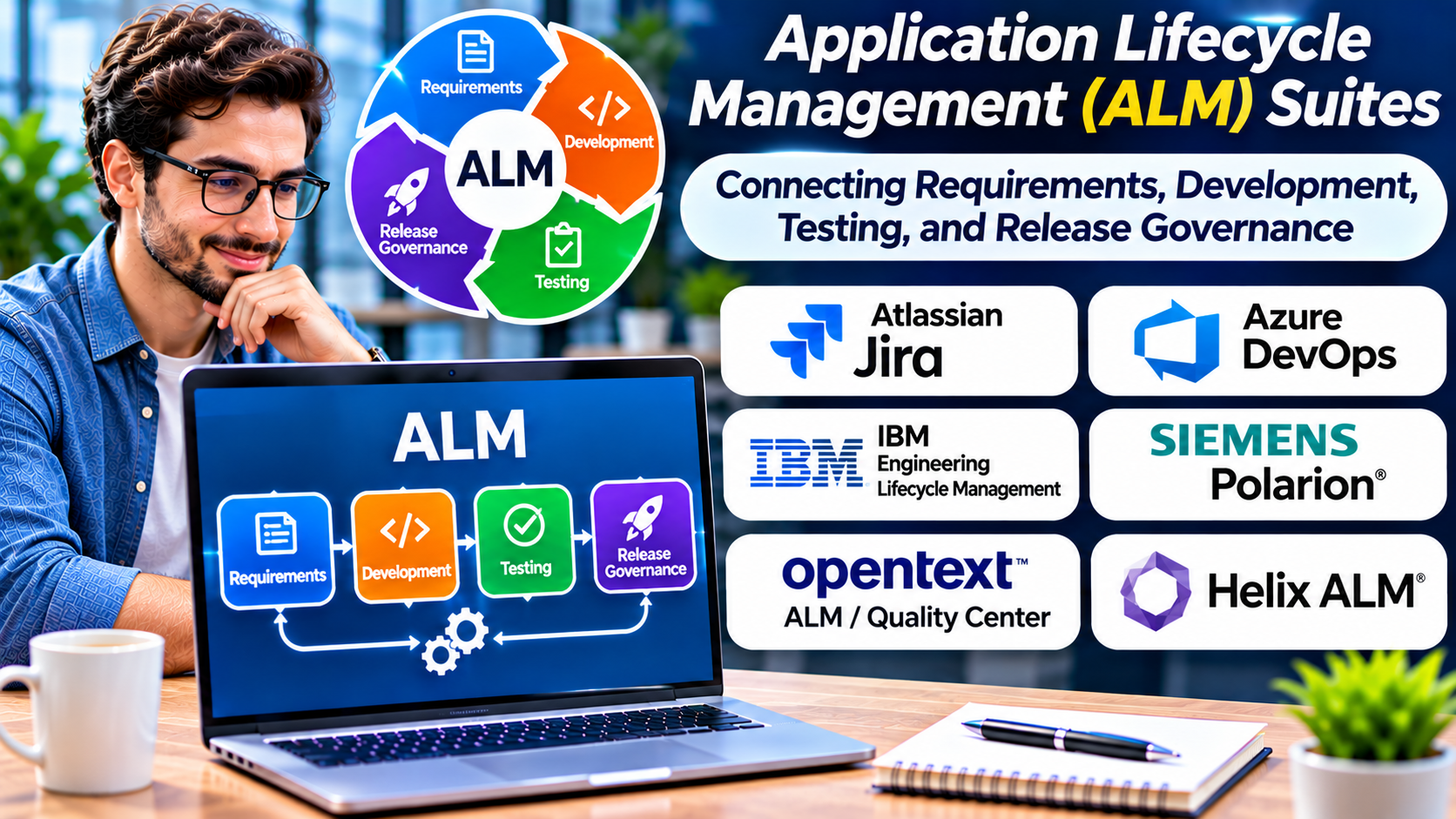
Application lifecycle management, commonly called ALM, addresses this challenge by coordinating the activities and information involved in planning, developing, testing, releasing, and maintaining software.
ALM suites provide platforms for managing these relationships.
Some offer closely integrated capabilities within one environment. Others connect specialized systems through shared workflows and traceability.
The central decision is whether an organization needs a comprehensive lifecycle platform, a connected development toolchain, or a combination of both.
What Application Lifecycle Management Includes
Application lifecycle management is the coordinated management of software from initial requirements through development, testing, deployment, maintenance, and eventual retirement.
It encompasses several disciplines.
Requirements management defines what the application must accomplish.
Planning and work management organize development activities and priorities.
Source code management preserves and coordinates code changes.
Testing and quality management evaluate whether the application behaves correctly.
Release management controls how changes become available to users.
Change management and governance establish appropriate approvals, responsibilities, and evidence.
Maintenance and operational feedback support improvements after deployment.
ALM is not identical to any one of these activities.
Its purpose is to preserve coordination across the complete lifecycle.
ALM Versus DevOps: A Distinction That Matters
ALM and DevOps overlap, but they are not interchangeable.
ALM focuses on managing the application lifecycle, including requirements, governance, development, testing, and maintenance.
DevOps emphasizes collaboration and automation between software development and operations, particularly around building, deploying, and operating applications.
A DevOps platform may provide many capabilities needed for ALM.
However, organizations with formal requirements, regulatory obligations, or complex verification processes may need additional lifecycle governance.
For example, a software company delivering frequent website updates may prioritize automated pipelines, issue tracking, and operational monitoring.
A manufacturer developing safety-critical embedded software may need detailed relationships between approved requirements, architecture, implementation, verification, and release evidence.
Both organizations manage application lifecycles.
Their required controls are substantially different.
Integrated ALM Suites Versus Connected Toolchains
One of the most important architectural decisions is whether to centralize lifecycle activities or connect specialized products.
Integrated ALM platforms
An integrated ALM platform aims to manage several lifecycle disciplines within a coordinated environment.
Potential advantages include consistent data structures, shared permissions, common reporting, and closer relationships between requirements and tests.
However, integrated platforms may introduce complexity.
Organizations must evaluate whether the platform supports their preferred engineering tools and whether its administrative model is appropriate.
Modular toolchains
A modular approach combines specialized products.
For example, an organization might use one platform for requirements, another for issue tracking, a repository service for source code, and a separate testing system.
This allows teams to select tools suited to their workflows.
The challenge is maintaining reliable connections between them.
Integrations may require configuration, monitoring, and ongoing maintenance.
Hybrid approaches
Many organizations adopt a hybrid model.
They may use a central ALM platform for governance and traceability while allowing development teams to work in familiar code repositories and build systems.
This approach can preserve specialized capabilities without losing lifecycle oversight.
The correct architecture depends on the organization, not on a universal preference for fewer tools.
ALM Platforms Worth Evaluating
Siemens Polarion ALM
Siemens Polarion supports connected lifecycle activities, including requirements management, testing, collaboration, and traceability.
It is relevant to organizations that need formal relationships between engineering artifacts and controlled development processes.
Its capabilities are particularly important when teams must demonstrate how requirements connect to verification evidence.
Suitable for: Complex engineering programs and compliance-oriented software development.
Evaluation priority: Requirements traceability, workflow governance, configuration management, and integration with existing engineering systems.
OpenText Application Quality Management and ALM Octane
OpenText provides application quality and lifecycle management products, including ALM Octane.
ALM Octane is oriented toward coordinating application quality, testing, and development workflows.
Its documented integration capabilities include connections with development tools, continuous integration systems, and testing frameworks.
This makes it relevant to organizations seeking greater visibility across software quality and delivery activities.
Suitable for: Enterprises with substantial testing requirements and established quality management processes.
Evaluation priority: Test management, automation integration, reporting, release traceability, and migration from existing quality management systems.
PTC Codebeamer
PTC Codebeamer provides application lifecycle management capabilities focused on requirements, risks, testing, and connected engineering processes.
It is relevant to organizations developing complex products where software requirements and verification must remain controlled.
A manufacturer might evaluate Codebeamer to coordinate requirements changes with related engineering and testing activities.
Suitable for: Product engineering organizations requiring structured lifecycle traceability.
Evaluation priority: Requirements relationships, risk workflows, configuration management, and integration with product development systems.
Azure DevOps
Microsoft Azure DevOps provides services for work tracking, source code management, build and release pipelines, and testing workflows.
It is not identical to every specialized ALM suite, but it can serve as a major component of an organization’s application lifecycle environment.
For teams building business applications, Azure DevOps can connect planning, development, and delivery processes.
Additional tools may be necessary for highly specialized requirements management or regulatory traceability.
Suitable for: Software development teams seeking connected planning and delivery capabilities within the Microsoft ecosystem.
Evaluation priority: Repository strategy, pipeline requirements, testing processes, permissions, and integrations.
GitLab
GitLab provides a development platform with capabilities spanning planning, source code management, continuous integration, security workflows, and delivery activities.
Its integrated approach can reduce the number of separate systems required for certain software development workflows.
However, organizations needing formal requirements baselines or specialized engineering verification should assess whether complementary systems are required.
Suitable for: Development teams seeking a connected DevSecOps-oriented toolchain.
Evaluation priority: Development workflow coverage, security controls, deployment architecture, and the requirements for external lifecycle integrations.
Comparing ALM Approaches
| Platform | Main orientation | Key consideration |
|---|---|---|
| Siemens Polarion ALM | Engineering lifecycle traceability | Formal requirements and verification |
| OpenText ALM Octane | Application quality and delivery coordination | Testing and automation integration |
| PTC Codebeamer | Connected engineering lifecycle management | Requirements, risk, and testing |
| Azure DevOps | Development planning and delivery | Microsoft ecosystem integration |
| GitLab | Integrated development and DevSecOps workflows | Planning-to-delivery continuity |
These platforms do not all address exactly the same requirements.
An organization should compare them according to the lifecycle capabilities it actually needs.
Traceability Is the Foundation of Controlled ALM
Traceability connects information across lifecycle stages.
A business requirement may lead to a technical requirement.
That technical requirement may connect to a development task.
The task may be implemented through a code change and verified by one or more tests.
Finally, the verified change may be associated with a release.
These relationships allow teams to answer important questions.
Which requirements have been implemented?
Which tests verify a particular requirement?
What will be affected if a requirement changes?
Which defects remain unresolved in a planned release?
What evidence supports the decision to deploy?
Without traceability, teams may need to reconstruct answers manually from several systems.
However, traceability should reflect meaningful relationships rather than become an exercise in creating links.
The goal is reliable understanding and control.
The Role of Test Management in ALM
Testing is a central part of application lifecycle management.
Different forms of testing provide different evidence.
Unit tests examine individual components.
Integration tests evaluate interactions between components or systems.
System tests assess broader application behavior.
Acceptance testing determines whether agreed requirements have been satisfied.
Security and performance testing address additional quality attributes.
An ALM environment may help organize test plans, execution results, defects, and requirement coverage.
This becomes particularly valuable when a release decision depends on formal evidence.
For example, a regulated software product may require documented verification that specific requirements have passed approved tests.
The platform should help preserve that evidence and connect it to the correct software configuration.
Release Management and Change Control
A release is more than a collection of completed development tasks.
Organizations need to know which changes are included, whether required tests passed, which defects remain open, and whether deployment conditions have been satisfied.
A controlled release process may involve:
- Establishing the intended release scope.
- Identifying included changes.
- Completing required verification.
- Reviewing unresolved defects and risks.
- Obtaining necessary approvals.
- Deploying the release.
- Monitoring operational behavior.
- Recording outcomes and lessons learned.
The level of formality should match the risk.
A low-risk internal application may use automated deployment with minimal manual approval.
A safety-critical product may require extensive review and documented evidence.
ALM software should support the appropriate process without imposing unnecessary controls.
How ALM Connects With Continuous Integration and Delivery
Continuous integration and continuous delivery, often abbreviated CI/CD, automate important parts of software building, testing, and deployment.
These practices can complement ALM.
For example, a code change associated with a development issue may trigger automated tests.
The resulting test evidence can inform release readiness.
An ALM environment may help connect these technical events with requirements and approval processes.
However, automated pipelines do not automatically establish full lifecycle traceability.
Organizations must determine which relationships are required and how they will be maintained.
A successful implementation connects automated delivery with meaningful governance rather than treating them as competing approaches.
Security and Governance Requirements
ALM platforms can contain sensitive information about application architecture, vulnerabilities, customer requirements, and planned releases.
Security evaluation should include authentication, access controls, audit records, integration permissions, and data protection.
Organizations should also consider how the platform manages privileged access and separation of duties.
For example, some environments may require different employees to develop, approve, and release software.
The required controls depend on organizational policy, applicable standards, and the consequences of failure.
A platform’s advertised compliance capabilities should not be confused with proof that an organization’s implementation satisfies its obligations.
The Hidden Cost of ALM Integration
Software licensing is only one component of total cost.
Integration work can become substantial when organizations connect multiple lifecycle systems.
Consider a toolchain containing separate requirements, issue tracking, source control, testing, and release platforms.
Each connection may require decisions about:
- Which system owns particular records.
- How identifiers remain consistent.
- What happens when information changes.
- How permissions are enforced.
- How integration failures are detected.
- Whether historical relationships remain accessible.
- How upgrades affect compatibility.
A platform that appears inexpensive initially may require significant integration maintenance.
Conversely, a comprehensive suite may cost more to license but reduce certain coordination burdens.
Neither outcome is guaranteed.
A realistic evaluation should estimate implementation, administration, training, integration, and migration costs.
Migration From Existing Lifecycle Systems
Replacing an established ALM environment can be difficult.
Organizations may have years of requirements, defects, test results, approvals, and release records.
Migration requires more than copying text fields.
Historical relationships, identifiers, attachments, audit records, and configuration information may be important.
A disciplined migration process should begin with an inventory of existing information.
Teams should determine which records must remain active, which require historical access, and which can be archived.
Next, map the data structures between systems.
Test the migration using representative projects before moving production information.
Finally, verify that important relationships and records remain understandable.
For regulated environments, migration plans may require additional validation and documented approval.
A Practical ALM Evaluation Scenario
Imagine an organization developing a connected industrial control application.
The project includes hardware interfaces, embedded software, a cloud service, and a user-facing dashboard.
A requirement changes because a sensor specification has been updated.
The ALM evaluation should test whether the platform can support the resulting workflow.
First, identify the original requirement and its approved version.
Next, determine which design elements, development tasks, and tests depend on it.
Then record the proposed change and route it through the required review process.
After approval, update the affected work and verification activities.
Finally, demonstrate how the release record connects to the implemented change and its verification evidence.
This exercise tests the platform’s ability to preserve lifecycle continuity.
It is more informative than a generic demonstration of dashboards and project boards.
Common ALM Adoption Mistakes
Buying a comprehensive suite without defining the process
A large platform cannot resolve unclear responsibilities or inconsistent engineering practices.
Establish the intended lifecycle model before extensive configuration.
Forcing every team into the same workflow
Different products and risk levels may require different controls.
Standardize where consistency creates value, but preserve justified flexibility.
Treating integrations as one-time projects
Connected systems change over time.
Integrations require monitoring, maintenance, and ownership.
Measuring success through tool adoption alone
A high number of active users does not prove that the lifecycle process is effective.
Measure whether teams can maintain traceability, resolve issues, verify requirements, and deliver reliable releases.
Ignoring long-term data portability
Lifecycle records may need to remain accessible for many years.
Evaluate export options, historical data access, and the consequences of changing vendors.
Choosing Between an ALM Suite and a Modular Toolchain
A dedicated ALM suite may be appropriate when requirements, verification, governance, and auditability are central to the organization’s engineering process.
A modular development toolchain may be more appropriate when teams prioritize flexibility, rapid delivery, and specialized development tools.
A hybrid architecture may provide the best balance for organizations with both formal governance and diverse engineering practices.
Before making a decision, identify the lifecycle questions the organization must answer reliably.
Can teams trace requirements to verification?
Can they identify the impact of changes?
Can they establish which defects affect a release?
Can they demonstrate that necessary approvals occurred?
Can they preserve this information as systems and teams evolve?
The right platform should make these answers available without excessive manual reconstruction.
Building an Application Lifecycle That Remains Under Control
Application lifecycle management is not primarily about consolidating software products.
It is about maintaining continuity between decisions, engineering work, quality evidence, and operational outcomes.
Siemens Polarion, OpenText ALM Octane, PTC Codebeamer, Azure DevOps, and GitLab represent different approaches to this challenge.
The appropriate choice depends on the organization’s engineering environment, governance needs, development practices, and long-term maintenance responsibilities.
A successful ALM implementation creates clear ownership, dependable traceability, and a consistent understanding of release readiness.
It allows teams to change software confidently because they understand what is affected, what must be verified, and what evidence supports delivery.
That connection between requirements and real-world outcomes is the foundation of effective application lifecycle management.