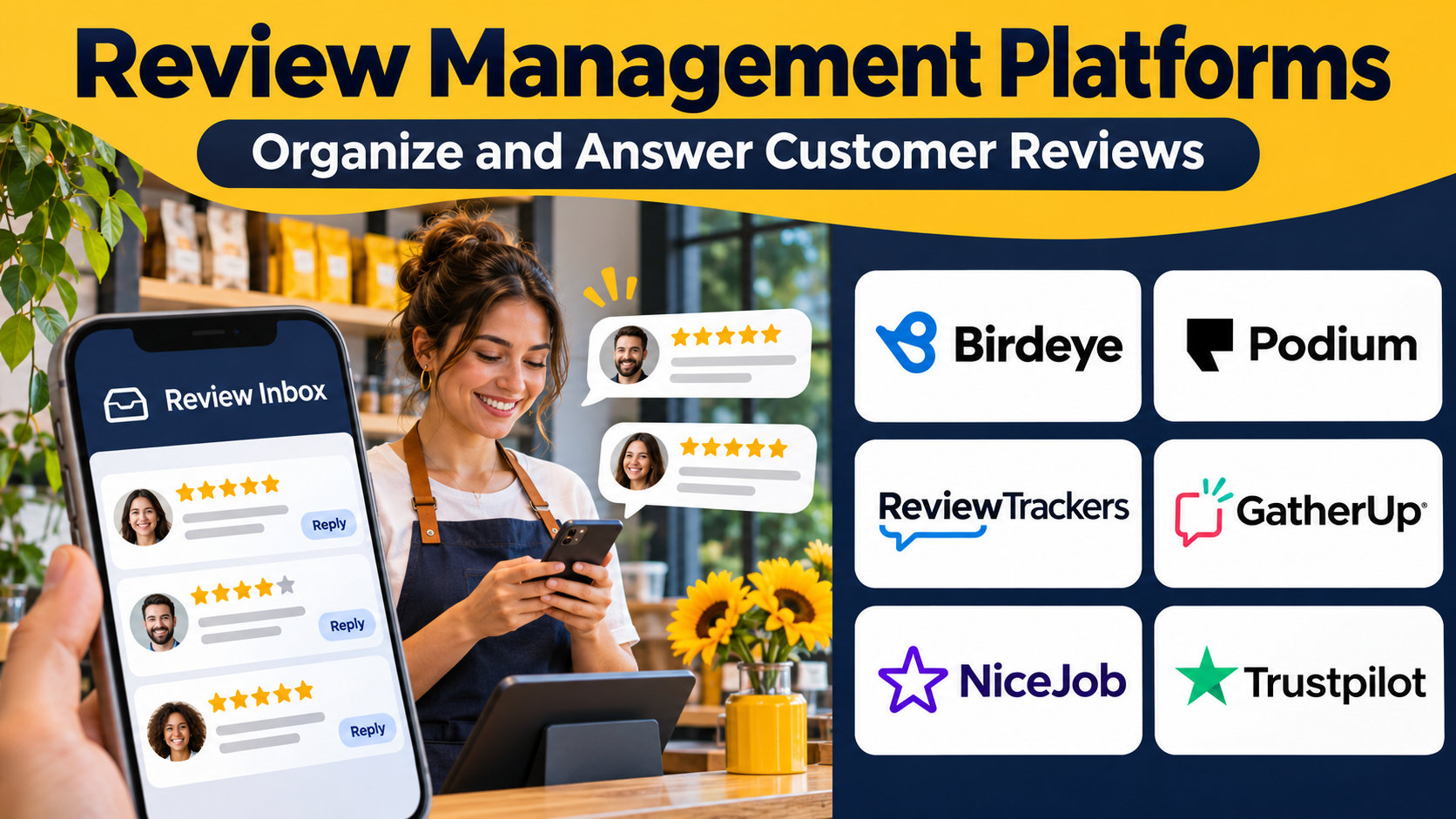
Introduction
Customer reviews influence how people evaluate businesses, compare services, and make purchasing decisions. A prospective customer may examine recent ratings, read negative experiences, and observe how a company responds before making contact.
For businesses operating across several locations or review websites, managing this feedback manually becomes increasingly difficult.
Review management platforms help organizations collect genuine customer feedback, monitor published reviews, coordinate responses, and analyze recurring customer experience issues.
Some platforms specialize in generating review invitations and managing customer communication. Others provide advanced analytics, multi-location reporting, local search integrations, and enterprise reputation workflows.
Selecting the right platform requires more than comparing average ratings or automation features. Businesses must consider review source coverage, privacy requirements, customer experience workflows, platform policies, and the ability to turn feedback into measurable improvements.
This guide examines ten established review management platforms, explains their capabilities and limitations, and provides practical recommendations for different business types.
What Are Review Management Platforms?
Review management platforms are software applications that help businesses monitor, collect, organize, respond to, and analyze customer reviews across supported websites and digital channels.
These platforms commonly integrate with online review services, business profiles, customer databases, and operational software.
Their purpose is to make review management more consistent while helping organizations understand what customers value and where service improvements are needed.
How Review Management Software Works
A typical workflow includes collecting customer contact information through legitimate business interactions, inviting customers to leave genuine feedback, monitoring published reviews, and assigning appropriate responses.
The platform may also categorize complaints, identify rating trends, and generate performance reports.
For multi-location businesses, review management systems can compare branches and help managers identify recurring operational problems.
Main Benefits
- Centralized monitoring: View supported reviews without checking every website separately.
- Consistent customer follow-up: Automate neutral review invitations.
- Faster responses: Assign feedback to the appropriate employees.
- Operational insights: Identify recurring service and product concerns.
- Location comparisons: Evaluate performance across branches.
- Reporting: Track review volume, response rates, and rating trends.
- Customer trust: Demonstrate attentive, professional communication.
- Team accountability: Establish ownership for feedback handling.
Top 10 Review Management Platforms
1. Birdeye
Best For: Multi-location organizations requiring review management, customer communication, and reputation analytics.
Short Description
Birdeye is a customer experience and reputation management platform that helps businesses organize online reviews, customer feedback, messaging, and digital presence workflows.
Its review management capabilities are particularly relevant to businesses receiving feedback across multiple locations and review sources.
Organizations can use Birdeye to request reviews, monitor incoming feedback, coordinate responses, and evaluate customer experience patterns.
The platform also provides broader communication and business information management capabilities through available products.
For larger organizations, its location-level reporting can help identify branches with recurring service problems.
However, buyers should evaluate package requirements, integration coverage, and automation controls before implementation.
Key Features
- Review aggregation: Collects reviews from supported websites into a centralized interface.
- Automated review requests: Helps send feedback invitations following customer interactions.
- Review response management: Coordinates replies across eligible platforms.
- Multi-location analytics: Compares review activity and performance between branches.
- AI-assisted responses: Supports response drafting where included, with human oversight.
- Customer feedback analysis: Identifies common satisfaction and complaint themes.
- Business listings integration: Connects reputation workflows with location information.
- Reporting dashboards: Tracks review trends, response rates, and selected performance indicators.
- Team collaboration: Supports shared responsibilities and review management workflows.
Benefits
Birdeye connects review operations with broader customer engagement. Businesses can use review data to understand service quality rather than simply monitor star ratings.
Pros
- Broad review management capabilities.
- Strong multi-location support.
- Customer communication features.
- Automated workflows.
- Useful reputation analytics.
Cons
- Advanced functionality may require additional modules.
- Implementation can be complex.
- Pricing depends on business requirements.
- Automated responses require review.
Use Cases
Retail chains can compare reviews across stores. Healthcare practices can organize public feedback while protecting confidential information. Service companies can automate appropriate post-service review invitations.
Best Suited For: Multi-location businesses, established service providers, and enterprise customer experience teams.
2. Reputation
Best For: Enterprise organizations seeking advanced review intelligence and location-level customer experience analysis.
Short Description
Reputation is an enterprise reputation and customer experience management platform that helps organizations collect and interpret public feedback.
Its review management capabilities support businesses with large numbers of locations, complex organizational structures, and formal reporting requirements.
The platform helps teams monitor reviews, evaluate sentiment, identify recurring complaints, and coordinate responses.
It also connects review-related information with broader customer experience and digital presence workflows.
For large organizations, this approach can help transform scattered feedback into operational intelligence.
However, successful deployment requires clearly defined ownership, integration planning, and consistent customer communication policies.
Key Features
- Centralized review monitoring: Organizes reviews from supported platforms.
- Review response workflows: Helps teams assign and manage replies.
- Customer experience analytics: Identifies feedback patterns across locations.
- Sentiment analysis: Estimates the tone of review content.
- Location benchmarking: Compares selected reputation indicators.
- Business listings support: Connects reviews with digital presence management.
- Enterprise reporting: Provides dashboards for regional and executive teams.
- Workflow automation: Reduces repetitive review handling tasks.
Benefits
Reputation helps organizations understand differences in customer experience across business units and locations.
Pros
- Enterprise-grade reputation analytics.
- Multi-location reporting.
- Review response coordination.
- Broad customer experience focus.
- Scalable operational workflows.
Cons
- May require substantial onboarding.
- Commercial pricing varies.
- Excessive for very small businesses.
- Analytical findings depend on data quality.
Use Cases
Hospitality groups can investigate service complaints across properties. Automotive networks can compare dealership feedback. Healthcare networks can monitor public experiences while following privacy requirements.
Best Suited For: Large enterprises, franchise networks, and customer experience departments.
3. Podium
Best For: Local businesses seeking review invitations alongside customer messaging.
Short Description
Podium is a customer communication platform that supports messaging, customer engagement, and review-related workflows.
It is particularly useful for businesses where customer relationships involve appointments, purchases, or completed service jobs.
Rather than focusing exclusively on analytics, Podium helps organizations connect review requests with everyday customer communication.
A service business can follow up after completing work and invite customers to share their experiences.
The platform also provides shared messaging capabilities that can help teams coordinate customer conversations.
Businesses should ensure that review requests are neutral, appropriately consented, and compliant with relevant review platform policies.
Key Features
- Review invitations: Helps request genuine customer reviews.
- Customer messaging: Supports communication through eligible channels.
- Shared inbox: Centralizes supported customer conversations.
- Automated follow-ups: Reduces repetitive post-service outreach.
- Customer contact organization: Maintains relevant communication information.
- Review workflow support: Connects feedback collection with customer engagement.
- Business integrations: Supports selected operational systems.
- Communication reporting: Tracks relevant interaction activity.
Benefits
Podium helps businesses integrate review collection into existing customer service processes.
Pros
- Strong customer messaging.
- Review invitation automation.
- Practical service business workflows.
- Shared communication tools.
- Useful operational integrations.
Cons
- Not primarily an advanced review intelligence platform.
- Features depend on subscription.
- Messaging costs require evaluation.
- Customer consent must be managed carefully.
Use Cases
Automotive service centers can request feedback after repairs. Contractors can follow up after completed projects. Retail businesses can coordinate customer communication and reviews.
Best Suited For: Local service businesses, automotive providers, and customer-facing SMBs.
4. ReviewTrackers
Best For: Businesses prioritizing review monitoring, customer feedback analysis, and location comparisons.
Short Description
ReviewTrackers focuses on collecting and analyzing customer reviews from supported online sources.
It is relevant to businesses that want to understand recurring customer feedback without manually reviewing every website.
The platform helps organizations monitor ratings, discover new reviews, and evaluate patterns in customer comments.
Its analytical capabilities can support service improvement programs and location-level performance reporting.
ReviewTrackers is particularly useful when businesses need to connect review information with operational decision-making.
Organizations should verify current product availability, supported integrations, and service arrangements before purchasing.
Key Features
- Review aggregation: Collects feedback from supported sources.
- Rating trend analysis: Tracks changes in customer ratings.
- Review notifications: Alerts teams to new feedback.
- Feedback categorization: Helps identify recurring customer concerns.
- Multi-location reporting: Compares branches or facilities.
- Response management: Supports organized review handling.
- Analytics dashboards: Presents customer feedback indicators.
- Operational reporting: Helps teams identify service improvement opportunities.
Benefits
ReviewTrackers helps organizations interpret review content as a source of customer experience intelligence.
Pros
- Focused review analytics.
- Location-level comparisons.
- Useful notifications.
- Customer feedback analysis.
- Operational reporting.
Cons
- Limited broader marketing functionality.
- Source integrations need verification.
- Not a complete customer service platform.
- Commercial availability should be confirmed.
Use Cases
Restaurants can identify recurring food service complaints. Hotels can compare guest feedback. Retail groups can analyze location-specific customer experiences.
Best Suited For: Multi-location businesses and customer experience analysts.
5. GatherUp
Best For: Agencies and local businesses managing feedback collection and online reviews.
Short Description
GatherUp is a customer feedback and reputation management platform that helps organizations collect customer opinions and manage online review activity.
Its workflows support review invitations, feedback monitoring, response management, and reporting.
GatherUp is particularly relevant to marketing agencies managing reputation programs for several clients.
It can also help businesses establish consistent feedback collection processes across multiple locations.
The platform’s value lies in connecting review management with customer experience improvement.
Organizations should evaluate its supported review sources and available automation options against their specific requirements.
Key Features
- Customer feedback requests: Helps collect authentic customer opinions.
- Review monitoring: Tracks supported public review sources.
- Review response tools: Supports coordinated responses.
- Customer surveys: Collects additional feedback beyond public reviews.
- Agency account management: Organizes multiple client programs.
- Multi-location workflows: Supports branch-level review management.
- Reporting: Summarizes review trends and feedback activity.
- Automation: Simplifies recurring review invitation processes.
Benefits
GatherUp helps organizations maintain a repeatable review management program while collecting useful customer insights.
Pros
- Review and feedback integration.
- Agency-oriented workflows.
- Multi-location support.
- Customer survey capabilities.
- Practical reporting.
Cons
- Less focused on enterprise social intelligence.
- Integrations vary by source.
- Requires responsible review invitation practices.
- Broader customer support may need separate tools.
Use Cases
Agencies can manage client review programs. Local businesses can request post-service feedback. Franchise groups can compare review trends across locations.
Best Suited For: Marketing agencies, local businesses, and multi-location service organizations.
6. NiceJob
Best For: Small service businesses seeking automated review collection.
Short Description
NiceJob is a reputation marketing platform designed to help businesses collect customer reviews and present authentic feedback.
It is particularly relevant to service companies that complete individual customer jobs and want consistent follow-up processes.
NiceJob helps reduce the manual effort required to invite customers to share their experiences.
The platform also supports selected reputation marketing workflows that can help businesses display genuine customer feedback.
Its focused approach is useful for smaller organizations without dedicated reputation management staff.
However, it is not intended to replace comprehensive enterprise review intelligence or customer experience software.
Key Features
- Automated review invitations: Supports post-service feedback requests.
- Customer follow-up workflows: Helps maintain consistent communication.
- Review activity tracking: Monitors selected reputation indicators.
- Reputation marketing: Supports presentation of authentic feedback.
- Business integrations: Connects with supported service applications.
- Contact management: Organizes customer review request information.
- Performance reporting: Measures review collection activity.
- Workflow simplification: Reduces repetitive administrative work.
Benefits
NiceJob makes review requests easier to incorporate into daily service operations.
Pros
- Designed for smaller businesses.
- Automated feedback requests.
- Service industry relevance.
- Straightforward workflows.
- Reputation marketing support.
Cons
- Limited enterprise analytics.
- Not a broad media monitoring platform.
- Integration coverage varies.
- Requires compliant review collection practices.
Use Cases
Cleaning companies can invite customers to review completed work. Contractors can follow up after projects. Local maintenance businesses can establish recurring feedback processes.
Best Suited For: Contractors, home service businesses, and local service providers.
7. BrightLocal
Best For: Local SEO agencies and businesses connecting reviews with local search performance.
Short Description
BrightLocal provides local SEO software that includes review monitoring and reputation-related capabilities.
Its tools are relevant to organizations that need to understand both customer reviews and local search visibility.
Businesses can use BrightLocal to monitor supported review sources, manage selected feedback workflows, and evaluate local marketing performance.
Agencies can combine review reports with local ranking and citation information when preparing client updates.
This integration is useful because customer reviews and accurate business information are important elements of a local digital presence.
However, BrightLocal is not a comprehensive enterprise customer experience platform.
Key Features
- Review monitoring: Tracks supported customer review sources.
- Review generation support: Helps request customer feedback.
- Local rank tracking: Measures selected local search positions.
- Citation monitoring: Identifies business listing inconsistencies.
- Local SEO audits: Evaluates local visibility factors.
- Agency reporting: Produces client-oriented performance reports.
- Location management: Organizes business location information.
- Reputation dashboards: Summarizes review-related metrics.
Benefits
BrightLocal helps organizations manage reviews within a broader local search strategy.
Pros
- Strong local SEO focus.
- Review monitoring.
- Useful agency reporting.
- Citation analysis.
- Suitable for local businesses.
Cons
- Limited enterprise reputation intelligence.
- Not primarily a social listening platform.
- Some services involve additional costs.
- Review source support should be verified.
Use Cases
Local SEO agencies can report on review activity and rankings. Small businesses can track reputation alongside local search visibility.
Best Suited For: Local SEO agencies, small businesses, and regional marketing teams.
8. SOCi
Best For: Franchise networks and multi-location brands requiring centralized review governance.
Short Description
SOCi is a multi-location marketing platform that supports review management, local digital presence, and related marketing operations.
It is designed for organizations where corporate teams establish standards while individual branches manage customer relationships.
SOCi can help organizations monitor reviews, coordinate responses, and compare performance across locations.
The platform also supports broader localized marketing workflows, making it relevant to franchise and retail networks.
Its value increases when organizations must maintain consistent brand communication across many branches.
However, implementation requires careful planning of permissions, responsibilities, and location-level processes.
Key Features
- Review monitoring: Collects supported customer feedback.
- Multi-location dashboards: Compares review activity across branches.
- Response workflows: Coordinates review replies.
- Role-based governance: Supports corporate and local responsibilities.
- Local marketing integration: Connects reviews with location-specific activities.
- Listings support: Helps maintain digital business information.
- Automation: Reduces repetitive reputation tasks.
- Performance reporting: Tracks location-level trends.
Benefits
SOCi helps franchise and enterprise teams manage review programs consistently without eliminating local accountability.
Pros
- Strong multi-location orientation.
- Centralized governance.
- Review response coordination.
- Local marketing integration.
- Useful location reporting.
Cons
- Complex for single-location businesses.
- Implementation requires coordination.
- Commercial costs vary.
- Advanced functionality may require training.
Use Cases
Franchise restaurants can coordinate review responses. Retail chains can compare store feedback. Regional managers can investigate recurring customer complaints.
Best Suited For: Franchises, retail chains, and multi-location enterprises.
9. Grade.us
Best For: Agencies and service providers managing review generation and reputation campaigns.
Short Description
Grade.us is a review management platform associated with the Traject product ecosystem.
It focuses on review generation, monitoring, and reputation-related marketing workflows.
The platform has been relevant to agencies that manage online reputation services for multiple business clients.
Its capabilities can help organizations establish repeatable review request processes and organize reputation activities.
Agency-oriented functionality is particularly useful when businesses need standardized reporting and client management.
Because product packaging and availability may change, buyers should confirm current commercial offerings and integration support.
Key Features
- Review request workflows: Helps invite genuine customer feedback.
- Review monitoring: Tracks supported reputation sources.
- Campaign management: Organizes review generation activities.
- Agency workflows: Supports multiple client accounts.
- Reputation reporting: Summarizes review activity.
- Review display tools: Supports presentation of authentic customer feedback.
- Workflow automation: Reduces repetitive tasks.
- Client management: Organizes reputation programs across accounts.
Benefits
Grade.us can help agencies standardize review management services across clients.
Pros
- Agency-oriented functionality.
- Review generation workflows.
- Multi-client management.
- Reporting.
- Repeatable campaigns.
Cons
- Current product availability needs verification.
- Not an enterprise consumer intelligence platform.
- Integration coverage varies.
- Review solicitation must comply with platform policies.
Use Cases
Marketing agencies can manage client review campaigns. Local businesses can establish structured feedback collection processes.
Best Suited For: Reputation agencies and local marketing service providers.
10. Broadly
Best For: Local service businesses combining customer messaging with review requests.
Short Description
Broadly is a customer communication platform offering reputation-related workflows for local businesses.
Its tools help businesses maintain contact with customers and invite them to share feedback after legitimate service interactions.
Broadly is particularly relevant to businesses that rely on direct customer relationships and recurring appointments.
Its communication capabilities can help teams coordinate customer follow-up and reduce manual administrative tasks.
The platform is useful when reputation management is closely connected to customer messaging.
Organizations requiring extensive review intelligence or enterprise analytics may need additional software.
Key Features
- Review invitations: Helps request customer feedback.
- Customer messaging: Supports direct communication.
- Follow-up automation: Simplifies post-service outreach.
- Shared communication workflows: Helps teams manage interactions.
- Customer contact organization: Maintains relevant contact details.
- Review-related reporting: Tracks selected reputation activity.
- Business integrations: Connects with supported service systems.
- Customer engagement tools: Supports ongoing communication.
Benefits
Broadly helps local service businesses build repeatable feedback and customer communication processes.
Pros
- Local business focus.
- Review invitation automation.
- Customer messaging.
- Practical workflows.
- Useful service integrations.
Cons
- Limited advanced analytics.
- Not designed for enterprise media intelligence.
- Feature availability varies.
- Messaging requires appropriate customer consent.
Use Cases
Home service companies can request feedback after completed jobs. Local professional firms can manage customer follow-up.
Best Suited For: Small local businesses and service providers.
Review Management Platforms Comparison Table
| Platform | Main Strength | Review Requests | Multi-location Support | Best For |
|---|---|---|---|---|
| Birdeye | Review and customer engagement | Yes | Strong | Multi-location businesses |
| Reputation | Enterprise reputation intelligence | Yes | Advanced | Enterprises |
| Podium | Messaging and review invitations | Yes | Supported | Local businesses |
| ReviewTrackers | Review analytics | Product-dependent | Strong | Customer experience teams |
| GatherUp | Feedback and review management | Yes | Yes | Agencies |
| NiceJob | Automated review collection | Yes | Limited | Service SMBs |
| BrightLocal | Reviews and local SEO | Yes | Yes | Local SEO agencies |
| SOCi | Franchise review governance | Yes | Advanced | Multi-location brands |
| Grade.us | Agency review campaigns | Yes | Client-oriented | Agencies |
| Broadly | Customer communication | Yes | SMB-oriented | Local services |
How to Choose the Best Review Management Platform
1. Identify Your Review Sources
Determine where customers actually publish feedback. A platform is useful only when it supports the sources relevant to your business.
2. Evaluate Review Request Compliance
Choose tools that support fair and neutral feedback invitations. Avoid fake reviews, undisclosed incentives, or selectively soliciting only positive public reviews.
3. Review Response Workflows
Look for assignment, escalation, templates, and approval options.
4. Assess Multi-location Needs
Businesses with multiple branches require location-specific reporting and permissions.
5. Examine Analytics
Review volume, rating distribution, recurring complaint topics, and response time are more informative together than a single average rating.
6. Consider Integrations
Customer relationship management, appointment scheduling, point-of-sale, and service management integrations can reduce administrative work.
7. Evaluate Privacy
Do not expose confidential customer information in public review responses.
8. Test Automation
AI-assisted response tools should support human review for sensitive or unusual complaints.
9. Compare Total Cost
Evaluate subscription fees, location charges, messaging costs, and integration requirements.
10. Conduct a Pilot
Test the platform with actual review sources and normal customer feedback workflows.
Best Review Management Software by User Type
| User Type | Recommended Platform | Reason |
|---|---|---|
| Enterprise chains | Reputation | Advanced analytics |
| Growing multi-location businesses | Birdeye | Integrated review workflows |
| Local service businesses | Podium | Customer messaging |
| Customer experience analysts | ReviewTrackers | Review insights |
| Marketing agencies | GatherUp | Client management |
| Contractors | NiceJob | Automated review invitations |
| Local SEO specialists | BrightLocal | Reviews and search reporting |
| Franchise groups | SOCi | Location-level governance |
| Reputation agencies | Grade.us | Review campaign workflows |
| Small local businesses | Broadly | Customer follow-up |
Practical Example: Managing Reviews Across a Dental Practice Group
A dental organization operates six clinics and wants to improve response consistency and identify common patient experience concerns.
Step 1: Establish Objectives
The organization defines targets for timely responses, review monitoring, and service improvement.
Step 2: Connect Review Profiles
Each clinic’s supported business profiles is connected to the platform.
Step 3: Create Response Policies
Staff receive guidance on professional responses that do not confirm patient relationships or reveal protected health information.
Step 4: Configure Neutral Feedback Requests
The organization invites eligible patients to provide honest feedback without selectively targeting satisfied individuals.
Step 5: Assign Responsibilities
Clinic managers review routine feedback. Sensitive concerns are escalated to authorized personnel.
Step 6: Categorize Themes
Feedback is grouped into appointment scheduling, waiting time, communication, and facility experience.
Step 7: Evaluate Results
Suppose the following hypothetical results are recorded:
| Metric | Previous Month | Current Month |
|---|---|---|
| New reviews | 90 | 120 |
| Reviews receiving a response | 54 | 102 |
| Response rate | 60% | 85% |
| Median response time | 48 hours | 18 hours |
Current response rate:
102 ÷ 120 × 100 = 85%
Step 8: Improve Operations
Repeated comments about appointment delays lead the organization to review scheduling procedures.
Step 9: Monitor Trends
The team measures whether scheduling-related complaints decrease after operational changes.
Step 10: Report Findings
Management reviews customer experience trends without exposing private patient information.
Common Mistakes to Avoid
Review gating: Soliciting public reviews selectively from satisfied customers can violate platform policies.
Ignoring negative reviews: Constructive criticism may reveal real service problems.
Publishing generic replies: Responses should acknowledge the customer’s concern appropriately.
Overusing automation: Sensitive feedback needs human judgment.
Focusing only on ratings: Review content often provides more actionable insights.
Failing to address root causes: Reputation improvements depend on actual service quality.
Frequently Asked Questions
1. What is a review management platform?
It is software that helps businesses collect, monitor, respond to, and analyze customer reviews.
2. Which platform is best for enterprise organizations?
Reputation and Birdeye are strong candidates for complex, multi-location requirements.
3. Which tools are suitable for small businesses?
NiceJob, Podium, Broadly, and BrightLocal may be appropriate.
4. Can review management tools automatically request reviews?
Yes. Many platforms support automated invitations following legitimate customer interactions.
5. Can businesses remove negative reviews?
Businesses generally cannot remove legitimate reviews merely because they are unfavorable. Reviews violating platform rules may be reported.
6. Are automated review responses safe?
They can help with routine replies, but sensitive situations require human oversight.
7. Do review management tools support Google reviews?
Many do, subject to available integrations and platform permissions.
8. Can review management improve local SEO?
Genuine reviews and accurate business information can support a stronger local digital presence, but rankings are never guaranteed.
9. What is review gating?
It is a practice that directs satisfied customers toward public reviews while discouraging dissatisfied customers from posting publicly.
10. What metrics should businesses track?
Review volume, rating trends, response rates, response times, complaint categories, and operational improvements.
11. Can agencies manage multiple clients?
Yes. Platforms such as GatherUp and Grade.us have supported agency-oriented workflows.
12. Is review management different from reputation management?
Review management focuses on reviews, while reputation management may also include broader public perception and customer experience activities.
13. Can platforms analyze review sentiment?
Many provide automated sentiment or topic analysis, but important results should be checked manually.
14. Should businesses respond to positive reviews?
Thoughtful responses can demonstrate appreciation and engagement, provided they remain appropriate and manageable.
15. What matters most when selecting a platform?
Reliable review source coverage, compliant feedback collection, practical response workflows, and useful customer experience insights.
Final Thoughts
Review management platforms help organizations turn scattered customer feedback into organized, actionable information.
Birdeye and Reputation support broad reputation programs. Podium and Broadly emphasize customer communication, while ReviewTrackers focuses on review intelligence.
GatherUp and Grade.us offer agency-oriented workflows, NiceJob supports small service businesses, BrightLocal connects reviews with local SEO, and SOCi supports franchise operations.
The best platform is the one that helps an organization collect genuine feedback, respond responsibly, and improve the experiences that influence customer trust.