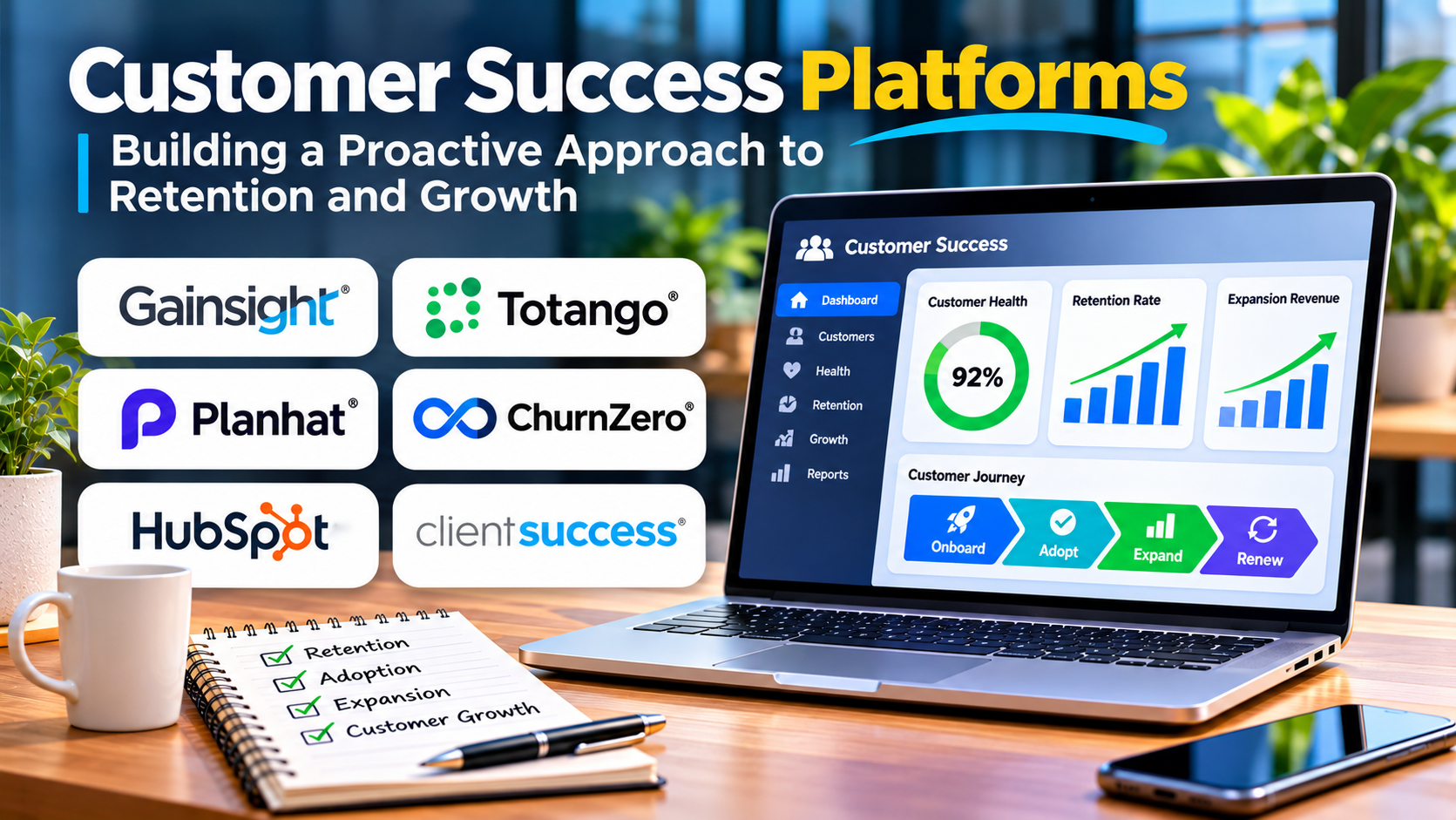
Winning a new customer is only the beginning of a business relationship.
Customers must successfully adopt a product, achieve meaningful results, and continue seeing value over time.
When businesses manage these activities through disconnected spreadsheets, emails, and CRM records, important warning signs can go unnoticed.
Customer success platforms help teams coordinate the work required to support long-term customer outcomes.
What Is a Customer Success Platform?
A customer success platform is software that helps businesses manage customer relationships after the initial sale.
It combines relevant customer information with workflows for onboarding, engagement, account reviews, risk management, and renewals.
Many platforms are designed for subscription businesses, although the underlying practices can apply to other recurring customer relationships.
The main objective is to help customers achieve the outcomes they expected when purchasing a product or service.
Customer Success vs. Customer Support
Customer support typically responds to specific questions, problems, and service requests.
Customer success takes a broader approach.
A customer success manager may help a customer establish goals, adopt relevant features, and identify opportunities to improve results.
Support and success teams should share information, but their responsibilities are not identical.
Customer Success Platforms to Evaluate
Gainsight
Gainsight offers customer success management capabilities for organizing account information, engagement, and customer lifecycle workflows.
It is relevant to organizations managing complex customer relationships.
Buyers should evaluate implementation effort, data requirements, and the level of process maturity needed to use the platform effectively.
ChurnZero
ChurnZero focuses on customer success workflows, customer engagement, and retention-related activities.
It may appeal to subscription businesses seeking structured account monitoring and outreach.
Planhat
Planhat provides customer success and customer management capabilities designed to connect customer information with operational workflows.
Organizations should evaluate data modeling, account visibility, and integration needs.
Vitally
Vitally focuses on customer success management and collaborative account workflows.
It may suit teams seeking to coordinate customer information, tasks, and engagement activities.
Totango
Totango has offered customer success management capabilities covering customer lifecycle processes.
Because customer success vendors and product portfolios can change, buyers should confirm the current product offering and commercial arrangements before evaluation.
Understanding Customer Health Scores
Many platforms use customer health scores to help teams identify accounts that may require attention.
A score might consider product usage, support activity, engagement, and commercial information.
However, a health score is only as useful as its underlying assumptions.
For example, low product usage may indicate poor adoption for one customer but normal behavior for another.
Organizations should validate their scoring model against actual customer outcomes.
A score should support human judgment rather than replace it.
Essential Platform Capabilities
| Capability | Business purpose |
|---|---|
| Customer profiles | Consolidate account information |
| Onboarding workflows | Coordinate early customer milestones |
| Health monitoring | Identify potential customer risks |
| Playbooks | Standardize recurring success activities |
| Engagement tracking | Maintain relationship visibility |
| Renewal management | Coordinate contract-related activities |
| Reporting | Measure retention and customer outcomes |
Building a Customer Success Process
Begin by defining what success means for different customer segments.
A small business customer may prioritize quick setup and ease of use. An enterprise customer may require integration, adoption across departments, and measurable financial value.
Create onboarding milestones based on these needs.
Assign ownership for important customer activities.
Use customer information to identify accounts that require intervention.
Finally, establish a process for reviewing whether customer success activities actually improve outcomes.
Measuring Customer Success
Useful metrics may include:
- Gross revenue retention.
- Net revenue retention.
- Customer churn.
- Time to first value.
- Product adoption.
- Onboarding completion.
- Customer satisfaction.
No single metric explains the entire customer relationship.
Retention can improve because of contractual restrictions or switching costs rather than genuine satisfaction.
Use several indicators to understand the complete picture.
Common Implementation Problems
Disconnected customer records can produce misleading account views.
Poorly designed automation can send irrelevant messages.
Excessive health alerts may overwhelm customer success managers.
A successful implementation requires clear data ownership and practical processes before advanced automation.
Final Thoughts
Customer success platforms help organizations move from reactive account management toward more coordinated customer relationships.
Their value comes from helping teams understand customer needs, identify problems early, and deliver measurable outcomes.
Choose software that supports a clear customer success strategy rather than expecting the platform to create that strategy automatically.