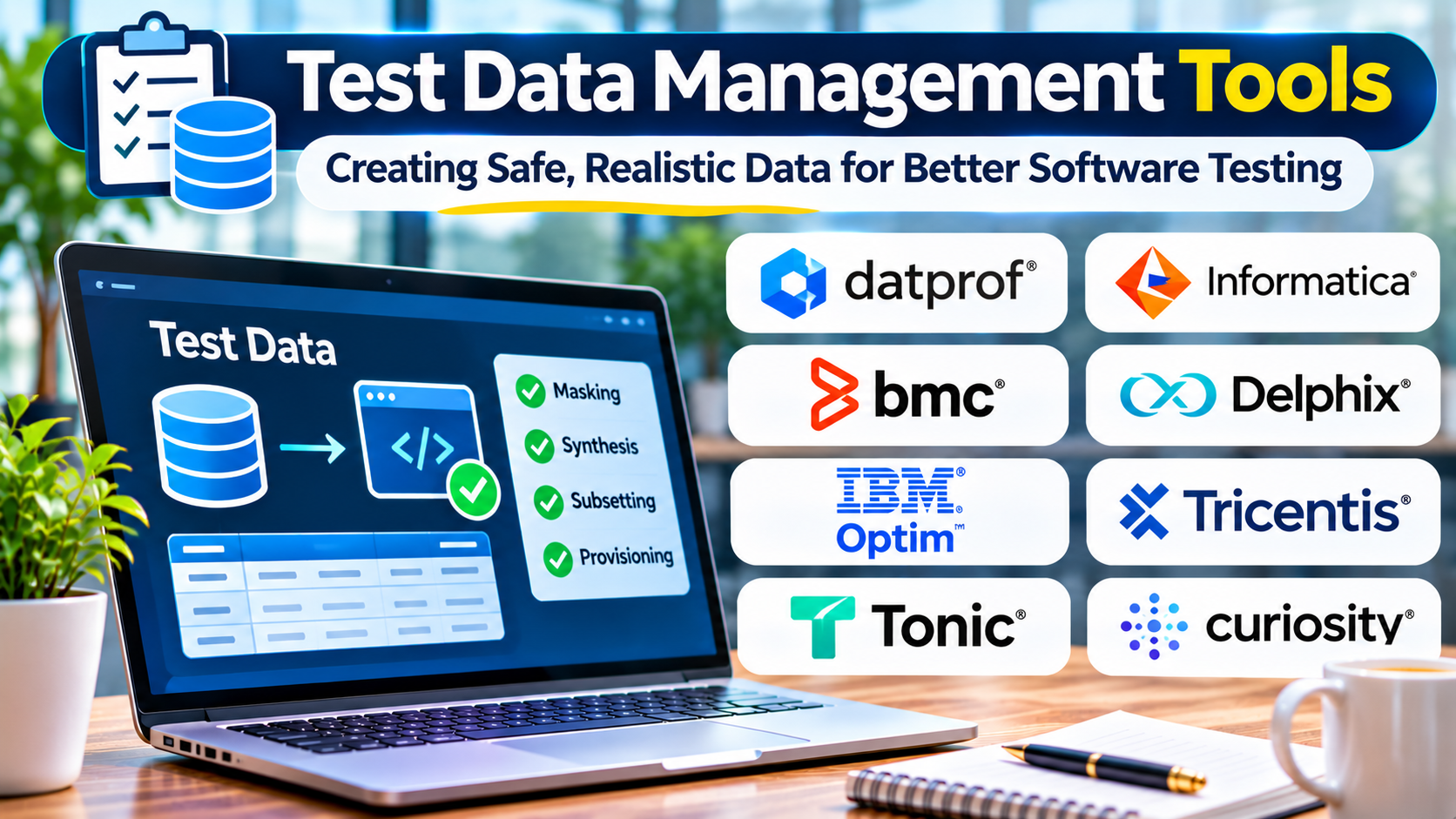
A testing environment is only as useful as the data inside it.
An application may work perfectly with ten sample customers but fail when it processes thousands of orders, complex account relationships, or unusual transaction histories.
Developers need realistic data to identify these problems. However, copying production databases into testing environments can introduce serious privacy and security risks.
Test data management tools help organizations balance these competing requirements.
They make it easier to create, protect, prepare, and deliver the data required for meaningful software testing.
What Is Test Data Management?
Test data management, or TDM, is the process of preparing and maintaining data used during software development and testing.
It includes creating test records, selecting representative datasets, protecting sensitive information, and making data available to testing environments.
A complete test data management process may involve:
- Synthetic data generation
- Data masking and de-identification
- Database subsetting
- Test data provisioning
- Data refresh and reset
- Referential integrity management
- Access control
- Data lifecycle management
- Integration with automated testing
The goal is to provide useful testing data without creating unnecessary operational or privacy risks.
Why Test Data Management Matters
Modern applications depend on complex data relationships.
An online banking application may connect customers, accounts, payments, beneficiaries, and transaction histories.
A healthcare application may process appointments, clinical records, insurance details, and billing information.
Testing these systems with a few manually created records often misses important behavior.
However, using real customer information creates another problem.
Sensitive data can spread across development environments, temporary databases, backups, and third-party testing services.
Test data management helps organizations improve testing quality while limiting unnecessary exposure.
Main Approaches to Test Data Management
Synthetic Data Generation
Synthetic data is artificially created information designed to represent useful characteristics of real data.
For example, a team can generate thousands of fictional customers with addresses, account balances, and transaction histories.
Synthetic data is useful when privacy requirements make production data unsuitable.
However, generated records must reflect the relationships and edge cases required by the application.
Random values alone do not guarantee realistic testing.
Data Masking
Data masking replaces or transforms sensitive values while preserving selected characteristics needed for testing.
A customer name might be replaced with a fictional name while maintaining consistent references across related tables.
Masking is useful when teams need realistic database structures.
Its effectiveness depends on the techniques used and the risk of re-identification.
Simple substitutions do not necessarily provide sufficient privacy protection.
Database Subsetting
Subsetting extracts a smaller portion of a larger dataset.
This reduces storage requirements and can make testing environments faster to provision.
A useful subset must preserve relationships between records.
For example, copying an order without its associated customer or payment records may make the dataset unusable.
Data Virtualization and Provisioning
Some platforms help teams create accessible copies or virtual representations of datasets without repeatedly performing full physical database copies.
This can improve environment preparation and reset workflows.
However, capabilities depend on database technology, infrastructure, and the selected product.
Test Data Management Tools to Consider
Informatica Test Data Management
Informatica has offered enterprise test data management capabilities focused on data discovery, protection, and provisioning.
Its solutions are relevant to organizations managing complex enterprise data environments.
Strengths: Enterprise data management experience and capabilities associated with sensitive-data handling.
Considerations: Buyers should verify current product packaging, supported data sources, and deployment options.
Informatica may be relevant when test data management must align with broader enterprise data governance.
Broadcom Test Data Manager
Broadcom offers enterprise test data management technology associated with the CA Test Data Manager product family.
It addresses requirements such as creating test data and supporting complex enterprise testing processes.
Strengths: Enterprise-oriented test data capabilities and support for structured testing workflows.
Considerations: Product compatibility, licensing, and implementation requirements need evaluation.
It may suit organizations with established enterprise testing infrastructure.
Delphix
Delphix provides data management capabilities associated with data provisioning, masking, and development environment workflows.
Its approach is relevant when teams need to make complex datasets available without relying on slow manual copying processes.
Strengths: Data provisioning and protection capabilities.
Considerations: Infrastructure compatibility and operational requirements should be assessed.
Delphix may be particularly relevant to organizations managing large database environments.
K2view
K2view provides data management technology, including test data management capabilities.
Its approach emphasizes working with data associated with business entities and their relationships.
Strengths: Entity-oriented data management and support for complex data relationships.
Considerations: Evaluate implementation complexity, data-source compatibility, and governance requirements.
K2view is worth considering when test scenarios depend on related information across multiple systems.
Tonic.ai
Tonic.ai provides technology for creating and managing data used in development and testing.
Its offerings include approaches involving synthetic data and sensitive-data protection.
Strengths: Developer-oriented data workflows and privacy-focused test data preparation.
Considerations: Validate supported data types, privacy guarantees, and application-specific data relationships.
Tonic.ai can be relevant to software teams seeking more controlled alternatives to raw production data.
GenRocket
GenRocket focuses on synthetic test data generation.
It helps teams create data for different testing scenarios and application requirements.
Strengths: Synthetic data generation and configurable testing scenarios.
Considerations: Complex business relationships may require substantial data modeling.
GenRocket is relevant when organizations need to generate varied test records without copying production information.
Mockaroo
Mockaroo is a synthetic data generation service.
It allows users to create sample datasets using configurable fields and formats.
Strengths: Accessible data generation for prototypes, development, and simpler testing needs.
Considerations: It is not a complete replacement for enterprise test data governance or complex production-data provisioning.
Mockaroo can be useful for smaller projects that need sample records quickly.
Comparing Test Data Management Approaches
| Requirement | Useful approach |
|---|---|
| Avoid using real customer data | Synthetic data |
| Preserve selected production characteristics | Carefully designed masking |
| Reduce large dataset sizes | Database subsetting |
| Prepare environments quickly | Automated provisioning |
| Test complex relationships | Relationship-aware data generation |
| Reset tests consistently | Repeatable data snapshots or seeding |
Many organizations need more than one approach.
For example, a team might use masked database subsets for integration testing and synthetic data for automated edge-case testing.
How to Choose Test Data Management Tools
Identify the Data Sources
List the databases, applications, file formats, and cloud services involved in testing.
A tool that supports relational databases may not automatically support document databases, streaming data, or specialized enterprise systems.
Evaluate Data Privacy
Determine whether the platform can identify and protect sensitive information.
Review masking methods, access permissions, audit capabilities, and data handling.
Privacy requirements may also depend on applicable laws and contractual obligations.
Check Referential Integrity
Realistic data requires consistent relationships.
A test dataset containing valid customer records but broken order references can produce misleading failures.
Measure Provisioning Time
Testing environments should be available when developers need them.
Evaluate how long it takes to prepare, refresh, and reset data.
Assess Automation
Test data workflows should integrate with the organization’s development and testing processes.
Manual preparation can become a bottleneck when teams deploy frequently.
Building a Reliable Test Data Strategy
Start by identifying the application workflows that require realistic data.
Then classify the data according to sensitivity and testing purpose.
Use synthetic data where it can accurately represent the required behavior.
When production-derived data is necessary, apply appropriate protection and limit access.
Create repeatable provisioning and cleanup processes.
Finally, review datasets regularly as application schemas and business requirements change.
Common Test Data Management Mistakes
One mistake is assuming that masked data is automatically anonymous.
Another is generating large volumes of random data without preserving meaningful relationships.
Teams also overlook data refresh requirements.
A dataset that worked during one release may become incompatible after database schema changes.
Finally, organizations sometimes buy a complex enterprise platform when a smaller synthetic data generator would satisfy their needs.
Match the solution to the actual problem.
Final Thoughts
Test data management tools help teams create realistic testing environments while controlling privacy and operational risks.
Informatica, Broadcom, Delphix, K2view, Tonic.ai, GenRocket, and Mockaroo address different parts of the test data problem.
The strongest strategy combines realistic data, appropriate protection, repeatable provisioning, and clear ownership.
Better test data does more than improve test coverage. It helps teams discover defects that simple sample datasets would never reveal.
Frequently Asked Questions
What is the difference between synthetic and masked data?
Synthetic data is artificially generated. Masked data is derived from existing records after selected information has been transformed or replaced.
Can test data management tools improve automated testing?
Yes. They can help create repeatable datasets, support test isolation, and reduce failures caused by inconsistent records.
Is production data safe to use in testing?
Using production data can introduce privacy and security risks. Organizations should apply appropriate safeguards and evaluate whether production-derived data is necessary.
Do small development teams need test data management software?
Not always. Smaller teams may use data generation libraries, database seeding scripts, and controlled fixtures.