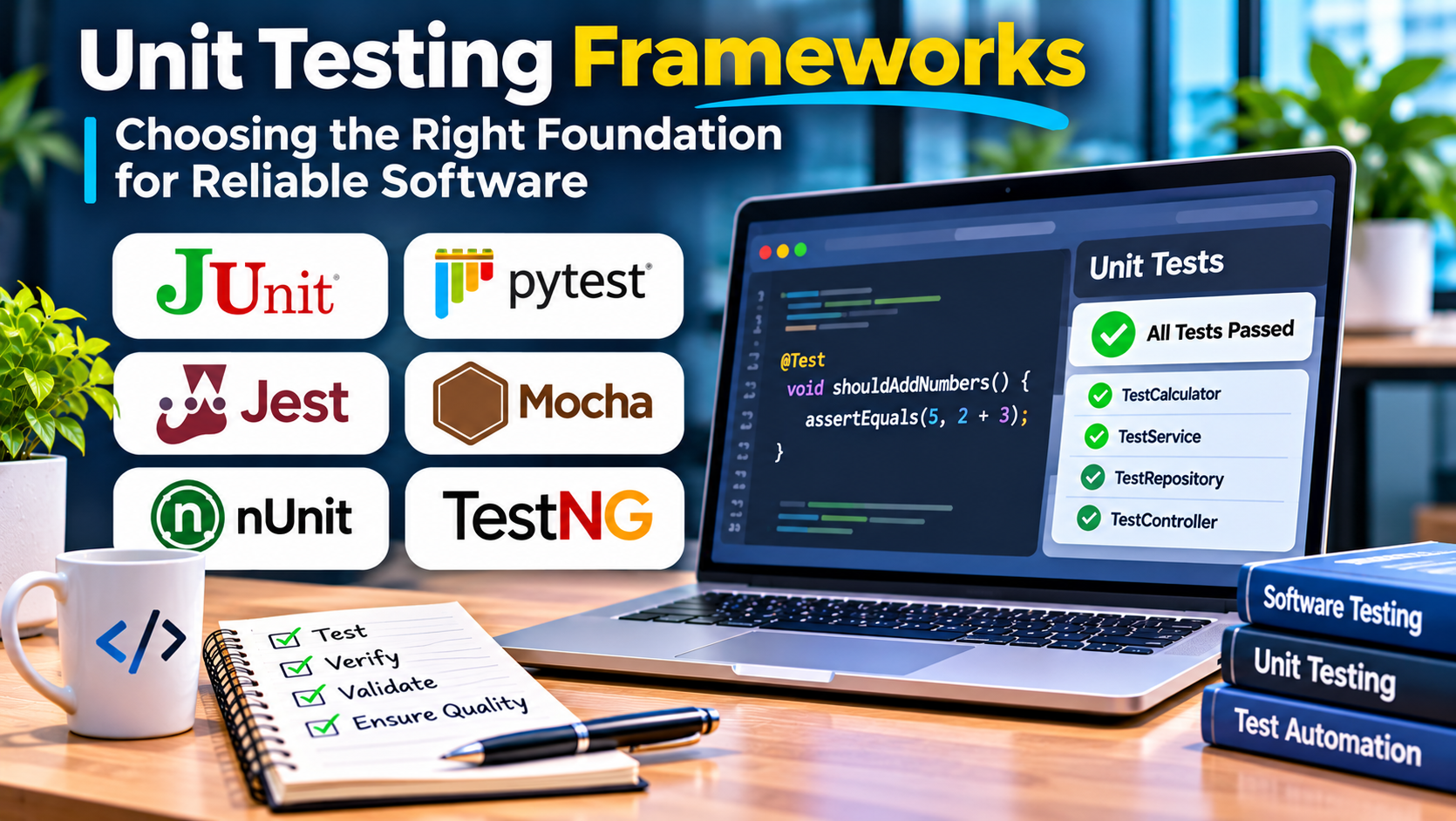
A small code change can cause a surprisingly large problem.
A developer updates a pricing function, fixes a validation rule, or changes how an application processes dates. The change looks harmless, but another feature stops working.
Unit testing helps teams catch these problems early.
However, writing tests is only part of the challenge. Developers also need a framework that makes tests easy to create, understand, execute, and maintain.
The right unit testing framework supports better software design without slowing down development.
What Is a Unit Testing Framework?
A unit testing framework provides tools for testing small parts of software independently.
A unit might be a function, method, class, or component with a clearly defined responsibility.
For example, an online store may contain a function that calculates a discount.
A unit test can verify that the function returns the correct amount for different inputs.
The framework executes the test, checks the expected result, and reports whether it passes or fails.
Most unit testing frameworks provide:
- Test discovery and execution
- Assertions for checking results
- Setup and cleanup functions
- Test grouping and organization
- Error and failure reporting
- Integration with development tools
- Support for automated execution
Some frameworks also include mocking, parameterized testing, or plugin systems.
Why Unit Testing Matters
Unit tests provide fast feedback when developers change application code.
They help detect errors before those errors reach integration testing or production.
Well-designed tests also document expected behavior.
For example, a test that checks how a payment calculation handles negative values communicates an important business rule.
Unit tests can also support refactoring.
Developers can improve internal code structure while checking that externally observable behavior remains consistent.
However, unit tests do not prove that an entire application works correctly. They complement integration, system, and end-to-end testing.
Popular Unit Testing Frameworks
JUnit
JUnit is a widely used testing framework for Java applications.
Its modern framework architecture supports annotations, assertions, lifecycle methods, and parameterized tests.
JUnit integrates with common Java build tools and development environments.
Best suited for: Java developers building backend services, enterprise applications, and libraries.
Strengths: Mature ecosystem, clear test structure, and strong integration with Java tooling.
Limitations: Mocking and some specialized testing capabilities require additional libraries.
JUnit is a practical starting point for Java projects because it fits naturally into established development workflows.
pytest
pytest is a Python testing framework known for its concise test syntax.
It supports fixtures, parameterized tests, assertions, and a broad plugin ecosystem.
Developers can write straightforward tests using ordinary Python functions.
Best suited for: Python applications, libraries, APIs, and data-processing systems.
Strengths: Readable tests, reusable fixtures, and flexible extensions.
Limitations: Large projects need consistent fixture organization to prevent hidden dependencies.
pytest is particularly useful when teams value simple test definitions and reusable testing infrastructure.
Jest
Jest is a JavaScript testing framework commonly associated with frontend and Node.js development.
It provides test execution, assertions, mocking capabilities, and snapshot testing.
Jest has an established ecosystem and remains relevant to many JavaScript projects.
Best suited for: JavaScript applications and projects already using Jest-based tooling.
Strengths: Integrated testing capabilities and broad community familiarity.
Limitations: Configuration and transformation requirements can become complicated in some modern JavaScript environments.
Vitest
Vitest is a JavaScript and TypeScript testing framework designed to work closely with Vite-based development environments.
It offers familiar test syntax, mocking, and integration with modern frontend tooling.
Best suited for: Modern JavaScript and TypeScript applications, particularly projects using Vite.
Strengths: Developer-friendly execution and integration with contemporary build workflows.
Limitations: Teams should verify compatibility with their specific runtime, dependencies, and existing test infrastructure.
NUnit
NUnit is an open-source testing framework for the .NET ecosystem.
It supports assertions, parameterized tests, and organized test execution.
Best suited for: C# and .NET teams seeking an established testing framework.
Strengths: Expressive assertions and flexible test organization.
Limitations: Teams must manage the supporting test runner and mocking tools appropriate to their environment.
xUnit.net
xUnit.net is another prominent testing framework for .NET applications.
It emphasizes modern testing patterns and integration with .NET development tools.
Best suited for: Developers working on modern .NET applications and libraries.
Strengths: Clean testing conventions and compatibility with common .NET workflows.
Limitations: Developers migrating from other frameworks may need to adapt to different lifecycle and setup patterns.
GoogleTest
GoogleTest is a C++ testing framework.
It provides assertions, test fixtures, and support for parameterized testing.
Best suited for: C++ libraries, systems software, and native applications.
Strengths: Established C++ testing conventions and integration with build systems.
Limitations: Native compilation, linking, and dependency management add complexity compared with some interpreted-language testing environments.
PHPUnit
PHPUnit is a unit testing framework for PHP.
It supports assertions, test fixtures, and automated testing workflows.
Best suited for: PHP applications, frameworks, and libraries.
Strengths: Strong relevance to PHP development and integration with common PHP tooling.
Limitations: Test isolation can become challenging when applications depend heavily on global state or external services.
Unit Testing Framework Comparison
| Framework | Primary ecosystem | Main advantage |
|---|---|---|
| JUnit | Java | Mature Java integration |
| pytest | Python | Simple syntax and fixtures |
| Jest | JavaScript | Integrated testing features |
| Vitest | JavaScript/TypeScript | Modern frontend tooling |
| NUnit | .NET | Flexible test organization |
| xUnit.net | .NET | Modern testing conventions |
| GoogleTest | C++ | Native code testing |
| PHPUnit | PHP | Established PHP testing |
The best framework usually follows the application’s programming language and development environment.
What Makes a Good Unit Test?
Test One Behavior Clearly
A test should communicate what behavior it verifies.
Avoid combining unrelated checks into a single large test.
When a test fails, the developer should quickly understand which behavior broke.
Keep Tests Independent
A test should not require another test to run first.
Independent tests are easier to execute in parallel and troubleshoot.
Use Meaningful Assertions
An assertion should verify a useful outcome.
For example, checking that a calculation returns the correct amount is more valuable than merely checking that the function executes.
Avoid Unnecessary External Dependencies
Traditional unit tests should generally avoid depending on live databases, external APIs, or network services.
Such dependencies can make tests slow and unpredictable.
Use appropriate test doubles where isolation is valuable.
Test Important Edge Cases
Consider empty inputs, invalid values, boundaries, and unusual conditions.
These cases often reveal errors that normal examples miss.
Unit Testing and Code Coverage
Code coverage measures which parts of an application execute during testing.
Coverage can help identify untested areas.
However, high coverage does not automatically mean high-quality tests.
A test can execute a function without checking whether its result is correct.
Focus on meaningful assertions and important behavior rather than chasing a coverage percentage alone.
How to Choose a Unit Testing Framework
Start with your programming language and existing development tools.
Next, evaluate:
- Ease of writing and reading tests
- Test execution speed
- Debugging capabilities
- Mocking and fixture support
- CI/CD integration
- IDE compatibility
- Community documentation
- Long-term maintenance
For most teams, a well-supported framework that fits their existing ecosystem is preferable to introducing an unfamiliar testing stack.
Common Unit Testing Mistakes
One common mistake is testing internal implementation details instead of observable behavior.
These tests break during harmless refactoring.
Another mistake is creating excessive mocks.
When every dependency is mocked, tests may stop representing meaningful application behavior.
Teams also sometimes ignore failing tests or allow unstable tests to remain in their pipelines.
Over time, this reduces trust in the entire testing process.
Final Thoughts
Unit testing frameworks help developers build confidence in software changes.
JUnit, pytest, Jest, Vitest, NUnit, xUnit.net, GoogleTest, and PHPUnit serve different programming ecosystems.
The best choice is the framework that fits your codebase, supports readable tests, and works reliably with your development process.
A useful unit test suite should make software easier to change—not harder.
Frequently Asked Questions
What is the difference between unit testing and integration testing?
Unit testing checks small parts of software in isolation. Integration testing checks how components work together.
Which unit testing framework is best for Python?
pytest is a popular choice because of its readable syntax and fixture system. Python also includes the standard-library unittest framework.
Is 100% code coverage necessary?
No. Coverage is a useful measurement, but meaningful test quality matters more than achieving a particular percentage.
Should unit tests run in CI/CD?
Yes. Fast, reliable unit tests are well suited to automated execution during code changes.