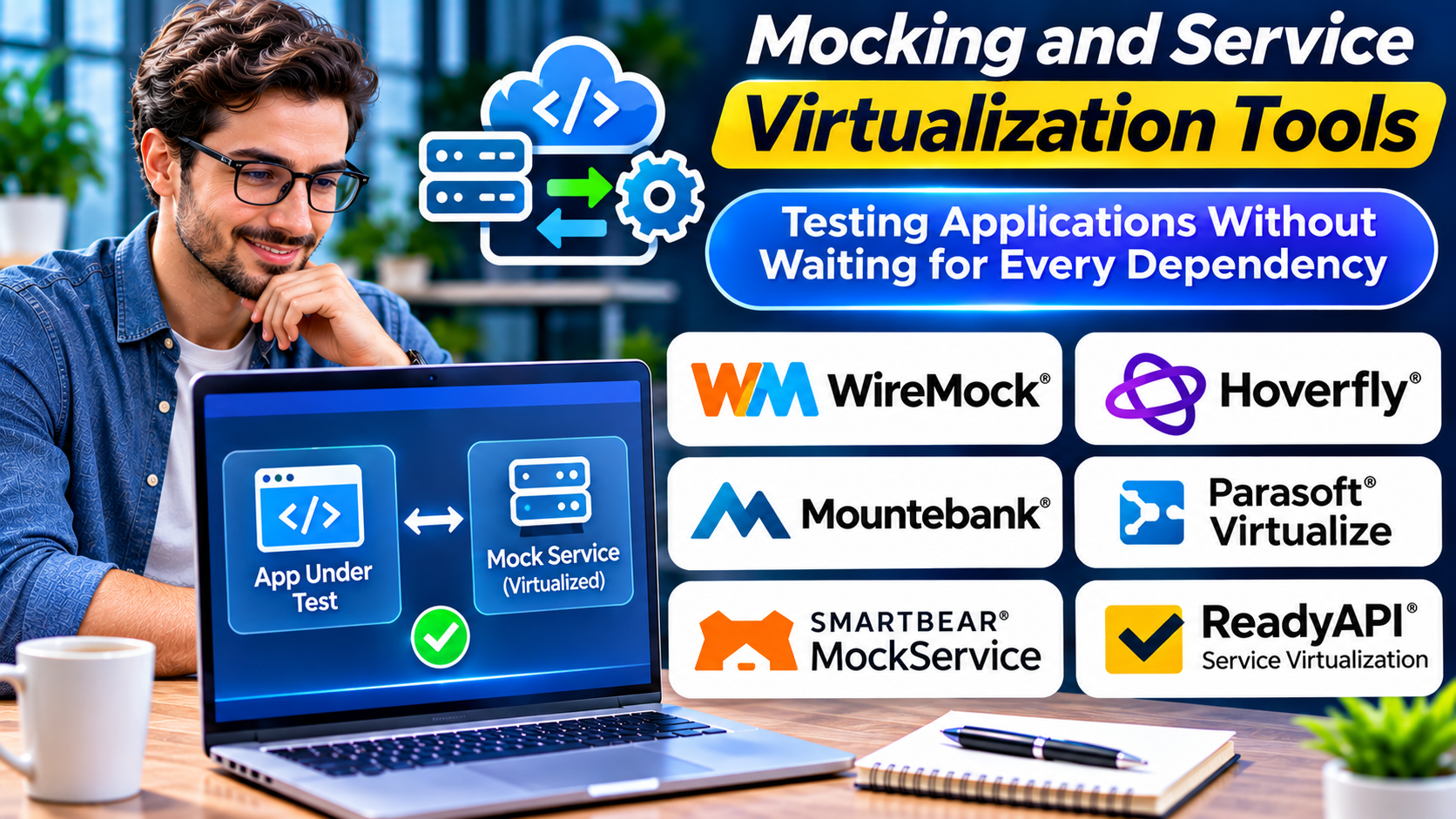
Modern applications rarely work alone.
A checkout service may depend on payment gateways, inventory systems, shipping providers, authentication services, and external APIs.
When one dependency becomes unavailable, development and testing can slow down.
A team might need to test a payment failure, but the payment provider’s sandbox does not reliably produce that condition.
Another team may be waiting for an API that has not been developed.
Mocking and service virtualization tools help solve these problems by replacing selected dependencies with controlled alternatives.
However, choosing between a simple mock and a more realistic virtual service requires understanding what each approach can—and cannot—prove.
What Is Mocking?
Mocking is a testing technique that replaces a real dependency with a controlled test double.
For example, a unit test for an order-processing function may replace a payment service with a mock object.
The mock can return a successful payment result, reject a transaction, or simulate an error.
This allows developers to test application behavior without contacting the actual payment system.
Mocks are especially useful for isolated unit tests.
They help developers control inputs, verify interactions, and reproduce specific conditions.
What Is Service Virtualization?
Service virtualization simulates the behavior of dependent systems at a service or protocol boundary.
A virtual service may respond to HTTP requests, imitate API behavior, or represent a system that is expensive or difficult to access.
More advanced implementations can model:
- Different response conditions
- Stateful interactions
- Network delays
- Error scenarios
- Authentication behavior
- Request validation
- Complex service dependencies
Service virtualization is useful when integration testing depends on systems that are unavailable, unstable, costly, or difficult to configure.
Mocking vs. Service Virtualization
Although the terms are sometimes used together, they describe different levels of simulation.
| Area | Mocking | Service virtualization |
|---|---|---|
| Typical scope | Function or component dependency | External service or system |
| Common use | Unit testing | Integration and system testing |
| Setup | Often implemented in test code | May require a standalone service |
| Realism | Usually limited to defined interactions | Can model broader service behavior |
| Main benefit | Fast, isolated tests | Reduced dependency on external systems |
The distinction is not absolute.
Some tools support both approaches, and lightweight API mocks can provide useful integration-level behavior.
Mocking and Service Virtualization Tools to Consider
Mockito
Mockito is a mocking framework for Java.
It helps developers create mock objects and verify interactions during unit testing.
Mockito integrates naturally with common Java testing frameworks.
Best suited for: Java developers testing classes and components with external dependencies.
Strengths: Familiar Java integration, interaction verification, and configurable mock behavior.
Limitations: Excessive mocking can make tests depend too heavily on internal implementation details.
Mockito is a strong option for Java unit testing but does not replace a complete service virtualization platform.
unittest.mock
unittest.mock is part of Python’s standard library.
It provides mock objects, patching utilities, and tools for controlling dependencies during tests.
Best suited for: Python developers who need mocking without introducing a separate framework.
Strengths: Standard-library availability and flexible dependency replacement.
Limitations: Incorrect patching or excessive mock configuration can make tests difficult to understand.
WireMock
WireMock is a tool for mocking HTTP-based services.
It can return configured responses to requests and simulate different API behaviors.
WireMock is useful when teams need to test applications against controlled HTTP dependencies.
Best suited for: API integration testing and development environments with unavailable external services.
Strengths: HTTP request matching, response simulation, and configurable service behavior.
Limitations: Complex service behavior requires careful configuration and maintenance.
MockServer
MockServer provides capabilities for mocking and proxying HTTP-based interactions.
It can be used to create expectations and controlled responses for testing.
Best suited for: Teams that need programmable HTTP mocking and request verification.
Strengths: Flexible request matching and controlled dependency behavior.
Limitations: Maintaining realistic expectations can become complex as APIs evolve.
Mountebank
Mountebank is an open-source tool for creating test doubles for supported network protocols.
It is designed to help teams simulate external dependencies during testing.
Best suited for: Integration environments that need standalone service doubles.
Strengths: Service simulation and protocol-oriented testing workflows.
Limitations: Teams should verify protocol support and project maintenance against current requirements.
Microcks
Microcks is an open-source API mocking and testing platform.
It can use API definitions and related artifacts to support mock services and API testing workflows.
Best suited for: Teams working with API contracts and service-oriented architectures.
Strengths: Contract-oriented API workflows and mock generation capabilities.
Limitations: API definitions must remain accurate for generated behavior to remain useful.
Postman Mock Servers
Postman provides mock server capabilities within its API development ecosystem.
Teams can use examples associated with API definitions or collections to simulate responses.
Best suited for: API teams already using Postman for design, collaboration, and testing.
Strengths: Convenient integration with API development workflows.
Limitations: Teams should verify plan restrictions, access controls, and support for complex behavior.
Parasoft Virtualize
Parasoft Virtualize is a commercial service virtualization solution.
It targets organizations that need to simulate complex dependent systems and support enterprise testing environments.
Best suited for: Enterprises with difficult-to-access systems and sophisticated integration testing requirements.
Strengths: Enterprise-oriented service simulation capabilities.
Limitations: Licensing, administration, and implementation effort may be substantial.
When Should You Use a Mock?
Mocks are useful when a test needs to isolate a specific piece of logic.
For example, a shipping cost calculation should not require a live shipping API if the test only needs to verify how the application handles a known rate.
Mocks can also help simulate rare errors.
However, a mock only behaves as its creator defines it.
If the real service changes its response format, a test using an outdated mock may continue passing.
This is why mocks should not be the only form of integration validation.
When Is Service Virtualization More Appropriate?
Service virtualization becomes valuable when applications depend on complex external systems.
Consider a banking application that integrates with a transaction-processing service.
Testing may require approved transactions, declined transactions, timeouts, duplicate requests, and temporary service failures.
A virtual service can make these scenarios repeatable.
It may also reduce testing costs when real external systems charge per request or have limited sandbox capacity.
However, virtual services require maintenance.
Their behavior must remain aligned with the systems they represent.
The Risk of Unrealistic Simulations
A perfectly reliable mock can hide real integration problems.
For example, a mock API may always return responses immediately.
The real service may experience network delays, rate limits, and intermittent failures.
If tests never represent these conditions, the application may perform poorly in production.
Teams should use realistic failure scenarios and periodically validate their assumptions against actual dependencies.
How to Choose the Right Tool
Identify the Testing Level
For unit tests, language-specific mocking frameworks are often sufficient.
For API integration tests, tools such as WireMock or MockServer may be appropriate.
For complex enterprise dependencies, a broader service virtualization platform may be justified.
Review Protocol Requirements
Not every tool supports every protocol.
Check whether your systems use HTTP, SOAP, messaging protocols, or other interfaces.
Evaluate Stateful Behavior
Some tests require more than returning a fixed response.
A service may need to remember previous requests or simulate a sequence of transactions.
Consider Automation
The tool should work with your CI/CD process.
Teams need predictable startup, configuration, test execution, and cleanup.
Examine Maintenance Effort
Service doubles can become outdated.
Choose a solution that makes behavior easy to update and review.
A Practical Testing Strategy
Use unit-level mocks for isolated business logic.
Use API mocks to support development before dependent services become available.
Use service virtualization for complex integration scenarios.
Then validate important workflows against real systems in suitable integration environments.
This layered approach balances speed, control, and realism.
Final Thoughts
Mocking and service virtualization tools reduce the friction caused by unavailable or unpredictable dependencies.
Mockito and unittest.mock support isolated testing.
WireMock, MockServer, Mountebank, Microcks, and Postman Mock Servers help simulate service interactions.
Parasoft Virtualize addresses broader enterprise virtualization requirements.
The right choice depends on how realistic the simulation must be and which integration risks the team needs to control.
The goal is not to eliminate real integration testing. It is to make development and testing more reliable while preserving confidence in actual system behavior.
Frequently Asked Questions
What is the difference between a mock and a stub?
A stub typically provides predefined responses. A mock can also support verification of expected interactions, although terminology varies between frameworks.
Can service virtualization replace integration testing?
No. It supports integration testing by simulating dependencies, but important workflows should also be validated against real systems.
Is WireMock suitable for unit testing?
WireMock is commonly used for HTTP-level testing. A language-specific mocking framework may be simpler for isolated unit tests.
Are service virtualization tools useful for microservices?
Yes. They can help teams test services independently when other services are unavailable or difficult to configure.