Introduction
A university offers an important examination to students studying from different locations. Some use personal laptops. Others rely on shared computers or unstable internet connections. Every candidate needs a fair opportunity to demonstrate their knowledge.
The institution also needs confidence that candidates follow examination rules.
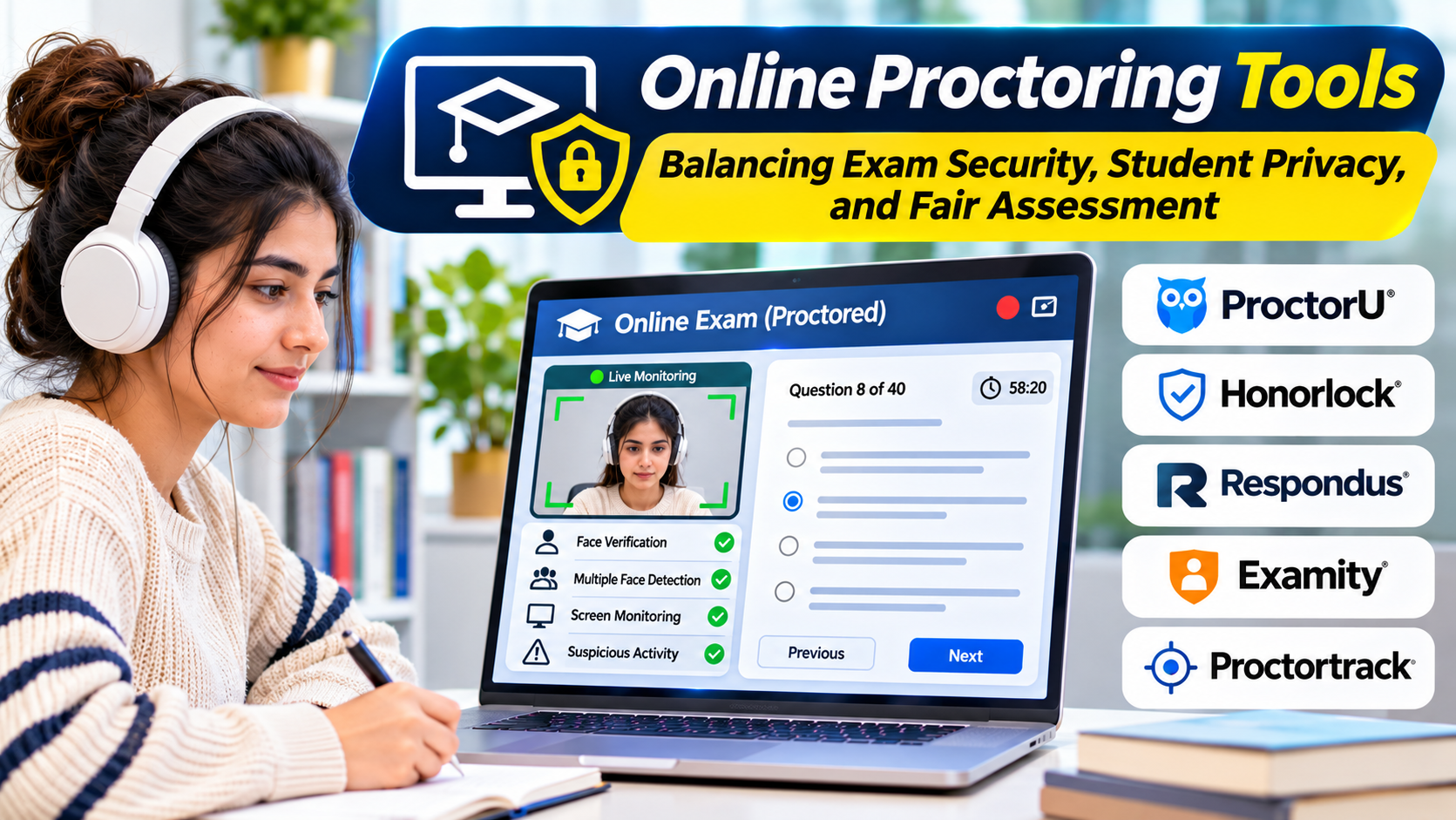
Traditional examination halls provide physical supervision, but remote assessments require a different approach. Online proctoring tools attempt to address this challenge through identity verification, browser restrictions, video monitoring, and examination review workflows.
However, monitoring technology introduces new risks. A disconnected camera might reflect a technical failure rather than misconduct. Unusual eye movements may have innocent explanations. Strict browser controls may interfere with accessibility software.
Choosing an online proctoring platform therefore requires more than comparing monitoring features.
Institutions must decide which risks genuinely threaten assessment integrity, what evidence the technology can provide, and how candidates will receive fair treatment when something goes wrong.
What Are Online Proctoring Tools?
Online proctoring tools are software systems used to supervise examinations taken outside traditional examination centers.
They may verify candidate identity, monitor examination sessions, restrict access to unauthorized resources, and record information for later review.
Depending on the platform, supervision may involve human proctors, automated monitoring, or a combination of both.
Online proctoring is commonly associated with higher education, professional certification, recruitment assessments, and remote training programs.
Its purpose is to support examination integrity, but the software cannot independently establish whether every candidate has behaved appropriately.
Monitoring produces observations and alerts. Institutions remain responsible for interpreting evidence and applying examination policies.
Three Main Approaches to Remote Proctoring
Understanding the monitoring model is the first important purchasing decision.
Live online proctoring
Live proctoring uses human supervisors who observe candidates during examinations.
A proctor may verify identity, inspect the testing environment, explain permitted materials, and respond to potential rule violations.
This model provides opportunities for immediate human judgment.
However, live supervision introduces staffing, scheduling, and operating costs.
Institutions must also consider the number of candidates each proctor supervises and how communication works when technical problems occur.
Live supervision should not be assumed to eliminate misconduct or assessment errors.
Recorded proctoring
Recorded proctoring captures selected examination activity for later review.
Depending on the product and configuration, recordings may include webcam video, microphone audio, screen activity, or other session information.
This approach can reduce the need for continuous human supervision.
However, it creates a review workload.
Institutions must determine which recordings require examination, who reviews them, and how long evidence is retained.
Recording an examination is not equivalent to evaluating it.
Automated proctoring
Automated proctoring uses software rules and, in some products, machine learning to identify events that may require attention.
Examples include interruptions to camera visibility, unexpected changes in the testing environment, or attempts to access restricted resources.
Automated alerts can help reviewers prioritize sessions.
However, an alert should not automatically be treated as proof of misconduct.
A candidate may look away from the screen while thinking. Environmental noise may come from another person in the household. A network interruption may temporarily disrupt monitoring.
Automated systems cannot reliably infer intent from these observations alone.
Hybrid proctoring
Hybrid systems combine automated monitoring with human supervision or review.
For example, software may identify an event, after which a trained reviewer examines the relevant context.
This approach can help institutions manage large examination volumes while preserving human involvement.
Its effectiveness depends on how alerts are generated, how reviewers are trained, and whether candidates can challenge decisions.
Online Proctoring Products Worth Evaluating
Several established products approach examination supervision differently.
The following examples are useful starting points for institutional research, not an independently tested ranking.
Respondus Monitor and LockDown Browser
Respondus offers tools associated with secure online assessment.
LockDown Browser restricts selected computer activities during supported examinations, while Respondus Monitor adds webcam-based proctoring capabilities.
This combination may be relevant to institutions that already use compatible learning management systems and want to strengthen controls around online examinations.
However, a restricted browser does not guarantee that a candidate cannot access unauthorized information through another device.
Institutions should also examine supported operating systems, accessibility accommodations, installation requirements, and the exact examination workflows available through their LMS.
Honorlock
Honorlock offers online proctoring services that combine automated monitoring capabilities with human proctoring support.
Its published product information describes identity verification, browser controls, examination monitoring, and assistance for candidates.
This approach may appeal to institutions seeking a combination of automated oversight and access to live support.
Buyers should investigate when human proctors become involved, how incidents are escalated, and what evidence is available to institutional reviewers.
They should also confirm the contractual scope of candidate support and monitoring services.
Proctorio
Proctorio provides remote assessment integrity tools, including secure proctoring and identity verification capabilities.
Its product portfolio emphasizes configurable examination security and monitoring.
Institutions evaluating Proctorio should determine which monitoring options are necessary for their assessments and which can be disabled.
The evaluation should also examine candidate device requirements, integration with examination platforms, and access to recorded information.
Meazure Learning
Meazure Learning offers examination and assessment services, including remote proctoring through its associated solutions.
It may be relevant to certification organizations and institutions seeking a wider assessment delivery and supervision arrangement.
The main purchasing question is whether the organization requires a standalone proctoring layer or a broader examination delivery service.
Institutions should verify which services, integrations, support arrangements, and proctoring methods are included in a specific proposal.
Comparing Proctoring Models
| Model | Main advantage | Important limitation |
|---|---|---|
| Live human proctoring | Immediate human interaction | Staffing and scheduling demands |
| Recorded proctoring | Flexible review after examinations | Recording storage and review workload |
| Automated proctoring | Helps identify sessions requiring attention | Alerts can be misleading |
| Hybrid proctoring | Combines software monitoring with human review | Requires clear escalation procedures |
| Restricted-browser assessment | Limits selected device activities | Cannot control every external resource |
The right model depends on examination stakes, candidate circumstances, and institutional resources.
A short practice quiz generally does not require the same supervision arrangements as a professional licensing examination.
Identity Verification Is a Separate Security Decision
Candidate authentication is a central part of remote examination integrity.
Some platforms support identity document checks, webcam-based verification, or integration with institutional authentication systems.
However, identity verification can introduce privacy and accessibility concerns.
Not every candidate has the same identity documents or camera equipment.
Institutions should establish acceptable alternatives before requiring a particular verification method.
They should also distinguish between verifying an account holder and confirming that the same person remains present throughout an examination.
These are related but different problems.
Questions to ask vendors
- Which identity verification methods are supported?
- What happens when automated verification fails?
- Can a human reviewer resolve an identity issue?
- Are identity images retained?
- Who can access verification records?
- Can institutions configure alternative procedures?
A fair verification process must account for legitimate candidates who cannot complete the default workflow.
The Problem With Treating Alerts as Evidence of Cheating
One of the greatest risks in automated proctoring is overinterpreting behavioral signals.
A monitoring system may flag movement, sound, or changes in camera visibility.
These events do not necessarily demonstrate misconduct.
Consider a candidate who looks away from the screen repeatedly.
The candidate may be reading permitted notes, thinking through a difficult question, or responding to an environmental distraction.
Without additional context, the observation is ambiguous.
Institutions should distinguish three stages:
- The system records an event.
- A reviewer determines whether the event requires investigation.
- An authorized decision-maker evaluates the evidence under institutional policy.
Skipping these stages can lead to unfair outcomes.
Vendors should explain how their software generates alerts and what limitations apply.
Institutions should not assume that a proprietary algorithm has independently established candidate intent.
Privacy and Data Protection Requirements
Online proctoring may involve unusually sensitive information.
Depending on the configuration, the system can collect identity documents, video recordings, audio, screen activity, device information, and details about a candidate’s home environment.
This creates obligations beyond ordinary application security.
Institutions should establish a clear purpose for each category of collected information.
They should also evaluate whether less intrusive methods can achieve the same assessment objective.
Data retention
How long should examination recordings remain available?
The answer depends on applicable regulations, institutional policies, and legitimate review requirements.
Retaining information indefinitely increases exposure without necessarily improving assessment integrity.
A suitable platform should support appropriate retention and deletion arrangements.
Access controls
Only authorized personnel should be able to review examination evidence.
Institutions should evaluate role-based permissions, authentication protections, audit logging, and vendor access.
They should also determine whether subcontractors process candidate information.
Cross-border processing
Remote examination services may involve candidates, institutions, and infrastructure in different jurisdictions.
Buyers should identify where data is processed and stored, and what contractual safeguards apply.
Privacy compliance cannot be established solely from a vendor’s marketing materials.
The institution must evaluate its own legal and operational responsibilities.
Accessibility Must Be Tested Before Deployment
A remote examination system can unintentionally disadvantage candidates who use assistive technologies.
Screen readers, alternative input devices, speech recognition, and other accessibility tools may interact poorly with restrictive browser software.
Candidates may also need additional time, movement breaks, or alternative examination arrangements.
Institutions should test these scenarios before introducing mandatory proctoring.
A vendor’s general accessibility statement is not enough.
The school or examination provider should verify compatibility with the specific accommodations it must support.
Technical accessibility matters too
Not every candidate has a high-performance computer or reliable broadband connection.
A platform that requires continuous video transmission may create difficulties in areas with limited connectivity.
Institutions should examine minimum device requirements, supported operating systems, bandwidth needs, and recovery procedures.
They should also establish alternatives for candidates who cannot meet the technical requirements.
Integration With Learning and Assessment Platforms
Online proctoring tools often operate alongside learning management systems and examination delivery applications.
Integration quality affects candidate experience and administrative reliability.
A well-designed workflow should allow authorized candidates to enter the correct examination without unnecessary account switching.
The platform should also communicate relevant session status and review information to authorized administrators.
However, institutions should not assume that a listed LMS integration supports every examination configuration.
They should test their actual assessment types, including timed examinations, accommodations, multiple attempts, and interrupted sessions.
Test the complete candidate journey
Begin with candidate authentication.
Then launch the examination, complete the required identity checks, and simulate a technical interruption.
After the session, examine what information appears in the institution’s review interface.
This reveals integration problems that feature demonstrations may overlook.
Understanding the Full Cost of Online Proctoring
Proctoring pricing may depend on examination volume, candidate numbers, session duration, service level, and monitoring model.
Human supervision can introduce different cost drivers from automated monitoring.
Institutions should also account for implementation, technical support, administrative review, accessibility accommodations, and appeals.
A low per-examination fee may not represent the lowest overall cost.
For example, a system that generates many ambiguous alerts can create substantial review work.
Similarly, difficult installation requirements can increase candidate support requests.
The financial evaluation should include these operational consequences.
A Practical Pilot Before Institutional Adoption
A useful pilot should include representative candidates and realistic examinations.
Test different operating systems, connection conditions, and accessibility arrangements.
Include a candidate who loses internet access during an examination.
Include another who requires an approved break.
Examine how the platform records these situations and how staff resolve them.
The institution should also test the appeals process.
A candidate who disputes a monitoring decision should have a clear route to request review.
Measure the right outcomes
Useful evaluation measures include examination completion rates, technical support incidents, unresolved identity checks, and time spent reviewing alerts.
Candidate feedback can identify confusing instructions or intrusive procedures.
These measures are more informative than simply counting the number of monitoring alerts.
When Online Proctoring May Not Be the Best Solution
Not every assessment requires remote surveillance.
Institutions should also consider open-book examinations, oral assessments, practical demonstrations, project-based work, and supervised examination centers.
These alternatives address assessment integrity in different ways.
An open-book examination, for example, can assess reasoning and application rather than memorization.
A practical demonstration may provide stronger evidence of certain skills than a remotely monitored multiple-choice test.
The choice should reflect the learning or certification objective.
Proctoring should be one possible assessment control, not an automatic requirement.
Making a Defensible Proctoring Decision
A responsible online proctoring strategy begins with the purpose of the examination.
Institutions should identify the risks they need to manage and choose proportionate controls.
The selection process must consider candidate privacy, accessibility, technical reliability, human review, and operational costs.
The strongest platform is not necessarily the one that records the most information or applies the most restrictions.
It is the system that supports a fair, reliable, and explainable examination process.
Online proctoring can contribute to assessment integrity, but only when institutions maintain clear policies, meaningful human oversight, and practical alternatives for candidates who cannot use the standard workflow.