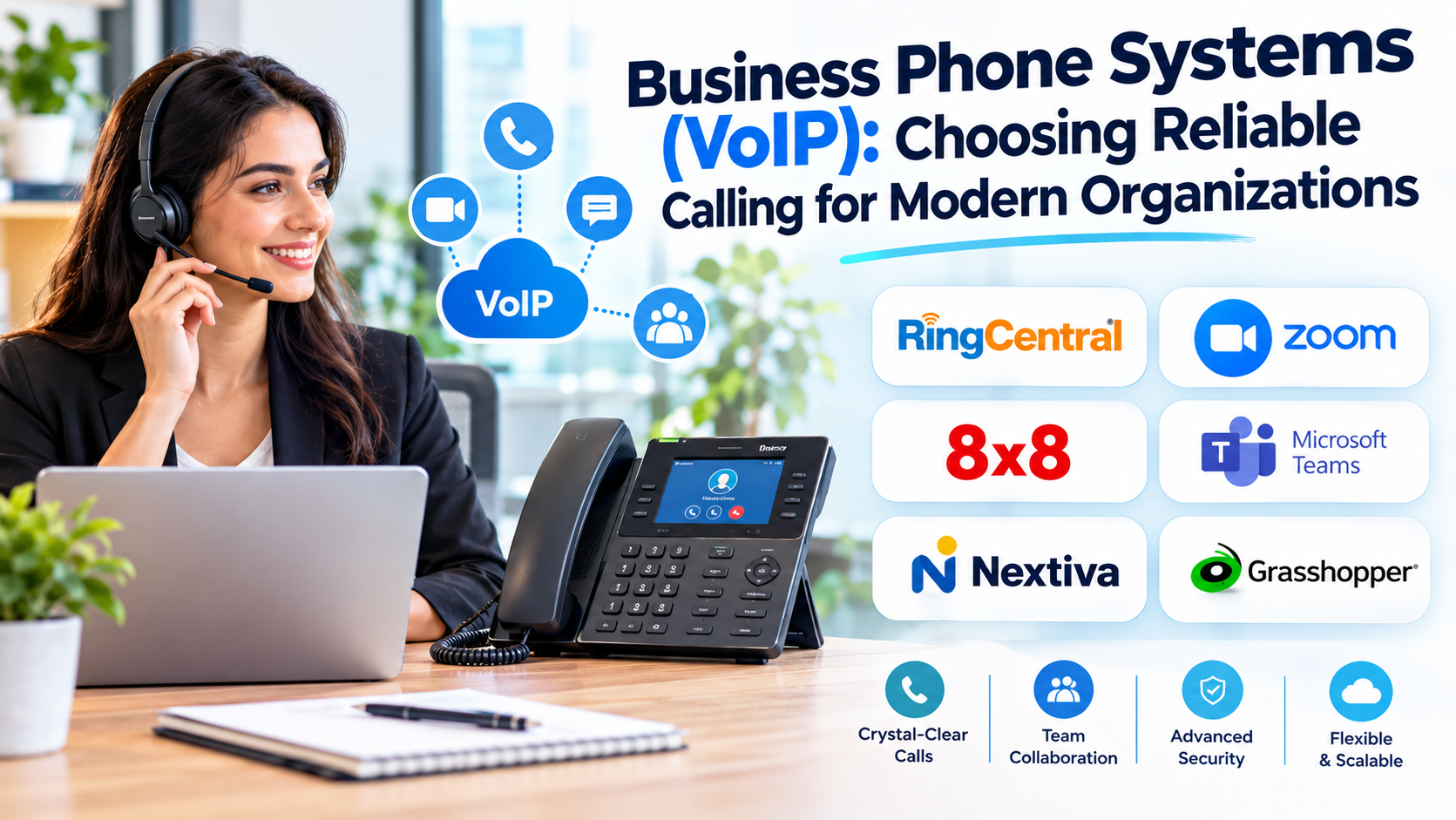
Business phone systems remain important even as companies adopt messaging, video meetings, and online collaboration.
Customers still call to request support, confirm orders, schedule appointments, and discuss urgent issues.
A reliable phone system helps businesses manage these conversations professionally.
Voice over Internet Protocol, or VoIP, allows organizations to make and receive calls using IP-based networks instead of relying exclusively on traditional telephone infrastructure.
Choosing the right VoIP system requires careful attention to calling features, network reliability, security, and ongoing costs.
What Is a VoIP Business Phone System?
A VoIP business phone system uses internet protocol technology to transmit voice communications.
Employees may make calls through desktop applications, mobile applications, supported desk phones, or browser-based interfaces.
Many business VoIP services include phone numbers, extensions, voicemail, call routing, and administrative controls.
Some platforms also support video meetings, team messaging, and CRM integrations.
VoIP describes the underlying communication technology. It does not automatically mean every service uses the same deployment model or feature set.
Cloud VoIP vs. On-Premises Phone Systems
Cloud-hosted phone systems generally place core calling infrastructure under the provider’s management.
On-premises systems place more infrastructure responsibility within the organization.
| Consideration | Cloud VoIP | On-premises system |
|---|---|---|
| Infrastructure | Primarily provider-managed | Primarily organization-managed |
| Maintenance | Shared between provider and customer | Greater internal responsibility |
| Remote access | Often designed for distributed users | Depends on configuration |
| Customization | Depends on provider capabilities | May offer greater infrastructure control |
| Costs | Often recurring subscriptions | Hardware, licensing, and maintenance |
| Reliability | Depends on provider and connectivity | Depends on local infrastructure and connectivity |
Neither approach is universally superior.
Business Phone Systems Worth Evaluating
RingCentral
RingCentral offers cloud business communications, including calling capabilities.
It may suit organizations seeking business telephony alongside broader communication tools.
Nextiva
Nextiva provides business communication services, including cloud calling and customer interaction capabilities.
It is worth evaluating for organizations seeking an integrated business communications environment.
Zoom Phone
Zoom Phone provides cloud-based business calling within Zoom’s communications portfolio.
It may appeal to companies already using Zoom for meetings.
Microsoft Teams Phone
Microsoft Teams Phone supports business calling through the Microsoft Teams environment.
Organizations should evaluate licensing, telephony connectivity, geographic availability, and administration.
8×8
8×8 provides business communications and related contact center services.
Its suitability depends on calling requirements, service availability, and the specific product configuration.
3CX
3CX offers a software-based business phone system with deployment flexibility.
It may suit organizations that want more control over telephony configuration and infrastructure choices.
Technical administration requirements should be considered carefully.
Essential Business Calling Features
Auto-attendant
An auto-attendant answers incoming calls and directs callers to appropriate departments or extensions.
Call queues
Call queues help distribute incoming calls when multiple representatives handle the same type of request.
Voicemail
Voicemail allows callers to leave messages when employees are unavailable.
Some services also provide transcription or message notifications.
Call forwarding
Call forwarding helps route calls to alternative numbers, devices, or employees.
Business hours routing
Organizations can configure different calling behavior during working hours, holidays, and after-hours periods.
Call reporting
Reporting helps managers understand call volumes, missed calls, and service performance.
Why Network Quality Matters
VoIP calls depend on network performance.
Packet loss, latency, jitter, and congestion can reduce call quality.
Organizations should evaluate internet connectivity and internal network conditions before deployment.
For business-critical calling, consider backup connectivity and continuity procedures.
Employees working remotely may experience different network conditions from office-based teams.
Security Considerations
Business phone systems can face threats such as unauthorized access, toll fraud, and account compromise.
Useful security measures include strong authentication, restricted administrative permissions, secure configuration, and monitoring for unusual calling activity.
Organizations should also evaluate provider security documentation and incident response processes.
Understanding VoIP Costs
A subscription price may not represent the complete cost of ownership.
Additional expenses can include:
- Business telephone numbers.
- International calling.
- Compatible desk phones.
- Implementation and migration.
- Optional recording or analytics.
- Support arrangements.
- Network improvements.
Request a cost estimate based on realistic calling patterns.
How to Choose a VoIP Provider
Start by documenting current call volumes, telephone numbers, and essential calling workflows.
Identify employees who need desk phones, mobile access, or specialized routing.
Confirm geographic service availability and emergency calling requirements.
Test call quality and administrative controls.
Evaluate number portability and migration procedures before committing to a provider.
Common Mistakes
Choosing solely by subscription price can lead to unexpected expenses.
Ignoring network readiness can produce poor call quality.
Migrating without testing call routing can interrupt customer communication.
Failing to document emergency calling arrangements can create serious operational risks.
Final Thoughts
VoIP business phone systems can provide flexible calling for organizations of many sizes.
The right system should support reliable customer communication, practical administration, and predictable costs.
Prioritize service continuity and real calling requirements over unnecessary features.