Introduction
A university instructor receives a research paper with a high similarity score. Several paragraphs match published academic sources. The report looks concerning, but the student has cited those sources correctly.
Another submission receives a much lower score, yet it contains an argument taken from an unpublished document without acknowledgment.
Which paper presents the greater academic integrity concern?
The answer cannot be determined from similarity percentages alone.
Plagiarism detection tools are widely used in education, publishing, research, and professional writing. They compare submitted text against available sources and highlight passages that may require investigation.
However, these systems do not independently determine whether plagiarism has occurred. They identify similarities that people must interpret.
Choosing an appropriate platform requires understanding source coverage, matching methods, document handling, reporting controls, and the limits of automated analysis.
What Plagiarism Detection Software Actually Does
Plagiarism detection software typically analyzes submitted text and compares it with material available in one or more reference collections.
These collections may include public websites, academic publications, previously submitted student papers, and private institutional repositories.
When the system identifies matching or similar passages, it generates a report.
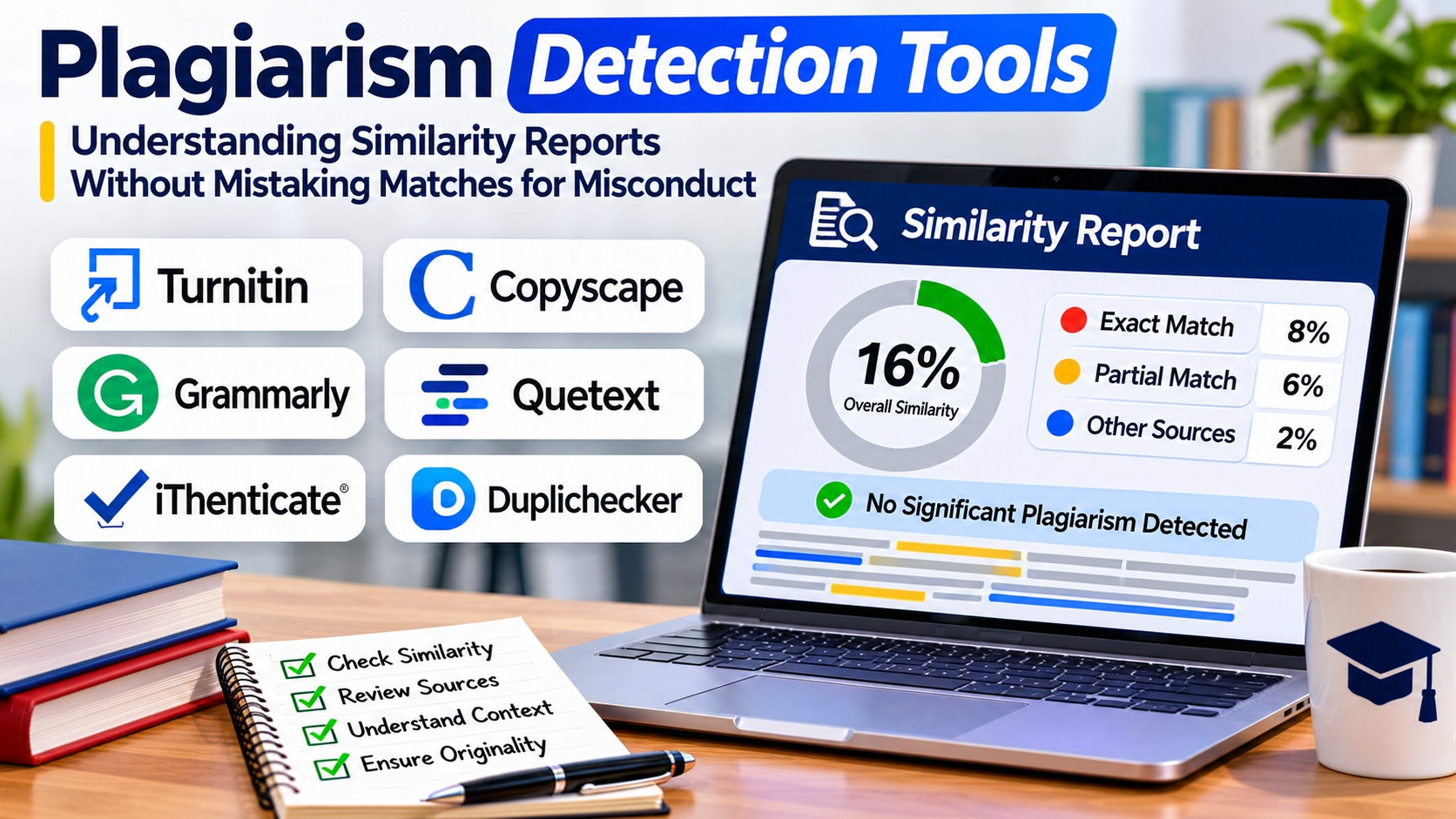
The report may show the matched text, possible sources, and a similarity percentage.
A similarity percentage indicates the amount of text identified as matching available sources under the system’s analysis settings.
It does not measure the probability that an author committed plagiarism.
This distinction is essential.
A correctly quoted passage can produce a legitimate match. A copied idea expressed in different words may not produce a substantial text match.
Human interpretation remains necessary.
Similarity Is Not the Same as Plagiarism
Plagiarism generally involves presenting another person’s words, ideas, or work as one’s own without appropriate acknowledgment.
The precise definition and consequences depend on institutional or publishing policies.
Text similarity is a technical observation.
Two documents may contain identical language for entirely legitimate reasons.
For example, research papers often use standardized terminology, methodological descriptions, and established definitions.
A literature review may contain many properly attributed quotations.
A legal document may reproduce statutory language.
These similarities are not automatically misconduct.
Conversely, a document can have a low similarity score while containing unattributed ideas, translated copying, or material that is absent from the software’s reference collection.
Therefore, no universal similarity threshold can establish academic integrity.
How Text-Matching Systems Work
Most similarity-checking workflows follow several stages.
Document submission
The user uploads a document or submits it through an integrated learning or publishing platform.
Supported file formats and document limits vary by product.
The system extracts text from the submitted file.
Documents containing scanned pages, images, mathematical notation, or unusual formatting may require special handling.
Source comparison
The extracted text is compared with available reference material.
Some systems emphasize academic publications and student submissions.
Others focus on publicly accessible websites or broader content monitoring.
The size of a reference collection is important, but its relevance matters more.
A large web index may still provide limited coverage of specialized subscription journals.
Match identification
The software identifies passages that resemble existing sources.
The matching process may consider exact phrases, overlapping text, or other textual similarities.
Some products offer additional analysis for paraphrasing or unusual document patterns.
However, these capabilities should not be treated as comprehensive detection of every form of plagiarism.
Similarity reporting
The system presents findings for review.
Useful reports show matched passages alongside source information.
Some platforms allow reviewers to exclude quotations, bibliographies, or selected matches.
These settings can change the reported similarity percentage.
Reviewers should understand which exclusions are active before comparing results.
Plagiarism Detection Tools Worth Evaluating
Different products serve different writing and review environments.
Turnitin Similarity
Turnitin Similarity is designed to help educational institutions identify text matches in submitted academic work.
Its similarity reporting draws on sources that include web content, academic publications, and student submissions.
The platform is relevant to universities and schools that need similarity checking as part of coursework review.
Its usefulness depends on how instructors interpret the reports and how the institution integrates them into academic integrity procedures.
Turnitin’s own guidance makes clear that similarity reports do not determine whether plagiarism has occurred.
Institutions should evaluate the available learning platform integrations, repository settings, access permissions, and student-facing feedback options.
iThenticate
iThenticate is oriented toward research, scholarly publishing, and other high-stakes writing workflows.
Its source comparison capabilities include scholarly literature and publisher-related content.
This makes it particularly relevant to journal editors, researchers, academic publishers, and organizations reviewing manuscripts before publication.
A research-focused institution may value specialized scholarly source coverage more than classroom assignment management.
Buyers should examine how manuscripts are stored, which repositories are searched, and whether their publishing workflow requires collaboration or editorial integrations.
Copyleaks
Copyleaks offers text similarity and content analysis capabilities, including products for plagiarism checking and AI-related content detection.
It may be relevant to education providers, businesses, and organizations seeking content analysis through applications or integrations.
The main evaluation issue is whether the available source coverage and reporting methods match the organization’s documents.
Buyers should separately assess similarity checking and AI writing detection rather than treating them as interchangeable functions.
Grammarly Plagiarism Checker
Grammarly provides plagiarism checking within its broader writing assistance environment.
This approach can appeal to individuals who want writing feedback and source checking within a familiar editing workflow.
However, individual writing assistance and institutional academic integrity management are different requirements.
Organizations should confirm whether the product offers the repository controls, administrative permissions, reporting, and integrations needed for formal review processes.
Other alternatives
Products such as Quetext and PlagScan have been associated with text similarity checking, although buyers should verify current availability, product arrangements, and support before considering any legacy or specialized service.
A product name appearing in an older comparison does not establish that the same service remains available independently.
Comparing Different Tool Categories
| Category | Typical audience | Main evaluation priority |
|---|---|---|
| Academic similarity platforms | Schools and universities | Student repositories, LMS integration, fair review |
| Scholarly manuscript checkers | Researchers and publishers | Academic source coverage and editorial workflows |
| Writing assistance tools | Individual writers | Ease of use and practical source feedback |
| API-based content analysis | Software providers and enterprises | Integration, throughput, and data handling |
| Internal document comparison | Organizations with private collections | Confidentiality and repository management |
The most appropriate product depends on the type of content being reviewed.
A journal publisher checking manuscripts has different requirements from a teacher reviewing student essays.
Source Coverage Is More Important Than Marketing Numbers
Vendors may advertise large collections of indexed documents.
These figures can provide context, but they do not guarantee that a particular source will be found.
The relevant question is whether the tool covers the materials that matter to the organization.
For a university, that may include student submissions and scholarly publications.
For a publisher, it may include subscription journals, conference papers, and preprints.
For a content agency, public websites may be especially important.
Organizations should test representative documents containing known matches from their relevant source categories.
Why missing sources matter
A similarity checker cannot reliably identify a match to material it cannot access.
Unpublished documents, private repositories, paywalled sources, and poorly extracted text may fall outside the available comparison collection.
A clean report therefore does not establish that a document is original.
It only indicates what the system identified under the conditions of the check.
Understanding Similarity Scores Correctly
A similarity score is often the most visible part of a report.
Unfortunately, it can also be the most misleading.
Suppose a research paper contains a substantial methodology section describing a standardized experimental procedure.
The language may closely resemble other publications because the procedure itself is conventional.
A high similarity percentage could reflect legitimate methodological overlap.
Now consider a short essay that copies a distinctive argument but changes enough wording to avoid obvious phrase matches.
The score may be low despite a serious attribution concern.
The percentage alone cannot distinguish these situations.
What reviewers should examine
Reviewers should consider the location and nature of each match.
Is the text a properly attributed quotation?
Does the passage contain common terminology?
Is the matched source the original publication or another document quoting it?
Does the author acknowledge the source of the underlying idea?
Are several long passages reproduced without meaningful attribution?
These questions provide a stronger basis for judgment than a fixed percentage cutoff.
Why AI Writing Detection Requires Separate Evaluation
Some similarity-checking vendors also offer AI writing detection.
These are different technologies addressing different questions.
Text similarity checking identifies relationships between submitted text and available source material.
AI writing detection attempts to estimate whether certain text may have been produced or modified using generative AI systems.
An AI-generated passage can be entirely new and produce few similarity matches.
A human-written passage can closely match published material.
Therefore, the two scores should not be combined or interpreted as equivalent.
The risk of false accusations
AI detection systems can misclassify human-written material.
Their reliability may vary with writing style, language, document length, and other factors.
Even vendors acknowledge limitations.
An automated AI writing indicator should not be the sole basis for disciplinary action.
Institutions need a transparent review process that considers the student’s work, assignment requirements, and relevant evidence.
They should also establish policies explaining when AI assistance is permitted.
Without clear rules, detection technology cannot resolve disputes fairly.
Repository Policies and Document Ownership
A major but frequently overlooked issue is what happens to submitted documents.
Some similarity-checking systems can retain submissions for future comparison.
This may help identify repeated copying across assignments.
However, it also creates questions about ownership, privacy, and retention.
Students, researchers, and businesses may submit confidential or unpublished work.
Organizations should establish whether documents are stored, indexed, shared, or excluded from future comparisons.
Questions worth asking
- Can submissions be checked without permanent repository storage?
- Who controls access to uploaded documents?
- Can documents be deleted when required?
- Are submissions used for other purposes?
- Where is the information processed?
- What happens when the subscription ends?
These questions are particularly important for unpublished research and commercially sensitive material.
Academic Integrity Should Be an Educational Process
Plagiarism detection is often treated as an enforcement mechanism.
However, similarity reports can also support writing education.
Students may not fully understand quotation rules, paraphrasing, citation styles, or the distinction between summarizing and copying.
A teacher can use a similarity report to explain where attribution is missing or where a passage relies too heavily on source language.
This approach is especially valuable during drafts and formative assessments.
Students can revise their work before final submission.
The purpose is to improve writing practices rather than simply reduce a numerical score.
Avoid teaching students to chase low percentages
A student may respond to a similarity report by changing words until the percentage decreases.
That behavior does not necessarily improve the quality or originality of the writing.
It can even produce inaccurate paraphrases.
Instruction should focus on understanding sources, developing independent arguments, and acknowledging intellectual contributions.
How to Evaluate a Plagiarism Detection Platform
A meaningful evaluation should use a controlled set of documents.
Include a paper with properly cited quotations.
Include another with unattributed copied passages.
Include a document containing common technical terminology.
Include a manuscript with references and standard methodology descriptions.
The goal is to understand how the platform presents matches, not to invent an overall accuracy ranking.
Examine report usability
A useful report should make it easy to inspect the source and context of a match.
Reviewers should be able to distinguish small phrase matches from substantial overlapping passages.
Filtering controls should be understandable.
If a reviewer excludes bibliography content, the system should make the effect of that decision clear.
Test document compatibility
Organizations should verify support for their common file types.
A system that performs well with ordinary text documents may struggle with scanned files or complex formatting.
The evaluation should also include multilingual content when relevant.
Examine administrative workflows
Universities may require LMS integration, role-based access, student submissions, and institutional reporting.
Publishers may need editorial workflows, manuscript confidentiality, and collaboration among reviewers.
Businesses may prioritize APIs, processing capacity, and contractual data protections.
The correct platform should fit the review process rather than forcing the organization to redesign every workflow around the software.
Cost Considerations Beyond the Subscription
Pricing structures vary across products.
Individual tools may use subscriptions or usage allowances.
Institutional platforms may require negotiated licensing based on users, document volume, or other commercial arrangements.
Additional costs can include integrations, staff training, administrative management, and document review.
The largest hidden cost may be human time.
A system that generates confusing reports can increase the workload of instructors or editors.
Organizations should consider how long reviewers need to interpret results and resolve disputes.
They should also examine whether additional AI-related features require separate licensing.
Establishing a Fair Review Policy
Institutions should document how similarity reports are used.
The policy should explain that a similarity score is not a finding of misconduct.
It should define who may review submissions and how potential concerns are investigated.
Students or authors should have an opportunity to provide explanations.
Reviewers should consider discipline-specific writing conventions and assignment expectations.
A formal process should also distinguish educational feedback from disciplinary proceedings.
These safeguards help prevent inconsistent decisions.
Common Mistakes to Avoid
One mistake is assuming that a high score automatically proves plagiarism.
Another is believing that a low score guarantees originality.
Organizations may also overlook source coverage limitations or compare reports generated with different filtering settings.
A further mistake is treating AI writing indicators as conclusive evidence.
Finally, institutions sometimes purchase a sophisticated platform without training reviewers to interpret its output.
The software may be technically capable while the review process remains unreliable.
Choosing Tools That Support Better Writing Decisions
Plagiarism detection tools are most valuable when they help people examine source use carefully.
The right platform depends on the organization’s content, reference sources, review workflow, and confidentiality requirements.
Educational institutions should prioritize fair interpretation and student learning.
Publishers should emphasize scholarly coverage and manuscript review processes.
Businesses should examine data handling and integration requirements.
Regardless of the product, the central principle remains the same: similarity is evidence to investigate, not a verdict.
A trustworthy integrity process combines appropriate software, informed human judgment, transparent policies, and a commitment to responsible writing.