Introduction
A research team completes a complex study. The results appear promising, but the data is scattered across personal laptops, shared drives, laboratory systems, and external cloud accounts.
Some files have clear names. Others contain several versions with no explanation of which one is final. The researcher responsible for the analysis has left the institution.
A new team member needs to reproduce the findings.
The files still exist, but understanding them is difficult.
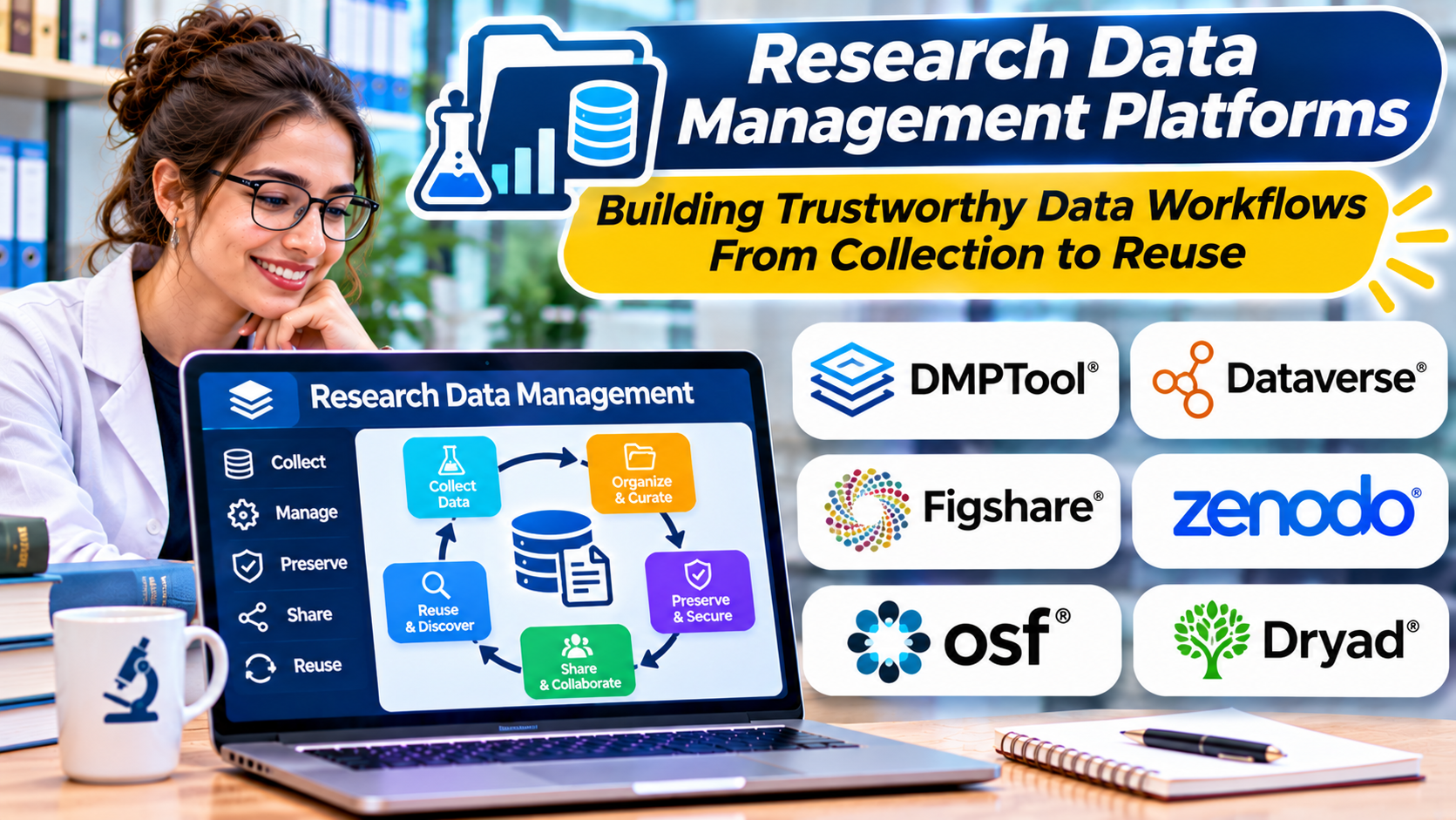
Research data management platforms address this problem by helping institutions organize, document, protect, share, and preserve research data.
The category is broader than a single type of software. Some products help researchers plan data handling. Others support active collaboration, institutional repositories, metadata management, or publication.
Choosing the right platform begins with understanding the research data lifecycle and the responsibilities of everyone involved.
What Is Research Data Management?
Research data management refers to the practices used to handle research information throughout its lifecycle.
These practices include planning, collection, organization, documentation, storage, security, analysis, sharing, and preservation.
Research data can take many forms.
It may include survey responses, laboratory measurements, images, interview recordings, simulation outputs, software code, observational records, or large computational datasets.
Different disciplines have different requirements.
A clinical research project may handle sensitive participant information.
An astronomy project may generate extremely large data files.
A social science project may rely on interviews that require strict confidentiality.
A useful research data management strategy must account for these differences.
Why One Platform Rarely Covers the Entire Lifecycle
The phrase “research data management platform” can suggest that a single product manages every stage of research.
In practice, institutions often use several connected systems.
A planning tool may document how data will be collected and shared.
An active research environment may provide controlled storage and collaboration.
An electronic lab notebook may record experiments.
A repository may publish datasets with persistent identifiers.
A preservation service may maintain long-term copies.
These systems perform different functions.
The goal should be a coherent workflow rather than unnecessary consolidation.
The main stages of research data stewardship
| Stage | Primary responsibility |
|---|---|
| Planning | Define data types, responsibilities, storage, and sharing requirements |
| Collection | Capture information accurately and consistently |
| Active management | Organize, secure, document, and version working data |
| Analysis | Preserve methods, software, and reproducibility information |
| Publication | Make appropriate datasets discoverable and citable |
| Preservation | Maintain integrity, context, and access over time |
| Reuse | Help others understand permitted uses and limitations |
The software architecture should reflect which stages the institution needs to support.
Data Management Plans: Decisions Before Data Collection
A data management plan, often abbreviated DMP, describes how a research project will handle its data.
It may address expected data types, storage locations, documentation practices, security controls, sharing arrangements, and long-term retention.
Funding organizations and institutions may require such plans.
However, a DMP should not be treated as a form completed once and forgotten.
Research projects change.
New data sources may appear, collaborators may join, and storage requirements may increase.
The plan should remain useful throughout the project.
DMPTool
DMPTool is designed to help researchers create data management plans.
It provides templates and guidance relevant to research planning requirements.
Institutions may use it to support researchers preparing plans for funding applications or internal projects.
However, a planning tool does not itself provide all the storage, preservation, and access services described in the plan.
Organizations should distinguish planning support from operational data infrastructure.
Active Research Data Management
During a project, researchers need reliable access to working data.
They may collaborate across departments, institutions, or countries.
The platform should support appropriate sharing without losing control of sensitive information.
Important capabilities can include permissions, versioning, audit trails, metadata, and integration with analysis environments.
File organization and version control
A common problem is uncertainty about which file contains the authoritative results.
Names such as final_data, final_data_new, and final_data_revised provide little reliable information.
A better workflow uses consistent naming conventions, documented versions, and clear ownership.
Some research environments provide version history directly.
Others rely on repositories or version control systems.
The correct approach depends on file size, data type, and collaboration requirements.
Permissions and collaboration
Not every project member needs unrestricted access to all data.
A statistician may need a de-identified dataset.
A principal investigator may require access to additional records.
An external collaborator may be permitted to view selected outputs but not download sensitive source files.
Platforms should support these distinctions.
Institutions should also establish what happens when collaborators leave a project.
Access should not continue indefinitely merely because an account remains active.
Metadata Makes Research Data Understandable
Metadata is information that describes data.
It may include a dataset title, creator, methodology, variables, units, collection conditions, software dependencies, and usage rights.
Without adequate metadata, a dataset can become difficult to interpret even when its files remain intact.
Consider a spreadsheet containing temperature measurements.
If the file does not explain the units, measurement location, instrument, or collection method, future researchers may not be able to use it reliably.
A good platform should support metadata appropriate to the discipline.
General versus domain-specific metadata
General metadata helps identify and discover datasets.
Domain-specific metadata captures information necessary for a particular field.
For example, a genomics dataset may require specialized biological and sequencing information.
A geospatial dataset may require coordinate reference details.
Institutions should not assume that a generic metadata form is sufficient for every discipline.
The platform should support appropriate standards or allow well-governed extensions.
FAIR Data Principles and Their Practical Meaning
FAIR stands for Findable, Accessible, Interoperable, and Reusable.
These principles provide a framework for improving how research data is described and managed.
Findable data should have useful identifiers and metadata.
Accessible data should have clear retrieval conditions.
Interoperable data should use suitable formats and descriptions that support exchange.
Reusable data should include enough context and licensing information for appropriate future use.
FAIR does not mean that every dataset must be publicly downloadable.
Sensitive data may require controlled access.
A dataset can still follow FAIR principles when its metadata is discoverable and its access conditions are clearly documented.
Avoid confusing FAIR with open data
Open data emphasizes making information available for use and reuse under suitable conditions.
FAIR emphasizes the qualities that make data discoverable, understandable, and usable.
Some datasets can be both open and FAIR.
Others may need restricted access because of privacy, contractual, ethical, or security requirements.
A research data management platform should support these distinctions.
Research Data Repository Platforms Worth Evaluating
Research repositories are important components of the wider data management ecosystem.
They support publication, discovery, citation, and controlled access to datasets.
Dataverse
Dataverse is an open-source research data repository platform.
It supports dataset organization, descriptive metadata, data files, and research data sharing.
Its repository model allows institutions to organize datasets within collections.
Dataverse may be relevant to universities, research institutes, and other organizations seeking a structured environment for publishing and managing datasets.
Buyers should evaluate metadata requirements, access controls, storage arrangements, integration options, and the responsibilities associated with hosting.
InvenioRDM
InvenioRDM is an open-source research data management repository platform.
It is designed to support research outputs and related repository workflows.
Institutions considering InvenioRDM should examine its metadata model, records, communities, access arrangements, and technical deployment requirements.
It may be relevant where an organization wants control over its repository infrastructure and configuration.
However, operating an institutional repository requires ongoing technical and curatorial resources.
Figshare
Figshare provides a platform for sharing and managing research outputs.
It is used in individual and institutional research publishing contexts.
Institutions may evaluate it for dataset publication, discovery, citation, and related workflows.
The important questions include institutional branding, access controls, metadata, storage allowances, and integration with existing research systems.
Buyers should distinguish individual service functionality from the features included in institutional arrangements.
DSpace
DSpace is an open-source repository platform used by institutions to manage and provide access to digital research and scholarly materials.
It is relevant to organizations managing a broader institutional repository, potentially including publications, theses, and datasets.
Libraries should evaluate whether its data-oriented workflows meet their specific requirements.
A general institutional repository is not necessarily equivalent to a specialized research data repository.
Open Science Framework
The Open Science Framework, commonly called OSF, supports research project organization and collaboration.
It can help teams structure project materials and connect aspects of their research workflow.
Its role differs from that of a dedicated institutional data repository.
Researchers and institutions should assess whether they need active project collaboration, public sharing, formal archival publication, or a combination of these functions.
Comparing Research Data Platform Categories
| Platform category | Main purpose | Critical evaluation question |
|---|---|---|
| Data management planning tool | Define data stewardship responsibilities | Does it reflect relevant funder and institutional requirements? |
| Active research workspace | Manage ongoing project data | Are collaboration and security controls sufficient? |
| Research data repository | Publish and share datasets | Are metadata, citation, and access workflows appropriate? |
| Institutional repository | Manage wider scholarly outputs | Does it support specialized dataset requirements? |
| Preservation infrastructure | Maintain long-term digital integrity | Are preservation responsibilities and recovery procedures clear? |
These categories should not be ranked as if they were directly interchangeable products.
Persistent Identifiers and Data Citation
Research datasets need stable references if other researchers are expected to find and cite them.
Persistent identifiers, including Digital Object Identifiers, can help establish durable references to published datasets.
A repository may register identifiers through an appropriate service.
However, the identifier is only part of the process.
The repository must maintain metadata and provide a reliable landing page describing the dataset.
Versioning published datasets
Research data may change after initial publication.
Corrections, additional files, or revised documentation may create new versions.
A repository should provide a clear relationship between versions.
Researchers need to know which dataset version supports a particular publication or analysis.
Institutions should test how the platform handles corrections without obscuring historical records.
Sensitive Research Data Requires Special Controls
Research projects may involve personal information, confidential interviews, health-related records, commercially sensitive information, or restricted cultural knowledge.
These datasets cannot always be managed through ordinary public-sharing workflows.
Institutions should determine which data can be shared openly, which requires controlled access, and which must remain restricted.
The platform should support appropriate permissions, authentication, audit records, and data handling policies.
De-identification is not always sufficient
Removing names from a dataset does not necessarily eliminate privacy risks.
Individuals may be identifiable through combinations of other variables.
The risk depends on the data, context, and available external information.
Institutions should therefore evaluate disclosure risks before publication.
A repository’s access controls cannot substitute for appropriate ethical and legal review.
Data location and contractual obligations
Research collaborations may cross national borders.
Data protection obligations can vary by jurisdiction, funder, and research context.
Institutions should review where data is stored, who processes it, and what contractual safeguards apply.
No platform automatically guarantees compliance with every relevant requirement.
Reproducibility Requires More Than Preserving a Dataset
A dataset may be complete but still insufficient to reproduce an analysis.
Researchers may also need software code, parameter settings, documentation, processing steps, and information about the computational environment.
For example, a statistical result may depend on how missing values were handled.
If that transformation is not documented, another researcher may reach a different conclusion.
Research data management should therefore include the information necessary to understand how results were produced.
Connect data to code and methods
Where appropriate, institutions should encourage researchers to preserve analysis scripts and relevant documentation.
They should also record software dependencies and important processing decisions.
Some projects may benefit from reproducible computational environments.
However, no single tool can guarantee reproducibility.
It requires sound research practices supported by suitable infrastructure.
Storage, Backup, and Preservation Are Different Responsibilities
Storage provides a place to hold files.
Backup creates recoverable copies that help address loss or damage.
Preservation involves maintaining the integrity, accessibility, and understandability of digital information over time.
These responsibilities overlap but are not identical.
A cloud storage service may provide durable infrastructure without guaranteeing that a research dataset remains understandable decades later.
Preservation planning may require file format review, integrity checking, documentation, and ongoing stewardship.
Institutions should establish which services provide each function.
Integration With Research Infrastructure
Research data management platforms may connect to institutional identity services, laboratory systems, storage environments, electronic lab notebooks, and research administration applications.
Integration is especially important when data moves between active projects and formal repositories.
A researcher should not have to reconstruct metadata manually at every stage.
However, automatic transfers can create errors if different systems use inconsistent identifiers or metadata structures.
Institutions should define authoritative sources for important information.
They should also test what happens when a transfer fails or a dataset is updated.
A Realistic Evaluation Scenario
A university planning a research data platform should begin with representative projects.
Select one project involving ordinary tabular data.
Choose another involving large computational files.
Include a third project containing sensitive information that requires controlled access.
Then test the complete lifecycle.
Create the project record, assign collaborators, upload data, add metadata, revise files, and prepare a dataset for publication.
For the restricted project, test access approval and permission changes.
Finally, export the dataset and metadata.
This process reveals whether the platform supports the institution’s actual research practices.
Total Cost and Operational Ownership
Research data platforms may involve subscription charges, hosting expenses, storage costs, implementation services, and staff support.
Large datasets can create significant infrastructure requirements.
Institutions should examine how costs change as data volumes grow.
They should also account for metadata curation, user training, repository administration, and long-term preservation.
Open-source software may reduce licensing costs while increasing the importance of internal technical resources.
Commercial services may reduce some operational burdens but create contractual dependencies.
The correct financial comparison includes the entire stewardship process.
Governance Determines Whether the Platform Works
Research data management is not solely an IT responsibility.
Researchers understand the scientific meaning of their data.
Libraries and research support teams may provide metadata and repository expertise.
IT departments manage infrastructure and security.
Legal, ethics, and compliance teams may address restricted data.
A successful program defines how these responsibilities interact.
Establish clear ownership
Institutions should determine who approves data publication, who manages restricted access, and who maintains datasets after researchers leave.
They should also define retention and deletion policies.
Without clear ownership, even a technically capable platform can become a collection of poorly documented files.
Measuring the Value of Research Data Management
The success of a platform should be evaluated through practical outcomes.
Relevant indicators may include the proportion of datasets with complete metadata, unresolved access requests, failed transfers, and data recovery incidents.
Institutions may also examine how often published datasets receive citations or are reused.
However, usage counts alone do not establish research quality.
The more important objective is to make data trustworthy, discoverable, and appropriately accessible.
Building a Sustainable Research Data Ecosystem
Research data management platforms support a long-term institutional responsibility.
Researchers need practical tools during active projects.
Institutions need security, governance, and continuity.
Future users need sufficient metadata and documentation to understand the work.
A suitable architecture may combine planning tools, active storage, repositories, and preservation services rather than relying on one application.
The strongest choice is the combination that supports responsible data handling from the first research decision to eventual reuse.
Research data has lasting value only when its meaning, integrity, and appropriate access can be maintained. Software should make that stewardship achievable rather than merely provide another place to store files.