Introduction
A testing laboratory receives hundreds of samples from different customers.
Each sample requires identification, preparation, testing, review, and reporting. Some tests use specialized instruments. Others require multiple analysts or repeat measurements.
A single mislabeled sample can create uncertainty about the validity of the results.
A missed review step can delay a customer report. An incomplete instrument record can complicate an investigation.
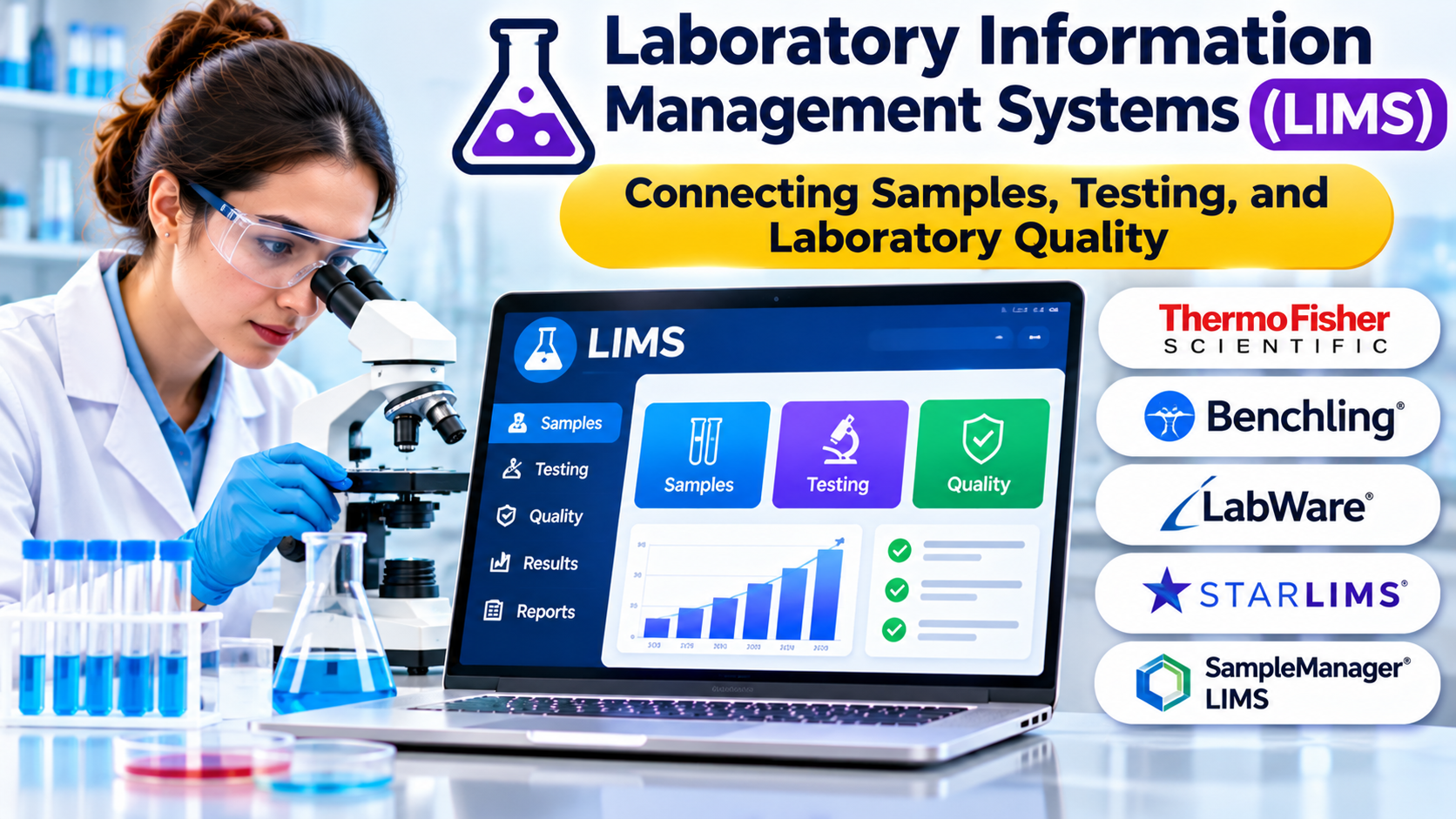
Laboratory information management systems, commonly called LIMS, help laboratories coordinate these activities.
A LIMS connects sample information with laboratory workflows, test results, quality procedures, and reporting.
However, the category includes products designed for very different environments, from environmental testing and food laboratories to pharmaceutical quality control and manufacturing.
Choosing a LIMS requires understanding the laboratory’s operating model before comparing software features.
What Is a Laboratory Information Management System?
A laboratory information management system is software used to manage laboratory samples, testing activities, associated data, and operational processes.
Its primary purpose is to support reliable movement of information through laboratory workflows.
A typical process begins when a sample arrives.
The laboratory registers the sample, assigns tests, records preparation steps, captures results, performs reviews, and issues a report.
The LIMS maintains relationships between these activities.
Depending on the product, it may also support instrument connections, inventory, quality control, scheduling, billing, and regulatory documentation.
A LIMS should not be treated as a universal replacement for every laboratory application.
Its capabilities depend on the scientific domain and the workflows it was designed to support.
Why Sample Traceability Is the Central Requirement
A laboratory result is meaningful only when it can be connected to the correct sample and testing process.
Suppose a water testing laboratory receives samples from several collection sites.
Each container must be associated with the correct location, collection time, requested analysis, and handling conditions.
If samples are mixed up, the resulting measurements may be scientifically valid but attributed to the wrong source.
A LIMS helps reduce this risk by maintaining structured sample identities and workflow records.
Sample registration
Sample registration records the information needed to identify and process incoming material.
Fields may include sample type, source, collection details, requested tests, priority, and customer information.
The system should support the laboratory’s actual sample numbering scheme.
It should also handle duplicate identifiers, incomplete submissions, and corrections.
Sample relationships
A single submitted sample may be divided into several portions.
These may be called aliquots, subsamples, or derivatives, depending on the laboratory.
The LIMS should preserve relationships between the original sample and its derived materials.
This is essential when different tests use different portions.
Chain of custody
Some laboratories need detailed records of who handled a sample and when.
Chain-of-custody requirements may be particularly important in forensic, environmental, or other legally sensitive testing.
The software should support the specific evidence requirements that apply.
A simple status history may not be sufficient for every chain-of-custody process.
Mapping the Complete Laboratory Workflow
The strongest LIMS implementations begin with a clear understanding of the laboratory’s workflow.
A typical sequence may include sample receipt, preparation, testing, result review, approval, and reporting.
However, real processes are rarely perfectly linear.
A sample may require retesting.
An instrument may fail during analysis.
A quality control result may invalidate an entire analytical batch.
A customer may request an additional test.
The LIMS should support these exceptions without losing traceability.
Workflow configuration
Laboratories should evaluate how tests and processes are configured.
Can staff define different workflows for different sample types?
Can the system assign work based on laboratory rules?
Can authorized users change priorities?
How does it handle samples placed on hold?
The answers determine whether the platform supports real operations or merely records their outcomes.
Instrument Integration and Automated Data Capture
Laboratory instruments generate measurements that may need to enter the LIMS.
Manual transcription can introduce errors and consume staff time.
Instrument integration may help automate the transfer.
However, the phrase “instrument integration” can describe very different capabilities.
Some systems import files.
Others connect through middleware, instrument software, or supported interfaces.
What a reliable integration should preserve
The laboratory should identify the sample associated with each result.
It should also preserve relevant measurement details, units, methods, and instrument information.
The transfer process should make errors visible.
For example, if an instrument produces a result for an unknown sample identifier, the LIMS should not silently attach it to another record.
The laboratory must define how unmatched results are handled.
Integration is not always direct
Some instruments require specialized software or middleware.
A LIMS vendor may support the workflow through an integration partner rather than a native connection.
Buyers should confirm the precise implementation approach and associated costs.
They should also test the instruments already installed in the laboratory.
Quality Control and Result Review
Laboratory quality depends on more than recording measurements.
Testing processes may require blanks, controls, calibration checks, duplicates, and other quality procedures.
A LIMS can help organize these records.
Some systems support rules for identifying results outside defined limits.
However, laboratories should verify whether the available functions match their methods.
Results outside specifications
An out-of-specification result may require investigation, retesting, or other controlled action.
The correct process depends on the laboratory’s domain and quality system.
Software should preserve the original result and subsequent investigation.
It should not allow staff to make an unfavorable result disappear through an undocumented overwrite.
Review and approval
Many laboratories separate result entry from technical review and final authorization.
The system should support the required roles.
A reviewer may need to examine raw data, quality control results, and method compliance before approving a report.
Institutions should test this complete process.
A simple approval button does not necessarily provide the controls needed for regulated work.
LIMS Products Worth Evaluating
The LIMS market includes broad enterprise platforms and specialized solutions.
Thermo Scientific SampleManager LIMS
SampleManager LIMS is a laboratory informatics platform associated with Thermo Fisher Scientific.
It is relevant to laboratories that need structured sample management, laboratory workflows, and connections with wider informatics processes.
Organizations evaluating it should examine configuration requirements, instrument integrations, reporting, and operational support.
The purchasing decision should consider whether its scope fits the laboratory’s complexity.
LabWare LIMS
LabWare offers LIMS software and related laboratory informatics capabilities.
Its products are used in laboratory environments requiring configurable workflows and structured management of testing information.
Buyers should test the platform against their actual sample lifecycle.
They should also investigate configuration governance, implementation effort, validation support, and long-term maintenance.
STARLIMS
STARLIMS provides laboratory information management software and associated informatics solutions.
It is relevant to organizations seeking structured laboratory operations and data management.
The evaluation should focus on the relevant industry solution, workflow coverage, integration requirements, and support arrangements.
A broad product portfolio does not mean every capability is included in every deployment.
LabVantage LIMS
LabVantage offers laboratory informatics software including LIMS capabilities.
It may be relevant to organizations seeking to manage laboratory workflows and associated information within a broader informatics environment.
Institutions should verify the precise functions included in the proposed configuration.
They should also assess implementation responsibilities and how the system handles changes to laboratory methods.
Bika LIMS and related open-source approaches
Open-source laboratory informatics projects can be relevant to organizations with specialized requirements and suitable technical resources.
Bika LIMS and related projects illustrate this alternative approach.
However, institutions should verify current project maintenance, available support, and suitability before considering deployment.
A historical open-source project listing does not establish that a particular version is actively supported.
Comparing LIMS Deployment Approaches
| Approach | Potential advantage | Main consideration |
|---|---|---|
| Enterprise LIMS | Extensive workflow configuration | Implementation complexity |
| Industry-focused LIMS | Processes aligned with particular testing domains | Flexibility outside the intended domain |
| Cloud-hosted LIMS | Reduced local infrastructure burden | Connectivity and vendor responsibilities |
| Self-managed LIMS | Greater infrastructure control | Internal maintenance and security |
| Custom laboratory database | Tailored initial workflows | Long-term traceability and support risks |
The correct choice depends on laboratory operations, not simply the number of samples processed.
A small regulated laboratory may need stronger auditability than a much larger research facility.
LIMS Versus ELN Versus Laboratory Execution Systems
These categories frequently overlap.
An ELN primarily records experimental work and scientific reasoning.
A LIMS emphasizes samples, testing workflows, results, and laboratory operations.
A laboratory execution system may guide analysts through controlled procedural steps.
Some enterprise informatics suites combine these capabilities.
The laboratory should identify the primary workflow before deciding which product category to evaluate.
A practical distinction
A scientist designing a new experiment may need flexible documentation and interpretation.
A quality control analyst performing an approved test may need a controlled procedure, sample identification, instrument data, and formal result review.
Both activities generate scientific information, but they place different demands on software.
Regulatory and Accreditation Considerations
Laboratories may operate under quality and regulatory frameworks.
Depending on the environment, these can include ISO/IEC 17025, Good Laboratory Practice, Good Manufacturing Practice, or applicable electronic record regulations.
These frameworks are not interchangeable.
An environmental testing laboratory and a pharmaceutical quality control laboratory may face different requirements.
The LIMS must be evaluated against the obligations relevant to the organization.
Software does not create compliance by itself
A vendor may provide features that support regulated workflows.
However, the laboratory remains responsible for appropriate procedures, staff training, system validation, access control, and record review.
Regulatory readiness depends on how the system is configured and used.
Institutions should request evidence supporting relevant vendor claims rather than relying on general compliance labels.
Audit Trails and Data Integrity
A trustworthy LIMS should preserve important information about record changes.
An audit trail may identify who changed a result, when the change occurred, and the reason for the change.
The required level of detail depends on the laboratory’s obligations.
Organizations should test whether changes can be traced across sample records, results, approvals, and related workflows.
They should also examine whether users can bypass controls through imports, administrative functions, or integrations.
Auditability must apply to the complete operating process.
Reporting and Certificates of Analysis
Many laboratories provide customers with formal test reports or certificates of analysis.
The LIMS may help assemble these documents from approved results.
However, the report must reflect the laboratory’s requirements.
Different customers may need different formats.
Some results may require units, methods, detection limits, uncertainty information, or explanatory notes.
The system should support controlled report templates and approval workflows.
A report generator is only useful when the underlying data is accurate and authorized for release.
Inventory, Reagents, and Equipment
Some LIMS platforms include functions for managing laboratory supplies and equipment.
These may include reagent lots, stock levels, instrument status, and calibration information.
However, buyers should not assume that every LIMS provides complete inventory or asset management.
The laboratory should determine whether these functions are essential to its workflow.
If a separate inventory or maintenance application is used, integration requirements should be documented.
Migrating to a LIMS
Implementation often involves translating laboratory procedures into configured software workflows.
This can be more demanding than importing existing records.
The project team must define sample types, test methods, status changes, user roles, and reporting rules.
Historical data may require cleanup.
Instrument connections need testing.
Regulated environments may require documented validation.
Avoid excessive customization
A highly customized system can reproduce every existing manual process.
However, that may preserve inefficient practices and complicate future upgrades.
Laboratories should distinguish essential requirements from habits that can reasonably change.
Configuration should support controlled operations without creating unnecessary technical debt.
A Practical Vendor Evaluation
Begin with a real sample type and a complete testing workflow.
Register the sample, assign tests, and generate a worklist.
Import a representative instrument result.
Then introduce a quality control failure.
Ask the vendor to show how the system handles the affected results, investigation, review, and final reporting.
Next, test a sample split into multiple portions.
Finally, export the relevant records and examine the audit history.
These scenarios reveal whether the platform can manage laboratory exceptions rather than simply record routine results.
Understanding Total Cost
LIMS costs may include licenses or subscriptions, configuration, implementation, instrument integrations, migration, validation, training, and support.
Complex laboratories may require substantial professional services.
Organizations should request a detailed statement of work.
They should also establish how future test methods, instruments, and sites will affect cost.
A low initial license price may be less important than the cost of maintaining the configured system.
Measuring Operational Value
Useful indicators include sample turnaround time, transcription errors, unresolved workflow exceptions, retest frequency, and reporting delays.
Laboratories should also monitor whether staff rely on unofficial spreadsheets.
Such workarounds may indicate that the configured LIMS does not adequately support real procedures.
However, faster processing should not come at the expense of data integrity.
Quality and traceability remain central.
Choosing a LIMS Around Laboratory Reality
A laboratory information management system becomes part of the operational foundation of a testing organization.
It must connect sample identities, analytical work, quality controls, and authorized results.
The best platform is not necessarily the one with the largest collection of modules.
It is the system that can represent the laboratory’s methods, handle exceptions, preserve traceability, and support change over time.
A successful selection process uses realistic sample workflows, verifies integration requirements, and establishes clear ownership of data and procedures.
When these foundations are sound, a LIMS can help laboratories operate more consistently without weakening the scientific and quality controls on which their results depend.