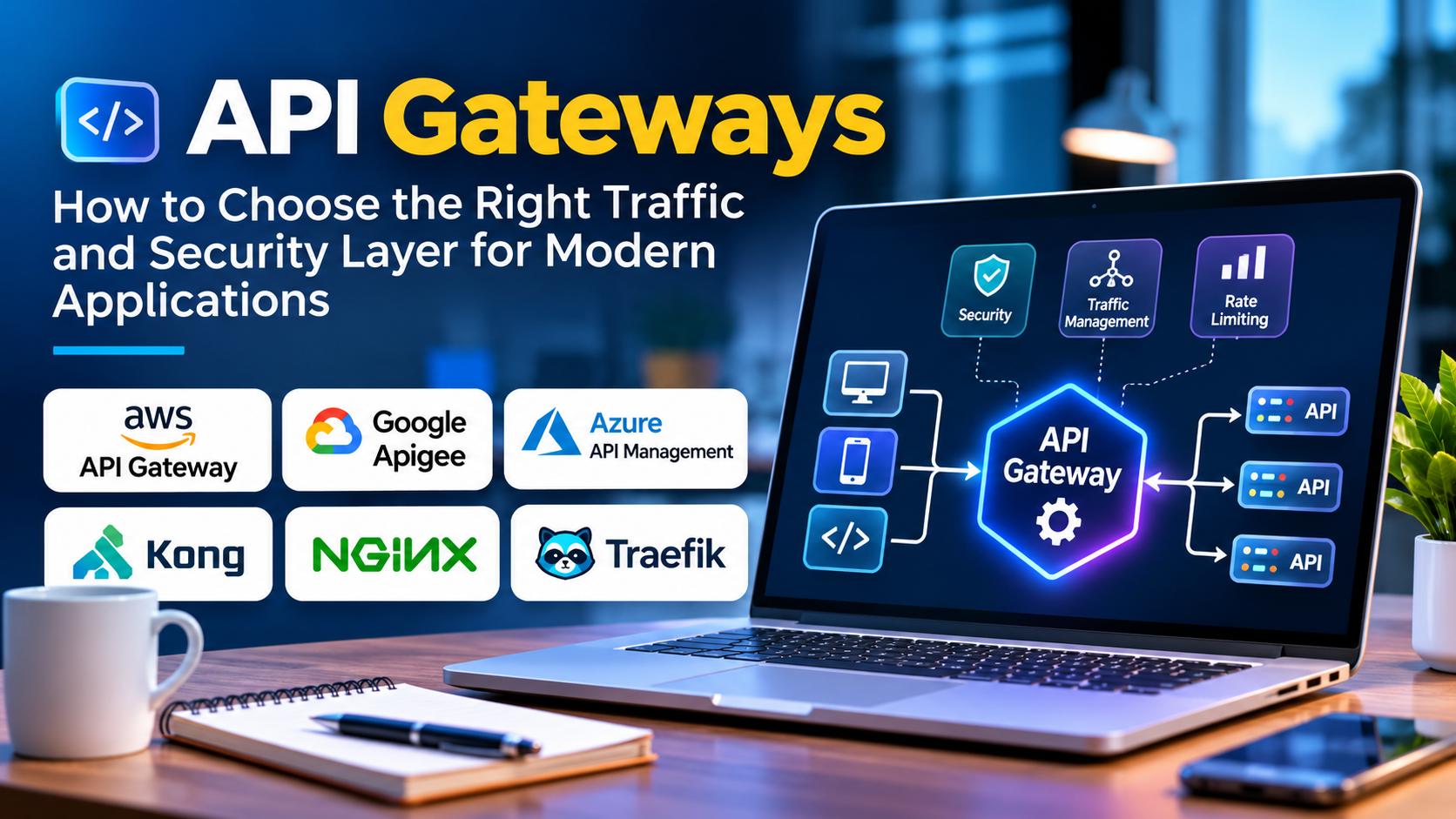
As applications grow into collections of services, managing communication between clients and backend systems becomes increasingly complicated.
Mobile applications, websites, partner integrations, and internal services may all need access to the same business capabilities.
Without a consistent entry point, teams can struggle with routing, authentication, traffic control, and operational visibility.
API gateways address many of these challenges.
However, introducing a gateway also creates a critical infrastructure dependency.
The right gateway must provide useful controls without becoming an unnecessary bottleneck or a single point of failure.
What Is an API Gateway?
An API gateway is a software component or managed service that receives API requests and forwards them to appropriate backend services.
Depending on its design, it may handle:
- Request routing
- Authentication enforcement
- Rate limiting
- Load balancing
- Request and response transformation
- TLS termination
- Logging and metrics
- Traffic filtering
- API protocol handling
Not every gateway supports every capability.
The gateway’s responsibilities should be defined according to the application’s architecture.
How an API Gateway Works
Consider an online retail application.
Its mobile client needs product information, customer accounts, shopping carts, and order services.
Instead of requiring the client to connect directly to every backend system, an API gateway can provide a coordinated entry point.
The gateway receives requests, applies relevant policies, and routes traffic to the correct service.
This arrangement can simplify client integration and centralize certain operational controls.
However, the gateway should not become a replacement for proper backend authorization or business logic.
API Gateway Versus Load Balancer
A load balancer distributes traffic across available servers or service instances.
An API gateway may also distribute traffic, but it typically provides additional API-specific capabilities such as authentication policies, routing rules, and request transformation.
The technologies can overlap.
Some architectures use both, while others rely on a product that combines relevant functions.
API Gateway Versus Service Mesh
An API gateway commonly manages traffic entering an application or API environment.
A service mesh focuses on communication between services, often including identity, encryption, observability, and traffic policies.
These responsibilities are related but distinct.
Organizations should avoid introducing both technologies without a clear architectural reason.
API Gateway Technologies Worth Evaluating
Kong Gateway
Kong Gateway is an API gateway technology built around extensible traffic management.
It supports routing and policy capabilities, with additional functionality depending on deployment and product edition.
It can be useful in architectures requiring flexible gateway deployment.
Teams should evaluate configuration management, plugins, and operational requirements.
NGINX
NGINX is widely used as a web server, reverse proxy, and traffic management component.
It can perform gateway-like functions through routing, TLS handling, and traffic controls.
However, a general reverse proxy configuration is not automatically equivalent to a comprehensive API management platform.
Apache APISIX
Apache APISIX is an open-source API gateway designed for dynamic routing and traffic management.
It supports a plugin-based approach to gateway functionality.
Organizations should evaluate deployment complexity, configuration management, and required operational expertise.
Traefik
Traefik is a cloud-native reverse proxy and application traffic management tool.
It is commonly associated with dynamic infrastructure and container environments.
Its capabilities can support certain API gateway use cases.
Teams should assess whether its policy and API management features meet their requirements.
Amazon API Gateway
Amazon API Gateway provides managed API gateway services within AWS.
It can reduce the infrastructure management burden for AWS-based applications.
However, service limits, pricing, integration patterns, and AWS dependencies should be considered.
Azure API Management Gateway
Azure API Management includes gateway capabilities for handling API traffic and applying policies.
It is relevant for organizations seeking integration with Microsoft’s API management environment.
The architecture and operational characteristics depend on the selected deployment model.
Comparing Gateway Options
| Gateway | Main orientation | Evaluation priority |
|---|---|---|
| Kong Gateway | Extensible API traffic management | Plugins and deployment |
| NGINX | Reverse proxy and traffic control | Configuration and API-specific needs |
| Apache APISIX | Open-source API gateway | Operations and plugin support |
| Traefik | Cloud-native traffic routing | Infrastructure integration |
| Amazon API Gateway | Managed AWS API service | Usage costs and AWS integration |
| Azure API Management Gateway | Azure API policy enforcement | Networking and management model |
Security Boundaries
API gateways can enforce authentication and traffic policies.
However, they should not be the only security layer.
Backend services must still validate permissions and protect sensitive operations.
For example, a gateway may verify that a request includes a valid access token.
The application must still determine whether the authenticated user can access a particular customer record.
This distinction is essential for preventing authorization vulnerabilities.
Rate Limiting and Traffic Control
Rate limiting helps manage excessive request volumes.
Different policies may apply to users, applications, API keys, or network sources.
The correct limits depend on service capacity and business requirements.
Poorly configured limits can disrupt legitimate users.
Teams should also consider burst handling, retries, and the interaction between gateway policies and backend capacity.
Performance and Latency
Every additional network component introduces some overhead.
Gateway performance depends on configuration, traffic patterns, plugins, deployment topology, and hardware resources.
Organizations should benchmark representative workloads rather than relying only on published throughput figures.
Tests should include authentication, logging, transformation, and other policies expected in production.
Reliability and High Availability
A gateway sits on a critical request path.
Its failure can affect multiple applications simultaneously.
Production architectures should consider redundancy, health checks, failover behavior, and configuration recovery.
Changes to gateway policies should be tested and deployed through controlled processes.
Rollback capabilities are especially valuable when a configuration error affects many services.
Observability and Troubleshooting
Gateway metrics can help identify traffic patterns and operational problems.
Useful signals include request rates, error responses, latency, rejected requests, and upstream failures.
Distributed tracing can help correlate gateway activity with backend service behavior.
Logging must be configured carefully to avoid exposing credentials or sensitive payloads.
Choosing a Deployment Model
Self-hosted gateways provide substantial infrastructure control but require operational ownership.
Managed services reduce some maintenance responsibilities while introducing provider-specific limits and commercial dependencies.
Hybrid approaches may be appropriate when applications span cloud and private environments.
The right model depends on networking, security, reliability, and team expertise.
A Practical Gateway Evaluation
Select one representative API.
Configure routing, authentication, rate limiting, and monitoring.
Test normal requests, invalid credentials, excessive traffic, backend failures, and configuration changes.
Measure latency and operational complexity.
Then evaluate how easily the gateway can be maintained through infrastructure automation and deployment pipelines.
Frequently Asked Questions
Is an API gateway necessary for microservices?
Not always. It is useful when centralized ingress and policy controls solve real architectural problems.
Can an API gateway replace application security?
No. Backend services remain responsible for appropriate authorization and secure business logic.
Are open-source API gateways suitable for production?
They can be, provided organizations have the expertise to operate, secure, and maintain them.
What is the difference between a gateway and API management?
A gateway handles runtime API traffic. API management includes broader lifecycle and governance functions.
Final Thoughts
API gateways can simplify communication between clients and backend systems while improving consistency in traffic management.
Their value depends on choosing the right responsibilities and operating model.
A well-designed gateway provides security controls, observability, and reliable routing without creating unnecessary complexity.
The best gateway is the one that strengthens the architecture rather than becoming its most fragile component.