Support teams rarely struggle because they lack communication channels.
The real problem is often fragmented information.
A customer sends an email, follows up through chat, and eventually calls. Without a shared system, different agents may handle the same issue without understanding its history.
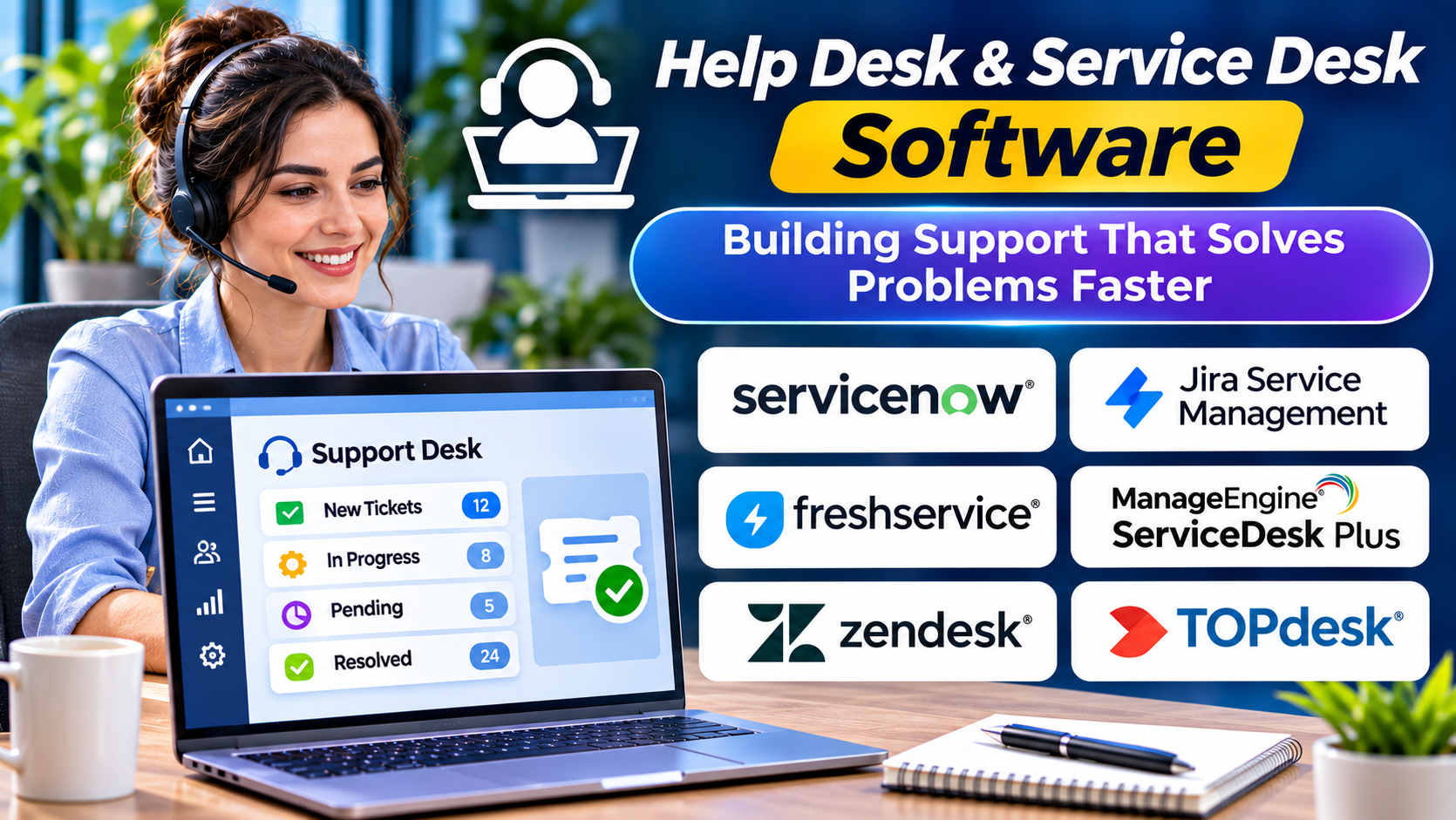
Help desk and service desk software bring support requests into organized workflows.
The right platform improves visibility, accountability, and resolution quality.
But businesses should understand an important distinction before choosing one.
Help Desk Versus Service Desk: What Is the Difference?
Help desk software primarily focuses on responding to support requests and resolving individual issues.
Typical examples include answering product questions, troubleshooting access problems, and managing customer complaints.
Service desk software generally supports a broader service management approach.
In an IT environment, this can include incidents, service requests, knowledge management, changes, and relationships with business services.
The terms overlap in commercial software.
Some products marketed as help desks provide sophisticated service management capabilities, while some service desk platforms emphasize straightforward ticketing.
Buyers should evaluate workflows rather than relying on product labels.
What Problems Should the Software Solve?
A useful support platform should help teams answer several practical questions.
Who owns each request?
What has already been attempted?
How urgent is the issue?
When should it be escalated?
What information does the customer need?
Which recurring problems should be prevented?
The software should make these answers easier to find.
Help Desk and Service Desk Platforms to Evaluate
Zendesk
Zendesk focuses on customer service workflows, including ticketing, knowledge management, and support across communication channels.
It is worth considering for customer-facing support operations that need a shared interaction history.
Organizations should evaluate the cost of advanced functionality and the administrative effort required for complex workflows.
Freshdesk
Freshdesk provides customer support ticketing, automation, and knowledge management capabilities.
It may suit teams seeking structured support workflows without immediately adopting a large IT service management platform.
Buyers should confirm which features are included in the plans they are evaluating.
Jira Service Management
Jira Service Management supports IT service workflows and integrates with the wider Atlassian ecosystem.
It is relevant to organizations that want support operations connected with software development and technical teams.
Its flexibility can be valuable, but workflow configuration should remain manageable.
ServiceNow IT Service Management
ServiceNow provides enterprise IT service management capabilities.
It is relevant to large organizations managing complex service processes and governance requirements.
Implementation scope, licensing, and administration deserve careful evaluation.
ManageEngine ServiceDesk Plus
ManageEngine ServiceDesk Plus supports IT help desk and service management processes.
It is worth considering when organizations need structured IT support and related operational capabilities.
Deployment options and feature availability should be checked for the specific edition.
GLPI
GLPI is an open-source IT service management and asset management platform.
It may appeal to organizations seeking greater control over their environment.
However, self-managed deployments still require technical administration, maintenance, and security oversight.
The Features That Create Real Support Value
Centralized Ticket Management
Every request should have a clear status, owner, priority, and history.
This reduces duplicated work and prevents requests from disappearing between channels.
Service Level Agreements
Service level agreements define expected response or resolution commitments.
Useful software can track deadlines and trigger escalation workflows.
However, unrealistic service targets can encourage rushed responses rather than effective resolutions.
Knowledge Management
A knowledge base helps customers solve straightforward problems independently.
It also gives agents consistent troubleshooting information.
Knowledge articles need regular review to remain useful.
Automation
Automation can assign tickets, identify categories, and notify relevant teams.
Start with simple rules before introducing complicated workflows.
Poorly designed automation can create unnecessary transfers and delays.
Reporting
Useful measures include resolution time, backlog age, reopened tickets, customer satisfaction, and recurring issue categories.
Ticket volume alone does not explain support quality.
How to Choose Between Help Desk and Service Desk Software
The decision depends on organizational complexity.
A small customer support team may primarily need ticketing, shared inboxes, and knowledge articles.
An internal IT department may need incident management, service requests, approval workflows, and asset information.
A large enterprise may require formal change management and extensive service governance.
Consider the following before purchasing:
- Number of agents and support users
- Communication channels
- Ticket routing and escalation requirements
- Knowledge management needs
- Existing collaboration and identity systems
- Reporting requirements
- Security and data retention policies
- Implementation and ongoing administration costs
Use real support scenarios during product demonstrations.
Avoiding Common Support Software Mistakes
Creating Too Many Ticket Categories
Complex categorization slows agents and produces inconsistent reporting.
Begin with a small number of meaningful categories.
Automating Before Understanding the Process
Automation cannot repair unclear responsibilities.
Document existing workflows first.
Ignoring Customer Experience
Internal efficiency matters, but customers care about getting their problems solved.
Measure resolution quality alongside operational performance.
Failing to Maintain Knowledge Articles
Outdated instructions can increase ticket volume rather than reduce it.
Assign responsibility for reviewing documentation.
A Practical Implementation Plan
Start by identifying the most common support requests.
Define ownership, priority levels, and escalation paths.
Configure ticket intake and routing.
Import useful customer or asset information where appropriate.
Create a small knowledge base.
Train agents using realistic scenarios.
Launch with a limited group before expanding.
Monitor bottlenecks and refine workflows based on actual support activity.
Frequently Asked Questions
Is help desk software the same as CRM software?
No. Help desk software focuses on support requests. CRM software manages broader customer relationships, although some platforms combine both functions.
Can service desk software support non-IT teams?
Yes. Some organizations use service management workflows for HR, facilities, and other internal services.
Is open-source help desk software suitable for businesses?
It can be, provided the organization can manage deployment, maintenance, security, and support responsibilities.
What is the most important support metric?
No single metric is sufficient. Resolution quality, customer satisfaction, and operational efficiency should be evaluated together.
Final Thoughts
Help desk and service desk software should make support easier for both customers and employees.
The best choice depends on the complexity of the services being delivered.
Businesses should prioritize clear workflows, reliable information, useful automation, and measurable resolution outcomes.
A well-designed support system does more than organize tickets. It helps teams solve problems consistently and learn from recurring issues.