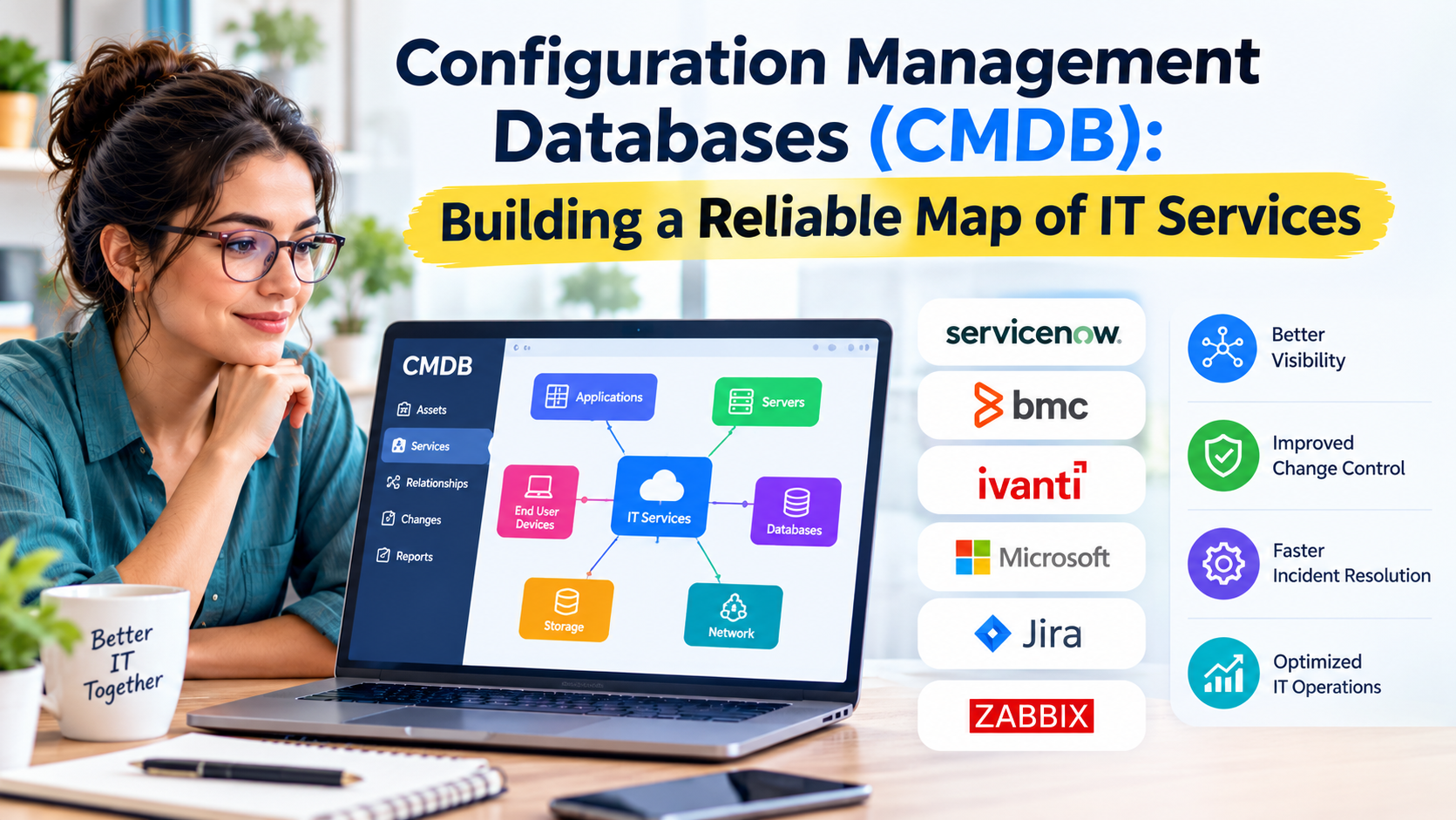
When a critical application fails, IT teams need to understand more than which server is affected.
They need to know which databases, networks, applications, and business services depend on it.
Without reliable relationship information, troubleshooting becomes slower and change decisions become riskier.
A configuration management database helps organizations organize this information.
However, a CMDB is only useful when its records remain accurate and connected to real operational processes.
What Is a CMDB?
A configuration management database stores information about configuration items and their relationships.
Configuration items, commonly called CIs, are components that need to be managed to deliver an IT service.
Examples include:
- Applications
- Servers
- Databases
- Network devices
- Cloud resources
- Business services
- Supporting infrastructure
A CMDB may record ownership, status, relationships, and other relevant attributes.
Its purpose is to help teams understand how technology components support services.
Why Relationships Matter More Than Inventory Alone
Consider an application that depends on a database and an authentication service.
An inventory system may identify all three components.
A CMDB can represent their relationships.
This helps teams evaluate the potential effect of a database outage or planned infrastructure change.
The value comes from understanding dependencies, not simply storing more records.
CMDB Platforms and Related Tools
ServiceNow CMDB
ServiceNow provides configuration management capabilities integrated with its broader service management platform.
It is relevant to enterprises seeking connected configuration, incident, and change information.
BMC Helix CMDB
BMC Helix CMDB supports configuration information and relationships within enterprise service management environments.
It is worth evaluating for organizations with complex operational dependencies.
Jira Service Management Assets
Assets in Jira Service Management supports structured object and relationship management.
It can be used for asset and configuration information connected with service workflows.
ManageEngine ServiceDesk Plus
ManageEngine ServiceDesk Plus provides configuration management capabilities within its IT service management environment.
Organizations should verify available functionality for the selected edition.
i-doit
i-doit is a specialized IT documentation and CMDB solution.
It is relevant to organizations seeking structured infrastructure documentation and configuration relationships.
Device42
Device42 focuses on infrastructure discovery, asset information, and dependency mapping.
It can be relevant when organizations need detailed technical visibility to support configuration management.
CMDB Versus Asset Management
Asset management primarily focuses on ownership, lifecycle, financial, and inventory information.
Configuration management focuses on the components needed to deliver services and their relationships.
The two disciplines overlap.
A server can be both a financial asset and a configuration item.
However, the information needed for each purpose may differ.
A CMDB should not become an uncontrolled copy of every asset record.
The Most Important CMDB Design Principle
Start with decisions the CMDB must support.
For example:
Which services depend on this server?
Who owns this application?
What might be affected by a planned change?
Which components support a critical business process?
These questions help determine which configuration items and relationships are worth maintaining.
Attempting to model every possible technical detail often creates unnecessary complexity.
Data Collection and Discovery
Automated discovery can help identify infrastructure components.
However, discovery does not automatically establish every business relationship.
Some dependencies may require application telemetry, integration data, or manual validation.
Organizations should define trusted data sources and reconciliation rules.
They should also establish ownership for correcting inaccurate records.
Common CMDB Failure Patterns
Too Much Data
A CMDB overloaded with unnecessary records becomes difficult to maintain.
Unclear Ownership
Records deteriorate when nobody is responsible for accuracy.
Weak Relationship Mapping
A list of devices offers limited value for service impact analysis.
Disconnected Processes
A CMDB that is never used during incidents or changes becomes a documentation exercise.
Blind Trust in Discovery
Automated tools can produce incomplete or conflicting information.
Discovery results require governance and validation.
How to Implement a CMDB
Begin with a small number of important business services.
Identify the applications and infrastructure supporting those services.
Define configuration item classes and essential attributes.
Establish ownership and authoritative data sources.
Map important relationships.
Connect the information with incident and change workflows.
Measure data quality and operational usefulness.
Expand coverage only after the initial model proves valuable.
Measuring CMDB Quality
Useful measures include:
- Completeness of critical service relationships
- Accuracy of configuration item ownership
- Frequency of stale records
- Duplicate record rates
- Usefulness during incident investigations
- Reliability of change impact assessments
A large number of configuration items is not necessarily a sign of success.
Frequently Asked Questions
Is a CMDB the same as an asset database?
No. A CMDB emphasizes service configuration and relationships, while asset databases often emphasize ownership and lifecycle information.
Can a CMDB update automatically?
Many platforms support discovery and integrations, but complete accuracy still requires governance.
Do small organizations need a CMDB?
Not always. A simpler configuration inventory may be sufficient for less complex environments.
What is the biggest CMDB challenge?
Maintaining accurate, useful relationships over time is often more difficult than initially collecting data.
Final Thoughts
A CMDB should help IT teams understand the systems behind important services.
Its value depends on trustworthy records, meaningful relationships, and integration with operational decisions.
Organizations should begin with specific use cases rather than attempting to document everything.
A smaller, accurate CMDB can be more useful than a comprehensive database nobody trusts.