Introduction
A university library owns thousands of printed books, provides access to electronic journals, and serves students across several campuses.
A student searches for a textbook that appears available in the catalog. However, the copy is already on loan. Another student requests an article through an interlibrary service. Meanwhile, librarians are processing new acquisitions and correcting duplicate catalog records.
These activities depend on information moving accurately between different library workflows.
Library management systems help institutions organize collections, track circulation, manage acquisitions, and provide reliable access to resources.
However, modern libraries manage more than shelves of books.
They may need to coordinate print collections, electronic resources, digital repositories, consortium agreements, and discovery services.
The central purchasing decision is therefore not simply which system can catalog books. It is which architecture can support the library’s collection, users, staff, and long-term service responsibilities.
What Is a Library Management System?
A library management system is software used to administer library collections, transactions, and operational workflows.
Traditional systems are often called integrated library systems, or ILS.
They commonly include modules for cataloging, circulation, acquisitions, serials management, patron records, and reporting.
A library services platform, or LSP, may extend this model by supporting broader management of print and electronic resources.
The distinction is useful but not absolute.
Vendors may use different terminology, and product capabilities can overlap.
Libraries should evaluate actual workflows rather than assuming that a platform with a newer category label is automatically more capable.
The Core Workflows Behind Library Operations
A library management platform connects several activities that may appear independent to patrons.
Cataloging establishes what the library owns or provides access to.
Circulation records who has borrowed physical materials and when they are due.
Acquisitions manages the purchase or receipt of new resources.
Electronic resource management tracks access to licensed digital content.
Discovery services help users find relevant materials.
When these processes share reliable information, library staff can serve patrons more efficiently.
When they are disconnected, staff may encounter inaccurate availability information, duplicate records, and unnecessary manual work.
Cataloging: The Foundation of Resource Discovery
Cataloging describes library materials so they can be identified, organized, and retrieved.
A catalog record may include title, author, publication details, subject headings, identifiers, and information about the resource’s format.
Libraries often rely on established metadata standards.
MARC 21 remains important for bibliographic records in many library environments.
Other metadata approaches, including Dublin Core and emerging linked-data models, may be relevant depending on the collection and system architecture.
A suitable library management system should support the standards the institution actually uses.
Bibliographic records versus item records
This distinction is essential.
A bibliographic record describes a publication or intellectual work.
An item record represents a particular physical copy or holding.
A library may own several copies of the same book.
Those copies can share bibliographic information while having different barcodes, locations, loan statuses, and circulation histories.
Software that handles this relationship correctly helps prevent duplicate catalog entries and inaccurate availability information.
Authority control
Authority control helps libraries maintain consistent names, subjects, and related descriptive information.
For example, an author may publish under several variations of a name.
Consistent authority data helps users discover related works.
Libraries should evaluate whether their platform supports the authority workflows and external data sources they require.
Circulation Management: Keeping Borrowing Records Accurate
Circulation is one of the most visible library services.
A circulation module typically supports checkouts, returns, renewals, reservations, and loan policies.
However, different patron groups may have different borrowing privileges.
Students, faculty members, external researchers, and community members may receive different loan periods or borrowing limits.
Libraries should verify whether the software can represent these policies without excessive manual intervention.
Holds and reservations
A patron may request an item that is currently on loan.
The system should manage the request queue and notify the patron when the item becomes available.
In a multi-branch library, the workflow may also involve transferring the item between locations.
The software should accurately represent the item’s status throughout the process.
Overdue materials and fines
Some libraries charge overdue fines, while others use alternative borrowing policies.
The platform should support the institution’s actual rules.
Libraries should not assume that every system handles complex fee structures, lost-item replacement charges, and exceptions in the same way.
Acquisitions and Budget Management
Acquisitions workflows connect collection development with purchasing and financial control.
A library may need to create purchase requests, issue orders, record receipts, manage suppliers, and track expenditure against budgets.
These functions become particularly important for institutions with multiple departments or restricted funding sources.
A useful acquisitions module should make it possible to identify outstanding orders and reconcile received materials.
It should also support the institution’s approval procedures.
Acquisition records are not full accounting systems
Library acquisitions software may track orders, invoices, and fund allocations.
However, it should not automatically be treated as a replacement for institutional accounting software.
Universities and public library systems may need integrations with enterprise finance applications.
Buyers should establish which system owns financial records and how transactions move between them.
Managing Electronic Resources
Electronic collections introduce challenges that differ from physical circulation.
A library may license access to journals, ebooks, databases, and streaming resources.
The library may not own these resources permanently.
Access may depend on subscription agreements, user eligibility, authentication systems, and contractual conditions.
An electronic resource management workflow can involve license information, subscription periods, access entitlements, and usage reporting.
Traditional circulation-focused systems may not provide all these capabilities.
Libraries with extensive electronic collections should examine whether a broader library services platform is appropriate.
Knowledge bases and link resolution
Electronic resource discovery often depends on accurate information about which titles and collections the institution can access.
A knowledge base may contain details about electronic holdings and coverage.
Link resolvers help connect users from citations or discovery results to available full text.
These functions are particularly important in academic libraries.
Buyers should investigate how electronic holdings information is maintained and how quickly changes become visible.
Library Management Software Options Worth Evaluating
The market includes open-source integrated library systems, commercial library services platforms, and specialized products.
The following examples represent different architectural and operational approaches.
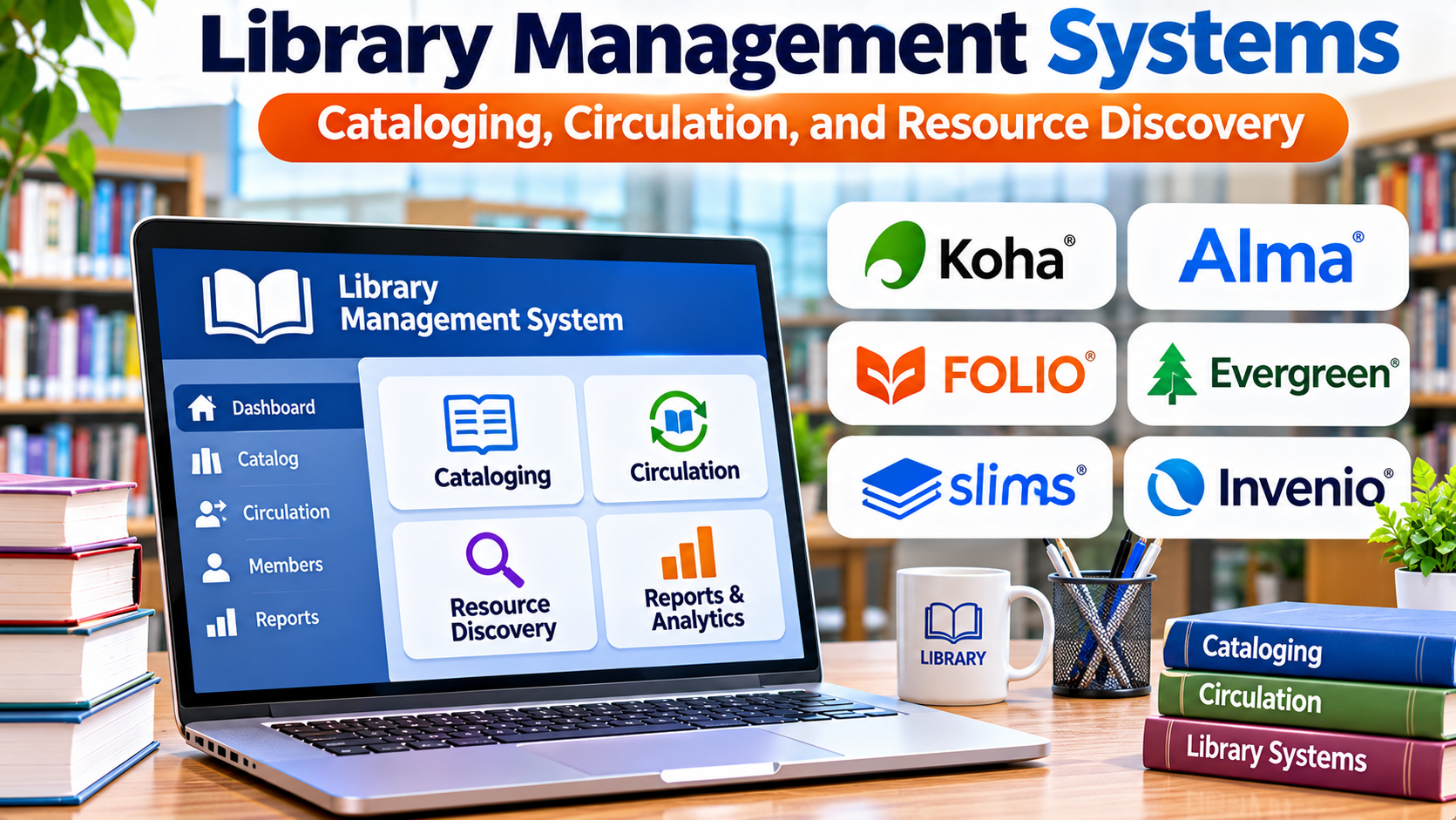
Koha
Koha is an open-source integrated library system.
Its established functionality includes cataloging, circulation, acquisitions, serials, patron management, and online catalog access.
Koha can be relevant to public, academic, school, and specialist libraries seeking a configurable ILS.
Its open-source licensing model gives institutions options for deployment and service arrangements.
However, operating a reliable Koha environment still requires technical expertise or a suitable support provider.
Libraries should evaluate hosting, maintenance, backups, upgrades, integrations, and staff training.
The absence of a conventional proprietary license does not eliminate operating costs.
Evergreen
Evergreen is an open-source integrated library system with a history of supporting library consortia and multi-branch operations.
It is relevant to institutions that need shared cataloging and circulation across participating libraries.
A consortium may value centralized infrastructure combined with branch-specific policies.
However, libraries should assess the administrative and technical responsibilities associated with a shared deployment.
They should also test complex circulation rules, reporting, and resource sharing workflows.
FOLIO
FOLIO is an open-source library services platform built around a modular application architecture.
It is designed to support library workflows through a combination of applications and shared platform services.
This approach can appeal to academic and research libraries seeking flexibility in how library functions are assembled and integrated.
However, modularity introduces architectural and operational decisions.
Libraries should examine hosting arrangements, application compatibility, migration requirements, and support responsibilities.
A modular platform may provide flexibility, but that flexibility needs effective governance.
Ex Libris Alma
Alma is a commercial library services platform associated with the management of print, electronic, and digital library resources.
It is particularly relevant to academic and research libraries with substantial electronic collections and complex resource management requirements.
Libraries evaluating Alma should examine its acquisitions, metadata, electronic resource, fulfillment, and integration workflows.
They should also investigate how it works with discovery services and institutional systems.
Commercial terms, migration services, and ongoing support should be evaluated through a detailed proposal.
OCLC WorldShare Management Services
WorldShare Management Services is a cloud-based library management platform associated with OCLC’s wider library data and service ecosystem.
It may be relevant to libraries that value shared bibliographic infrastructure and connected resource management services.
Buyers should examine how the platform supports their circulation, acquisitions, metadata, and electronic resource requirements.
They should also determine which related OCLC services are included and which involve separate arrangements.
Comparing Library System Architectures
| Approach | Potential advantage | Main trade-off |
|---|---|---|
| Open-source integrated library system | Flexibility and control over deployment arrangements | Technical maintenance and support responsibilities |
| Consortium-oriented ILS | Shared infrastructure and cooperative workflows | Governance across participating institutions |
| Modular library services platform | Flexible application architecture | Integration and operational complexity |
| Commercial cloud library platform | Vendor-managed infrastructure and connected services | Subscription commitments and vendor dependence |
| Specialized library applications | Focused support for particular collections | Additional integration requirements |
These differences matter more than a generic feature count.
A community library with a predominantly print collection has different needs from a university library managing thousands of electronic subscriptions.
Discovery Systems Are Not the Same as Library Management Systems
A library’s public search interface is often the most visible part of its technology.
However, the discovery experience and the management platform may be separate products.
A discovery service helps patrons search across catalog records, electronic resources, and other collections.
The library management system maintains operational information such as holdings, circulation, and acquisitions.
Some vendors provide both components.
Others integrate with third-party discovery products.
Libraries should determine how availability information moves between these systems.
A discovery interface that displays outdated circulation status can frustrate patrons even when the underlying library records are accurate.
Test search behavior with real queries
A library should test searches involving alternate spellings, author names, subject terms, editions, and different resource formats.
The evaluation should also examine accessibility and mobile usability.
Patrons should be able to distinguish physical availability from electronic access.
For academic libraries, linking to licensed full-text resources is particularly important.
Metadata Migration Is Often the Hardest Part
Moving to a new library system involves more than transferring a list of titles.
A library may need to migrate bibliographic records, item records, patron information, circulation transactions, holds, acquisitions data, and serials information.
Historical records may contain inconsistent identifiers or local cataloging practices.
Some fields may have been customized for institutional requirements.
The migration team must understand what each field means before mapping it to the new platform.
Avoid assuming that record counts prove success
A migration can transfer the expected number of bibliographic records while losing important relationships.
For example, a book may appear in the catalog but no longer be associated with the correct physical copy.
A patron’s borrowing history may be incomplete.
An item may lose its location or circulation status.
Validation should therefore include representative records and complete workflows.
Libraries should test checkouts, returns, holds, acquisitions, and discovery after migration.
Interoperability and Library Standards
Library systems depend on established protocols and metadata formats.
MARC remains important for many bibliographic workflows.
Z39.50 and SRU can support information retrieval and record exchange in relevant environments.
SIP2 and NCIP are associated with circulation-related communication between systems and devices.
APIs may support additional integrations.
However, the presence of a standard in a vendor’s documentation does not guarantee that every required workflow is supported.
Libraries should verify the specific implementation.
For example, an RFID self-checkout system may depend on particular circulation messages and configuration settings.
A standards checklist is useful, but a practical integration test is more reliable.
Supporting Multiple Branches and Library Consortia
Multi-branch libraries face additional challenges.
They may share bibliographic records while maintaining different circulation policies.
One branch may allow longer loans than another.
Some materials may circulate between locations, while others remain restricted.
A library consortium may also require shared cataloging, interlibrary lending, and coordinated acquisitions.
The platform should support these arrangements without losing local accountability.
Governance matters as much as software
Shared systems require decisions about permissions, cataloging standards, data ownership, and operational responsibilities.
A technical platform cannot resolve disagreements about institutional policy.
Participating libraries should establish governance before implementation.
This includes determining who can change shared records and how conflicts are resolved.
Security and Patron Privacy
Library systems hold information about patrons and their use of library services.
Borrowing records can reveal personal interests, research topics, or other sensitive information.
Libraries should minimize unnecessary access to these records.
Role-based permissions, authentication controls, audit logs, and appropriate retention practices are important.
Institutions should also examine how patron information is shared with third-party services.
Protect borrowing confidentiality
Not every staff member needs access to a patron’s complete circulation history.
Libraries should define which information is necessary for operational purposes.
They should also establish retention rules consistent with institutional policy and applicable law.
The system should support these decisions rather than encouraging unnecessary collection or indefinite storage.
Evaluate cloud service responsibilities
Cloud-hosted platforms may reduce local infrastructure management.
However, libraries remain responsible for evaluating vendor security arrangements and contractual obligations.
They should review data processing terms, backups, recovery procedures, access controls, and service continuity commitments.
The Real Cost of a Library Management System
The purchase or subscription price is only one component of total cost.
Other expenses may include data migration, hosting, implementation, training, integrations, support, and ongoing configuration.
Open-source platforms can reduce certain licensing expenses but still require professional administration.
Commercial platforms may include managed services, but the scope of those services varies.
Libraries should request detailed cost information for the functions they need.
Include migration and exit costs
A system replacement may require extensive metadata cleanup and staff involvement.
Libraries should also consider future data portability.
Before signing a contract, they should understand how bibliographic records, holdings, patron information, and other operational data can be exported.
They should establish whether export tools or professional services involve additional charges.
These arrangements can affect long-term flexibility.
A Practical Library Software Evaluation Process
A meaningful evaluation should begin with representative workflows.
Ask the vendor to catalog a new title and create multiple physical item records.
Then check out one copy and reserve another.
Examine how the public catalog displays availability.
Next, process an acquisition.
Create an order, record receipt of the item, and examine the associated financial information.
For academic libraries, test electronic resource access and changes to licensed holdings.
For multi-branch institutions, test a transfer between locations.
Include exception scenarios
What happens when a patron loses an item?
How does the system handle a duplicate barcode?
Can staff correct a catalog record without breaking associated holdings?
What happens when an external discovery service becomes temporarily unavailable?
These scenarios reveal operational limitations that ordinary demonstrations may not expose.
Planning a Successful Migration
A library should begin by documenting its existing systems and data sources.
The project team should identify local metadata practices, circulation rules, integrations, and reporting requirements.
Data cleanup should take place before migration whenever possible.
Trial migrations allow staff to identify mapping errors.
A representative group of librarians should validate cataloging, circulation, acquisitions, and discovery workflows.
Training should reflect staff responsibilities.
Catalogers need different instruction from circulation staff, acquisitions specialists, and system administrators.
A staged implementation may reduce disruption, but the appropriate approach depends on the institution’s service requirements.
Measuring Success After Implementation
A library management system should improve the reliability of services.
Useful measures may include cataloging backlogs, unresolved circulation errors, acquisition processing time, discovery complaints, and staff support requests.
Libraries can also examine how often employees need manual workarounds.
However, numerical indicators should be interpreted carefully.
A reduction in transaction time is valuable only if records remain accurate and patrons receive appropriate service.
Regular feedback from staff and users helps identify problems that operational reports may miss.
Choosing a System That Can Support the Library’s Future
Library management software is long-term infrastructure.
Its value depends on accurate records, reliable transactions, effective discovery, and the ability to adapt to changing collections.
A print-focused library may find a traditional integrated library system sufficient.
A research institution with complex electronic resource management may need a broader library services platform.
A consortium may prioritize shared workflows and governance.
The strongest selection process begins with the library’s actual collection and service model.
It then tests the software against representative workflows, examines metadata and integration requirements, and establishes realistic operating costs.
The right library management system should make resources easier to manage and easier to discover without compromising patron privacy or institutional control.