Introduction
A clinical study operates across several hospitals.
One site is enrolling participants faster than expected. Another is waiting for a contract amendment. A monitoring visit has been postponed, and the study manager needs an accurate view of outstanding activities.
Meanwhile, the sponsor must understand whether the trial is progressing according to plan.
These are operational questions, but their answers are distributed across teams, sites, documents, and systems.
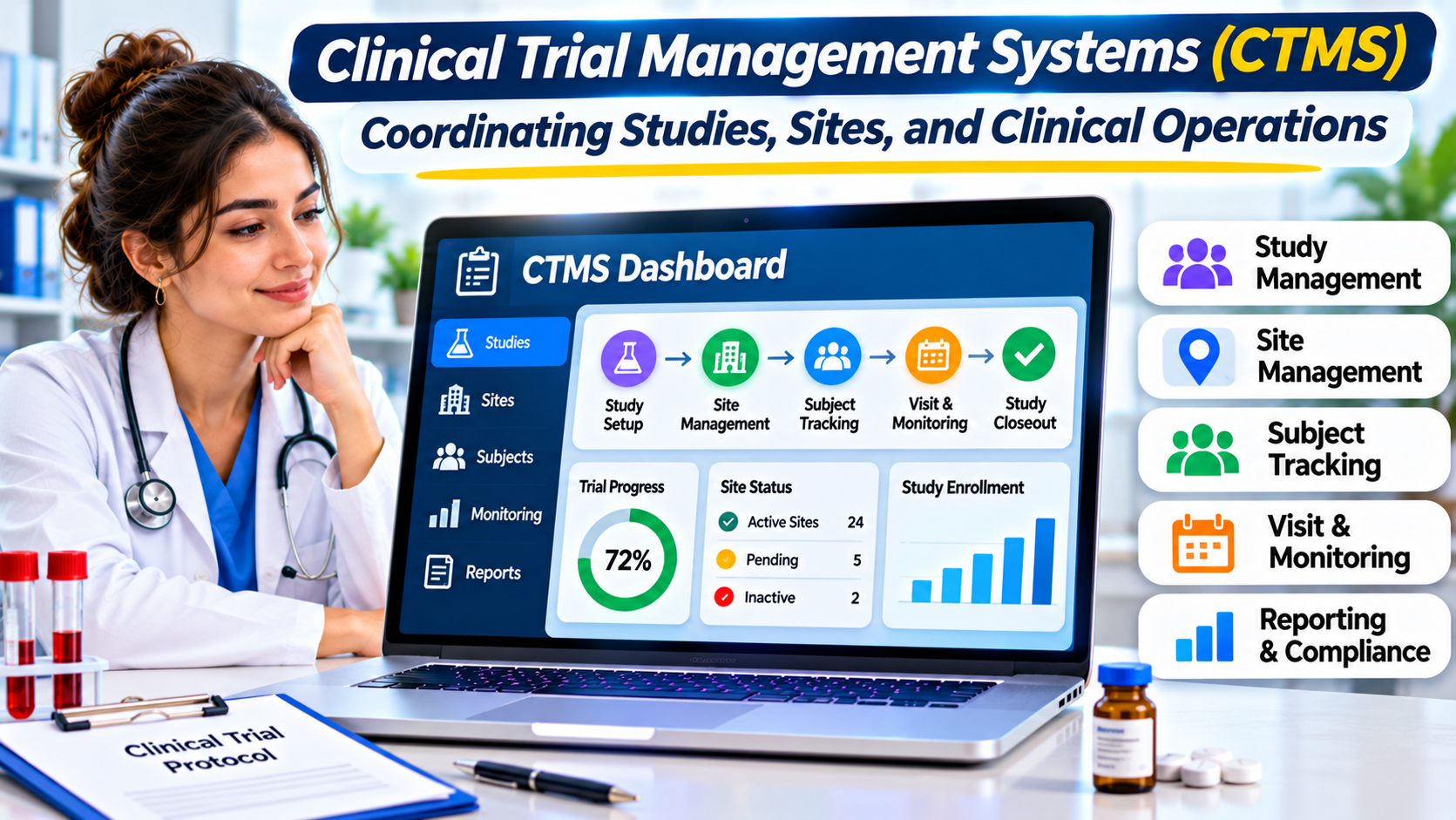
A clinical trial management system, commonly called CTMS, helps organizations coordinate the administrative and operational work involved in clinical studies.
It may support study planning, site management, milestones, monitoring activities, financial tracking, and reporting.
However, CTMS software does not replace clinical judgment, participant safety procedures, or the systems responsible for collecting clinical data.
Choosing the right platform requires understanding which activities it should control, how it connects to other trial technologies, and what evidence the organization needs for oversight.
What Is a Clinical Trial Management System?
A clinical trial management system is software used to plan, track, and manage operational aspects of clinical research.
Sponsors, contract research organizations, academic research centers, and clinical trial sites may use CTMS platforms.
Their requirements differ.
A sponsor may need oversight across many studies and service providers.
A contract research organization may need detailed operational workflows across client projects.
A hospital research office may prioritize investigator studies, participant visit tracking, and financial administration.
CTMS software should be evaluated in the context of these responsibilities.
Typical capabilities include study records, site information, milestone tracking, monitoring activities, enrollment reporting, and trial-related financial workflows.
The exact scope varies by product.
The Operational Problems a CTMS Should Solve
Clinical trials involve numerous activities that must occur in a coordinated manner.
Sites need to be selected and activated.
Contracts and budgets may require approval.
Investigators and staff must complete relevant training.
Monitoring activities need scheduling and documentation.
Enrollment and operational progress must be reviewed.
Study closeout requires additional coordination.
When these activities are managed through disconnected spreadsheets, organizations can struggle to establish a consistent view of progress.
A CTMS can help create a shared operational record.
However, the software must reflect the organization’s responsibilities and study model.
CTMS Is Not the Same as EDC or eTMF
Clinical research technology includes several distinct systems.
Electronic data capture, or EDC, software supports the collection and management of clinical study data.
An electronic trial master file, or eTMF, system manages essential trial documentation.
A CTMS focuses on operational planning, tracking, and oversight.
These categories overlap in some product suites.
However, their central purposes remain different.
A practical example
An EDC system may contain a participant’s clinical assessment data.
An eTMF may contain the approved protocol and relevant study documents.
The CTMS may show whether a site has been activated, when a monitoring visit occurred, and which operational milestones remain outstanding.
These records are related, but they should not be confused.
Organizations need clear rules governing which system is authoritative for each type of information.
Study Planning and Milestone Management
A CTMS may help organizations define study milestones and track progress.
Milestones can include site selection, initiation, enrollment targets, monitoring activities, and closeout.
However, a milestone dashboard is only useful when information is updated reliably.
Organizations should establish who owns each milestone and how completion is verified.
Avoid false confidence from status indicators
A dashboard may show that most sites are active.
That does not necessarily mean recruitment is progressing or that operational risks are under control.
Similarly, a milestone marked complete may conceal unresolved dependencies.
The CTMS should allow teams to examine underlying activities rather than relying entirely on summary status.
Site Selection and Activation
Site management is a central clinical operations responsibility.
Organizations may need to track investigator information, site qualifications, contracts, budgets, required documentation, and activation status.
A CTMS can help organize these activities.
However, the precise workflow varies by study and organization.
Site activation dependencies
A site may be unable to begin certain activities until required approvals, contracts, training, and operational arrangements are complete.
The system should make these dependencies visible.
It should also distinguish between an administrative task being recorded and the task being appropriately authorized.
Software should not allow a convenient status change to bypass required institutional controls.
Enrollment and Recruitment Oversight
Trial teams need to understand enrollment progress.
A CTMS may track planned and actual enrollment at study or site level.
Some products connect with other systems to obtain recruitment or participant information.
However, organizations should distinguish operational enrollment summaries from the underlying clinical source records.
The CTMS should not become an uncontrolled duplicate of sensitive participant data.
Enrollment metrics need context
A site with low enrollment may be experiencing recruitment challenges, staffing shortages, or delays in activation.
A high-enrolling site may still have other operational issues.
A useful platform should help teams investigate these differences.
The goal is to support informed decisions rather than create competition around simplistic metrics.
Monitoring Visit Management
Monitoring activities help organizations oversee trial conduct and compliance with relevant requirements.
A CTMS may support visit scheduling, monitoring reports, follow-up activities, and issue tracking.
However, the software must fit the organization’s monitoring model.
Some studies use extensive onsite monitoring.
Others incorporate remote or centralized approaches.
Tracking findings and follow-up
A monitoring visit may identify issues requiring corrective action.
The CTMS should help responsible personnel track those activities through resolution.
However, a completed status is not sufficient evidence that a problem was appropriately addressed.
Organizations need clear review and escalation procedures.
The platform should support those procedures without replacing professional oversight.
Clinical Trial Management Software Options
The CTMS market includes enterprise clinical operations platforms, specialized applications, and research institution solutions.
Medidata CTMS
Medidata offers clinical trial management capabilities within its wider clinical research technology portfolio.
Its approach may be relevant to sponsors and research organizations seeking connected trial operations.
Buyers should evaluate how CTMS functions integrate with the other clinical systems they use.
The main question is whether the proposed solution supports the organization’s study portfolio and operating model.
Veeva Vault CTMS
Veeva Vault CTMS is part of Veeva’s clinical operations software environment.
It is relevant to organizations that want to manage trial operations alongside related clinical processes.
Institutions should evaluate site management, monitoring workflows, milestones, and integration with other clinical applications.
They should also examine configuration governance and the implications of adopting a broader vendor ecosystem.
Oracle Clinical One and related clinical systems
Oracle provides clinical trial technology, including applications for clinical data and study operations.
Organizations considering Oracle products should identify the exact application and capabilities relevant to CTMS requirements.
A clinical data platform should not automatically be treated as a complete CTMS.
The purchasing process should establish which operational workflows are supported natively and which require additional systems.
Florence Healthcare
Florence Healthcare provides clinical research technology with a focus on site and sponsor collaboration and related study workflows.
It may be relevant to organizations seeking to improve coordination between research sites and sponsors.
However, buyers should determine whether the specific product under consideration provides the CTMS functionality they need or complements an existing CTMS.
Product categories should not be treated as interchangeable.
Advarra OnCore
OnCore is a clinical trial management system associated with Advarra.
It is particularly relevant to research institutions and organizations managing clinical research operations.
Buyers should evaluate its study administration, participant-related operational workflows, financial functions, and institutional integration requirements.
Academic medical centers may have different priorities from commercial sponsors.
The evaluation should reflect those differences.
Comparing CTMS Operating Models
| Organization | Likely priorities | Important consideration |
|---|---|---|
| Pharmaceutical sponsor | Portfolio oversight, sites, milestones, monitoring | Visibility across studies and partners |
| Contract research organization | Operational delivery across clients | Workflow flexibility and reporting |
| Academic medical center | Institutional studies and financial administration | Integration with hospital and research systems |
| Clinical research site | Study coordination and daily operations | Usability and administrative workload |
| Multi-organization collaboration | Shared operational visibility | Permissions and data ownership |
A platform designed primarily for large sponsors may be unnecessarily complex for a small research site.
Conversely, a site-oriented application may not provide sufficient portfolio oversight for a global sponsor.
Financial Management and Study Budgets
Clinical trials involve complex financial arrangements.
Organizations may need to track site budgets, contracts, payment milestones, invoices, and other operational expenses.
Some CTMS products provide financial management functionality.
However, the depth varies.
A platform may track expected site payments without replacing enterprise accounting or procurement systems.
Test financial scenarios
Ask the vendor to demonstrate how a contract amendment affects the study budget.
Then examine how completed activities trigger payment review.
The organization should establish who approves financial changes and how records reconcile with accounting systems.
A financial dashboard is useful only when its underlying transactions are trustworthy.
Integration With the Clinical Technology Ecosystem
A CTMS rarely operates alone.
It may connect with EDC, eTMF, identity management, financial applications, and other clinical systems.
Integration can reduce duplicate data entry and improve operational visibility.
However, poorly designed integrations can create contradictory records.
Define the source of truth
Study identifiers, site records, enrollment summaries, and document status may appear in several systems.
Organizations should determine which application owns each data element.
They should also define how updates propagate.
If a site changes status, connected systems should not continue displaying conflicting information indefinitely.
Integration failures need visible alerts and clear recovery procedures.
Risk-Based Oversight and Operational Reporting
Trial managers need to identify emerging problems.
A CTMS may support dashboards, reports, and tracking of operational risks.
However, software cannot determine every clinical or regulatory risk from administrative information.
A delayed monitoring visit may be important, but its significance depends on the study and circumstances.
The system should help teams prioritize attention while preserving the ability to investigate underlying evidence.
Avoid treating dashboards as decisions
A red indicator can draw attention to an issue.
It does not explain the cause or establish the appropriate response.
Organizations should use CTMS reporting to support trained clinical operations personnel.
Human oversight remains essential.
Regulatory Requirements and Data Integrity
Clinical trials operate within regulatory and ethical frameworks.
Depending on jurisdiction and study type, organizations may need to consider Good Clinical Practice requirements and applicable electronic record rules.
For example, ICH E6 Good Clinical Practice provides an important framework for clinical trial conduct.
Electronic systems may also need to meet relevant requirements for record integrity, security, and traceability.
However, regulatory compliance depends on how an organization uses its systems.
Validation and controlled change
A regulated organization may need to validate its configured CTMS according to intended use and risk.
It should also control changes to workflows, permissions, and integrations.
Vendor documentation can support this work, but it does not replace organizational responsibility.
Institutions should evaluate how upgrades are tested and how configuration changes are approved.
Security and Participant Confidentiality
CTMS platforms may contain investigator details, site information, financial records, and participant-related operational data.
The amount and sensitivity of information depend on the system’s purpose.
Organizations should avoid collecting identifiable participant information unnecessarily.
Access should reflect study responsibilities.
A monitor, study manager, finance employee, and external partner may require different permissions.
The platform should support appropriate authentication, audit trails, and controlled access.
Data processing and cross-border arrangements also require review where relevant.
Implementing CTMS Without Recreating Spreadsheet Problems
A CTMS implementation should begin with operational process mapping.
Organizations need to identify how studies are initiated, how sites are managed, and how activities are reviewed.
Existing spreadsheets may contain inconsistent study identifiers, duplicate site information, and undocumented status rules.
Migrating these records without cleanup can reproduce the same problems in a more expensive system.
Establish common definitions
What does “site activated” mean?
When is a monitoring visit considered complete?
Which activities count toward a milestone?
Different teams may answer these questions differently.
A CTMS implementation should establish consistent definitions where appropriate.
Without them, reporting can remain unreliable despite centralized software.
A Realistic CTMS Vendor Demonstration
A useful evaluation should follow a study from setup through operational management.
Create a study and add several sites.
Record activation requirements and demonstrate how dependencies are tracked.
Then schedule a monitoring visit.
Introduce a finding that requires follow-up.
Next, update enrollment information and examine the resulting reports.
Finally, test a site closure and a financial adjustment.
These scenarios help determine whether the platform supports the organization’s actual operating procedures.
Include exception handling
A site may be temporarily suspended.
A monitor may change assignments.
A contract may be amended.
A milestone may be delayed.
The software should handle these events without obscuring historical information.
Total Cost of Ownership
CTMS pricing may depend on deployment scope, users, studies, modules, and contractual arrangements.
Implementation can involve configuration, integrations, migration, validation, training, and ongoing administration.
Organizations should evaluate the complete cost rather than a starting subscription figure.
They should also clarify which responsibilities belong to the vendor and which remain internal.
Future expansion matters.
A platform that works for a small portfolio may require additional configuration or licensing as operations grow.
Measuring CTMS Success
Useful measures include the time required to activate sites, unresolved operational issues, monitoring follow-up delays, and inconsistencies between systems.
Organizations may also evaluate reporting effort and user adoption.
However, improved dashboard visibility is not the same as improved trial conduct.
The platform should help teams make timely, informed decisions and maintain reliable operational records.
It should not encourage staff to focus on superficial status indicators.
Choosing a CTMS That Supports Responsible Trial Operations
A clinical trial management system is an operational coordination platform.
Its value depends on accurate study information, clear responsibilities, reliable workflows, and appropriate integration with other clinical systems.
Sponsors, research organizations, and clinical sites should evaluate different requirements rather than assume one product architecture fits every environment.
The strongest selection process tests real study scenarios, verifies regulatory and security responsibilities, and establishes ownership of operational information.
A CTMS cannot guarantee a successful clinical trial.
It can, however, help organizations maintain the coordination, traceability, and oversight needed to conduct complex studies responsibly.