Introduction
Traditional B2B marketing often focuses on generating large numbers of leads and moving them through a sales funnel.
Although this approach can work, it may be inefficient for companies selling complex products to enterprise customers.
Large B2B purchases typically involve multiple decision-makers, long evaluation periods, and significant coordination between marketing and sales teams.
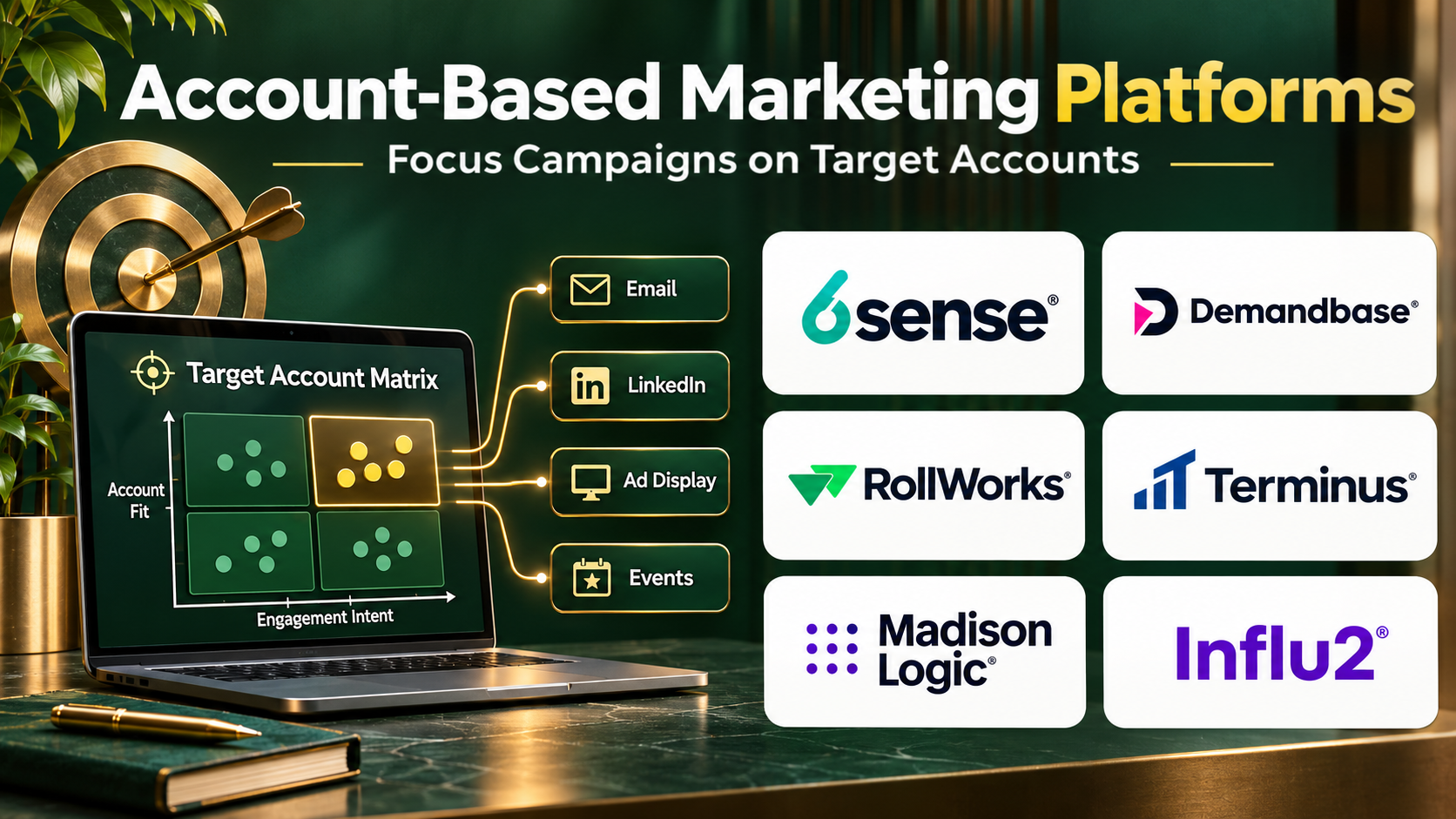
Account-based marketing, commonly called ABM, addresses these challenges by focusing marketing resources on selected target accounts.
Instead of treating every lead independently, ABM teams identify valuable organizations, understand their buying groups, and coordinate personalized engagement.
Account-based marketing platforms help businesses identify target accounts, analyze buying signals, segment audiences, deliver campaigns, and measure account engagement.
Some platforms specialize in intent data and account identification. Others provide advertising activation, website personalization, sales intelligence, or coordinated revenue workflows.
Choosing the right ABM platform requires evaluating data quality, target account coverage, integrations, campaign capabilities, privacy, and measurement.
This guide compares ten established ABM platforms and explains how organizations can build an effective account-based marketing strategy.
What Are Account-Based Marketing Platforms?
Account-based marketing platforms are software solutions that help B2B organizations plan, execute, and measure marketing programs directed at selected companies and their buying groups.
Rather than targeting broad audiences, ABM teams concentrate on accounts with strong strategic value and a suitable customer profile.
For example, a cybersecurity company might identify 200 enterprise accounts that match its ideal customer profile.
Marketing and sales teams can then coordinate advertising, content, outreach, and relationship development for those organizations.
Core ABM Capabilities
Account Identification: Finds companies that match defined customer criteria.
Account Enrichment: Adds firmographic and other business information.
Intent Data: Provides signals suggesting potential interest in relevant topics.
Audience Segmentation: Organizes accounts by industry, size, buying stage, or engagement.
Advertising Activation: Delivers campaigns to selected account audiences.
Website Personalization: Adapts digital experiences for relevant visitors.
Sales Coordination: Connects marketing activity with account owners and sales workflows.
Account Analytics: Measures engagement, pipeline influence, and business outcomes.
Benefits of ABM Platforms
ABM platforms can help organizations focus resources, improve sales and marketing alignment, personalize engagement, and measure performance at the account level.
However, account engagement does not automatically mean purchase intent.
Organizations should combine data signals with direct customer evidence and evaluate outcomes using credible attribution methods.
Top 10 Account-Based Marketing Platforms
1. 6sense
Short Description
6sense is a revenue intelligence and account-based marketing platform that helps B2B organizations identify accounts, analyze buying signals, and coordinate go-to-market activities.
It is particularly relevant for businesses with complex sales cycles and large target account populations.
The platform combines account information, intent-related signals, predictive capabilities, and campaign activation.
Marketing teams can use 6sense to prioritize accounts that appear to match their ideal customer profile and demonstrate relevant activity.
Sales teams can use account insights to support outreach planning and opportunity development.
6sense also supports advertising and broader revenue workflow capabilities, helping organizations coordinate marketing and sales engagement.
Its value depends on data coverage, model interpretation, CRM quality, and consistent execution.
Organizations should avoid treating predictive buying-stage classifications as confirmed customer intentions.
Key Features
- Account Identification: Helps discover organizations matching target criteria.
- Intent Signals: Provides indicators of relevant research activity.
- Predictive Insights: Supports account prioritization using modeled signals.
- Audience Segmentation: Groups accounts by defined characteristics.
- Advertising Activation: Supports campaigns targeting selected account audiences.
- Sales Intelligence: Provides account information for outreach planning.
- CRM Integration: Connects account insights with revenue workflows.
- Account Engagement Analytics: Measures selected interaction patterns.
- Revenue Reporting: Supports analysis of account and pipeline outcomes.
Benefits
6sense helps revenue teams prioritize accounts and coordinate marketing activities around shared targets.
Pros
- Broad ABM and revenue intelligence capabilities.
- Strong account prioritization focus.
- Supports marketing and sales coordination.
- Useful campaign activation.
- Relevant for enterprise B2B organizations.
Cons
- Enterprise investment can be substantial.
- Predictive signals require careful interpretation.
- Data quality affects results.
- Implementation requires cross-functional alignment.
Use Cases
A cybersecurity vendor can prioritize enterprise accounts researching relevant security categories.
A software company can coordinate targeted advertising with account executive outreach.
Best For: Enterprise B2B revenue teams seeking account intelligence and coordinated ABM execution.
2. Demandbase One
Short Description
Demandbase One is a go-to-market platform that provides account intelligence, advertising, intent-related insights, and account-based engagement capabilities.
It is designed for B2B organizations that want to coordinate marketing and sales around valuable target accounts.
Demandbase helps teams identify relevant companies, understand account characteristics, and create targeted engagement programs.
Its capabilities can support account segmentation, advertising, sales intelligence, and measurement.
The platform is particularly useful for organizations that already have an established ideal customer profile and a defined target account strategy.
Marketing teams can use account data to develop differentiated campaigns for industries, account tiers, or buying stages.
Sales teams can use related insights to prioritize outreach.
However, successful implementation requires accurate CRM records and disciplined account planning.
Key Features
- Account Intelligence: Provides business information about target organizations.
- Intent Data: Supports identification of relevant research signals.
- Account Identification: Helps recognize companies engaging with digital properties.
- Audience Segmentation: Builds account groups for campaigns.
- B2B Advertising: Supports targeted account advertising.
- Sales Intelligence: Helps representatives research and prioritize accounts.
- CRM Integration: Connects account activity with sales workflows.
- Engagement Analytics: Tracks relevant account interactions.
- Go-to-Market Reporting: Supports account and revenue performance analysis.
Benefits
Demandbase One helps organizations create coordinated account engagement programs using shared account data.
Pros
- Comprehensive ABM capabilities.
- Strong account intelligence orientation.
- Supports advertising and sales workflows.
- Useful account-level reporting.
- Suitable for enterprise marketing teams.
Cons
- Requires mature account targeting processes.
- Pricing may exceed smaller budgets.
- Integration quality affects usefulness.
- Intent signals are not guaranteed buying decisions.
Use Cases
A B2B infrastructure company can target selected enterprise accounts with industry-specific campaigns.
A revenue team can coordinate sales outreach with advertising engagement.
Best For: Established B2B organizations seeking integrated account intelligence and ABM activation.
3. RollWorks
Short Description
RollWorks is an account-based marketing platform focused on helping B2B companies identify target accounts, reach relevant audiences, and measure engagement.
It is particularly useful for organizations seeking a practical ABM advertising and account targeting solution.
RollWorks supports account selection, segmentation, digital advertising, and account-level reporting.
Marketing teams can use the platform to develop campaigns directed at companies that fit their ideal customer profile.
Its integration capabilities help connect campaign information with CRM and marketing automation systems.
RollWorks is relevant for growing B2B organizations that want to introduce structured account-based advertising.
However, advertising reach and account matching quality depend on available data and audience coverage.
Key Features
- Account Targeting: Builds campaigns around selected companies.
- Audience Segmentation: Organizes accounts by business characteristics.
- Digital Advertising: Supports targeted account campaigns.
- Account Identification: Helps recognize relevant company audiences.
- Intent-Related Signals: Supports account prioritization.
- CRM Integration: Connects campaign information with sales records.
- Marketing Automation Connectivity: Coordinates compatible workflows.
- Engagement Reporting: Measures campaign activity at the account level.
- Campaign Optimization: Supports adjustment of targeting and spending.
Benefits
RollWorks helps B2B teams implement account-focused advertising and evaluate engagement among selected organizations.
Pros
- Strong ABM advertising focus.
- Useful for growing B2B teams.
- Account segmentation capabilities.
- Integrates with marketing workflows.
- Supports targeted campaign measurement.
Cons
- Less comprehensive than some enterprise revenue platforms.
- Advertising results depend on audience coverage.
- Attribution requires careful interpretation.
- Data quality affects account targeting.
Use Cases
A SaaS company can advertise to accounts in its target industry.
A marketing team can run separate campaigns for strategic accounts and broader high-fit companies.
Best For: B2B marketing teams emphasizing account-based digital advertising.
4. Terminus
Short Description
Terminus is associated with account-based marketing technology and go-to-market capabilities that have included account engagement, advertising, and related marketing workflows.
Its ABM offerings have historically focused on helping B2B organizations identify, engage, and measure target accounts.
The platform is relevant to discussions of account-based marketing because of its established role in account engagement and campaign activation.
Businesses evaluating Terminus should verify current product availability, ownership, branding, integrations, and commercial packaging before making a purchasing decision.
This is especially important because the ABM software market has experienced consolidation and product changes.
The capabilities historically associated with Terminus can help explain what organizations should look for in an account engagement platform.
Key Features
- Target Account Management: Organizes selected account audiences.
- Account-Based Advertising: Supports targeted digital engagement.
- Audience Segmentation: Separates accounts by relevant criteria.
- Engagement Tracking: Measures selected account interactions.
- Campaign Coordination: Connects marketing activities around target accounts.
- Sales Alignment: Supports collaboration around account priorities.
- Account Reporting: Evaluates engagement patterns.
- Marketing Integration: Connects with supported marketing systems.
- Campaign Measurement: Supports analysis of account-focused programs.
Benefits
The Terminus ABM approach emphasizes coordinated engagement and account-level measurement.
Pros
- Established ABM market presence.
- Account engagement orientation.
- Advertising-focused capabilities.
- Useful account measurement concepts.
- Relevant to coordinated B2B marketing.
Cons
- Current commercial availability must be verified.
- Product branding and packaging may have changed.
- Integration support requires confirmation.
- Historical features should not be assumed available today.
Use Cases
A B2B marketing team can evaluate Terminus-related account engagement capabilities when reviewing existing technology investments.
An organization can use its historical ABM approach as a benchmark for account targeting and campaign measurement.
Best For: Organizations evaluating existing Terminus-related ABM investments, subject to current product verification.
5. Madison Logic
Short Description
Madison Logic provides account-based marketing and demand generation solutions focused on engaging B2B buying groups.
It is particularly relevant for organizations that want to combine account targeting with content distribution and demand generation programs.
Madison Logic helps businesses identify relevant audiences and activate marketing programs designed to reach selected accounts.
Its approach emphasizes connecting account intelligence with content engagement.
This makes it useful for companies that need to reach buying groups during long and complex purchasing journeys.
Marketing teams can use its capabilities to support awareness, consideration, and pipeline development.
However, businesses should evaluate lead quality, audience transparency, and the relationship between engagement and actual sales opportunities.
Key Features
- Account Targeting: Focuses campaigns on selected B2B organizations.
- Buying Group Engagement: Supports outreach to relevant professional audiences.
- Content Syndication: Distributes marketing content through supported programs.
- Intent-Related Insights: Helps identify account interest signals.
- Audience Segmentation: Targets accounts using defined characteristics.
- Campaign Activation: Coordinates account-focused demand programs.
- Lead Information: Provides campaign response data where applicable.
- Performance Reporting: Measures engagement and campaign outcomes.
- Marketing Integration: Connects campaign information with revenue workflows.
Benefits
Madison Logic helps organizations coordinate content-based demand generation with an account-focused marketing strategy.
Pros
- Strong B2B demand generation focus.
- Useful content engagement capabilities.
- Supports buying group targeting.
- Relevant for enterprise campaigns.
- Helps coordinate account-focused programs.
Cons
- Campaign costs require evaluation.
- Lead quality must be validated.
- Engagement does not guarantee purchase intent.
- Less suited to simple self-service advertising.
Use Cases
An enterprise software vendor can distribute technical content to selected buying groups.
A cybersecurity company can run account-focused educational campaigns for priority industries.
Best For: B2B organizations combining ABM with content syndication and demand generation.
6. Influ2
Short Description
Influ2 is a B2B advertising platform focused on person-based advertising and contact-level engagement.
It is particularly relevant for organizations that want to target known buying group members rather than relying only on broad account audiences.
Influ2 helps marketers connect advertising activity with selected contacts and sales workflows.
This approach can support personalized campaigns directed at stakeholders involved in complex purchasing decisions.
Sales and marketing teams can coordinate around known contacts and evaluate engagement signals.
The platform is useful when organizations have reliable contact data and clear buying group strategies.
However, person-level advertising requires careful attention to privacy, data permissions, and applicable marketing regulations.
Key Features
- Person-Based Advertising: Targets selected professional contacts through supported channels.
- Buying Group Targeting: Focuses engagement on relevant stakeholders.
- Contact Segmentation: Organizes audiences by role or account.
- Advertising Activation: Runs campaigns for selected audiences.
- Engagement Signals: Provides information about supported advertising interactions.
- Sales Coordination: Connects advertising insights with outreach.
- CRM Integration: Uses relevant contact and account records.
- Campaign Analytics: Measures advertising performance.
- Audience Management: Supports ongoing targeting adjustments.
Benefits
Influ2 helps B2B teams coordinate advertising with known buying group relationships.
Pros
- Strong contact-level targeting orientation.
- Useful for complex B2B buying groups.
- Supports sales and marketing coordination.
- Provides engagement insights.
- Relevant for personalized ABM campaigns.
Cons
- Requires accurate contact information.
- Privacy requirements need careful review.
- Audience reach depends on available matching.
- Not a complete marketing automation platform.
Use Cases
An enterprise technology vendor can target selected decision-makers within strategic accounts.
A sales team can coordinate outreach with relevant advertising campaigns.
Best For: B2B teams pursuing contact-level advertising and buying group engagement.
7. Uberflip
Short Description
Uberflip is a content experience platform that has supported personalized content destinations and account-based marketing experiences.
It is particularly relevant for organizations that want to tailor educational resources to specific accounts, industries, or buying groups.
Instead of focusing primarily on advertising, Uberflip emphasizes how audiences experience and consume marketing content.
Marketing teams can organize resources into targeted experiences that support different stages of the buyer journey.
This approach is useful for complex B2B sales where customers need substantial information before making decisions.
Uberflip’s role in the broader content and ABM software market has evolved, so organizations should verify current product packaging and availability.
Its core value proposition remains relevant: personalized content can improve the usefulness of account engagement programs.
Key Features
- Content Experience Management: Organizes marketing resources.
- Personalized Content Hubs: Creates targeted content destinations.
- Account-Based Experiences: Tailors content for selected audiences.
- Content Recommendations: Helps visitors discover relevant resources.
- Engagement Analytics: Measures content interaction.
- Campaign Integration: Connects content with marketing activities.
- Sales Enablement Support: Makes relevant resources available to sales teams.
- Content Organization: Structures materials by audience or topic.
- Marketing Automation Connectivity: Supports compatible engagement workflows.
Benefits
Uberflip helps organizations create more relevant content experiences for selected accounts.
Pros
- Strong content personalization orientation.
- Useful for complex B2B education.
- Supports account-specific experiences.
- Helps organize marketing resources.
- Relevant for sales and marketing alignment.
Cons
- Current product availability should be verified.
- Requires substantial content resources.
- Not a standalone intent data platform.
- Personalization depends on audience information.
Use Cases
A software company can create industry-specific resource hubs for strategic accounts.
A marketing team can provide personalized content collections for enterprise buying groups.
Best For: Content-focused ABM teams seeking personalized buyer experiences.
8. HubSpot Marketing Hub
Short Description
HubSpot Marketing Hub is a marketing automation platform that supports CRM-connected campaigns, segmentation, reporting, and account-based marketing workflows.
It is particularly relevant for growing B2B organizations that want ABM capabilities within a broader marketing and CRM environment.
HubSpot allows teams to organize target accounts, coordinate marketing activity, and connect engagement information with sales records.
Businesses can create segmented campaigns using email, forms, content, advertising integrations, and automation.
Its integrated approach reduces the need for separate systems for every marketing process.
However, HubSpot is a general marketing platform rather than a specialized enterprise intent data provider.
Organizations should verify which ABM capabilities are included in their subscription tier.
Key Features
- Target Account Management: Supports account-focused marketing workflows.
- CRM Integration: Connects marketing and sales information.
- Audience Segmentation: Builds account and contact groups.
- Marketing Automation: Coordinates engagement workflows.
- Email Campaigns: Supports targeted communication.
- Advertising Integrations: Connects compatible advertising channels.
- Contact Activity Tracking: Provides engagement information.
- Reporting Dashboards: Measures marketing performance.
- Sales Collaboration: Supports coordinated account engagement.
Benefits
HubSpot helps organizations introduce ABM practices without implementing a separate enterprise ABM technology stack.
Pros
- Integrated CRM and marketing workflows.
- Accessible for growing businesses.
- Strong automation capabilities.
- Useful sales and marketing coordination.
- Broad marketing functionality.
Cons
- Advanced ABM features depend on subscription.
- Less specialized in third-party intent data.
- Enterprise account identification may require integrations.
- Costs can rise with scale.
Use Cases
A growing SaaS company can build campaigns for selected target accounts.
A B2B services company can coordinate marketing emails with sales follow-up activities.
Best For: SMB and mid-market B2B teams seeking CRM-connected ABM workflows.
9. LinkedIn Campaign Manager
Short Description
LinkedIn Campaign Manager is an advertising platform that allows businesses to reach professional audiences through LinkedIn.
Although it is not a complete ABM management suite, it provides important account targeting capabilities for B2B marketing.
Organizations can use company-based targeting and supported audience tools to deliver campaigns to selected professional groups.
This makes LinkedIn particularly relevant for reaching business decision-makers and buying group members.
Marketing teams can combine account targeting with job function, seniority, industry, and other supported professional characteristics.
LinkedIn Campaign Manager is useful as an activation channel within a broader ABM strategy.
However, it does not replace specialized account intelligence, CRM coordination, or comprehensive revenue attribution.
Key Features
- Company Targeting: Reaches audiences associated with selected organizations.
- Professional Audience Segmentation: Uses supported job-related attributes.
- Matched Audiences: Supports uploaded or integrated audience groups.
- Sponsored Content: Delivers advertising within LinkedIn.
- Lead Generation Forms: Collects permitted prospect information.
- Campaign Analytics: Measures advertising performance.
- Audience Exclusions: Refines campaign targeting.
- Conversion Tracking: Supports campaign outcome measurement.
- Marketing Integrations: Connects with supported external systems.
Benefits
LinkedIn Campaign Manager helps B2B marketers reach professional audiences within target accounts.
Pros
- Strong professional audience targeting.
- Useful company-based advertising.
- Relevant for B2B buying groups.
- Supports lead generation campaigns.
- Accessible without a full ABM suite.
Cons
- Not a complete ABM platform.
- Advertising costs can be substantial.
- Account matching and audience reach vary.
- Attribution requires broader measurement.
Use Cases
An enterprise software company can advertise to technology leaders at selected organizations.
A consulting firm can target professional audiences in strategic industries.
Best For: B2B marketers needing account-targeted professional advertising.
10. Salesforce Marketing Cloud Account Engagement
Short Description
Salesforce Marketing Cloud Account Engagement, formerly known as Pardot, is a B2B marketing automation platform connected to the Salesforce ecosystem.
It helps organizations coordinate lead nurturing, marketing campaigns, scoring, and sales alignment.
Although it is not exclusively an ABM platform, it can support account-focused marketing workflows when connected with Salesforce CRM and related capabilities.
Marketing teams can segment prospects, deliver targeted communication, and track engagement.
Sales teams can use CRM-connected information to coordinate account follow-up.
The platform is particularly relevant for organizations already using Salesforce as their central customer and revenue system.
However, advanced account intelligence and advertising activation may require additional products or integrations.
Key Features
- B2B Marketing Automation: Coordinates marketing workflows.
- Prospect Segmentation: Groups contacts using defined criteria.
- Email Nurturing: Delivers targeted communication sequences.
- Lead Scoring: Supports prioritization based on engagement.
- Salesforce CRM Integration: Connects marketing with account records.
- Campaign Reporting: Measures marketing activity.
- Landing Pages and Forms: Supports lead collection.
- Sales Alignment: Connects marketing signals with sales workflows.
- Account-Based Campaign Support: Enables coordinated engagement through CRM data.
Benefits
Salesforce Account Engagement helps B2B organizations coordinate account-focused nurturing within their existing Salesforce environment.
Pros
- Strong Salesforce integration.
- Useful B2B marketing automation.
- Supports sales and marketing alignment.
- Flexible segmentation.
- Relevant for established CRM processes.
Cons
- Not a dedicated ABM intent data platform.
- Advanced account targeting may require integrations.
- Administration can be complex.
- Licensing requires evaluation.
Use Cases
A B2B software company can nurture multiple contacts within strategic accounts.
An enterprise marketing team can connect campaign engagement with Salesforce opportunity records.
Best For: Salesforce-centered B2B organizations building CRM-connected account engagement programs.
ABM Platforms Comparison Table
| Platform | Primary Strength | Ideal Users | Main Consideration |
|---|---|---|---|
| 6sense | Predictive account intelligence | Enterprise revenue teams | Investment and data quality |
| Demandbase One | Integrated ABM | Enterprise B2B teams | Implementation maturity |
| RollWorks | Account advertising | Growing B2B marketers | Audience coverage |
| Terminus | Account engagement | Existing ABM users | Verify current availability |
| Madison Logic | Content-driven ABM | Demand generation teams | Lead quality |
| Influ2 | Person-based advertising | Buying group marketers | Privacy and matching |
| Uberflip | Personalized content | Content-focused teams | Verify current packaging |
| HubSpot Marketing Hub | CRM-connected ABM | SMB and mid-market | Feature tiers |
| LinkedIn Campaign Manager | Professional targeting | B2B advertisers | Not a complete ABM suite |
| Salesforce Account Engagement | B2B nurturing | Salesforce organizations | Specialized integrations |
How to Choose the Right ABM Platform
1. Define Your Ideal Customer Profile
Identify the industries, company sizes, regions, technologies, and business characteristics associated with suitable customers.
2. Establish Target Account Tiers
Strategic accounts may justify highly personalized campaigns.
Broader target groups may require scalable advertising and automated engagement.
3. Evaluate Account Data Quality
Review company coverage, duplicate handling, enrichment accuracy, and refresh practices.
4. Understand Intent Signals
Intent data may indicate relevant research activity, but it does not prove that a company is ready to purchase.
5. Review Advertising Capabilities
Determine whether the platform supports the channels and targeting methods required by your campaign strategy.
6. Examine Buying Group Coverage
For complex B2B purchases, evaluate whether the platform helps teams understand multiple stakeholders.
7. Integrate Sales and Marketing
Account owners should have visibility into relevant campaign activity.
Marketing teams should understand sales priorities and account status.
8. Evaluate Privacy and Compliance
Review data collection practices, audience matching, consent requirements, and applicable advertising regulations.
9. Measure Account Outcomes
Track qualified account engagement, meetings, opportunities, pipeline progression, and revenue.
10. Calculate Total Cost
Include platform licensing, advertising spend, data services, integrations, campaign production, and operational resources.
Best ABM Software by User Type
| User Type | Recommended Platform | Reason |
|---|---|---|
| Enterprise revenue teams | 6sense | Account intelligence |
| Mature ABM organizations | Demandbase One | Integrated activation |
| Growing ABM advertisers | RollWorks | Account-based advertising |
| Existing Terminus customers | Terminus | Account engagement continuity |
| Content syndication teams | Madison Logic | B2B demand programs |
| Contact-level marketers | Influ2 | Person-based targeting |
| Content personalization teams | Uberflip | Account-focused experiences |
| SMB B2B marketers | HubSpot | CRM-connected workflows |
| Professional audience advertisers | LinkedIn Campaign Manager | Company and role targeting |
| Salesforce marketing teams | Account Engagement | CRM-integrated nurturing |
Practical Example: Launching an Enterprise ABM Campaign
Consider a B2B cybersecurity company selling a complex security platform.
The company wants to target 150 enterprise accounts.
Step 1: Define the Ideal Customer Profile
The team identifies organizations that match its industry, size, and technical requirements.
Step 2: Select Target Accounts
Sales and marketing agree on a list of 150 accounts.
Step 3: Identify Buying Groups
The company maps relevant security, IT, finance, and procurement stakeholders where information is available and lawfully usable.
Step 4: Select an ABM Platform
The team compares 6sense, Demandbase One, and RollWorks.
Step 5: Segment Accounts
Accounts are grouped by industry, strategic value, and engagement characteristics.
Step 6: Develop Relevant Content
The marketing team creates resources addressing the security challenges of each target segment.
Step 7: Activate Campaigns
Advertising and sales outreach are coordinated around selected accounts.
Step 8: Monitor Engagement
The team reviews meaningful website interactions, content engagement, and direct sales responses.
Step 9: Measure Pipeline Outcomes
Suppose 30 of the 150 accounts generate qualified sales opportunities.
The hypothetical account-to-opportunity rate is 20%.
The company compares results with an appropriate baseline rather than assuming every opportunity was caused by ABM.
Step 10: Refine Targeting
Accounts showing poor fit are removed, while promising segments receive additional attention.
Frequently Asked Questions
1. What is account-based marketing?
Account-based marketing is a B2B strategy that coordinates marketing and sales around selected target accounts.
2. What does an ABM platform do?
It helps identify, segment, engage, and measure target accounts.
3. How is ABM different from traditional lead generation?
ABM focuses on organizations and buying groups, while traditional lead generation often focuses on individual prospects.
4. Which ABM platform is best for enterprises?
6sense and Demandbase One are established enterprise candidates.
5. Which platform is suitable for growing B2B teams?
RollWorks and HubSpot are relevant options depending on advertising and CRM requirements.
6. What is intent data?
Intent data consists of signals that may indicate interest in certain business topics or products.
7. Does intent data prove purchase readiness?
No. Research activity is not equivalent to a confirmed buying decision.
8. Can LinkedIn be used for ABM?
Yes. LinkedIn supports company and professional audience targeting, although it is not a complete ABM suite.
9. What is person-based advertising?
Person-based advertising focuses on selected professional contacts rather than only company-level audiences.
10. Can ABM work for small businesses?
Yes, particularly when a business has a limited number of valuable target customers.
11. What is a buying group?
A buying group consists of people who influence or participate in a purchasing decision.
12. How should ABM success be measured?
Useful measures include qualified account engagement, opportunities, pipeline progression, and revenue outcomes.
13. Does ABM replace sales outreach?
No. ABM usually works best when marketing and sales coordinate their activities.
14. Are ABM platforms expensive?
Costs vary considerably based on data, advertising, platform capabilities, and enterprise requirements.
15. What is the biggest ABM implementation mistake?
Launching campaigns before establishing a clear target account strategy and shared sales objectives.
Final Thoughts
Account-based marketing platforms help B2B organizations focus on valuable accounts and coordinate more relevant engagement.
6sense and Demandbase One provide broad account intelligence and activation capabilities.
RollWorks, Influ2, and LinkedIn Campaign Manager emphasize advertising and audience targeting.
Madison Logic supports content-driven demand generation, while HubSpot and Salesforce Account Engagement provide CRM-connected marketing workflows.
Terminus and Uberflip remain important names to evaluate with attention to current product availability and packaging.
The best ABM platform depends on target account strategy, data quality, sales alignment, and campaign requirements.
Successful ABM is not simply personalized advertising. It is a coordinated approach to understanding and serving the needs of selected business customers.