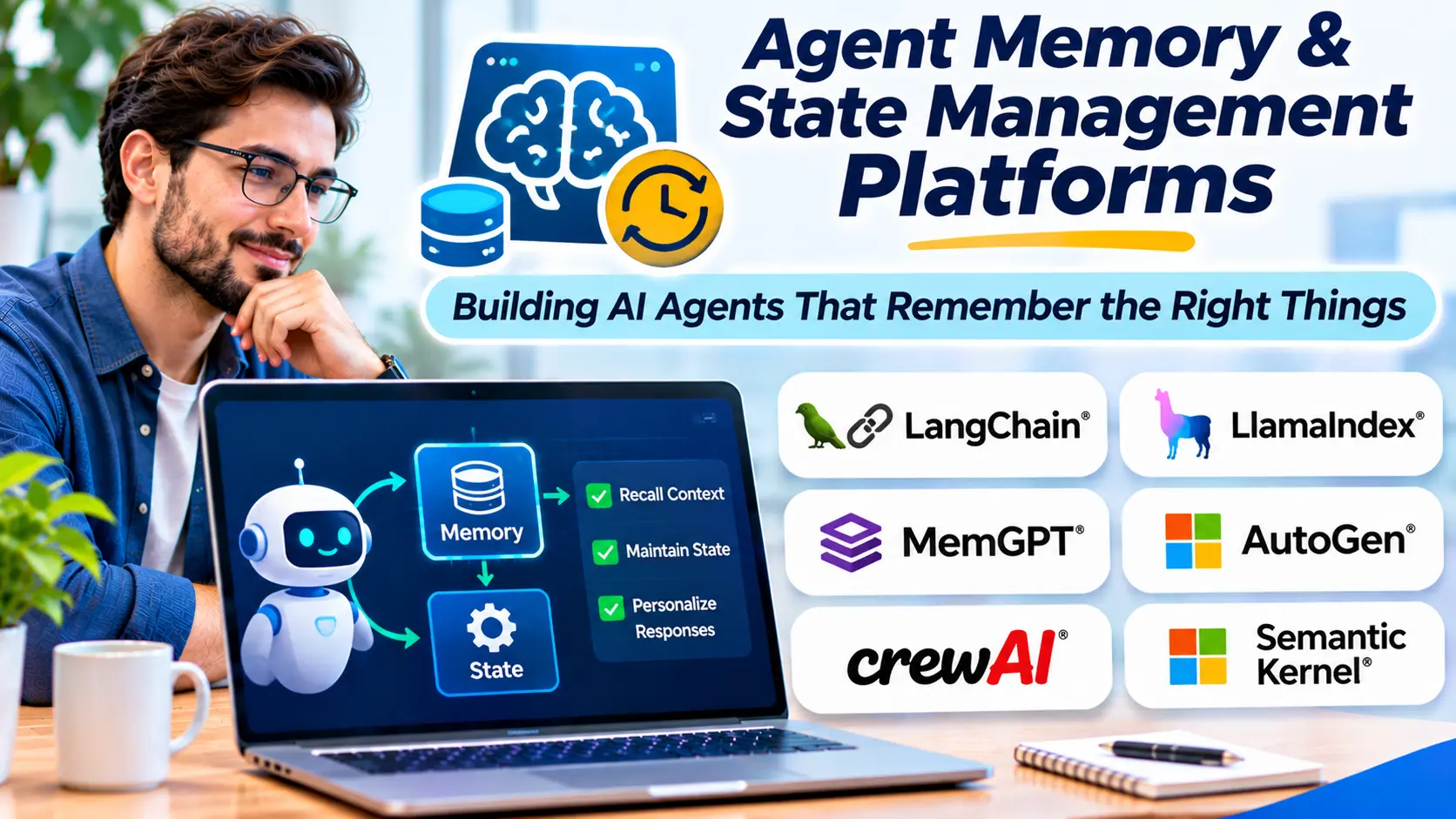
An AI assistant can produce an excellent answer and still fail at a simple follow-up task.
Imagine a customer support agent that collects an order number, checks a delivery status, and prepares a replacement request. The customer returns later, but the agent cannot identify which order was discussed. Worse, an interrupted workflow may restart and submit the same replacement request twice.
These are not simply language-model problems. They are problems of memory, execution state, and application design.
Agent memory and state management platforms help developers preserve useful context, resume interrupted operations, and coordinate information across AI-driven workflows.
The most important architectural decision is deciding what the system should remember, how long that information should remain available, and which source is authoritative.
Memory and State Are Different Problems
The terms memory and state are often used interchangeably in AI development, but they serve different purposes.
Agent memory stores information that may be useful during future interactions or decisions.
Examples include a user’s stated preferences, relevant conversation history, or a summary of an earlier task.
Agent state describes the current condition of an executing workflow.
It may include the current step, pending approval, selected tool, intermediate results, or completion status.
Consider an AI travel assistant.
Remembering that a user prefers direct flights is a memory function.
Recording that a booking is awaiting payment confirmation is a state management function.
The distinction matters because these records have different reliability requirements.
A preference may change or become outdated. A payment confirmation must reflect an authoritative transaction result.
A robust system should never treat a remembered conversational statement as proof that an external operation succeeded.
Why Language Model Context Is Not Enough
Language models process information supplied within their available context.
That context may include instructions, conversation messages, retrieved documents, and tool results.
However, the model’s context window is not a durable database.
Information can disappear when a session ends, become unavailable when a conversation grows, or be excluded by context management decisions.
Long conversations also introduce relevance problems.
Even when information remains available, not every previous message deserves equal attention.
A reliable agent architecture separates temporary working context from persistent information.
It also provides a deliberate method for retrieving relevant records when needed.
Four Memory Patterns Worth Understanding
Short-Term Conversational Memory
Short-term memory preserves information during an active interaction.
It may include recent messages, selected tool results, and current task details.
This helps an agent respond coherently to follow-up requests.
However, retaining every message indefinitely can increase costs and introduce irrelevant context.
Long-Term User Memory
Long-term memory stores selected information across sessions.
It may include explicitly provided preferences, recurring requirements, or approved profile details.
Such information should be associated with the correct user or organization.
It should also be possible to correct or delete outdated records.
Semantic Memory
Semantic memory stores information that can be retrieved according to meaning.
Vector embeddings and similarity search are commonly used for this purpose.
For example, an agent may retrieve relevant passages from earlier project notes without requiring an exact keyword match.
However, semantic similarity does not establish factual accuracy.
Retrieved information still needs appropriate validation.
Episodic Memory
Episodic memory records events or prior experiences.
An agent might store a summary of an earlier troubleshooting session, including the observed problem and resolution.
This can help identify recurring issues.
However, historical outcomes should not automatically determine future actions.
The operating environment may have changed.
What Agent Memory Platforms Actually Provide
Memory platforms vary in scope.
Some focus on extracting and retrieving useful information from conversations.
Others provide databases, memory APIs, user-scoped storage, or retrieval infrastructure.
State management systems may provide checkpointing, persistence, execution histories, and workflow recovery.
Some agent frameworks include both capabilities.
The distinction is important when comparing products.
A vector database can store searchable information, but it is not automatically a complete agent memory system.
Likewise, a workflow checkpoint store may preserve execution state without providing meaningful long-term personalization.
Platforms and Technologies to Evaluate
Mem0
Mem0 focuses on memory capabilities for AI applications.
It is relevant to developers who want to store and retrieve selected information across interactions.
Evaluation should focus on memory extraction, retrieval quality, user isolation, update behavior, and deletion controls.
Teams should also determine how the system handles contradictory or outdated information.
Zep
Zep provides memory and contextual capabilities for AI applications.
It is relevant to systems that need to organize and retrieve information from ongoing interactions.
Organizations should assess how memory records are created, updated, retrieved, and associated with users or sessions.
LangGraph Persistence
LangGraph provides persistence and checkpointing mechanisms for stateful workflows.
Its value is particularly relevant to agents that must pause, resume, or coordinate multi-step execution.
Checkpointing should be evaluated separately from long-term semantic memory.
The two capabilities solve different problems.
Redis
Redis can support low-latency storage for session data, application state, and other operational information.
It may form part of an agent memory architecture.
However, Redis does not independently provide all the reasoning, retrieval, or memory-selection logic required by an AI agent.
Developers must design those surrounding components.
PostgreSQL and Vector Extensions
PostgreSQL can store structured memory records, workflow information, and application data.
With appropriate extensions, it can also support vector-based retrieval.
This approach may appeal to teams that prefer established database infrastructure.
The trade-off is additional responsibility for memory extraction, ranking, retention, and lifecycle management.
Comparing Architectural Approaches
| Requirement | Common approach | Important limitation |
|---|---|---|
| Recent conversation continuity | Session storage | Limited long-term relevance |
| Cross-session personalization | Dedicated memory layer | Privacy and stale information |
| Semantic retrieval | Vector search | Similarity is not accuracy |
| Workflow recovery | Durable checkpoints | External side effects need separate verification |
| Structured agent state | Relational or key-value storage | Requires explicit schema and lifecycle |
| Complex contextual relationships | Graph-based memory | Higher modeling and operational complexity |
No single storage approach is automatically best for every agent.
The Problem of Stale and Contradictory Memory
Memory becomes harmful when an agent treats outdated information as current.
A user may change preferences, responsibilities, or project requirements.
An earlier conversation might contain an assumption that was later corrected.
If the system retrieves the wrong record, it can produce confidently incorrect results.
Memory systems should therefore consider timestamps, provenance, confidence, and update rules.
Where appropriate, records should distinguish confirmed facts from inferred preferences.
Critical information should be retrieved from authoritative systems rather than conversational memory.
For example, an agent should check the current order database before telling a customer that an item has shipped.
Checkpointing and Workflow Recovery
State persistence is essential for long-running agents.
An agent may pause while waiting for human approval or an external service.
A checkpoint can preserve the information needed to resume execution.
However, restoring state is not the same as safely repeating an action.
Suppose an agent submits a payment request and loses its connection before receiving confirmation.
Restarting the operation without checking the payment system could create a duplicate transaction.
Reliable recovery requires transaction identifiers, idempotency safeguards, and verification against authoritative systems.
Checkpointing is only one part of this design.
Multi-Agent State Coordination
Multi-agent applications introduce additional complexity.
Different agents may work on separate parts of the same task.
They may need to share information, exchange results, and coordinate completion.
A shared state store can provide a common record.
However, concurrent updates may create conflicts.
Developers must define which component can modify each field and how conflicting changes are resolved.
For important workflows, explicit state transitions are often safer than allowing every agent to rewrite shared context freely.
Security and Privacy Requirements
Persistent memory can contain sensitive information.
Organizations should consider data minimization, encryption, access controls, and retention policies.
Memory records must be isolated between users and tenants.
An agent should not retrieve another customer’s information simply because the records are semantically similar.
Deletion requirements also deserve attention.
Removing a record from one database may not remove it from caches, backups, or derived indexes.
Organizations should understand the full data lifecycle before storing personal information.
Measuring Memory Quality
A memory system should be evaluated through realistic tasks.
Useful questions include:
- Does the system retrieve the correct information?
- Can it distinguish current facts from outdated records?
- Does it respect user and tenant boundaries?
- Can incorrect memories be updated?
- Does retrieval introduce unnecessary context?
- Can users delete information appropriately?
A useful test set should include conflicting preferences, missing records, similar users, and changes over time.
High retrieval similarity scores alone do not demonstrate reliable agent behavior.
Understanding Costs
Memory infrastructure creates storage, retrieval, embedding, and maintenance costs.
Long-term retention can increase storage requirements.
Repeated retrieval can increase latency and model input costs.
Complex memory pipelines may also require additional processing to extract and summarize information.
Organizations should measure the value of retrieved information rather than storing everything indefinitely.
A smaller collection of relevant, well-maintained records can be more useful than a large collection of unverified memories.
A Practical Implementation Strategy
Begin by identifying the information the agent genuinely needs across interactions.
Separate conversational memory from authoritative business records.
Define explicit state fields for workflow execution.
Choose storage technologies based on retrieval, consistency, latency, and durability requirements.
Implement user isolation and retention controls before collecting sensitive information.
Add checkpointing for workflows that must survive interruptions.
Test contradictory records, stale context, concurrent updates, and interrupted operations.
Finally, monitor whether memory actually improves task completion.
Choosing the Right Memory and State Architecture
Dedicated memory platforms may be appropriate when contextual retrieval and personalization are central requirements.
Workflow frameworks with checkpointing are useful when durable execution is the main concern.
Established databases may be sufficient when teams need structured storage and have the engineering capacity to build the surrounding logic.
The most reliable systems rarely depend on one universal memory mechanism.
They combine temporary context, selective long-term memory, authoritative records, and explicit execution state.
Agent memory should help an AI system use relevant past information. State management should ensure that the system knows what is happening now.
Keeping those responsibilities separate is a foundation for reliable AI applications.