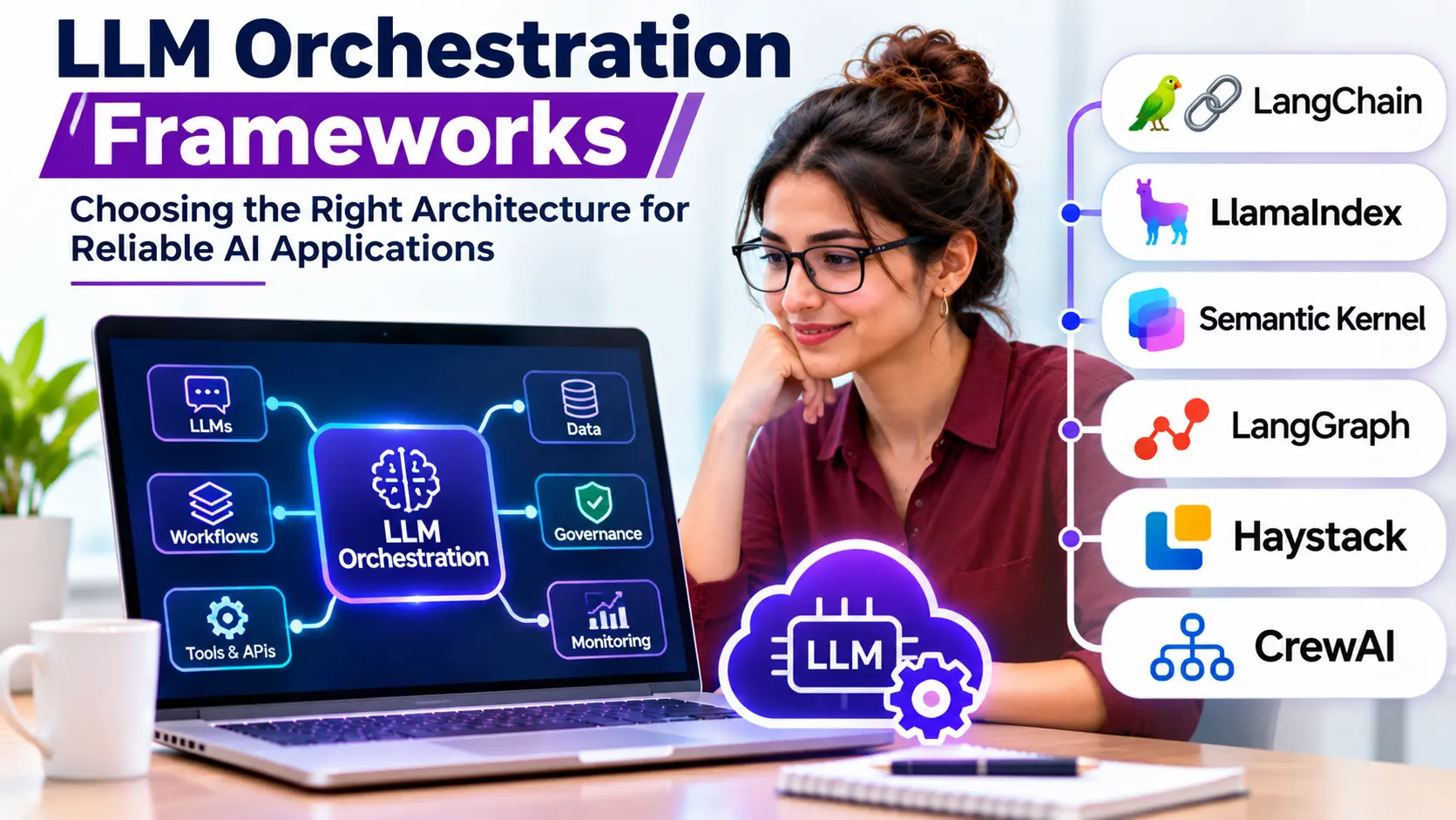
A language model can answer a question in one request. A production AI application often needs much more.
It may retrieve documents, validate information, call external tools, generate structured output, request human approval, and store results.
Each operation introduces dependencies.
A retrieval service might fail. A model might return invalid data. A tool may complete successfully while the surrounding workflow loses its connection.
Connecting these components reliably is the purpose of LLM orchestration.
LLM orchestration frameworks provide reusable structures for coordinating models, tools, data retrieval, and application logic.
However, adding a framework is not always the right decision.
For simple applications, direct model API calls may be easier to maintain. For complex systems, orchestration can reduce duplicated engineering effort and provide clearer execution control.
The challenge is choosing an architecture that matches the application’s actual requirements.
What Is LLM Orchestration?
LLM orchestration is the coordination of language-model interactions with other software components.
An orchestrated workflow may combine model inference, document retrieval, data processing, tool execution, and business rules.
The orchestration layer determines how these components interact.
For example, a document analysis application might follow this sequence:
- Receive a document.
- Extract its text.
- Retrieve relevant reference material.
- Ask a model to identify required information.
- Validate the structured output.
- Send uncertain results for human review.
- Save approved information.
The language model performs only part of the work.
The surrounding application controls execution, validation, and integration.
An orchestration framework helps developers organize these responsibilities.
When a Framework Becomes Useful
A basic chatbot may need only a model API and a small amount of application code.
Introducing a large orchestration framework can create unnecessary dependencies.
The value of a framework increases when an application has multiple components, repeated execution patterns, or complex state requirements.
Examples include retrieval-augmented generation, multi-step document processing, tool-connected assistants, and long-running agent workflows.
Frameworks may provide abstractions for common tasks.
However, abstractions can also hide implementation details.
Developers should understand the underlying model calls, data flows, and failure conditions.
A framework should simplify essential complexity rather than conceal it.
Three Architectural Approaches
Direct API Orchestration
Developers write application logic directly around model APIs.
This approach provides explicit control over requests, validation, and execution.
It is often suitable for small applications with limited workflow complexity.
The trade-off is that developers must implement more supporting infrastructure themselves.
Pipeline-Based Orchestration
Pipeline frameworks organize processing into connected components.
Each component performs a defined operation.
For example, one component retrieves documents, another prepares context, and another generates an answer.
This approach is useful when workflows are relatively structured.
It can also make individual stages easier to test.
Graph-Based and Agentic Orchestration
Graph-based systems represent workflows as nodes and transitions.
They may support branching, loops, state updates, and conditional execution.
Agentic systems introduce model-driven decisions about which actions to perform.
These approaches can support complex workflows, but they require careful control over execution paths and termination conditions.
LLM Orchestration Frameworks to Evaluate
LangChain
LangChain provides abstractions and integrations for building language-model applications.
It is relevant to developers who need model connections, tool integration, and reusable application components.
Its usefulness depends on the required abstractions and the team’s familiarity with the ecosystem.
Organizations should evaluate API stability, dependency management, and debugging requirements.
LangGraph
LangGraph focuses on stateful, graph-based orchestration.
It is particularly relevant to workflows requiring explicit execution paths, persistence, and human intervention.
Developers can use it to coordinate multi-step applications with controlled state transitions.
However, graph design introduces architectural decisions that may be unnecessary for simpler applications.
LlamaIndex
LlamaIndex provides tools and frameworks associated with connecting language models to external data.
It is especially relevant to retrieval-intensive applications.
Teams should evaluate its data connectors, indexing approaches, retrieval capabilities, and workflow support.
The main question is whether its data-oriented abstractions match the application’s needs.
Haystack
Haystack is an open-source framework for building AI applications using modular components and pipelines.
It is relevant to retrieval-augmented generation, search, and other structured AI workflows.
Its component-oriented design can be useful when developers want explicit control over processing stages.
Teams should examine supported integrations, deployment requirements, and pipeline complexity.
Microsoft Semantic Kernel
Semantic Kernel provides development capabilities for integrating AI models with application logic and external functions.
It is relevant to teams building AI functionality within supported software development environments.
Organizations should assess language support, integration patterns, and compatibility with existing enterprise systems.
DSPy
DSPy takes a different approach by emphasizing programmable and optimizable language-model pipelines.
It is relevant when developers want to define model-driven tasks and improve them using evaluation data.
Its suitability depends on the availability of meaningful examples, evaluation metrics, and the team’s willingness to adopt its programming model.
These frameworks are not identical substitutes.
Some emphasize data retrieval, others workflow state, integration, or systematic optimization.
Comparing Framework Approaches
| Framework | Primary architectural emphasis | Suitable evaluation scenario |
|---|---|---|
| LangChain | Model and tool integration | General LLM applications |
| LangGraph | Stateful graph workflows | Multi-step and interruptible execution |
| LlamaIndex | Data and retrieval workflows | Knowledge-intensive applications |
| Haystack | Modular pipelines | Search and RAG systems |
| Semantic Kernel | AI integration with application logic | Enterprise software development |
| DSPy | Programmable model pipelines and optimization | Evaluation-driven development |
This comparison describes architectural emphasis, not measured superiority.
The most appropriate framework depends on the application’s requirements.
Retrieval-Augmented Generation
Retrieval-augmented generation, or RAG, is a common orchestration pattern.
Instead of relying entirely on information contained in model parameters, the application retrieves relevant material from external sources.
The retrieved information becomes part of the context used to generate a response.
A typical RAG workflow includes document processing, indexing, retrieval, context preparation, and generation.
The quality of each stage matters.
Poor document extraction can damage retrieval quality.
Irrelevant search results can mislead the model.
Even accurate retrieved information may be interpreted incorrectly.
A framework can coordinate these stages, but it cannot guarantee factual accuracy.
Evaluation must cover the complete pipeline.
Tool Calling and External Actions
LLM applications may need to interact with APIs, databases, or business systems.
Tool calling allows a model to request supported operations.
The orchestration layer determines how those requests are executed.
Developers should validate tool arguments and enforce permissions independently of the model.
For example, a model may request an account update.
The application must verify that the requesting user has authority to modify that account.
Tool calling is a mechanism for requesting actions, not a substitute for authorization.
Structured Outputs and Validation
Many business applications require structured information rather than free-form text.
Examples include invoice fields, classification labels, or standardized records.
Frameworks may support structured-output generation and validation.
However, a response matching a schema is not necessarily factually correct.
An invoice total can be a valid number while still being wrong.
Developers should distinguish format validation from semantic validation.
Critical fields may require cross-checking against authoritative data or independent calculations.
Workflow State and Persistence
Long-running workflows may need to preserve information between steps.
State can include intermediate results, selected tools, approval status, and execution progress.
Persistence allows a workflow to resume after interruption.
However, state recovery must account for external side effects.
A framework may restore an earlier checkpoint, but it cannot automatically undo a completed payment or external database update.
Reliable applications need explicit handling for retries, idempotency, and transaction boundaries.
Human-in-the-Loop Orchestration
Some workflows require human judgment.
An application may generate a draft contract, prepare a customer response, or recommend a financial action.
The system can automate preparation while requiring approval before final execution.
Orchestration frameworks may support pauses, resumptions, and approval checkpoints.
These features are especially useful when workflows span several sessions.
However, approval interfaces should present the actual proposed action clearly.
Human review is meaningful only when the reviewer has sufficient information to make a decision.
Error Handling and Retry Strategies
Production workflows encounter temporary failures.
An external API may become unavailable.
A model request may time out.
A retrieval operation may return no results.
Orchestration should define how each failure is handled.
Some operations can be retried safely.
Others may have irreversible effects.
Developers should use bounded retries, clear timeout policies, and explicit failure states.
A workflow should not continue indefinitely because the model repeatedly attempts unsuccessful actions.
Termination conditions are particularly important for agentic systems.
Security Boundaries
LLM orchestration often connects trusted application logic with untrusted external content.
Retrieved documents, websites, and tool responses may contain malicious instructions.
Applications should treat such content as data.
Authorization should remain outside model-controlled reasoning.
Secrets should not be unnecessarily included in prompts.
Tool permissions should be limited to the minimum required scope.
Framework-level conveniences do not remove the need for secure application architecture.
Observability and Debugging
An orchestrated workflow may involve many model calls and external services.
Developers need visibility into execution paths.
Useful records include model requests, retrieval results, tool calls, validation failures, and state transitions.
Tracing helps identify where a workflow failed.
However, observability systems may capture sensitive data.
Teams should establish appropriate logging, redaction, and retention policies.
A framework’s compatibility with existing monitoring infrastructure can be an important selection factor.
Model Portability and Vendor Dependencies
Some frameworks support multiple model providers.
This can reduce the effort required to experiment with different models.
However, model portability is rarely perfect.
Providers may differ in tool-calling behavior, structured-output support, context limits, and multimodal capabilities.
Switching models can require prompt changes, validation updates, and additional testing.
Organizations should distinguish between API abstraction and genuine behavioral portability.
A framework can simplify provider integration without making every model interchangeable.
Understanding Framework Costs
Many orchestration frameworks are available as open-source software.
However, operating an application still creates costs.
These include model usage, retrieval infrastructure, databases, hosting, monitoring, and engineering maintenance.
Complex workflows may trigger multiple model requests for one user task.
Framework abstractions can sometimes make this consumption less obvious.
Teams should inspect actual execution traces and calculate costs per completed workflow.
A simpler architecture may be more economical when the task does not require advanced orchestration.
How to Evaluate an Orchestration Framework
Start with a representative application rather than a generic feature checklist.
Implement the same workflow using the leading candidates.
Measure development effort, execution reliability, latency, and debugging complexity.
Evaluate how each framework handles invalid outputs, unavailable tools, and interrupted execution.
Review documentation, dependency requirements, and upgrade practices.
Consider whether the framework fits the team’s programming languages and deployment environment.
Finally, assess how difficult it would be to replace or remove the framework later.
A good abstraction should make the application easier to maintain over time.
Common Architectural Mistakes
One common mistake is introducing autonomous agents where deterministic pipelines would be sufficient.
Another is adopting multiple frameworks without clear responsibility boundaries.
Teams may also underestimate state management and error recovery.
A workflow that works during a demonstration may fail under concurrent production requests.
Excessive abstraction is another risk.
When developers cannot explain how a request moves through the system, debugging becomes difficult.
The architecture should remain understandable to the people responsible for operating it.
Choosing the Right LLM Orchestration Framework
For simple applications, direct model APIs may provide the clearest solution.
For retrieval-intensive systems, data-oriented frameworks can reduce integration effort.
For stateful workflows requiring branching and recovery, graph-based orchestration may be appropriate.
For enterprise applications, compatibility with existing development practices and governance requirements may be decisive.
For evaluation-driven model pipelines, optimization-oriented frameworks deserve consideration.
The best framework is not necessarily the one offering the most abstractions.
It is the one that makes the application’s essential behavior explicit, testable, and maintainable.
LLM orchestration frameworks can provide a strong foundation for production AI systems. Their greatest value comes from coordinating models and software components without surrendering control over reliability, security, or business logic.