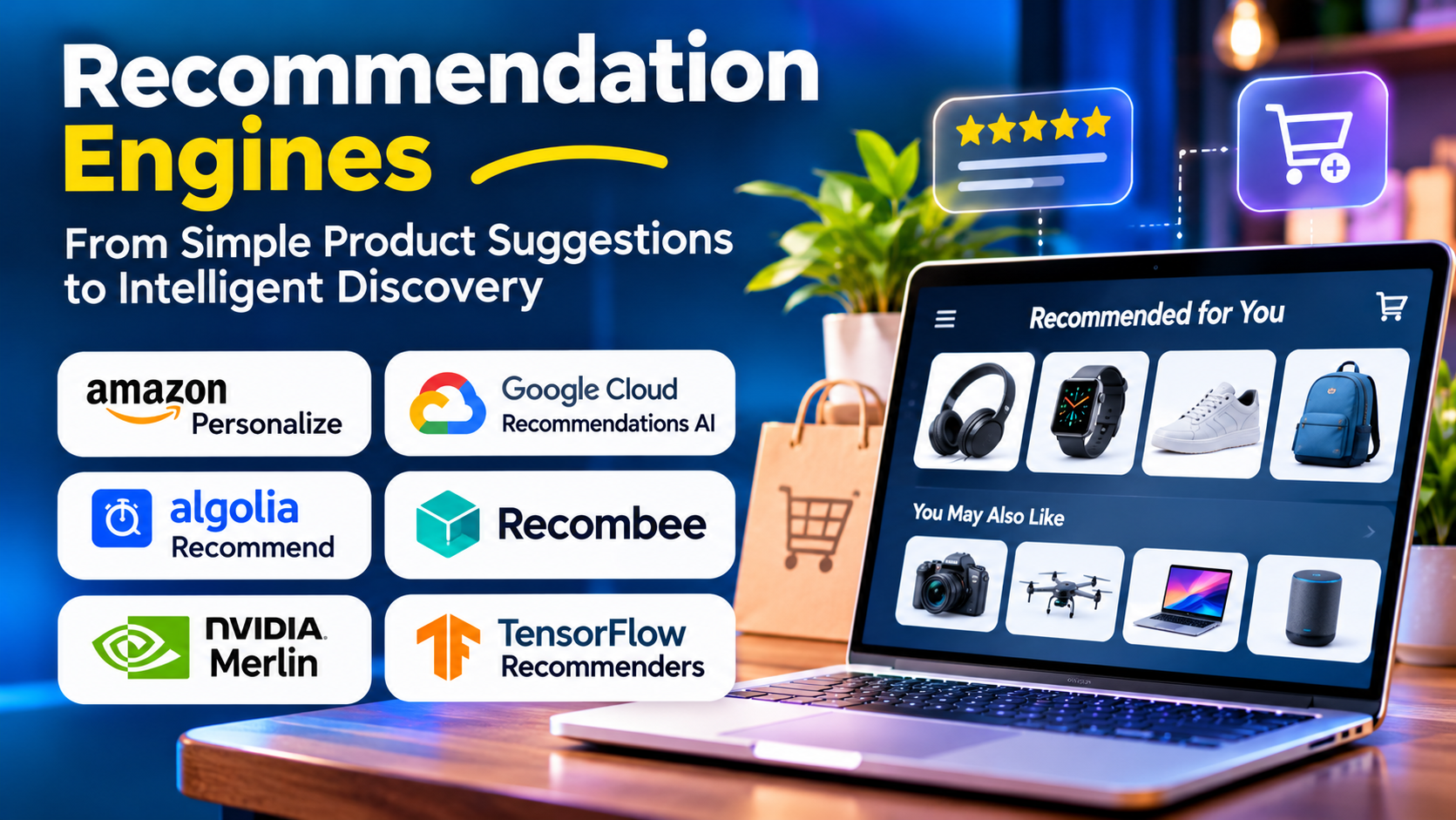
A recommendation system can influence which products customers discover, which videos they watch, and which articles they read.
But successful recommendations require more than predicting what someone might click.
A useful system must understand the available items, respond to changing interests, handle incomplete data, and operate within business and technical constraints.
Recommendation engines range from simple popularity-based systems to sophisticated machine learning architectures. The right choice depends on the problem being solved, not the complexity of the algorithm.
What Is a Recommendation Engine?
A recommendation engine is a software system that selects or ranks items likely to be relevant to a user or context.
The items might be products, articles, videos, songs, courses, job opportunities, or other content.
For example, an online bookstore may recommend titles related to a visitor’s browsing history.
A learning platform may suggest courses based on previously completed lessons.
The recommendation process generally involves collecting signals, identifying candidate items, ranking those candidates, and presenting the results.
Understanding Recommendation Methods
Popularity-based recommendations
These systems suggest widely viewed, purchased, or positively rated items.
They are relatively straightforward to implement and can work even when little information is available about a particular user.
However, they may overemphasize already popular content.
Content-based filtering
Content-based systems recommend items with characteristics similar to those a user has previously preferred.
A movie recommendation system might use genres, descriptions, or other content attributes.
This approach depends on useful item metadata.
Collaborative filtering
Collaborative filtering identifies patterns across users and items.
It may recommend something because users with similar interaction patterns also engaged with it.
The method can discover relationships that are not obvious from item descriptions alone.
However, sparse interaction data and new users can create challenges.
Hybrid recommendations
Hybrid systems combine multiple approaches.
For example, a platform might use collaborative signals, item characteristics, popularity, and business rules.
Hybrid designs can improve flexibility, but they also require more complex evaluation and maintenance.
Recommendation Platforms and Technologies
Amazon Personalize
Amazon Personalize is a managed AWS service for building recommendation and personalization experiences.
It provides infrastructure for supported recommendation workflows without requiring organizations to build every underlying component independently.
Suitable for: Teams seeking managed recommendation capabilities within AWS.
Considerations: Evaluate data requirements, integration effort, service charges, and model behavior.
Google Cloud Recommendations AI / Commerce Recommendations
Google Cloud offers commerce recommendation capabilities within its retail and commerce technology portfolio.
These services are relevant to retailers seeking managed product recommendation functionality.
Suitable for: Ecommerce organizations working with Google Cloud services.
Considerations: Product naming, packaging, availability, and integration requirements should be checked against current Google Cloud documentation.
Algolia Recommend
Algolia Recommend provides recommendation functionality connected to Algolia’s search and discovery ecosystem.
Suitable for: Commerce and content applications that already use or are considering Algolia.
Considerations: Evaluate supported recommendation models, catalog requirements, and pricing.
Recombee
Recombee provides recommendation APIs for personalized content and product discovery.
Suitable for: Developers who want a specialized recommendation service.
Considerations: Data integration, API usage, model configuration, and service dependency require assessment.
NVIDIA Merlin
NVIDIA Merlin is a collection of tools and frameworks for building recommendation systems.
It is more relevant to engineering teams developing custom machine learning pipelines than to businesses seeking a simple recommendation widget.
Suitable for: Data science and machine learning teams.
Considerations: Infrastructure, model development, and ongoing operations remain the organization’s responsibility.
TensorFlow Recommenders
TensorFlow Recommenders is an open-source library for developing recommendation models.
It supports recommendation-system development within the TensorFlow ecosystem.
Suitable for: Teams building custom recommendation architectures.
Considerations: It is a development library, not a complete managed recommendation service.
Comparing Recommendation Approaches
| Technology | Approach | Best aligned with |
|---|---|---|
| Amazon Personalize | Managed recommendation service | AWS applications |
| Google Cloud commerce recommendations | Managed commerce recommendations | Retail |
| Algolia Recommend | Search-connected recommendations | Digital discovery |
| Recombee | Specialized recommendation API | Custom applications |
| NVIDIA Merlin | ML development ecosystem | Advanced engineering |
| TensorFlow Recommenders | Open-source modeling library | Custom model development |
These options differ significantly in scope. They should not be compared as though they provide identical functionality.
The Cold-Start Problem
Recommendation engines often struggle when they have limited interaction history.
A new user may have no established preferences.
A new product may have no purchases, ratings, or engagement signals.
This is known as the cold-start problem.
Possible responses include using item metadata, contextual information, popularity signals, or explicit user preferences.
For example, a streaming platform might ask new users to select a few favorite genres before generating recommendations.
The appropriate solution depends on the application and the available data.
Ranking Is Only Part of the Problem
Many recommendation systems use a multi-stage architecture.
First, candidate generation identifies a manageable set of potentially relevant items.
Next, ranking models estimate which candidates are most useful.
Finally, business rules and presentation constraints may influence the displayed results.
A retailer might exclude unavailable products.
A news application might limit repetitive coverage of the same event.
A learning platform might prioritize prerequisites before advanced material.
These rules help connect algorithmic relevance with actual user needs.
Measuring Recommendation Quality
Offline evaluation may use historical interaction data and ranking metrics.
These tests are useful during development, but they do not fully predict live user behavior.
Online evaluation may examine engagement, conversions, retention, or other outcomes.
A recommendation system should also be assessed for diversity, coverage, freshness, and unintended effects.
Optimizing only for clicks can encourage repetitive or sensational content.
Optimizing only for purchases may reduce opportunities for customers to discover new products.
The measurement strategy should reflect the product’s broader purpose.
Build or Buy?
Managed recommendation services can reduce initial development effort.
They are attractive when the business problem closely matches supported workflows.
Custom development becomes more compelling when organizations have specialized requirements, substantial data science resources, or unusual ranking constraints.
However, custom models require data pipelines, training infrastructure, monitoring, retraining, and production serving.
The decision should account for ongoing operational costs rather than initial development alone.
Responsible Recommendation Design
Recommendation systems can shape what users see and what remains hidden.
Organizations should examine potential feedback loops, popularity bias, inappropriate recommendations, and privacy implications.
Users may also benefit from understandable controls that allow them to influence or reset recommendations.
Responsible design requires evaluating both the quality of predictions and their effect on the overall experience.
Frequently Asked Questions
Do recommendation engines always use machine learning?
No. Popularity rules, manually defined relationships, and content matching can support useful recommendations.
What is the difference between recommendations and search?
Search responds to an expressed query. Recommendations generally suggest items using context, behavior, or inferred relevance.
Can small businesses use recommendation engines?
Yes. Simpler rules or managed services may be more practical than developing custom machine learning models.
Final Thoughts
Recommendation engines should help users discover relevant choices without making the experience repetitive or opaque.
Begin with a clear discovery problem and a measurable outcome.
Use the simplest approach that meets the need, and introduce additional model complexity only when it produces demonstrable value.
The most successful recommendation system is not necessarily the most sophisticated one. It is the one that consistently improves discovery while respecting user interests and business constraints.