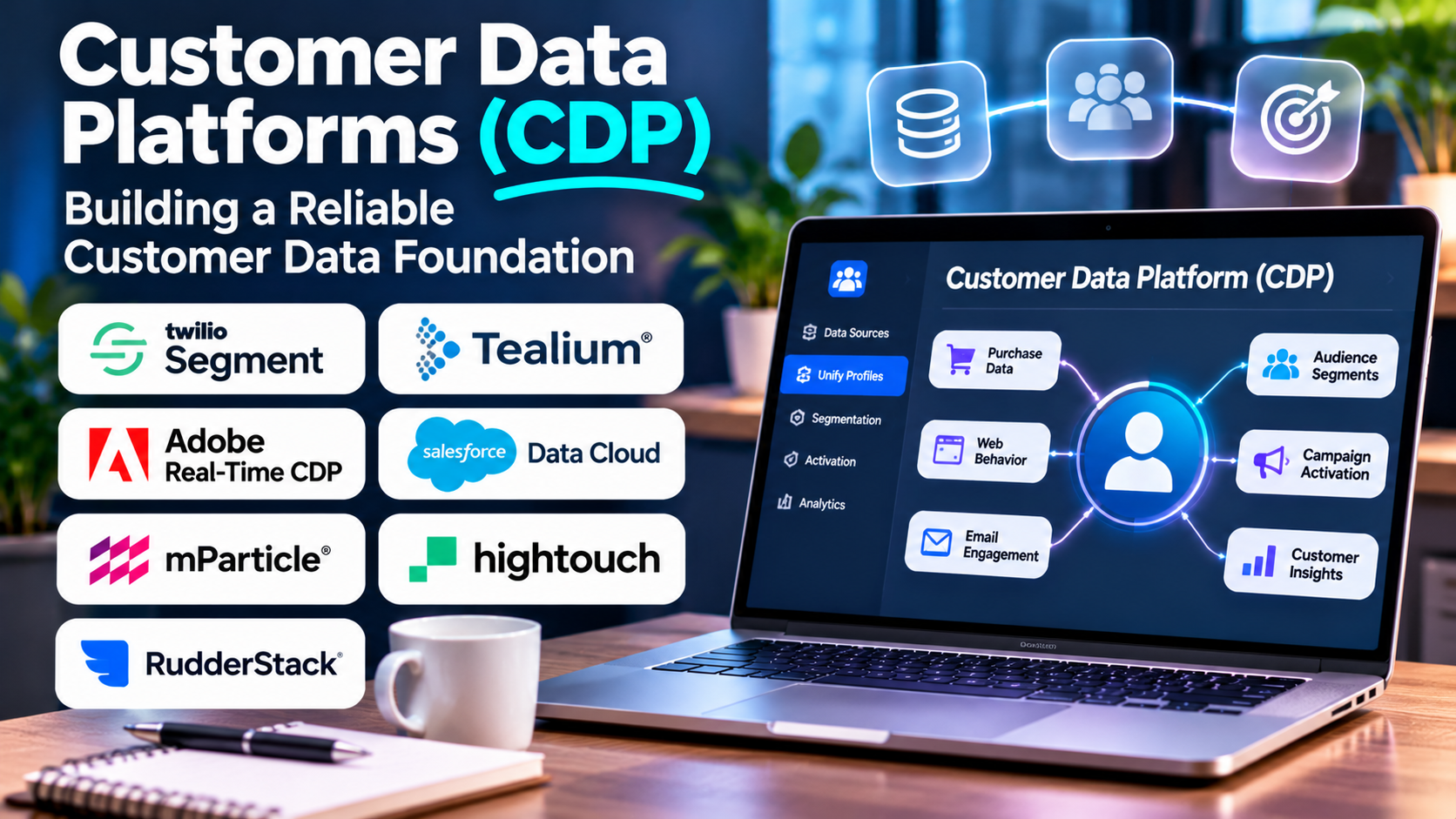
Customer information rarely lives in one place.
A business may store transactions in an ecommerce system, sales conversations in a CRM, website behavior in analytics software, and support interactions in another application.
Each system sees only part of the relationship.
Customer data platforms (CDPs) aim to connect these fragmented signals and make customer information available for analysis, segmentation, and activation.
But a CDP does not automatically solve inconsistent identities, poor data quality, or unclear governance.
The success of a CDP project depends as much on data architecture and organizational processes as on the software itself.
What Is a Customer Data Platform?
A customer data platform is software designed to collect and organize customer data from multiple sources and make it usable across business systems.
CDPs commonly support capabilities such as data ingestion, identity resolution, profile management, audience segmentation, and activation.
For example, a retailer may combine permitted purchase records, loyalty information, and website events to create useful customer segments.
Those segments may then be made available to marketing or customer engagement systems.
The exact architecture varies considerably between vendors.
Some CDPs maintain their own customer data storage.
Others operate more closely with existing cloud data warehouses.
CDP Versus CRM Versus Data Warehouse
These systems overlap, but they have different primary roles.
A CRM typically manages customer relationships, sales activities, and related business processes.
A data warehouse stores and organizes data for analysis and other workloads.
A CDP focuses on making customer information usable across connected systems, often including identity and audience activation.
A CDP may integrate with both a CRM and a warehouse.
It does not necessarily replace either one.
Two Important CDP Architectures
Packaged CDPs
Packaged CDPs typically provide an integrated environment for collecting data, managing profiles, creating audiences, and activating information.
They may be suitable for organizations that want business teams to work within a dedicated platform.
However, data duplication, vendor dependencies, and integration costs require attention.
Warehouse-native CDPs
Warehouse-native approaches use an existing data warehouse as a central foundation for customer data.
They can allow organizations to reuse established data models and governance processes.
However, they depend heavily on the quality and accessibility of the underlying warehouse.
Neither architecture is automatically superior.
The right approach depends on where trusted customer data already resides and how the organization intends to use it.
Customer Data Platforms to Evaluate
Twilio Segment
Twilio Segment provides customer data collection, integration, and related customer data capabilities.
It is relevant to organizations building standardized event collection and customer data workflows.
Suitable for: Businesses connecting digital customer interactions with downstream systems.
Considerations: Review identity requirements, destination integrations, and the cost of data collection at scale.
Tealium
Tealium provides customer data management capabilities, including event collection and audience-related workflows.
It is relevant to organizations managing customer data across numerous digital touchpoints.
Suitable for: Enterprises with complex data collection and activation requirements.
Considerations: Implementation planning and governance are important for large deployments.
Adobe Real-Time CDP
Adobe Real-Time CDP is part of Adobe’s customer experience technology ecosystem.
It supports customer profile and audience use cases within the broader Adobe environment.
Suitable for: Enterprises investing in Adobe experience technologies.
Considerations: Data architecture, product integration, and governance requirements should be carefully assessed.
Salesforce Data Cloud
Salesforce Data Cloud supports customer data unification and activation within the Salesforce ecosystem.
It is relevant to organizations connecting data with Salesforce business applications.
Suitable for: Businesses with substantial Salesforce infrastructure.
Considerations: Evaluate data consumption, integration requirements, and commercial cost drivers.
mParticle
mParticle provides customer data infrastructure focused on data collection, identity, and connected customer experiences.
Suitable for: Organizations managing customer information across digital products and channels.
Considerations: Review identity workflows, data quality controls, and integration coverage.
Hightouch
Hightouch provides warehouse-connected customer data activation and related CDP capabilities.
Its approach is relevant when organizations already maintain trusted customer data in a warehouse.
Suitable for: Data-driven businesses with established warehouse infrastructure.
Considerations: The quality of source models and warehouse operations directly affects the outcome.
RudderStack
RudderStack provides customer data infrastructure with an emphasis on data pipelines and warehouse-oriented architectures.
Suitable for: Engineering and data teams seeking greater control over customer event pipelines.
Considerations: Technical ownership and implementation requirements may be significant.
CDP Comparison by Architectural Fit
| Platform | General orientation | Important consideration |
|---|---|---|
| Twilio Segment | Customer data collection and connections | Event governance |
| Tealium | Enterprise customer data workflows | Integration complexity |
| Adobe Real-Time CDP | Experience ecosystem | Adobe dependencies |
| Salesforce Data Cloud | Salesforce-connected data | Consumption and integration |
| mParticle | Customer data infrastructure | Identity management |
| Hightouch | Warehouse-connected activation | Warehouse readiness |
| RudderStack | Data pipelines and warehouse workflows | Engineering ownership |
Identity Resolution: The Hardest Problem
Customer information may contain several identifiers.
A visitor might have an anonymous browser identifier, a registered account, and a loyalty number.
Identity resolution attempts to establish appropriate relationships between these records.
Some relationships are deterministic, such as matching a verified account identifier.
Others may involve probabilistic methods.
Incorrectly merging two people can cause serious privacy and data quality problems.
Failing to connect legitimate records can produce fragmented customer experiences.
Organizations should define acceptable matching methods, confidence requirements, and correction procedures.
Data Governance Must Come First
A CDP can make customer information easier to distribute.
That also increases the importance of controlling how data is used.
Governance should address:
- Data collection purposes
- Consent and preferences
- Retention periods
- Access permissions
- Sensitive information
- Data deletion and correction
- Destination restrictions
- Regional processing requirements
A CDP vendor’s security capabilities do not eliminate the organization’s responsibility to configure and operate the system appropriately.
The Hidden Costs of CDP Projects
Software licensing is only one component.
Additional costs may include event collection, profile processing, storage, integrations, implementation services, and ongoing administration.
Warehouse-native architectures may introduce additional warehouse compute and data transformation costs.
Organizations should also consider the labor required to maintain identity rules, event definitions, and audience logic.
A CDP without clear ownership can become another fragmented data system.
How to Evaluate a CDP
Begin with two or three practical customer data use cases.
For example, a business may want to suppress recent purchasers from acquisition campaigns or improve onboarding for newly registered customers.
Map the data sources required for each use case.
Determine how identities will be connected.
Define the privacy and governance requirements.
Then evaluate whether the proposed CDP can deliver the required data accurately and reliably.
A limited proof of concept should demonstrate the complete flow from source collection to downstream activation.
Do not evaluate only the quality of the platform’s dashboard.
Common CDP Implementation Mistakes
Buying before defining use cases: A broad platform purchase may produce little value without clear objectives.
Assuming identity resolution is automatic: Customer identifiers require careful modeling.
Ignoring source data quality: A CDP cannot reliably repair every upstream inconsistency.
Overcollecting information: More data increases complexity and privacy exposure.
Underestimating integration work: Connecting systems is often a continuing operational responsibility.
Frequently Asked Questions
Is a CDP necessary for every business?
No. Organizations with limited customer data sources or simple workflows may not need a dedicated CDP.
Can a CDP replace a CRM?
Usually not completely. CRMs and CDPs support different business processes, although some platforms offer overlapping capabilities.
Does a CDP automatically ensure privacy compliance?
No. Compliance depends on data practices, configuration, contracts, and applicable legal requirements.
Conclusion
A customer data platform should make customer information more trustworthy and useful.
The strongest CDP strategy starts with data quality, identity rules, governance, and specific business outcomes.
Choose the architecture that fits your existing infrastructure and organizational capabilities.
A smaller, well-governed customer data foundation can deliver more value than an ambitious platform that no one can reliably maintain.