Organizations rarely replace an Enterprise Content Management (ECM) system because it lacks features. They replace it because the platform has calcified into an unmanageable repository: terabytes of duplicate documents, inconsistent metadata taxonomies that users bypass, compliance rules applied after the fact, and integration costs that scale faster than operational volume.
The ECM market has fundamentally shifted away from monolithic, all-in-one document repositories toward modular content services architectures. Today’s procurement dilemma is no longer whether a platform can ingest scanned PDFs or maintain a version history. The real problem is governing unstructured data across hybrid workplace ecosystems without crippling daily productivity or building brittle point-to-point integrations.
Choosing the right platform requires cutting through marketing rebrands and evaluating how these systems manage ingestion, metadata automation, retention enforcement, security boundaries, and total cost of ownership.
Defining the Boundaries: ECM vs. Modern Content Services
Historically, traditional ECM promised a centralized, single-source-of-truth repository designed to ingest, process, store, and preserve every document an organization produced. In practice, centralized ECM initiatives often collided with real-world employee workflows. When filing a document requires populating ten manual metadata fields, workers default to local drives, desktop folders, or unsanctioned cloud storage.
The contemporary approach treats content management as a distributed fabric rather than a monolithic warehouse. Modern platforms acknowledge that unstructured data lives across ERPs, CRMs, chat applications, and customer portals.
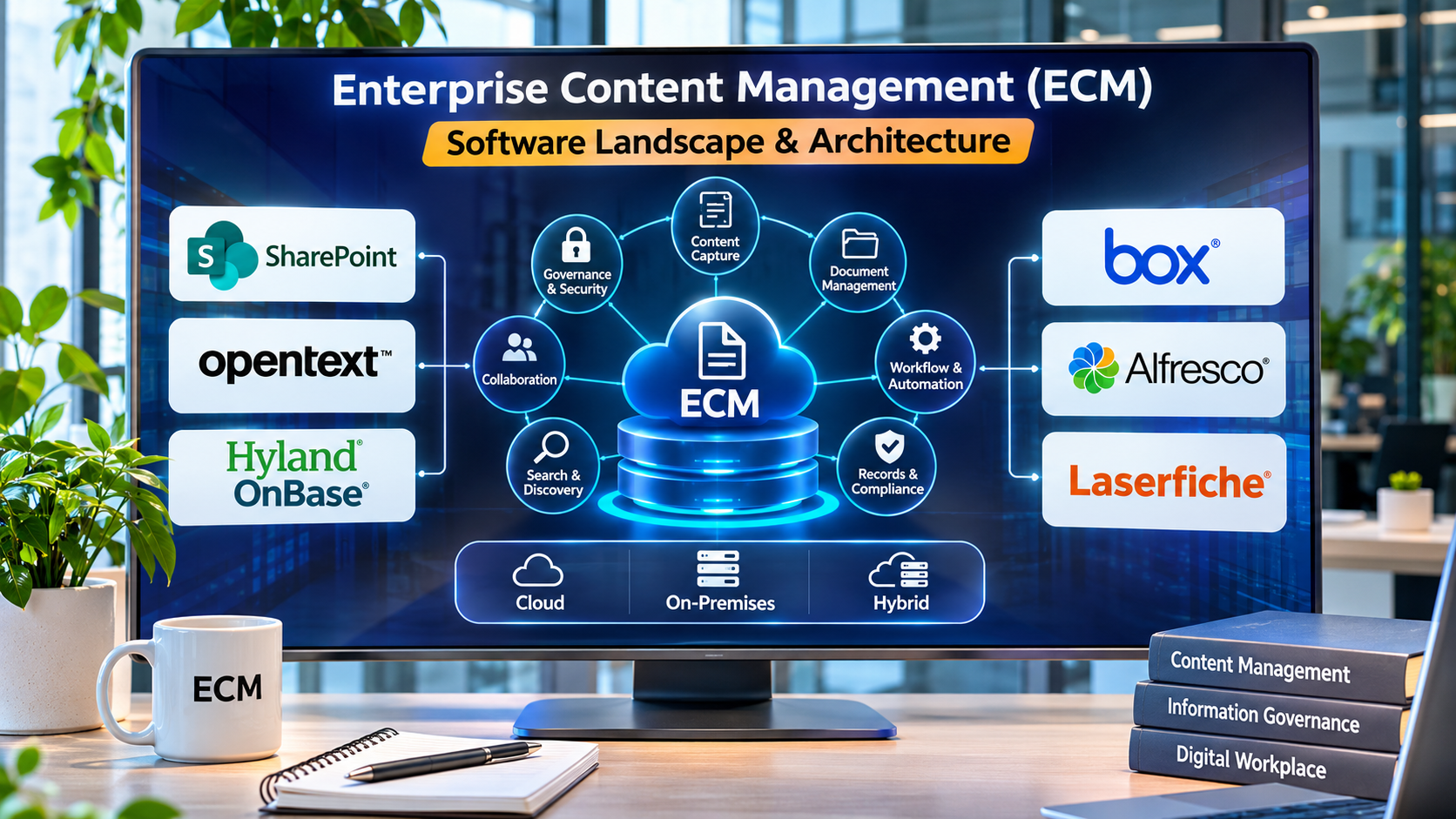
A capable platform must bridge five foundational pillars:
- Ingestion and Capture: Converting inbound streams (scans, email attachments, EDI files, digital forms) into structured formats using optical character recognition (OCR) and automated classification.
- Contextual Metadata: Attaching semantic, operational, and regulatory tags programmatically rather than relying purely on manual user input.
- Information Governance: Applying retention schedules, records disposition rules, defensible deletion, and immutable audit logs that satisfy sector-specific mandates.
- Process Orchestration: Executing document-centric workflows such as invoice matching, contract approvals, policy sign-offs, and claims processing.
- Secure Interoperability: Exposing robust REST or GraphQL APIs to feed line-of-business applications without requiring direct repository access.
Core Evaluation Criteria for Enterprise Buyers
Software selection should not begin with vendor feature lists. It should begin with an audit of an organization’s specific technical constraints, governance obligations, and user collaboration habits.
1. Ingestion Latency and Metadata Automation
Static search based solely on manual folder paths is obsolete. Systems must be evaluated on how reliably they extract data from semi-structured documents (such as invoices, bills of lading, and identity records). Look for machine learning capabilities that infer document types and assign metadata based on content context, reducing user friction.
2. Information Governance and Legal Hold
For regulated industries, document lifecycle management is a legal liability shield. Platforms must support:
- Event-based retention schedules (e.g., retain for seven years after contract termination, not creation date).
- Defensible destruction with non-repudiation audit trails.
- Granular legal holds that freeze document deletion across active workflows and backup replicas without disrupting normal viewing.
3. Integration Footprint and API Maturity
Content silos form when an ECM platform cannot embed cleanly into daily tools. If customer support teams use Salesforce or operations teams use SAP, documents generated in those systems must archive into the ECM transparently. Evaluate whether the vendor offers pre-built, supported connectors or whether custom integration requires complex middleware.
4. Storage Architecture and Hydration Costs
Cloud-native ECM platforms reduce infrastructure overhead, but retrieval patterns determine long-term operational costs. Evaluate whether the platform supports automated tiering from hot storage to cold or archival storage (such as AWS S3 Glacier or Azure Archive) and whether egress or hydration fees apply during routine e-discovery or compliance audits.
Analysis of Leading ECM and Content Service Platforms
The market contains mature enterprise suites, collaborative cloud-native environments, open platforms, and specialized workflow systems. The platforms examined below represent distinct, defensible approaches to solving enterprise content challenges.
Microsoft SharePoint & Microsoft 365: The Default Workspace Layer
Microsoft SharePoint is ubiquitous. Many organizations default to it because licensing is frequently bundled with broader enterprise productivity suites.
Operational Strengths
- Native User Familiarity: Employees interact with SharePoint directly through Word, Excel, Teams, and Outlook, minimizing onboarding friction and reducing shadow IT.
- Deep Identity Integration: Microsoft Entra ID integration enables granular, role-based access controls and conditional access policies out of the box.
- Automated Processing Capabilities: Using integrated tools like Microsoft Syntex and Power Automate, teams can train lightweight document models for automated form processing without writing custom scripts.
Constraints and Trade-Offs
SharePoint excels as an internal collaboration workspace, but using it as a strict records management repository for complex, multi-million-item archives can strain its capabilities. List view thresholds, complex site-collection hierarchies, and nuanced external-sharing permissions can create governance vulnerabilities. True defensible records management and event-driven retention often require higher-tier enterprise governance licenses and dedicated administrative oversight.
OpenText Content Cloud: The Heavyweight Enterprise Engine
OpenText represents the traditional bedrock of large-scale enterprise content management, powering complex regulatory environments across energy, financial services, life sciences, and the public sector.
Operational Strengths
- Massive Ingestion Capacity: Built to process millions of transactions per day, OpenText easily handles immense transaction volumes, complex CAD file management, and deep archival workflows.
- Deep ERP and CRM Integrations: OpenText’s pre-built integrations into SAP, Oracle, and Salesforce remain standard benchmarks for operational continuity. Documents attached to an ERP record live inside a governed repository without duplicating data.
- Rigorous Records Compliance: Offers unmatched compliance depth, including verified certifications across global government and financial standards, strict chain-of-custody tracking, and defensible disposition workflows.
Constraints and Trade-Offs
OpenText deployments are resource-intensive. Upgrades, system customizations, and ongoing administrative maintenance typically require specialized, expensive consultancy. The user interface across legacy modules can feel disjointed compared to modern SaaS platforms, leading to lower organic user adoption if not carefully deployed.
Hyland OnBase: The Transactional and Departmental Specialist
Hyland OnBase approaches content management from a process-first perspective. It is designed to combine workflow automation, case management, and document storage into a unified platform.
Operational Strengths
- Pre-Configured Departmental Solutions: Hyland provides deeply specialized solutions for healthcare (integrating with electronic health records like Epic), insurance claims processing, and higher education admissions.
- Cohesive Workflow Engine: Unlike platforms that treat workflow as an afterthought, OnBase ties document ingestion directly to transactional decisions, conditional routing, and automated approvals.
- Consolidated Case Management: Excels at handling unstructured case files where documents, notes, communications, and audit tasks revolve around a single business event.
Constraints and Trade-Offs
While powerful in regulated back-office environments, OnBase can feel rigid for informal, real-time collaboration. Integrating with bleeding-edge developer frameworks often requires navigating specialized proprietary configurations rather than standard open APIs.
Box Content Cloud: The Cloud-Native Collaboration Standard
Box transformed from a simple cloud-storage utility into an enterprise-grade content management platform focused on secure collaboration, workflow automation, and ecosystem integration.
Operational Strengths
- Frictionless External Collaboration: Sharing sensitive, governed files with external partners, contractors, and clients is far simpler to administer than in traditional on-premises ECM platforms.
- Broad Application Neutrality: Box acts as a neutral content layer, offering deep, polished integrations into Google Workspace, Salesforce, Slack, Microsoft 365, and Zoom simultaneously.
- Security and Sovereign Data Controls: Offerings like Box KeySafe (customer-managed encryption keys) and Box Zones (regional data residency compliance) provide enterprise security without on-premises hardware.
Constraints and Trade-Offs
Organizations with massive, high-volume automated ingestion pipelines (such as industrial optical scanning units processing hundreds of thousands of mail pieces daily) may find Box’s API rate limits and per-seat subscription models cost-prohibitive compared to dedicated ingestion systems.
Alfresco (by Hyland): The Extensible, Open-Source Architecture
Alfresco provides an open-source, modular content repository built for engineering teams that require complete architectural control and customization flexibility.
Operational Strengths
- Custom Extensibility: Because it is built on open standards (with support for CMIS—Content Management Interoperability Services), developers can customize data models, actions, and user interfaces down to the source level.
- Flexible Deployment Models: Alfresco runs reliably across bare-metal servers, private clouds, Docker containers, and managed Kubernetes clusters, preventing vendor lock-in.
- Active Community and Ecosystem: The availability of both a free Community Edition and a fully supported Enterprise Edition makes it attractive for research facilities, universities, and technical teams with internal development resources.
Constraints and Trade-Offs
The platform demands competent in-house software engineering and DevOps expertise. Without dedicated architectural planning, custom Alfresco implementations can become fragile and difficult to patch across major version upgrades.
Laserfiche: Agile Process Automation for Mid-Market and Public Sector
Laserfiche combines electronic document capture, form generation, and business process automation into an accessible package, widely favored by municipal governments, educational bodies, and mid-market financial firms.
Operational Strengths
- Accessible Low-Code/No-Code Workflows: Business analysts and department leads can design, test, and deploy complex approval chains using a visual canvas without writing application code.
- Integrated Digital Forms: Replaces physical document friction by generating user-friendly web forms that automatically archive submissions into structured, index-tagged repository paths.
- Balanced Deployment Architecture: Available both as a managed SaaS solution and as a mature on-premises installation, allowing organizations with air-gapped or localized requirements to maintain absolute custody.
Constraints and Trade-Offs
For Fortune 100 enterprises operating globally across tens of thousands of simultaneous users and multi-terabyte data streams, Laserfiche’s processing ceilings and global multi-region replication options may prove less expansive than OpenText or Microsoft 365.
Architectural Comparison: Capabilities and Operational Fit
The following matrix highlights the operational differences across leading platforms to guide procurement evaluations:
| Platform | Primary Deployment Model | Architectural Focus | Best-Fit Operational Scenario | Key Operational Trade-off |
| Microsoft SharePoint | Cloud SaaS (M365) / Hybrid | Collaborative content services & workspace management | Organizations embedded in Microsoft tools seeking unified document workflows | Retention rules and audit controls require strict governance to avoid sprawl |
| OpenText Content Cloud | Hybrid / Private Cloud / Managed | High-scale records preservation & deep ERP integration | Heavily regulated multinational enterprises running core operations on SAP or Oracle | High implementation complexity; requires specialized professional services |
| Hyland OnBase | Cloud SaaS / On-Premises | Transactional workflow & case management | Healthcare networks, insurance claims units, and public institutions | Rigid interface for open, exploratory team collaboration |
| Box Content Cloud | Cloud-Native SaaS | Secure collaboration & multi-ecosystem integration | Distributed modern enterprises prioritizing secure partner sharing and ease of use | Transactional scanning pipelines can trigger API thresholds or elevated seat costs |
| Alfresco | Containerized / Self-Hosted / Hybrid | Developer-extensible open repository | Software-driven organizations demanding custom UI, data sovereignty, and open APIs | Requires internal DevOps and Java/Spring developer talent to maintain |
| Laserfiche | Cloud SaaS / On-Premises | Visual process automation & digital forms | Mid-market enterprises, local governments, and financial firms seeking low-code agility | Scalability ceilings in hyper-scale global enterprise environments |
Technical Trade-Offs: Cloud-Native vs. Hybrid vs. On-Premises
Choosing an architectural deployment model is primarily a risk management and cost predictability decision.
The Cloud-Native Model
SaaS offerings eliminate the overhead of managing database clusters, SAN storage allocations, and continuous vulnerability patching. However, organizations in regions with strict data sovereignty mandates must verify that cloud tenants guarantee storage residency at rest and in transit. Furthermore, recurring subscription costs must be measured against multi-year license amortizations.
The Hybrid Reality
Most large enterprises operate in a hybrid reality. Active, daily collaboration occurs within cloud-hosted platforms, while sensitive records, historical archives, and specialized file types (like seismic imaging or patent schematics) remain in secure, private data centers. The challenge lies in maintaining a synchronized metadata layer across both environments so that e-discovery searches can query the entire corporate corpus through a single endpoint.
Implementation Pitfalls: Why ECM Deployments Stall
Even the best-engineered platform will fail if an organization makes common structural mistakes during implementation:
- Replicating Physical Folder Hierarchies Digitally: Moving a twenty-year-old network drive directly into a modern content platform simply preserves chaos in the cloud. Successful implementations abandon complex, nested directory trees in favor of flat structures governed by dynamic metadata views.
- Over-Engineering Metadata Schemas: Forcing end users to complete dozens of metadata fields before a document can be saved guarantees evasion. Limit required manual fields to two or three critical attributes and use background automation to populate file origins, creation dates, and departmental contexts.
- Failing to Budget for Data Cleanse and Migration: Migrating legacy content without a defensible triage plan inflates licensing costs and degrades search relevance. Organizations must execute a disciplined ROT (Redundant, Obsolete, Trivial) audit before migrating legacy assets to their new platform.
- Ignoring Egress and Ingestion Throttling: Cloud-to-cloud migrations frequently hit undocumented API throttling limits. Moving hundreds of gigabytes of small files (like PDFs and scans) involves high API call overhead that can extend migration windows by weeks if not planned with multithreaded tooling.
Strategic Selection Framework
To arrive at a defensible procurement decision, map your primary organizational constraints against this phased evaluation process:
Identify the Core Content Driver: If your primary challenge is unstructured employee collaboration, expand your existing investments in Microsoft 365 or deploy Box to create a unified, easily adopted layer. If your core problem is transactional claims processing, student records, or accounts payable workflows, prioritize process-centric tools like Hyland OnBase or Laserfiche.
Evaluate the Core Application Hub: Choose the platform that integrates most naturally with your primary line-of-business software. If your business runs on SAP, OpenText’s integration library provides immediate governance advantages. If your operations run on custom internal software, an API-first platform like Alfresco will reduce integration friction.
Conduct a Real-World Ingestion Pilot: Never purchase a content platform based solely on a vendor’s pre-rendered demo. Run a focused pilot using your organization’s actual documents: poor-quality scans, mixed-format invoices, and complex contracts. Measure classification accuracy, retrieval speeds, and user friction directly.