A customer visits a company’s website, reads a product guide, opens an email, and later returns through a mobile application.
Each interaction may be managed by a different system.
The website uses a CMS. Marketing campaigns run through an automation platform. Customer records sit in a CRM. Analytics tools collect behavioral information.
A Digital Experience Platform (DXP) aims to help organizations coordinate these fragmented experiences.
But a DXP is not simply a larger CMS. It represents a broader approach to managing digital interactions, and the complexity of that approach makes careful evaluation essential.
What Is a Digital Experience Platform?
A Digital Experience Platform is a collection of capabilities used to create, deliver, manage, and optimize digital experiences across customer or employee touchpoints.
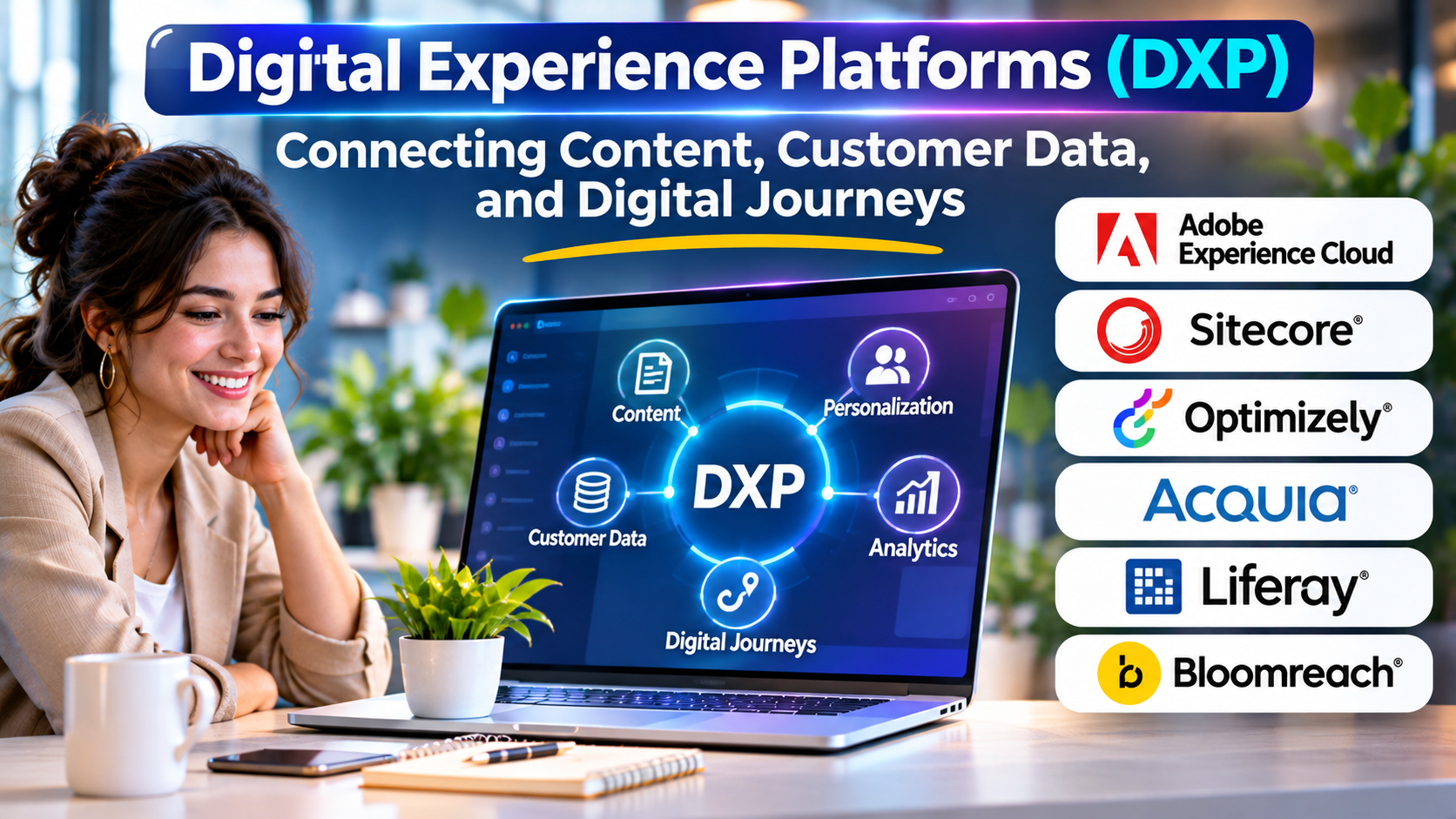
Depending on the vendor, these capabilities may include content management, personalization, experimentation, analytics, search, asset management, and integration with customer data systems.
Some DXPs are integrated suites. Others are modular platforms designed to work with separate services.
There is no universal feature set shared by every product marketed as a DXP.
That makes capability-level evaluation more useful than relying on the category label alone.
CMS vs DXP: Understanding the Difference
A CMS primarily manages digital content.
A DXP addresses a broader set of experience-related requirements, potentially including how content changes according to audience, context, and customer behavior.
For example, a CMS may publish a product page.
A DXP implementation might combine that page with audience segmentation, experimentation, customer journey data, and personalized content delivery.
However, these capabilities may come from separate modules or integrated third-party services.
A DXP should therefore be evaluated as an operational architecture rather than assumed to be one complete application.
Major Digital Experience Platforms
Adobe Experience Cloud
Adobe Experience Cloud brings together products for content, analytics, personalization, and customer experience management.
It is relevant to enterprises with substantial digital marketing operations and integration requirements.
Buyers should assess individual products and their commercial arrangements rather than assuming every capability is included in a single package.
Sitecore
Sitecore offers digital experience technologies covering content and related experience capabilities.
Its portfolio is relevant to organizations seeking enterprise content management and personalized digital experiences.
Implementation choices depend on the specific Sitecore products selected and their integration model.
Optimizely
Optimizely provides products associated with content management, experimentation, and digital experience optimization.
It is particularly relevant when teams want to connect content operations with testing and optimization.
Organizations should evaluate the actual modules required for their workflows.
Acquia
Acquia provides digital experience and marketing-related services with strong connections to the Drupal ecosystem.
It may be relevant to organizations seeking enterprise capabilities around Drupal-based digital experiences.
Liferay
Liferay offers a digital experience platform used for websites, portals, and connected business experiences.
It deserves consideration for organizations building customer, partner, or employee portals with substantial integration requirements.
Bloomreach
Bloomreach focuses on commerce-oriented digital experience capabilities, including discovery and personalization-related products.
It is relevant to businesses where product discovery and commercial customer journeys are central priorities.
Two Ways to Build a DXP
Integrated suite
An integrated suite brings several capabilities under one vendor ecosystem.
Potential advantages include coordinated administration, shared product conventions, and vendor-supported integrations.
The limitations may include higher switching costs, commercial dependencies, and implementation complexity.
Composable architecture
A composable approach combines specialized services through APIs and integration layers.
An organization might select a headless CMS, customer data platform, search engine, experimentation service, and analytics solution independently.
This offers flexibility but requires architectural coordination.
The important question is whether the organization has the engineering and operational capacity to manage those relationships.
Personalization Requires More Than Software
Personalization is frequently presented as a major DXP benefit.
Yet effective personalization depends on reliable data, meaningful audience definitions, consent practices, and measurable business objectives.
A platform cannot compensate for inconsistent customer identifiers or poorly designed content.
Organizations should begin with a narrow use case, such as showing relevant documentation to existing customers or adjusting content for clearly defined audience segments.
They should then measure whether the experience improves outcomes.
Personalization without evaluation can add complexity without delivering value.
Customer Data and Privacy
Digital experience platforms may process behavioral information, account details, preferences, and other customer data.
Organizations need to understand where that data originates, how it is combined, and which systems can access it.
Privacy obligations differ across jurisdictions.
Consent management, data minimization, retention, and access controls should be considered during architecture design rather than added after deployment.
A vendor’s security documentation is useful, but compliance remains dependent on the organization’s implementation and responsibilities.
What Makes DXP Projects Expensive?
DXP costs often extend beyond licensing.
Major cost drivers include:
- Integration with existing enterprise applications.
- Content migration.
- Customer data preparation.
- Frontend development.
- Personalization design.
- Analytics implementation.
- Staff training.
- Ongoing optimization.
- Support and platform administration.
A platform with many capabilities may still deliver poor value if the organization cannot use them effectively.
How to Evaluate a DXP
Start with three specific customer journeys.
For each journey, identify the systems involved, the information required, and the business outcome being improved.
Then evaluate whether a candidate platform can support those journeys with manageable integration effort.
Important criteria include content workflows, interoperability, identity integration, data governance, performance, analytics, experimentation, and operational support.
A proof of concept should demonstrate a complete journey rather than isolated features.
For example, testing personalization without validating the customer data feeding it provides an incomplete picture.
Common Implementation Mistakes
One mistake is buying an extensive suite before defining the business problem.
Another is treating personalization as a substitute for useful content and accessible design.
A third is underestimating integration work between customer data, commerce, marketing, and content systems.
Organizations also sometimes measure platform adoption rather than customer outcomes.
A successful implementation should improve something meaningful, such as task completion, content effectiveness, customer service efficiency, or conversion quality.
Frequently Asked Questions
Is a DXP the same as a CMS?
No. A CMS focuses primarily on content management. A DXP may combine content with personalization, analytics, experimentation, and other experience-related capabilities.
Do small businesses need a DXP?
Often not. Smaller organizations may achieve their goals with a CMS and a limited set of integrated tools.
What is a composable DXP?
It is an architecture that combines specialized digital experience services through integrations rather than relying entirely on one integrated suite.
Does a DXP automatically improve customer experience?
No. Outcomes depend on implementation quality, customer understanding, content, data, and continuous evaluation.
Final Perspective
A Digital Experience Platform should help an organization coordinate digital interactions that would otherwise remain disconnected.
The value lies in better customer journeys, more effective content operations, and measurable improvements—not in accumulating the largest possible collection of marketing technologies.
Organizations should invest in DXP capabilities only when the operational benefits justify the integration, governance, and maintenance responsibilities.