A support agent solves a difficult customer problem. The solution works, but it remains buried in a ticket.
Three weeks later, another agent faces the same issue and begins investigating from the beginning.
This is not simply a documentation problem. It is a failure to turn individual experience into reusable organizational knowledge.
Knowledge base software can help prevent that repetition. But creating a searchable collection of articles is only the beginning.
A useful knowledge base needs clear ownership, trustworthy information, and a process for keeping answers current.
What Is Knowledge Base Software?
Knowledge base software helps organizations create, organize, publish, and maintain information that people need to complete tasks or solve problems.
It may support internal employees, external customers, technical users, or a combination of audiences.
Common capabilities include article editing, search, categories, permissions, feedback, revision history, and publishing workflows.
Some platforms are closely connected to customer support systems. Others function as broader internal knowledge repositories.
The right choice depends on who needs the information and how they expect to find it.
Internal and External Knowledge Bases
An internal knowledge base supports employees.
Typical content includes onboarding instructions, operational procedures, troubleshooting guides, policies, and technical runbooks.
An external knowledge base helps customers or partners solve problems independently.
It may contain setup guides, product instructions, frequently asked questions, and troubleshooting articles.
These audiences have different needs.
Internal documentation may require detailed operational information and restricted access.
Customer-facing documentation needs clarity, accessible navigation, and language that does not assume internal knowledge.
Some platforms support both audiences, but permission boundaries and publishing processes must be designed carefully.
Knowledge Base Software Options
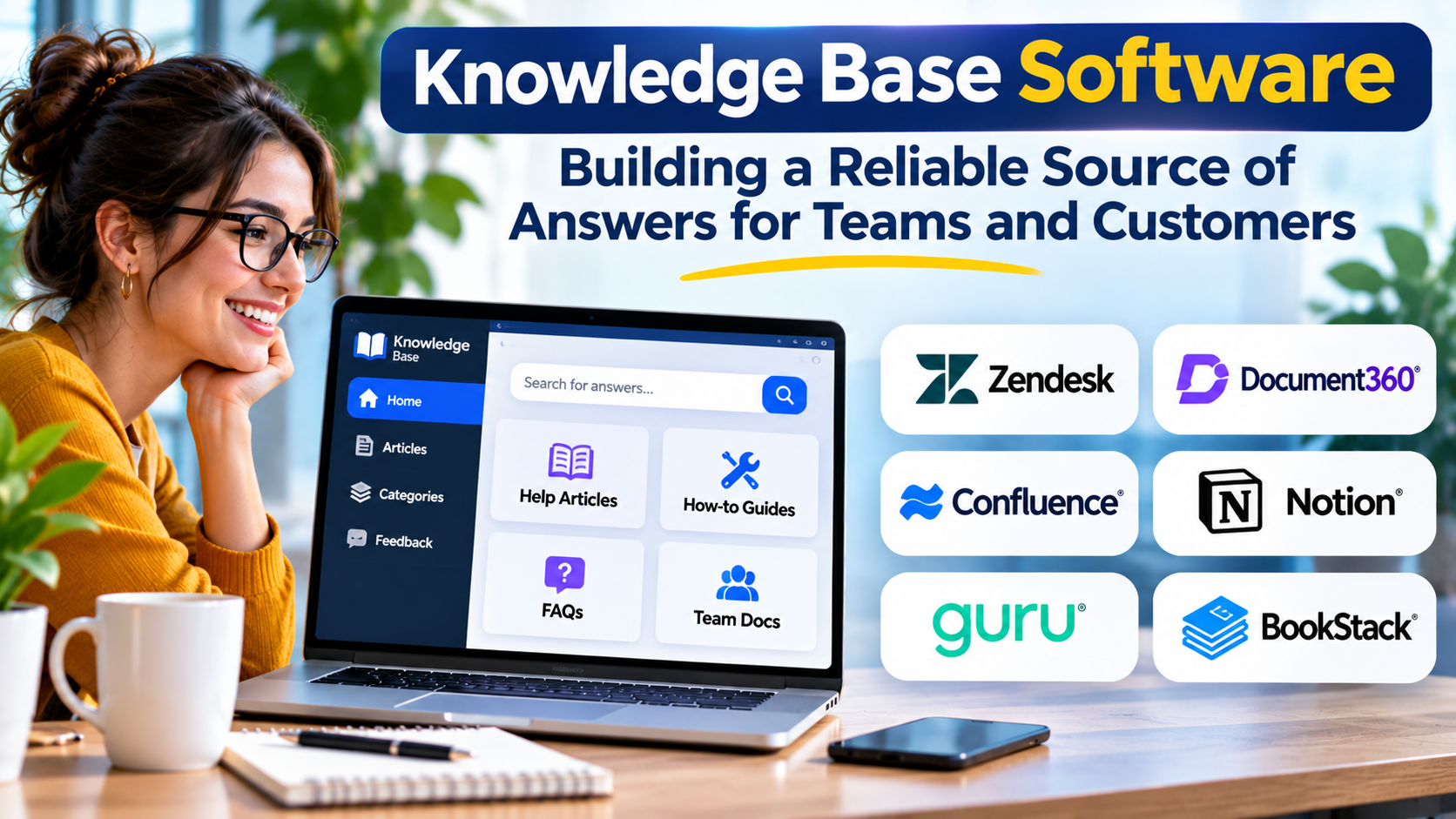
Zendesk Guide
Zendesk provides knowledge management capabilities within its customer service ecosystem.
It is relevant to organizations that want help-center content connected to support operations.
Buyers should evaluate how article management, customer self-service, and support workflows interact within the relevant subscription.
Document360
Document360 focuses on knowledge base creation and documentation management.
It is worth evaluating for organizations producing structured customer documentation or internal knowledge resources.
Important considerations include editing workflows, permissions, versioning, search, and publishing requirements.
Confluence
Atlassian Confluence supports collaborative documentation and knowledge sharing.
It is especially relevant to teams already using Atlassian products.
Its flexibility can support many documentation styles, although information architecture and governance become important as content grows.
Notion
Notion combines documents, databases, and collaborative workspaces.
It can serve as an internal knowledge hub for teams that want flexible organization and collaborative editing.
Organizations should evaluate permissions, publishing needs, and content governance before treating it as a formal enterprise knowledge system.
Guru
Guru focuses on organizational knowledge access and management.
It is relevant to teams seeking to make internal answers available within everyday work processes.
Evaluation should consider how information is verified, maintained, and delivered to users.
BookStack
BookStack is an open-source documentation platform organized around books, chapters, and pages.
It can suit organizations seeking a self-hosted knowledge repository with a straightforward structure.
Self-hosting provides control but requires maintenance, backups, and security administration.
Search Quality Is More Important Than Article Count
A knowledge base containing thousands of articles can still be ineffective if users cannot find the correct answer.
Search quality depends on several factors.
Content must use terminology that readers recognize.
Titles should describe actual problems.
Related topics should be connected.
Outdated articles should not compete with current instructions.
Search analytics can help reveal unsuccessful queries and missing information.
A useful evaluation exercise is to ask employees or customers to find answers using their own language rather than the terminology chosen by documentation authors.
The Importance of Knowledge Ownership
Documentation becomes unreliable when nobody is responsible for maintaining it.
Every important article should have a clear owner or responsible team.
Organizations can establish review triggers based on product releases, policy changes, recurring support incidents, or scheduled maintenance cycles.
Reviewing every article at the same frequency is rarely efficient.
High-risk operational procedures may require frequent validation, while stable reference material may change less often.
Ownership should reflect the consequences of outdated information.
Writing Articles People Can Actually Use
Good knowledge articles should answer a specific user need.
A troubleshooting article might include:
- The problem or symptom.
- Conditions under which it occurs.
- Required permissions or prerequisites.
- Steps to resolve it.
- Expected results.
- Escalation guidance if the steps fail.
Avoid vague titles such as “Important System Information.”
A title like “Resolve a Failed Two-Factor Authentication Login” tells readers what problem the article addresses.
Clarity is more valuable than unnecessary technical detail.
Measuring Knowledge Base Effectiveness
Page views alone are a weak measure of success.
A heavily visited article may be useful, but it may also indicate a recurring product problem.
More meaningful indicators include:
- Successful search outcomes.
- Article feedback.
- Repeated support questions.
- Time required to find an answer.
- Documentation-related escalations.
- Content freshness.
- Support cases resolved through self-service.
Organizations should interpret these metrics together rather than optimizing one number.
AI-Powered Knowledge Search
Some knowledge platforms use AI to summarize information or answer questions from existing content.
This can improve access when users ask questions in natural language.
However, AI-generated answers introduce additional risks.
A system may combine unrelated information, overlook permission boundaries, or produce an answer unsupported by its sources.
Organizations should evaluate whether answers provide traceable references and whether restricted information remains protected.
AI can improve knowledge discovery, but it cannot replace accurate source documentation.
Knowledge Base vs Wiki
A wiki emphasizes collaborative editing and interconnected information.
A knowledge base generally emphasizes dependable answers and structured access to information.
The categories overlap considerably.
A wiki can serve as a knowledge base when content ownership, search, and review practices are effective.
The distinction is more about operating model than software labels.
Frequently Asked Questions
What is the main purpose of knowledge base software?
Its purpose is to make useful organizational information easier to create, maintain, find, and reuse.
Can a knowledge base reduce support tickets?
It can help users resolve common issues independently, although results depend on content quality and discoverability.
Is a knowledge base suitable for small teams?
Yes. Even a small collection of well-maintained procedures can reduce repeated questions and onboarding effort.
Should internal and customer knowledge use the same platform?
That depends on access requirements, publishing workflows, and the platform’s ability to separate audiences securely.
Final Perspective
A successful knowledge base is not measured by how much information it contains.
It is measured by whether people can find accurate answers when they need them.
The best software supports that goal through effective search, clear organization, practical editing workflows, and manageable governance.
Without ownership and maintenance, even an advanced knowledge platform eventually becomes another place where outdated information accumulates.