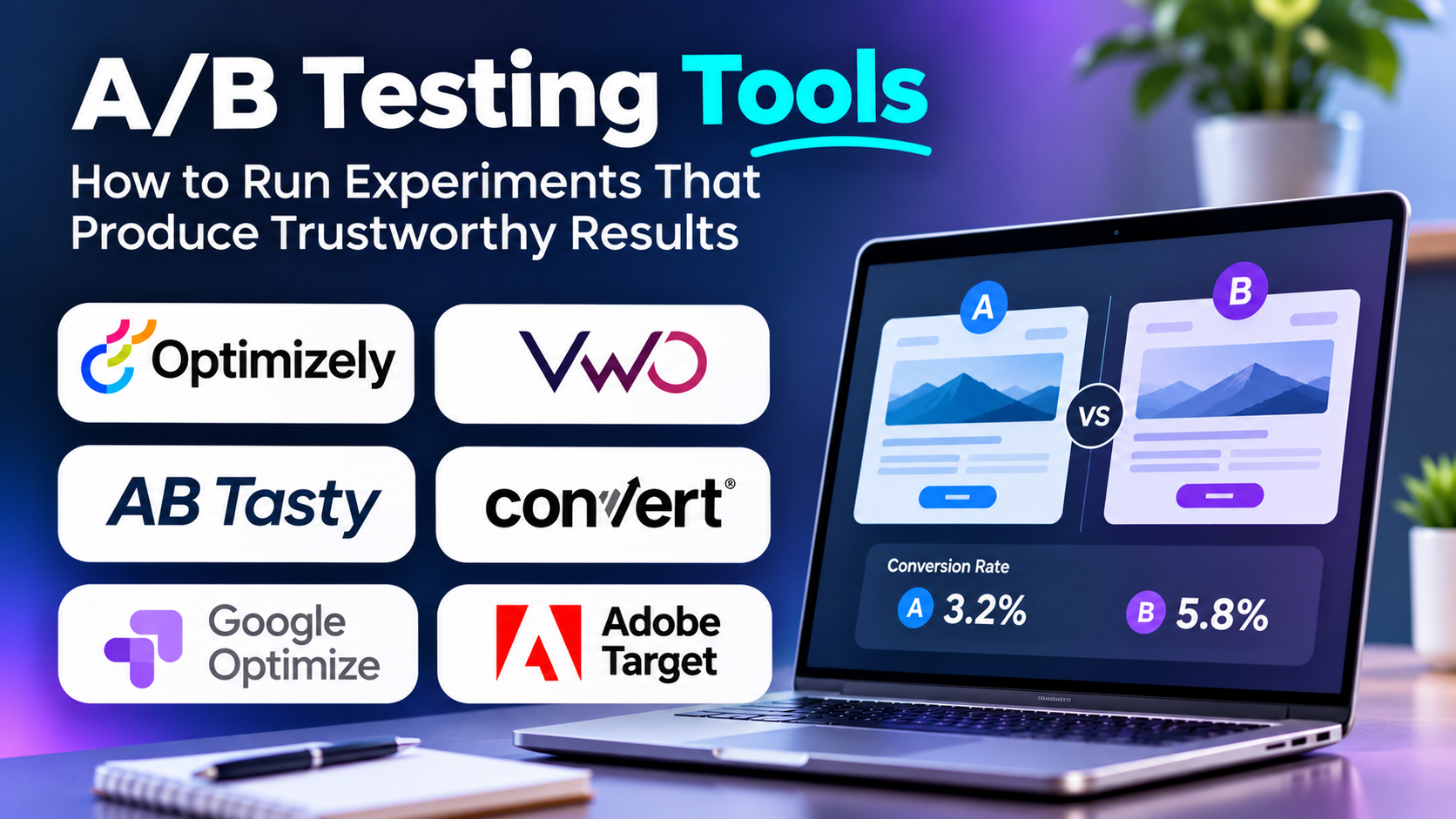
Changing a button color, rewriting a headline, or redesigning a checkout page may improve conversion rates. It may also make no meaningful difference—or even reduce performance.
Without a controlled experiment, teams can easily mistake ordinary variation for a successful improvement.
A/B testing tools help organizations compare alternative experiences and measure their effects. However, software alone cannot guarantee reliable conclusions.
The most important decisions involve experiment design, statistical interpretation, technical implementation, and the quality of the metrics being measured.
What Is A/B Testing?
A/B testing is a controlled experiment that compares two or more versions of an experience.
Participants are assigned to different variations, and their outcomes are measured.
For example, an online store might compare two checkout designs.
Version A uses the existing checkout. Version B introduces a simplified address form.
The experiment measures whether the new design changes purchase completion rates.
Random assignment helps reduce systematic differences between groups, making causal interpretation more credible when the experiment is implemented correctly.
A/B Testing Is More Than a Conversion Tool
Experimentation can support decisions across product development, marketing, and user experience.
Common applications include:
- Landing-page design
- Checkout optimization
- Subscription onboarding
- Search and navigation
- Pricing presentation
- Email campaigns
- Feature adoption
- Recommendation interfaces
Not every change should be evaluated solely through immediate conversion.
A new onboarding flow might improve initial activation while harming longer-term retention.
Teams should select primary and supporting metrics that reflect the actual business objective.
A/B Testing Platforms to Evaluate
Optimizely
Optimizely offers experimentation capabilities for digital experiences and product development.
It is relevant to organizations with established experimentation programs and multiple teams conducting tests.
Strengths: Experimentation workflows and enterprise-oriented capabilities.
Considerations: Product selection, implementation, and commercial requirements deserve careful evaluation.
VWO
VWO provides website experimentation and conversion optimization capabilities.
Its offering is relevant to marketing and optimization teams working on digital experiences.
Strengths: Website experimentation workflows and associated optimization functionality.
Considerations: Confirm which capabilities are included in the relevant product and plan.
AB Tasty
AB Tasty focuses on experimentation and digital experience optimization.
It can be considered by organizations managing customer-facing website and application changes.
Strengths: Experience optimization and experimentation capabilities.
Considerations: Evaluate technical compatibility and the level of engineering support required.
Statsig
Statsig combines experimentation with feature management and product-oriented measurement capabilities.
Its approach is especially relevant when experiments are closely connected to software releases.
Strengths: Developer-oriented experimentation and product delivery workflows.
Considerations: Implementation quality depends on consistent event data and assignment logic.
LaunchDarkly
LaunchDarkly is primarily associated with feature management and controlled software delivery, with experimentation capabilities in its broader platform.
It can help teams connect feature releases with measurement.
Strengths: Integration of feature control and experimentation.
Considerations: Confirm that its experimentation functionality meets the organization’s statistical and reporting requirements.
GrowthBook
GrowthBook offers experimentation and feature flag capabilities with open-source options.
It is relevant to technically capable teams seeking flexibility over experimentation architecture.
Strengths: Flexible implementation and integration with existing data infrastructure.
Considerations: Teams may need to manage additional configuration, analytics integration, and operational responsibilities.
Choosing Between Visual and Code-Based Experimentation
Visual experimentation tools allow teams to modify parts of a website through an interface.
They can be convenient for marketing-led tests involving text, layouts, or presentation.
However, visual modifications may introduce rendering issues, flicker, or compatibility problems.
Code-based experimentation places variants directly within application logic.
It often provides better control over complex product changes but requires developer involvement.
Neither method is universally superior.
Choose based on the complexity of the experiment, performance requirements, and the team’s technical capabilities.
The Statistical Mistakes That Mislead Teams
Stopping experiments too early
Repeatedly checking results and ending a test as soon as it appears successful can increase the risk of misleading conclusions under conventional fixed-horizon testing.
Use a predefined analysis plan or an appropriate sequential testing method.
Running tests without enough traffic
Small samples can produce highly uncertain estimates.
Before launching, estimate the sample size required to detect a meaningful effect.
Testing too many outcomes
Examining numerous metrics and declaring whichever one improves a success increases the chance of false discoveries.
Define the primary outcome in advance and account for multiple comparisons where appropriate.
Ignoring sample ratio mismatch
If an experiment expects equal assignment but observes a substantial unexplained imbalance, the implementation may be unreliable.
Investigate assignment, tracking, and eligibility before trusting the results.
Confusing statistical significance with business value
A small effect can be statistically detectable without being financially meaningful.
Evaluate the estimated effect size, uncertainty, operational cost, and potential downside.
How to Design a Useful Experiment
Begin with a clear hypothesis.
For example:
“Reducing unnecessary checkout fields will increase completed purchases without increasing payment errors.”
Next, define the eligible audience and randomization unit.
Choose a primary metric and appropriate guardrail metrics.
Determine the required sample size and planned duration.
Verify that assignment remains consistent and that tracking works correctly.
Run the experiment according to the analysis plan.
Finally, evaluate the results in the context of business value and uncertainty.
An inconclusive result is not a failed experiment. It may show that the available evidence is insufficient to justify a change.
Experimentation and Privacy
Experiments may involve user identifiers, behavioral events, and segmentation data.
Organizations should minimize unnecessary collection and apply suitable access controls.
Review consent requirements and ensure that experiment assignments do not expose private information.
Sensitive applications may also require additional safeguards before exposing users to experimental experiences.
When A/B Testing Is Not Appropriate
A/B testing may be impractical when traffic is too low, changes have serious ethical implications, or outcomes take an exceptionally long time to observe.
It may also be unnecessary for obvious defect fixes or mandatory security changes.
Alternative approaches include usability testing, qualitative research, staged rollouts, and observational analysis.
These methods answer different questions and should not be treated as interchangeable with randomized experiments.
Frequently Asked Questions
What is the difference between A/B testing and multivariate testing?
A/B testing compares defined variations. Multivariate testing evaluates combinations of multiple elements, generally requiring more traffic for useful analysis.
Can A/B testing guarantee higher conversions?
No. Experiments provide evidence about changes under particular conditions. Results may be neutral, negative, or uncertain.
Are feature flags required for experimentation?
Not always. They are especially useful for controlling application-level variations and software releases.
Conclusion
The value of A/B testing comes from reducing uncertainty.
Choose software that fits your technical environment, but invest equally in experiment design, data quality, and statistical discipline.
A trustworthy negative result is more valuable than a misleading positive one. Effective experimentation helps teams make better decisions, including knowing when not to change something.