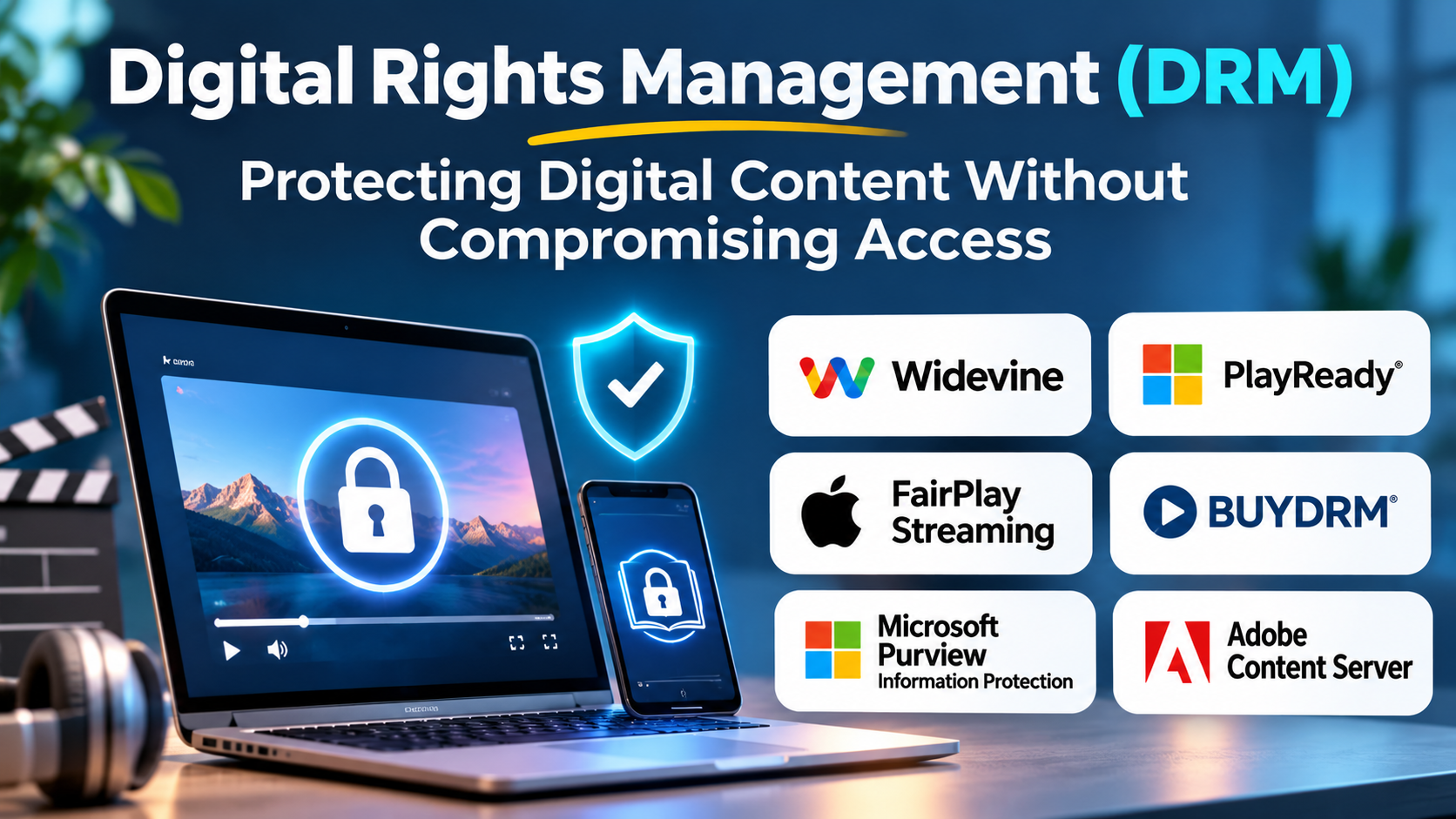
A company can encrypt a video, restrict access to a confidential document, and prevent unauthorized users from opening a digital publication. Yet none of these controls guarantees that valuable information will never be copied or redistributed.
That is the central challenge of Digital Rights Management (DRM).
DRM technology helps content owners control how digital material is accessed and used. But its effectiveness depends on the type of content, the devices involved, the licensing architecture, and the threat being addressed.
A streaming service protecting premium video faces different requirements from a manufacturer sharing confidential engineering drawings.
Understanding those differences is essential before investing in DRM.
What Is Digital Rights Management?
Digital Rights Management refers to technologies and policies used to control access to and permitted uses of digital content.
Depending on the implementation, DRM may restrict:
- Who can open a document or media file.
- Which devices or applications can access content.
- Whether users can copy, print, or redistribute material.
- How long access remains valid.
- Whether content can be used offline.
- Whether permissions can be revoked.
DRM is commonly associated with films, music, and ebooks, but enterprise information protection also uses rights-management concepts.
The objective is not simply to encrypt information. It is to enforce usage conditions throughout an authorized access workflow.
How DRM Works
A typical media DRM system involves content packaging, encryption, license management, and a compatible playback environment.
The content is encrypted before distribution. When a user attempts to play it, the application communicates with a license service.
The service evaluates relevant conditions and may provide the information needed for authorized playback.
The playback environment then applies the applicable restrictions.
Enterprise document protection follows a related principle but may involve identity systems, document permissions, policy labels, and protected applications.
Encryption protects content from unauthorized reading; DRM adds rules governing authorized use.
Those rules are only as effective as the applications and devices enforcing them.
Major DRM Technologies and Platforms
Google Widevine
Widevine is a DRM technology used in protected media delivery across supported devices and applications.
It is relevant to video services seeking playback support across a broad device ecosystem.
Implementation requires attention to compatible playback environments, licensing, and content packaging.
Microsoft PlayReady
Microsoft PlayReady provides content protection technology used in digital media distribution.
It is relevant to streaming providers and device ecosystems that support PlayReady-based licensing.
Its suitability depends on target devices, player integration, and distribution requirements.
Apple FairPlay Streaming
FairPlay Streaming supports protected streaming in Apple’s ecosystem.
Services delivering premium video to supported Apple devices may need FairPlay as part of their content protection strategy.
Its implementation involves Apple’s supported streaming and key-delivery mechanisms.
BuyDRM
BuyDRM offers commercial DRM-related services for media distribution.
Such providers can be relevant when organizations want managed licensing infrastructure rather than building every component themselves.
Microsoft Purview Information Protection
Microsoft Purview Information Protection applies information classification and protection capabilities to enterprise data.
Its role differs from video DRM. It is more relevant to protecting business documents and controlling access within supported applications and environments.
Adobe Content Server
Adobe’s Content Server technology has been used for rights-managed ebook distribution.
Organizations evaluating ebook DRM should confirm current product availability, supported readers, licensing arrangements, and long-term compatibility before committing to a deployment.
DRM Is Not One Market
| DRM category | Typical content | Primary concern |
|---|---|---|
| Video DRM | Films, television, premium streaming | Authorized playback |
| Ebook DRM | Digital books and publications | Reading and distribution rights |
| Enterprise rights management | Business documents and sensitive files | Access and usage restrictions |
| Software licensing protection | Commercial applications | License enforcement |
| Educational content protection | Courses and learning materials | Controlled distribution |
A solution built for protected video playback cannot automatically manage confidential spreadsheets.
Likewise, an enterprise document classification platform is not a substitute for a streaming license server.
Why Multi-DRM Matters for Streaming
Streaming platforms often serve audiences using different browsers, operating systems, televisions, and mobile devices.
Those environments may support different DRM technologies.
A multi-DRM architecture coordinates licensing and content delivery across supported systems.
This can involve Widevine, PlayReady, and FairPlay Streaming, depending on the intended devices.
However, supporting multiple DRM systems introduces additional complexity.
Teams must coordinate encryption formats, playback compatibility, license requests, authentication, and operational monitoring.
A multi-DRM service can simplify parts of that process, but it does not eliminate the need for device testing.
The Limits of DRM Protection
DRM can raise the difficulty of unauthorized copying. It cannot guarantee that content will never escape.
For example, someone may capture information using an external camera or another method outside the protected application.
Screen recording restrictions may help in certain environments, but their effectiveness depends on device and application capabilities.
DRM also cannot independently prevent credential sharing, compromised accounts, or inappropriate access permissions.
For valuable content, it should form part of a broader protection strategy that may include authentication, watermarking, monitoring, contractual controls, and incident response.
User Experience Is a Security Consideration
Overly restrictive DRM can harm legitimate users.
Common problems include playback failures, inaccessible purchased content, device incompatibility, and complicated offline access.
For enterprise documents, recipients may struggle to open protected files outside approved applications.
These failures can encourage users to seek insecure workarounds.
A successful implementation balances protection with practical access.
Evaluating a DRM Solution
Begin by defining the content and the rights that need enforcement.
For video, identify target devices, streaming formats, offline playback requirements, and licensing architecture.
For documents, identify supported file types, identity providers, external collaboration needs, and revocation requirements.
Then evaluate:
- Compatibility with real user environments.
- Licensing and key-management responsibilities.
- Access policy enforcement.
- Monitoring and audit capabilities.
- Offline access behavior.
- Integration with existing applications.
- Recovery and business continuity.
- Total implementation and operating costs.
Testing should include authorized users under realistic conditions, not just attempts to block unauthorized access.
DRM, Watermarking, and Access Control
These technologies address related but distinct problems.
Access control determines who may reach a resource.
Encryption protects information against unauthorized disclosure.
DRM governs permitted uses within supported environments.
Watermarking can help identify the origin of distributed or leaked content.
Combining these controls may provide stronger protection than relying on any single technology.
Frequently Asked Questions
Can DRM completely prevent piracy?
No. DRM can restrict unauthorized access and copying, but it cannot eliminate every method of redistribution.
Is DRM the same as encryption?
No. Encryption protects data using cryptographic methods. DRM combines protection mechanisms with licensing and usage policies.
Does every streaming platform need multi-DRM?
Not necessarily. The requirement depends on the devices, browsers, applications, and content rights involved.
Can DRM protect business documents?
Yes. Enterprise rights-management systems can apply access and usage restrictions to supported document formats and applications.
Final Perspective
Digital Rights Management is most useful when organizations understand exactly what they are protecting and how authorized users need to access it.
The strongest DRM strategy is not the one imposing the greatest number of restrictions. It is the one that provides appropriate protection, reliable compatibility, and manageable operations without unnecessarily obstructing legitimate use.