Software development involves much more than writing code.
Developers must understand requirements, investigate existing systems, identify defects, design interfaces, review changes, and maintain applications over time.
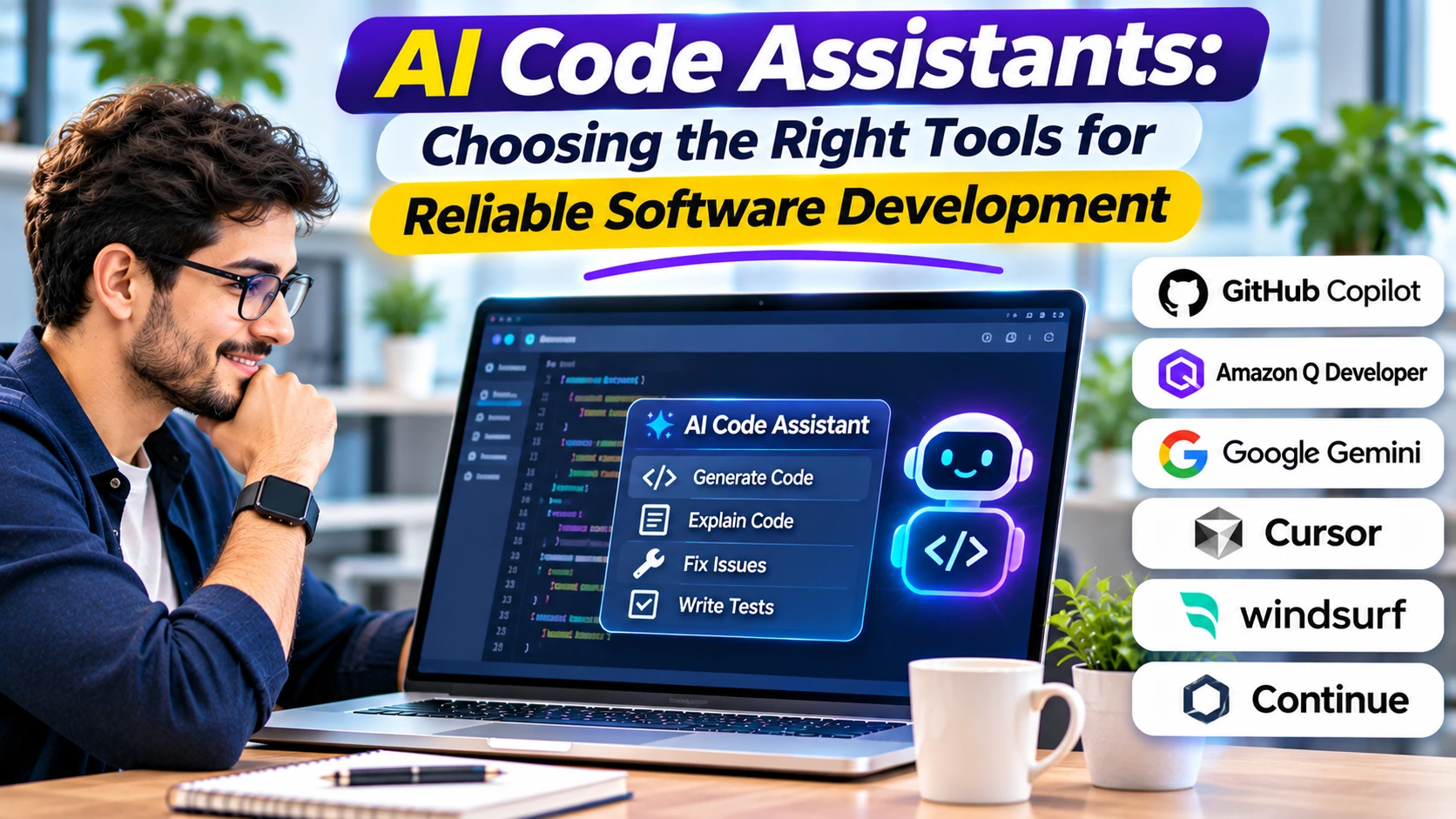
AI code assistants are becoming part of these workflows by helping developers generate, explain, modify, and examine source code.
Their appeal is straightforward: reducing repetitive work and making complex development tasks easier to approach.
However, automatically generated code can introduce errors, security weaknesses, unnecessary complexity, or incorrect assumptions.
The central question is not whether an AI assistant can produce code. It is whether the assistant helps a development team deliver reliable software while preserving engineering control.
What Are AI Code Assistants?
AI code assistants are software tools that use artificial intelligence to support programming activities.
They commonly work through code editors, integrated development environments, command-line interfaces, or web-based development systems.
Depending on the product, they may suggest code completions, generate functions, explain unfamiliar logic, propose tests, or assist with refactoring.
More advanced systems can examine multiple files, plan changes, execute supported development commands, and propose modifications across a repository.
These capabilities vary significantly between products.
A simple autocomplete assistant should not be evaluated as though it were an autonomous development agent.
How AI Code Assistants Work
Most modern AI code assistants rely on large language models trained to interpret and generate programming-related text.
When a developer requests assistance, the tool processes available context.
That context may include the current instruction, nearby code, open files, repository information, and other material made available through the application.
The model then generates a response based on the information it receives.
Some tools use additional retrieval or execution mechanisms to gather relevant context and test proposed changes.
However, generated code is not inherently verified.
A model can produce syntactically plausible code that fails at runtime or behaves incorrectly under unusual conditions.
This distinction is essential when evaluating assistant quality.
The Main Categories of AI Coding Tools
Inline Code Completion
Inline assistants suggest code while developers type.
They may complete statements, functions, or recurring patterns.
This approach is useful for reducing repetitive typing and maintaining development flow.
Its main limitation is that local suggestions may not account for broader architectural requirements.
Conversational Coding Assistants
These tools allow developers to ask questions about code.
A developer might request an explanation of a function, help diagnosing an error, or suggestions for improving readability.
Conversational assistance is particularly useful when investigating unfamiliar libraries or maintaining inherited systems.
However, explanations should be checked against the actual code and relevant documentation.
Repository-Aware Assistants
Repository-aware tools can work with information from multiple files.
They may help identify dependencies, locate relevant functions, or propose coordinated changes.
This broader context can improve usefulness for maintenance and refactoring.
Nevertheless, repository access introduces privacy and security considerations.
Agentic Coding Systems
Agentic coding tools can perform sequences of development actions under defined permissions.
They may inspect files, modify code, run tests, and revise their proposed changes.
These systems offer greater automation but also create greater operational risk.
Organizations should distinguish between generating suggestions and authorizing actions that change a development environment.
AI Code Assistants Worth Evaluating
Several products represent different approaches to AI-assisted development.
GitHub Copilot
GitHub Copilot integrates AI coding assistance into supported development workflows.
It is relevant to teams seeking code suggestions, conversational assistance, and capabilities connected to established developer tools.
Organizations should evaluate its supported editor environments, administrative controls, data-handling terms, and repository workflows.
Cursor
Cursor is an AI-oriented code editor designed around integrated coding assistance.
Its approach is relevant to developers interested in conversational editing and repository-aware workflows.
Teams should assess editor compatibility, migration requirements, context handling, and the degree of control available over proposed changes.
Amazon Q Developer
Amazon Q Developer provides AI-assisted development capabilities associated with Amazon’s developer ecosystem.
It is particularly relevant to organizations working with AWS services and supported development environments.
Evaluation should focus on actual task coverage, cloud integration requirements, security controls, and the applicable service configuration.
Gemini Code Assist
Gemini Code Assist provides AI-powered programming assistance through supported development workflows.
It may be relevant to teams using Google’s cloud and development ecosystem.
Organizations should verify supported languages, IDE integrations, administrative features, and data-governance options for the edition they intend to deploy.
Continue
Continue is an open-source-oriented coding assistant project that supports configurable AI-assisted development workflows.
It can appeal to teams interested in greater control over model selection and integration.
However, configuration flexibility introduces operational responsibility.
Teams must evaluate the complete deployment, including selected models, infrastructure, permissions, and maintenance requirements.
These products illustrate different approaches rather than a universal ranking.
Comparing AI Coding Workflows
| Development need | Relevant assistant capability | Important evaluation factor |
|---|---|---|
| Repetitive coding | Inline completion | Suggestion accuracy |
| Understanding legacy code | Conversational assistance | Context quality |
| Large refactoring tasks | Repository-aware editing | Change consistency |
| Automated maintenance | Agentic execution | Permissions and testing |
| Custom infrastructure | Configurable assistants | Deployment control |
| Cloud development | Ecosystem integrations | Service compatibility |
The most suitable assistant depends on how the development team works.
Why Code Quality Matters More Than Generation Speed
A coding assistant may generate a function in seconds.
That speed provides limited value if the function introduces defects that require hours of investigation.
Code quality includes correctness, readability, maintainability, security, and consistency with the existing architecture.
Generated code should follow the same engineering standards as manually written code.
Developers must understand what the code does before accepting it.
This is especially important when the assistant modifies authentication logic, financial calculations, database operations, or security-sensitive components.
Understanding Context Limitations
AI coding assistants work with the information available to them.
A tool may understand the current file but lack important details about system architecture, business rules, or deployment constraints.
Even repository-aware assistants may fail to retrieve the most relevant information.
This can lead to suggestions that are locally reasonable but globally incorrect.
For example, an assistant may propose a new utility function without recognizing that the project already contains an approved implementation.
Developers can reduce these problems by providing clear requirements, relevant examples, and explicit architectural constraints.
Context quality should be evaluated alongside model capability.
AI-Assisted Debugging
Debugging is one of the most practical applications of AI coding assistance.
Developers can provide an error message, relevant code, and expected behavior.
The assistant may identify possible causes or suggest diagnostic steps.
However, debugging recommendations should be treated as hypotheses.
A plausible explanation is not evidence that the root cause has been identified.
A reliable debugging process still requires reproduction, investigation, testing, and verification.
AI can accelerate this process by helping developers explore possibilities.
It should not replace evidence-based diagnosis.
AI Code Assistants and Automated Testing
AI assistants can help generate unit tests, suggest edge cases, and explain testing strategies.
This is particularly useful when working with unfamiliar functions or legacy code.
However, generated tests may repeat the same incorrect assumptions as the implementation.
A test that passes does not necessarily prove that the underlying business requirement has been satisfied.
Developers should define expected behavior independently.
They should also examine boundary conditions, error handling, and failure scenarios.
Testing quality depends on meaningful assertions, not merely the number of generated test cases.
Security Risks in AI-Generated Code
Security is a major consideration when adopting coding assistants.
Generated code may contain insecure patterns, unsafe dependencies, inadequate validation, or inappropriate handling of secrets.
The assistant may also misunderstand authentication and authorization requirements.
For example, code that correctly retrieves a database record may still fail to verify whether the requesting user has permission to access it.
Organizations should apply established security practices to all generated changes.
These include code review, dependency scanning, secret detection, static analysis, and appropriate security testing.
AI-generated code should not bypass existing development controls.
Privacy and Repository Access
Coding assistants may process proprietary source code, configuration files, documentation, and development instructions.
Before deployment, organizations should understand what information is transmitted to the provider.
Important considerations include data retention, training policies, access controls, and available enterprise agreements.
Teams should also evaluate whether sensitive repositories can be excluded from assistant access.
Credentials, customer information, and production secrets require particular care.
A development assistant should receive only the permissions and information necessary for its assigned task.
Agentic Coding and Execution Permissions
Agentic coding introduces a different level of responsibility.
A tool that can execute commands or modify files may create changes beyond a developer’s immediate expectations.
For example, an agent may attempt to install dependencies, alter configuration files, or run scripts while completing a task.
These actions can have security and operational consequences.
Teams should use isolated environments where appropriate, restrict permissions, and require approval for sensitive operations.
Changes should remain reviewable through version control.
Automated actions should also produce sufficient records for developers to understand what occurred.
The goal is controlled automation rather than unrestricted autonomy.
How to Measure Developer Productivity
Lines of code generated are a poor measure of development productivity.
More code does not necessarily produce better software.
Organizations should consider outcomes such as completed tasks, defect rates, review effort, maintainability, and developer experience.
A useful evaluation can compare representative development tasks with and without assistance.
Record the total time required, including reviewing and correcting generated code.
Examine whether the assistant improves understanding or simply shifts effort from writing to debugging.
Productivity improvements should be measured through real workflows rather than assumed from promotional claims.
Evaluating Integration With Existing Tools
An AI coding assistant must fit the development environment.
Important integration considerations include supported editors, programming languages, repository systems, testing tools, and organizational authentication.
A team using multiple programming languages may need consistent assistance across different environments.
A regulated organization may require centralized administration and detailed governance controls.
Developers may also prefer assistants that allow them to inspect and selectively apply proposed changes.
Integration quality can determine whether the tool becomes a useful part of daily work or an additional source of friction.
Understanding the Cost of AI Coding Assistance
Coding assistants may use subscriptions, seat-based licensing, usage limits, or consumption-based pricing.
The total cost can extend beyond the advertised plan.
Organizations may incur additional expenses for premium model usage, infrastructure, administration, training, and security review.
Agentic workflows can also consume resources through repeated model requests and tool execution.
A meaningful cost analysis should consider the value of completed development work.
If an assistant reduces repetitive tasks but increases review and correction time, the expected savings may not materialize.
A Practical Adoption Strategy
A cautious rollout is usually more informative than immediate organization-wide deployment.
Begin with a small group of developers working on representative tasks.
Include both experienced engineers and developers with different levels of familiarity with the codebase.
Define acceptable uses and prohibited actions.
For example, teams may allow code explanation and test suggestions while requiring additional approval for production configuration changes.
Collect feedback about usefulness, accuracy, interruptions, and review effort.
Review security and privacy concerns before expanding access.
Once the pilot provides meaningful evidence, establish clear usage guidelines and training materials.
When AI Coding Assistants Are Less Useful
AI assistance is not equally valuable for every development activity.
Highly specialized systems may contain business rules that are not visible in the code.
Safety-critical software may require extensive formal verification and controlled development processes.
Complex architectural decisions often depend on organizational constraints that a model cannot independently discover.
In these situations, AI assistance may still help with documentation or analysis.
However, experienced engineering judgment remains essential.
Choosing the Right AI Code Assistant
The best AI code assistant is not necessarily the one that generates the largest amount of code.
It is the one that fits the team’s workflow, respects security requirements, and helps developers produce reliable results.
Individual developers may prioritize editor experience and quick assistance.
Large engineering teams may place greater emphasis on repository integration, governance, and predictable costs.
Organizations adopting agentic tools should pay particular attention to permissions, execution controls, and review processes.
Evaluate candidates using real development tasks and measure the complete effort required to deliver correct changes.
AI code assistants can make software development more efficient, but their strongest role is to support developers rather than replace engineering responsibility.
Reliable software still depends on clear requirements, thoughtful design, careful testing, and accountable human review.