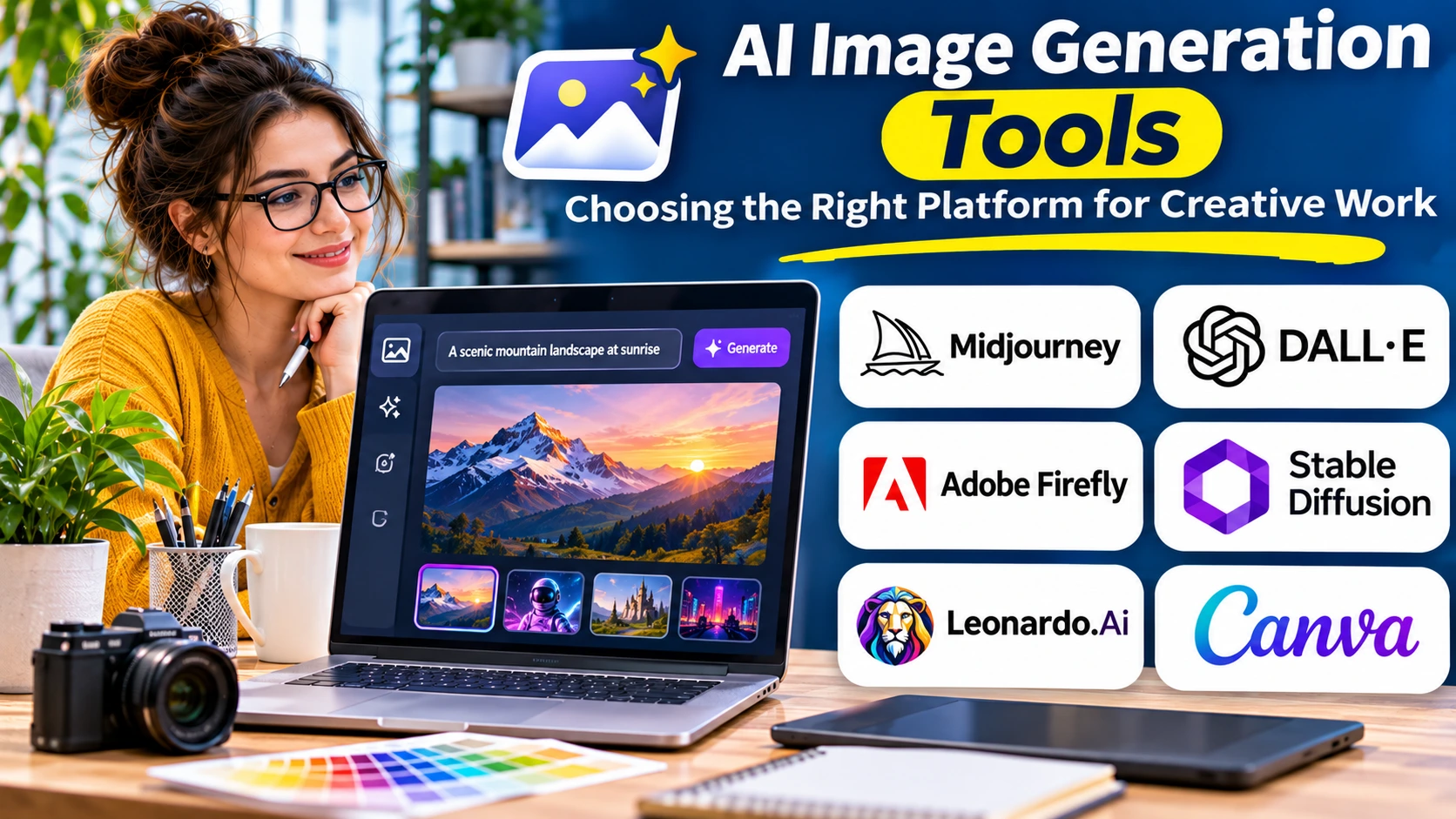
AI image generation has changed how businesses, designers, and content creators produce visual material. A task that once required a photo shoot, an illustrator, or hours of manual editing can now begin with a written description.
But generating an attractive picture is not the same as creating a usable business asset.
A marketing team may need consistent product imagery across dozens of campaigns. A designer may need precise control over composition and typography. A publisher may need original illustrations that fit its editorial style. Each situation places different demands on the software.
The most useful way to evaluate AI image generation tools is to look beyond impressive demonstrations and examine how reliably they fit a real creative workflow.
What Are AI Image Generation Tools?
AI image generation tools are software applications that create or transform images using machine learning models.
Users typically describe a desired visual through text, provide reference images, or combine both approaches. The system interprets these inputs and produces an image.
Depending on the product, users may generate illustrations, photorealistic scenes, conceptual artwork, advertising visuals, backgrounds, and other creative assets.
Some platforms also support editing existing images, extending compositions, replacing objects, and producing variations.
The underlying technology often uses diffusion-based or other generative architectures. However, the model architecture alone does not determine whether a product is suitable for professional work.
The surrounding editing tools, usage rights, integration options, and quality controls can matter just as much.
The Main Types of AI Image Generation Platforms
Not every image generator serves the same audience.
General-Purpose Image Generators
These applications translate everyday instructions into visual outputs.
They are useful for brainstorming, illustrations, presentation graphics, and initial marketing concepts.
Their main advantage is accessibility. Users do not necessarily need advanced design skills to experiment with ideas.
The limitation is predictability. A visually appealing result may still contain incorrect details or require substantial editing.
Design-Integrated Generators
These tools operate inside broader design environments.
They may combine image generation with layouts, templates, branding elements, and conventional editing functions.
This approach is particularly useful when an image is only one part of a finished deliverable.
A social media designer, for example, may need to generate a background, add approved typography, apply brand colors, and export several sizes.
An integrated workflow can reduce the number of applications involved.
Developer-Oriented Image Generation Services
Some providers expose image generation through APIs.
Developers can connect these services to websites, internal applications, creative production systems, or automated content pipelines.
This model offers flexibility, but it introduces additional concerns.
Teams must consider request limits, processing costs, moderation, error handling, data retention, and output review.
API availability also does not guarantee that every feature in a consumer interface is available programmatically.
Open-Weight and Self-Hosted Models
Organizations with technical resources may choose to operate compatible image generation models on their own infrastructure.
This can provide more control over deployment and workflow customization.
However, self-hosting does not automatically eliminate licensing restrictions, security risks, or operating costs.
Hardware requirements, model maintenance, and output governance become the organization’s responsibility.
AI Image Generation Tools Worth Understanding
Several established products illustrate the different approaches available.
Adobe Firefly
Adobe Firefly is designed around creative generation and integration with Adobe’s broader creative software ecosystem.
It is particularly relevant to teams already using professional design applications.
Its value should be assessed through the complete editing workflow rather than image generation alone.
Organizations should verify the applicable commercial-use terms and model-specific conditions before using generated material in client projects.
Midjourney
Midjourney is associated with visually expressive image generation and creative exploration.
It can be useful for concept development, mood boards, stylized illustrations, and visual experimentation.
Teams should test how well it handles recurring characters, exact layouts, revisions, and brand-specific requirements.
Strong visual style does not automatically mean strong production consistency.
OpenAI Image Generation
OpenAI’s image generation capabilities support natural-language-driven creation and editing workflows.
They are relevant when users want to describe visual changes conversationally or connect generation to supported applications and APIs.
For professional use, teams should assess image fidelity, editability, output specifications, privacy requirements, and the terms of the specific service being used.
Stable Diffusion Ecosystem
Stable Diffusion represents a broader ecosystem of models, interfaces, and deployment options rather than a single uniform application.
It appeals to technically capable teams interested in customization and greater infrastructure control.
However, capabilities and license conditions vary across models and distributions.
A team evaluating this ecosystem must assess the exact model, software interface, hardware environment, and permitted uses.
Canva AI Image Features
Canva offers AI-assisted creative capabilities within a wider visual design environment.
Its appeal is closely tied to template-based content production and accessible editing workflows.
For teams preparing social graphics, presentations, and marketing material, the surrounding design environment may be more important than maximum image-generation flexibility.
Comparison: Which Approach Fits Which Workflow?
| Workflow | Useful platform category | Main consideration |
|---|---|---|
| Creative concepts | General-purpose generators | Visual variety and iteration |
| Marketing graphics | Design-integrated tools | Brand consistency and editing |
| Professional design | Creative software integrations | Fine-grained control |
| Automated production | Image generation APIs | Reliability and operating cost |
| Custom infrastructure | Self-hosted models | Technical control and maintenance |
These are starting points, not universal rankings.
A platform that works well for an independent creator may be unsuitable for a regulated enterprise.
Why Prompt Quality Matters
A prompt is more than a description of the subject.
It can specify composition, lighting, visual style, camera perspective, background, intended audience, and other important details.
Consider a request for a laptop illustration.
A vague instruction might simply ask for a modern laptop on a desk.
A more useful instruction could specify a clean editorial photograph, soft natural light, a neutral workspace, a three-quarter camera angle, and empty space for a headline.
The second description provides clearer creative direction.
However, increasingly elaborate prompts are not always better.
Unnecessary constraints can conflict with one another and make results less predictable.
A practical workflow begins with the essential visual requirements, evaluates the output, and adds detail only where needed.
The Challenge of Consistency
Consistency is one of the hardest problems in AI-generated visual production.
A brand may require the same visual identity across a website, email campaign, and product brochure.
Yet an image generator can interpret similar prompts differently.
This becomes particularly noticeable with recurring characters, product shapes, logos, and visual proportions.
Reference images and editing controls may improve consistency, but they should not be treated as guarantees.
Teams should maintain approved examples and compare new outputs against them.
For product advertising, exact product representation deserves special attention.
Generated images should not invent features or create misleading expectations about what customers will receive.
Text, Typography, and Layout Accuracy
AI image generators may produce text within images, but the accuracy and editability of that text vary.
This matters for advertisements, infographics, presentations, and featured images.
A graphic with a misspelled product name is not ready for publication, even if the rest of the image looks polished.
For text-heavy designs, it is often safer to generate the visual background and add final typography through a conventional design application.
This also makes future updates easier.
Teams can change headlines, translations, prices, or legal disclosures without regenerating the entire image.
Copyright, Licensing, and Commercial Use
Commercial rights are an essential part of platform selection.
Users should review the provider’s current terms, including restrictions on generated outputs, uploaded reference images, and third-party intellectual property.
It is important to distinguish between permission to use an output under a platform’s terms and the availability of copyright protection.
These are separate legal questions.
Copyright treatment can depend on jurisdiction and the nature of human creative involvement.
Organizations should also consider trademarks, recognizable characters, publicity rights, and confidential source material.
An AI-generated image is not automatically free from third-party rights concerns.
Privacy and Sensitive Information
Image generation systems may receive uploaded photographs, product designs, customer information, or internal campaign material.
Before using such content, teams should understand how the provider handles uploaded data.
Important questions include:
- Is uploaded content retained?
- Can it be used to improve models?
- What access controls are available?
- Are enterprise data-handling options offered?
- Can users delete uploaded material?
- Are suitable contractual protections available?
These questions become especially important for unreleased products, confidential client work, and personal images.
How to Evaluate Image Quality Properly
A single attractive sample is not enough to evaluate a platform.
Create a small test collection that reflects the organization’s actual needs.
For example, a marketing team might test a lifestyle photograph, a product illustration, a campaign background, and a branded editorial image.
Evaluate each platform against the same requirements.
Look for accurate objects, usable composition, consistent style, sensible proportions, and the ability to revise specific details.
Record how many attempts were required to produce an acceptable result.
A platform that occasionally creates extraordinary images may still be inefficient if ordinary tasks require repeated regeneration.
Understanding the Real Cost
Subscription prices reveal only part of the cost.
The total expense may include generation credits, API requests, premium features, storage, editing software, and human review.
Self-hosted systems add hardware, maintenance, and technical staffing costs.
Teams should calculate the cost of an approved, usable image rather than the cost of a single generation.
For example, if an image requires multiple generations and substantial editing, the effective production cost can be much higher than the advertised generation price.
This is particularly important for businesses producing large volumes of content.
Building a Reliable Image Production Workflow
A practical production process can follow five stages.
First, define the creative brief. Specify the audience, message, format, style, and required visual elements.
Second, generate concepts. Explore several compositions before committing to a direction.
Third, review accuracy. Inspect objects, people, text, product details, and any potentially misleading elements.
Fourth, finish the design. Apply approved branding, typography, cropping, and accessibility requirements.
Fifth, document the final asset. Record its intended use, relevant rights information, and approved version.
This process combines AI-assisted speed with human editorial responsibility.
When AI Image Generation Is Not the Best Choice
Traditional photography remains valuable when an image must document a real event, person, location, or product accurately.
Professional illustration may be preferable when exact visual storytelling or distinctive authorship is essential.
Conventional graphic design tools are often better for diagrams, precise typography, and structured layouts.
AI image generation should complement these approaches rather than replace them indiscriminately.
Choosing the Right AI Image Generation Tool
The strongest choice depends on what happens after an image is generated.
Independent creators may prioritize speed and visual exploration.
Marketing teams may need consistent branding and convenient editing.
Developers may prioritize APIs, monitoring, and predictable costs.
Enterprises may place greater weight on governance, contractual protections, and deployment flexibility.
Before purchasing, test representative tasks, review usage terms, and calculate the complete production effort.
AI image generation tools are most valuable when they make creative work more efficient without sacrificing accuracy, consistency, or trust.